By about four in the afternoon there's a band of ache across the top of your shoulders and up into the base of your skull. You roll your head around. You pull your ear toward your shoulder and hold it. It helps for twenty minutes, then it's back, and by Thursday you're taking something for it.
You've probably been told the cause is your posture, your monitor height, your pillow, or your phone. Some of that matters at the margins. None of it explains why the same ache shows up on a weekend when you've barely touched a screen, or why your colleague sits exactly the same way and feels nothing.
Here's the more useful framing. A neck that hurts by the afternoon is usually a neck that runs out of endurance before the day does. Stretching a tired muscle makes it feel briefly better and leaves its capacity exactly where it was. Strength training moves the capacity. That's a slower fix and a much more durable one, and it has better trial evidence behind it than almost anything else people try for neck pain.
Why Stretching Alone Never Gets You There
Neck pain is not a niche problem. The GBD 2021 Neck Pain Collaborators, publishing in The Lancet Rheumatology, estimated that neck pain affected 203 million people worldwide in 2020, with an age-standardised prevalence of about 2,450 per 100,000. It's also stubborn. Most people who get it get it again.
What the evidence supports is unglamorous. The Cochrane review by Gross and colleagues (2015) examined exercise for mechanical neck disorders and found moderate-quality evidence, from four trials with 341 participants, that combined cervical and scapulothoracic stretching plus strengthening produced moderate pain relief and improved function out to long-term follow-up. Note the shape of that finding. It's not stretching. It's not the neck alone. It's stretching plus strengthening, covering the neck and the shoulder blades together.
That combination shows up again in the cervicogenic headache literature. Jull and colleagues (2002) randomised 200 people with cervicogenic headache into manipulative therapy, a specific low-load exercise program, both, or a control group. At the 12-month follow-up both the exercise group and the manipulative therapy group had significantly reduced headache frequency and intensity, and the neck pain improvements held. Six weeks of low-load training, a year of benefit.
Neck Strengthening Exercises: The Six-Move Plan
Four isometric holds, one motor-control drill, and one upper-back exercise. The whole thing takes about eight minutes and needs no equipment to start.
| Move | What it trains | Starting dose |
|---|---|---|
| Isometric flexion | Deep and superficial neck flexors | 3 holds of 8 seconds |
| Isometric extension | Cervical extensors, upper traps | 3 holds of 8 seconds |
| Isometric side bend | Lateral flexors, each side | 3 holds of 8 seconds per side |
| Chin tuck | Deep cervical flexors (motor control) | 10 reps, 5-second holds |
| Prone neck extension | Extensors through range | 2 sets of 10, slow |
| Shrugs and rows | Upper back and shoulder girdle | 2 sets of 12 to 15 |
1 to 3. The isometric holds
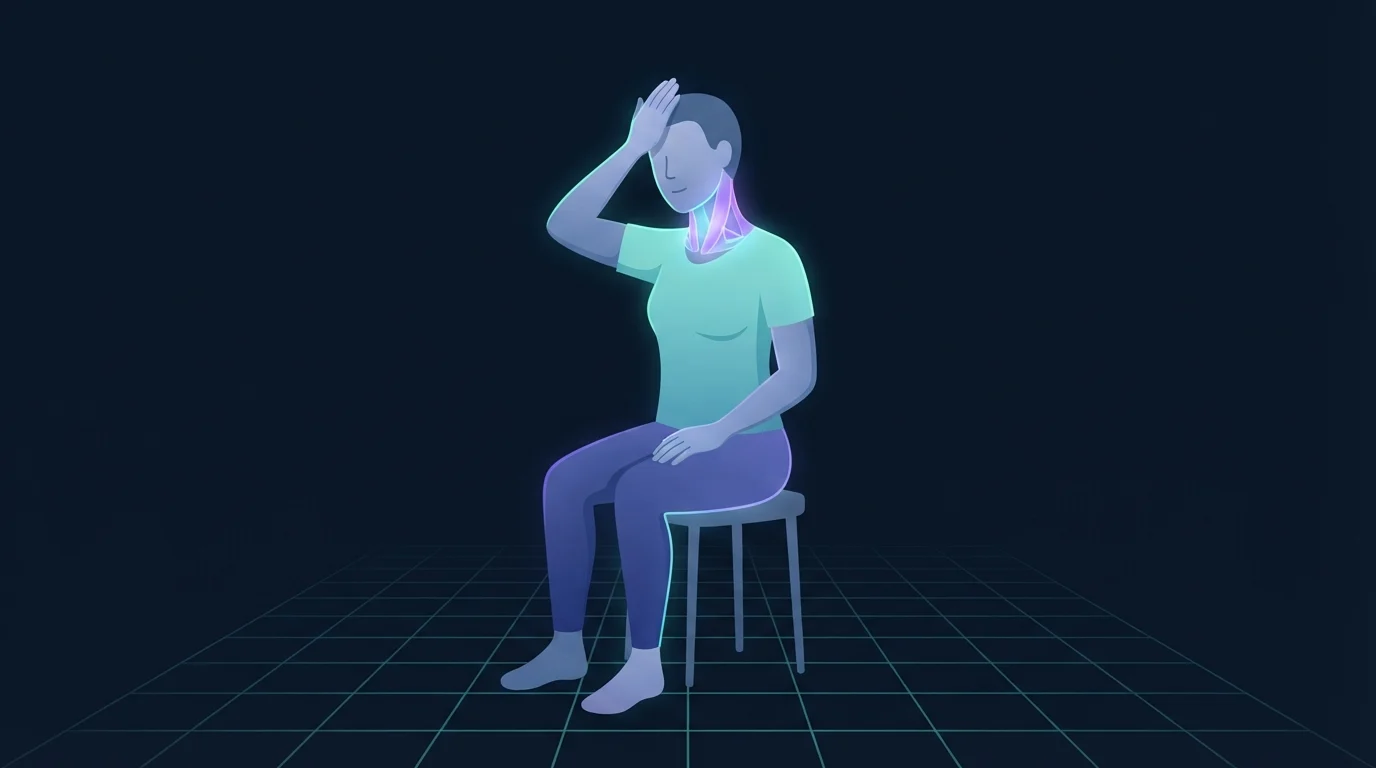
Sit tall. Place a palm flat on your forehead and press your head gently forward into it, building to a firm effort over about two seconds, holding for eight, then easing off over two more. The head shouldn't move at all. Repeat with both hands behind your head pressing backward, then with one palm against your temple pressing sideways, once to each side.
Three holds per direction is a starting point. Progress by pushing harder rather than by holding longer. These are isometric contractions, which means the muscle produces force without changing length, and that's exactly why they're the right entry point for a sore neck: you get real load without dragging a cranky joint through range. The wider evidence on isometric exercise covers what that kind of training does and doesn't do elsewhere in the body.
4. The chin tuck
Lie on your back with a folded towel under your head. Without lifting your head off the towel, gently nod your chin toward your throat as if making a double chin, hold for five seconds, and release. Ten of those.
This one isn't about force. It targets the deep cervical flexors, the small muscles that sit directly in front of the spine and hold the neck's segments in place while the big muscles do the moving. In people with persistent neck pain those muscles tend to be late to switch on, and the superficial muscles take over. The chin tuck is the standard re-training drill and it's the movement the low-load program in the cervicogenic headache trial was built around.
The most common error is yanking the chin down hard. If the muscles at the front of your throat are bulging, you've recruited the ones you're trying to quiet down. Small and gentle beats big and forceful here.
5. Prone neck extension
Lie face down on a bed with your head and neck off the edge, forehead facing the floor. Lift your head until it's level with your spine, hold for two seconds, lower slowly over three. Two sets of 10.
Extensors take more day-to-day load than any other neck muscle group, because they hold roughly 10 to 12 pounds of head against gravity every waking hour. This is the first move to progress with actual resistance, usually by adding a light weight on the back of the head over a folded towel once bodyweight becomes easy.
Find out what's really holding you back
FitCraft, our mobile fitness app, pairs you with an AI coach who builds you a personalized plan around your goals, schedule, and fitness level. Every FitCraft program is designed by Domenic Angelino, MPH (Brown University) and NSCA-CSCS, with research published in the Journal of Strength and Conditioning Research and Medicine & Science in Sports & Exercise.
Take the Free Assessment Free • 2 minutes • No credit card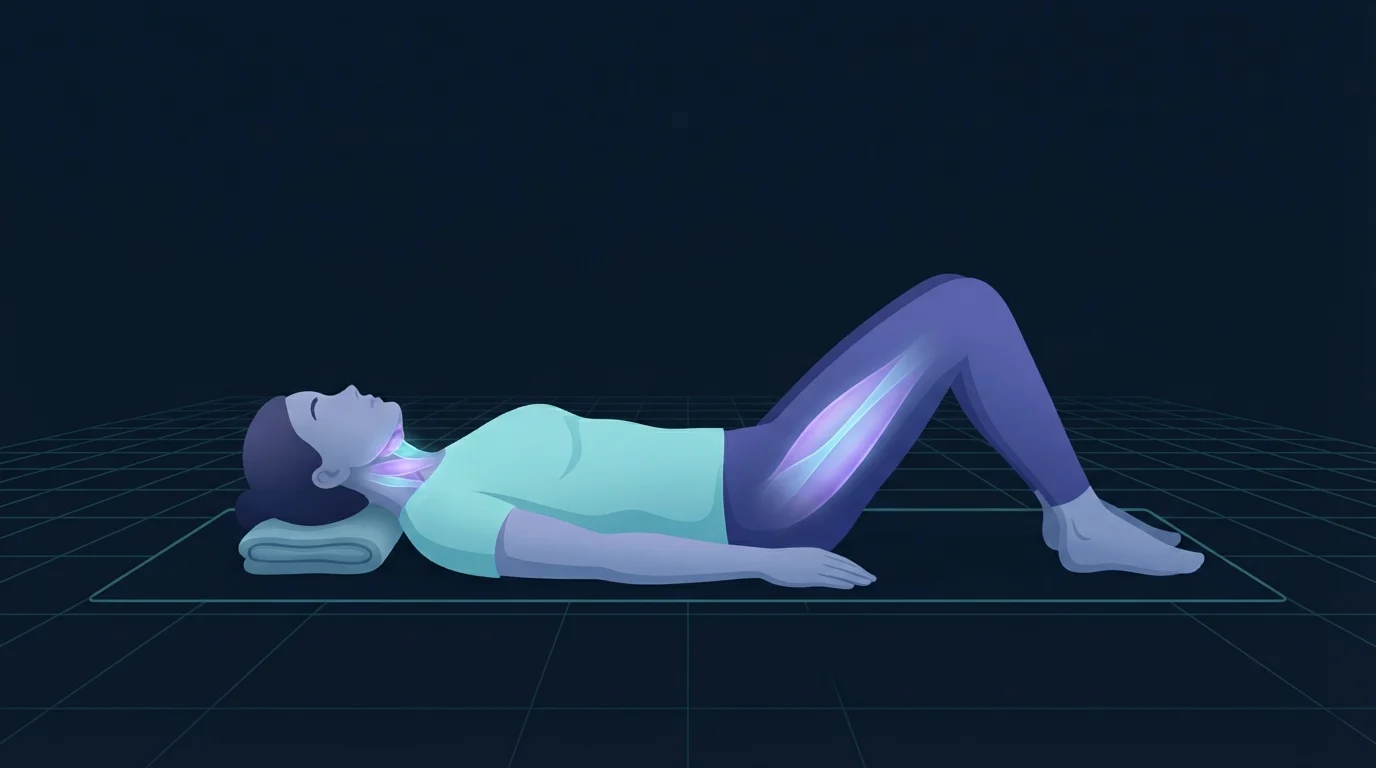
6. Shrugs and rows for the upper back
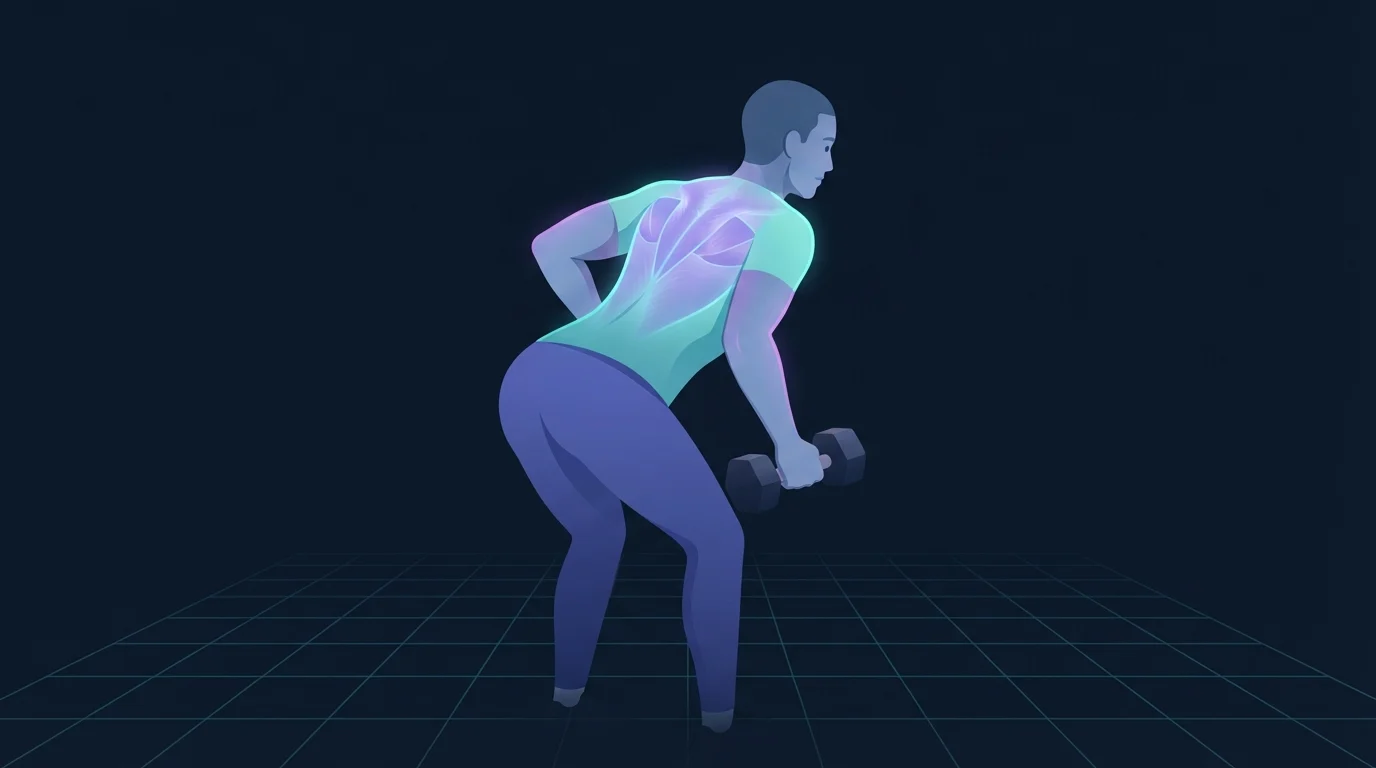
A dumbbell shrug and a bent-over dumbbell row, 2 sets of 12 to 15 each. That's it.
People skip this half and then wonder why the neck work plateaus. The neck attaches to the shoulder girdle, and the Cochrane finding was specifically about cervical and scapulothoracic work together, not the neck in isolation. The landmark trial below had its strength group doing shrugs, presses, curls, bent-over rows, flies and pullovers with a single adjustable dumbbell alongside the neck training. If you already train your back twice a week, you have this covered.
How Much Resistance, and How Often
The reference protocol comes from Ylinen and colleagues (2003), published in JAMA. They randomised 180 women office workers with chronic neck pain into three groups: high-intensity isometric strength training using a rubber band, dynamic endurance training, or a control group doing aerobic and stretching exercise. All three had a 12-day supervised rehabilitation block and then trained at home for a full year.
The strength protocol was smaller than you'd guess. One set of 15 repetitions, with the band resistance set to about 80 percent of the person's maximum isometric strength measured at baseline, working the neck forward, backward and obliquely to each side, three times a week. A single adjustable dumbbell covered the upper body work.
| 12-month change | Strength group | Endurance group | Control |
|---|---|---|---|
| Isometric neck flexion | +110% | +28% | +10% |
| Neck rotation strength | +76% | +29% | +10% |
| Neck extension strength | +69% | +16% | +7% |
Both training groups had significantly less neck pain and disability than the control group at 12 months. The strength group built far more strength, but the endurance group got meaningful symptom relief from much gentler work, which is worth knowing if high-effort holds aggravate your neck at the start.
For your own programming, the takeaway is progressive overload applied to a body part almost nobody applies it to. Three sessions a week. Push harder, or add a band or a light weight, every one to two weeks. If the routine feels the same in week 10 as it did in week 1, it stopped being training a while ago.
Upper Cross Syndrome: What the Label Gets Right
Upper cross syndrome is the name for a familiar pattern: tight chest and upper traps, weak deep neck flexors and lower traps, a head that sits forward of the shoulders, and shoulders that roll in. It's a useful shorthand for which muscles to train, and it gets oversold as an explanation for pain.
The exercise part holds up. Sepehri and colleagues (2024), pooling 22 studies in BMC Musculoskeletal Disorders, found therapeutic exercise significantly improved forward head posture, rounded shoulder and thoracic kyphosis angles in people with upper crossed syndrome, with strength work, stretching, shoulder-focused programs and comprehensive programs all showing benefit.
What that review measures is angles, not pain. The honest position is that the six moves above will change those angles and will also make your neck stronger, and the strength is the part most likely to change how your afternoon feels. Train for capacity and let the posture follow. Our guide to exercises for posture goes through what posture training genuinely does to a spine, and how to fix rounded shoulders covers the shoulder half of the same pattern.
Neck Strength and Head Impacts
If you play contact sport, or your kid does, there's a second reason to care about this. Collins and colleagues (2014), in the Journal of Primary Prevention, measured neck strength in more than 6,000 high school athletes and reported that each additional pound of neck strength was associated with about a 5 percent reduction in the odds of concussion.
Read that as a signal rather than a guarantee. It's an observational finding, not a trial, and stronger athletes differ from weaker ones in more ways than neck strength. Hrysomallis (2016), reviewing the area in Sports Medicine, concluded that neck training programs reliably build neck strength across trained and untrained groups using isometric or dynamic work and various resistance tools, while treating the injury-risk link as less settled. Building a stronger neck is cheap, quick and low risk. Treating it as head-injury insurance is not supported.
Where Rotator Cuff Exercises Fit In
Plenty of people arrive at neck training because something above the shoulder blade hurts and they aren't sure which structure it is. Worth sorting out, because the plan differs.
Neck sources tend to produce ache across the top of the shoulders, stiffness turning the head, and symptoms that worsen as the day goes on. Shoulder sources produce a catch at a specific arm position: reaching behind you, lifting overhead, lying on that side at night. If your symptoms are the second kind, the six moves here won't touch them, and our guide to rotator cuff exercises covers the loading that does.
The two programs also stack well. Shrugs and rows appear in both, prone Y raises train the same lower trapezius that upper cross syndrome flags as weak, and running the neck holds and the cuff work in the same eight-minute block means you only have to remember one habit instead of two.
Four Ways Neck Training Goes Wrong
Stretching instead of loading. The neck roll feels like the treatment because relief is immediate. It's symptom management. Twenty minutes later you're back where you started, and nothing about your capacity has changed.
Going hard on day one. A neck that hasn't been trained in twenty years does not want three sets of maximal holds on Monday. Start at maybe half effort, see how you feel the next morning, and build from there over two or three weeks.
Adding range before adding control. Fast neck circles and deep end-range stretches are where people aggravate things. Isometrics first, then small controlled range, then loaded range. The order matters more here than almost anywhere else in the body.
Ignoring the upper back. The Cochrane finding was about cervical and scapulothoracic work together. Neck holds alone are half a program, and the half that plateaus first.
What to Expect
Weeks 1 to 4 usually bring less end-of-day stiffness rather than less pain. That's an endurance change and it shows up before any strength change does. It's also the point where most people decide it's working, which is helpful, because week 5 onward is where the real adaptation happens and the sessions get boring.
Weeks 8 to 12 are where you should judge it, since that's the window most clinical trials use for their primary outcome. Strength gains of the size Ylinen reported took a year of consistent home training, so treat 12 weeks as evidence of a trend rather than the finish line.
Past that, this becomes maintenance, and maintenance is where every home program dies. Eight minutes three times a week is trivially small and almost impossible to remember on its own, which is why it works far better attached to something you already do. A home workout app that needs no equipment can carry the neck block into the same session as everything else, which is usually the difference between a routine that lasts three weeks and one that lasts a year.
The Bottom Line
Six moves, three times a week, eight minutes, with the resistance going up every week or two. Four isometric holds, a chin tuck, prone extension, and shrugs plus rows. That's the whole plan, and a version of it produced a 110 percent gain in neck flexion strength and significantly less pain and disability over 12 months in a randomised trial of 180 women.
Your neck isn't fragile and your posture isn't the villain. It's a set of small muscles that nobody ever asked to get stronger, holding up a heavy head for sixteen hours a day. Ask them.
Frequently Asked Questions
What are the best neck strengthening exercises?
Six cover the whole job: isometric neck flexion, isometric neck extension, isometric side bend on each side, the chin tuck, prone neck extension, and dumbbell shrugs plus rows for the upper back. The trial with the strongest results used exactly that combination, elastic-band resistance for the neck in four directions plus dumbbell work for the shoulder girdle, and produced a 110 percent gain in isometric neck flexion strength over 12 months (Ylinen et al., 2003).
Do neck strengthening exercises help neck pain?
Yes, and they beat stretching or general activity on their own. A Cochrane review of exercises for mechanical neck disorders found moderate-quality evidence from four trials and 341 participants that combined cervical and scapulothoracic stretching plus strengthening produced moderate pain relief and better function that held up to long-term follow-up (Gross et al., 2015). In the largest single trial, both strength and endurance training groups had significantly less pain and disability than controls at 12 months.
How often should you train your neck?
Three sessions a week is the usual prescription, and the landmark chronic neck pain trial used that frequency for a full year with a single set of 15 repetitions per direction. Neck muscles recover quickly and the total volume is small, so daily isometric holds are also fine if the sessions stay short. What matters far more than frequency is that the resistance goes up over time rather than staying where it started.
Are isometric neck exercises safe?
For most healthy people, yes, and they're the standard starting point precisely because the head never moves through range. Press your hand against your head, build to a firm effort over two seconds, hold for five to ten, and release slowly. Stop and get assessed if you have numbness, tingling or weakness in an arm, dizziness, visual changes, or pain that radiates below the elbow, since those symptoms point to something other than a weak neck.
Can neck exercises fix upper cross syndrome?
Exercise measurably changes the angles the label describes. A 2024 meta-analysis of 22 studies found therapeutic exercise significantly improved forward head posture, rounded shoulder and thoracic kyphosis angles, with strength work, stretching, shoulder-focused and comprehensive programs all showing benefit (Sepehri et al., 2024). What it doesn't support is the idea that the posture itself is the cause of your pain. Train for strength and endurance, and treat the posture change as a side effect.
How long does it take for neck strengthening exercises to work?
Give it 8 to 12 weeks before judging it. Most people notice less end-of-day stiffness in the first month, which is an endurance change rather than a strength change. Measurable strength gains take longer, and the big trials ran their follow-ups at 12 months, where the strength group had improved isometric neck flexion by 110 percent against 10 percent in controls.