If you've spent any time on fitness Instagram in the last two years, you've seen the claim. Tape your mouth shut. Breathe through your nose for every run, every lift, every zone 2 session. You'll get fitter, sleep better, and your VO2max will climb. The pitch sounds simple. The research is more interesting.
Two papers published in the last 18 months tell two very different stories. A 2025 PLOS ONE trial in healthy adults found that forcing exclusive nasal breathing during a maximal exercise test cut peak VO2 by roughly 16 percent and peak ventilation by 37 percent. A 2024 Frontiers in Physiology study in cardiac patients found that nasal breathing improved exercise ventilatory efficiency, with VE/VCO2 dropping by about 9 percent in heart failure participants. Same intervention, opposite-looking outcomes. The reconciling variable is intensity, and how long the person has trained the route.
This article walks through the four studies that actually matter on this topic. What nasal breathing does to peak performance. What it does at submaximal effort. Why cardiac patients see efficiency gains where untrained healthy adults see capacity losses. What the nitric oxide story does and does not show. And the simple intensity-matched rule the data actually supports.
What Nasal Breathing Does Physiologically
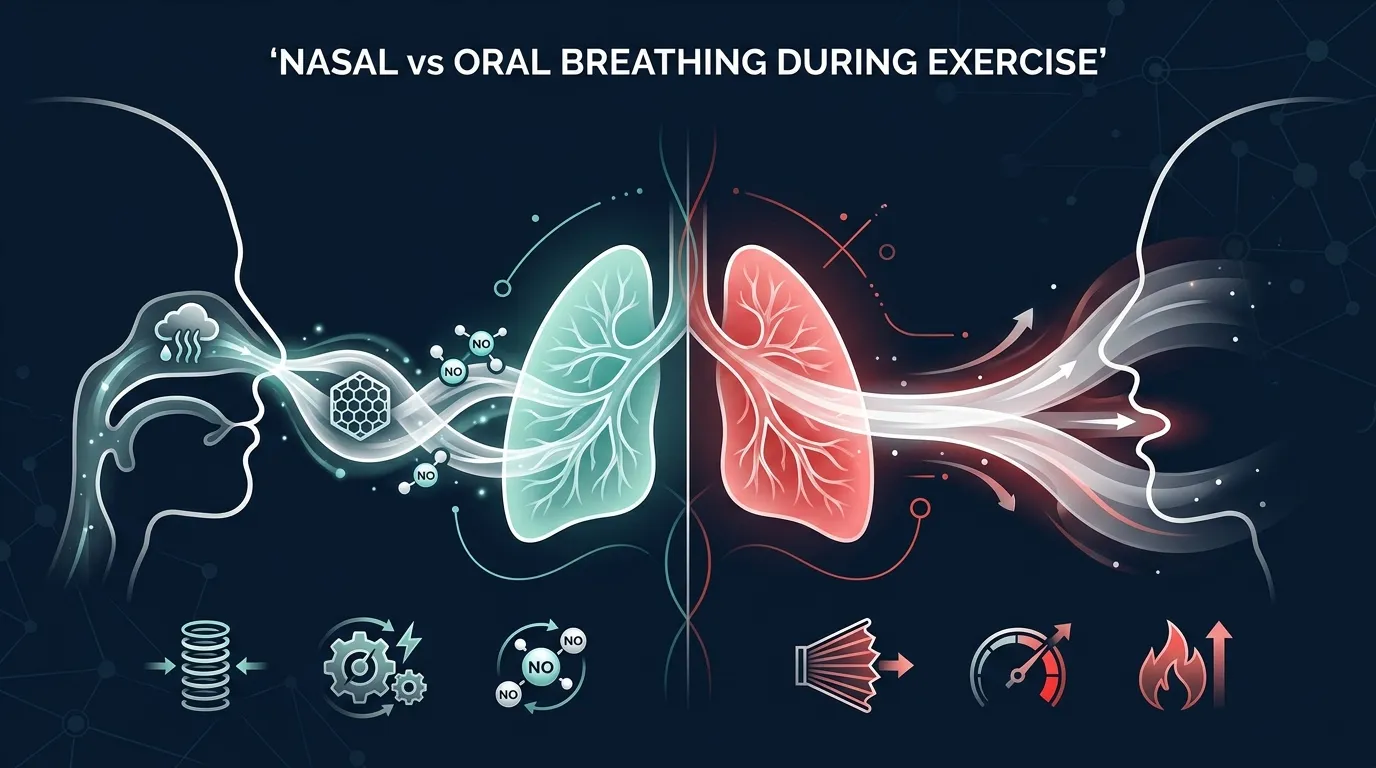
The nose is a narrower, more resistive airway than the mouth. Air entering through the nostrils gets warmed, humidified, and filtered before it reaches the lower airways. Resistance is roughly two to three times higher per breath, which raises the work of breathing and, at high flow rates, becomes a limiting factor.
Less obvious: the paranasal sinuses continuously produce nitric oxide. During nasal inhalation, this NO is drawn into the lower airways where it acts as a local vasodilator. Sanchez Crespo and colleagues (2010) in the Journal of Applied Physiology showed that this autoinhalation contributes to pulmonary vasodilation in the upright position, redistributing blood toward the upper lung lobes and improving local ventilation-perfusion matching. The effect is small in healthy people at rest. It becomes mechanistically interesting in conditions where pulmonary vascular tone is dysregulated, like heart failure.
Three things follow from that physiology. First, nasal breathing helps with gas mixing and humidification at low flow. Second, it costs more work per liter as flow rises. Third, the NO benefit favors populations whose pulmonary vasculature is already compromised. Those three together explain most of what the trials show.
The Research: What Trials Actually Found
Mapelli et al. 2025: The BreathWISE Maximal Exercise Trial
The cleanest test of "what happens if you force nasal breathing at maximal effort" is the 2025 BreathWISE trial by Mapelli and colleagues in PLOS ONE. Twelve healthy adults (mean age about 29, half male) completed three cardiopulmonary exercise tests on a cycle ergometer to maximal effort: one with standard breathing, one with exclusive nasal breathing (mouth taped), and one with partial nasal obstruction.
The results were striking. With exclusive nasal breathing:
- Peak VO2 dropped from about 33.4 to 28.0 mL/min/kg, roughly a 16 percent reduction.
- Peak ventilation fell by about 37 percent. The lungs simply could not move enough air through the nose to match maximal metabolic demand.
- Inspiration and expiration times lengthened, and Borg dyspnea scores rose sharply. Subjects perceived the work as harder for the same external load.
- Submaximal metabolic parameters at rest and easy effort showed only minor differences. Partial nasal obstruction produced negligible effects across the board.
The clean takeaway: in untrained nasal breathers, exclusive nasal breathing at peak intensity is a ventilatory bottleneck, not a performance enhancer. The mouth is not optional once flow demand crosses a threshold. The trial does not say nasal breathing is bad. It says forcing it through max-effort work has a measurable cost.
Eser et al. 2024: The Cardiac Patient Efficiency Study
Run the same kind of comparison in cardiac patients and the story flips. Eser and colleagues (2024) in Frontiers in Physiology studied 57 participants: 15 with heart failure, 15 with chronic coronary syndrome, 12 older healthy controls, and 15 younger healthy controls. Each performed a submaximal cycle ergometer test under both oral and nasal breathing conditions.
The pattern across groups:
- Heart failure patients showed the largest benefit. VE/VCO2 (the ventilatory equivalent for carbon dioxide, a marker of breathing efficiency) dropped by about 3.6 units with nasal breathing, roughly a 9 percent improvement. Respiratory frequency was 26 percent lower. End-tidal CO2 rose by about 10 percent, indicating better alveolar ventilation per breath.
- Six patients with exercise oscillatory ventilation (a pathological breathing pattern associated with poor prognosis in heart failure) showed marked reduction in those oscillations during nasal breathing.
- Healthy controls showed smaller but consistent ventilatory efficiency improvements with nasal breathing at submaximal effort.
The mechanism the authors invoke is partly the nasal nitric oxide vasodilation story (better pulmonary perfusion of upper lobes, improved V/Q matching) and partly the slower, deeper breathing pattern that nasal resistance enforces. Slower respiratory frequency at the same minute ventilation means more time per breath for gas exchange. In a population with already-impaired pulmonary gas exchange, that matters. In a healthy person at submaximal effort, it shows up as a small efficiency gain. In a healthy person at maximal effort, it shows up as a ventilation ceiling.

Dallam et al. 2018: Trained Nasal Breathers Hold VO2max
The obvious question after BreathWISE: what about people who have actually adapted? Dallam and colleagues (2018) in the International Journal of Kinesiology and Sports Science recruited 10 recreational runners (5 men, 5 women) who had spent at least six months training with nasally restricted breathing. Each completed two maximal treadmill tests, one nasal and one oral, in counterbalanced order.
The headline result: VO2max was statistically identical between conditions. The trained nasal breathers did not lose peak aerobic capacity when the test was nasal-only. Steady-state ventilatory equivalents (VE/VO2) were actually better during nasal breathing, suggesting more efficient submaximal work. Peak respiratory rate was lower under nasal conditions, but not at the cost of VO2.
This is the bridge between the two seemingly contradictory findings. The BreathWISE participants were healthy but untrained in nasal breathing. The Dallam participants had spent months adapting. The take-home is that the ventilation ceiling is partly trainable. Nasal-only running for six months appears to allow the system to hit the same peak VO2 it would have reached through oral breathing, presumably through some combination of higher respiratory muscle strength, lower nasal resistance through tissue adaptation, and shifted ventilatory drive.
Caveat: the Dallam sample is small (n=10) and self-selected. People who have trained nasal-only for six months are by definition the ones who tolerated it. Generalizing from "ten adapted nasal runners hold VO2max" to "you can hold VO2max if you train this" is plausible but not bulletproof.
Lee, Seo, and Lee 2025: The Treadmill Speed Gradient
The most recent data on what happens as intensity ramps comes from Lee, Seo, and Lee (2025) in the International Journal of Environmental Research and Public Health. Ten healthy women ran on a treadmill at speeds from 5 to 11 km/h under three breathing conditions: nasal only, oral only, and oronasal.
The pattern was a clean intensity gradient. At 5 to 7 km/h, breathing condition mattered little: respiratory frequency, minute ventilation, and ventilatory equivalents were similar across all three modes. At 10 to 11 km/h, nasal breathing produced lower respiratory frequency and lower minute ventilation but elevated VE/VCO2 (a sign of less efficient CO2 clearance per breath). Oronasal breathing matched oral on most metrics, suggesting the mouth simply opens up as a release valve when the nose alone cannot move enough air.
That maps cleanly onto perceived experience: jogging conversationally feels fine through the nose. Tempo running does not. The body is not malfunctioning; the airway resistance is just outpacing the available pressure gradient.
Get an evidence-based plan built for you
FitCraft, our mobile fitness app, pairs you with an AI coach who builds you a personalized plan around your goals, schedule, and fitness level. Every FitCraft program is designed by Domenic Angelino, MPH (Brown University) and NSCA-CSCS, with research published in the Journal of Strength and Conditioning Research and Medicine & Science in Sports & Exercise.
Take the Free Assessment Free • 2 minutes • No credit cardWhat Submaximal Studies Show About Efficiency
The submaximal piece is worth lingering on because that is where the marketing case for nasal breathing is actually defensible.
LaComb and colleagues (2017) in the International Journal of Kinesiology and Sports Science compared oral and nasal breathing during moderate-to-high intensity submaximal aerobic exercise. The oral group showed greater respiratory rate, ventilation, VO2, and VCO2 across all three intensities tested, which is the expected pattern when more air is moving through a less resistive route. But the efficiency metrics told a different story: nasal breathing produced superior ventilatory equivalents, meaning less air pumped per unit of useful metabolic work. The trade-off is roughly: oral moves more total volume; nasal moves less volume but uses it better.
At zone 2 effort (sustainable, conversational, the lower aerobic intensity range), this is a free upgrade. Your nose is not the limiting factor. Slower, deeper breathing through it tends to recruit the diaphragm more, calm the autonomic nervous system, and keep you below the threshold where the mouth needs to open. For more on what zone 2 actually is and why it matters, see our zone 2 training research writeup.
The pattern fits with what trained endurance athletes describe anecdotally: easy runs feel better through the nose, the rhythm self-paces, and the talk-test threshold becomes a natural breathing-change cue rather than something you have to monitor.
What the Practical Protocol Should Look Like
Translating the research into a usable rule:
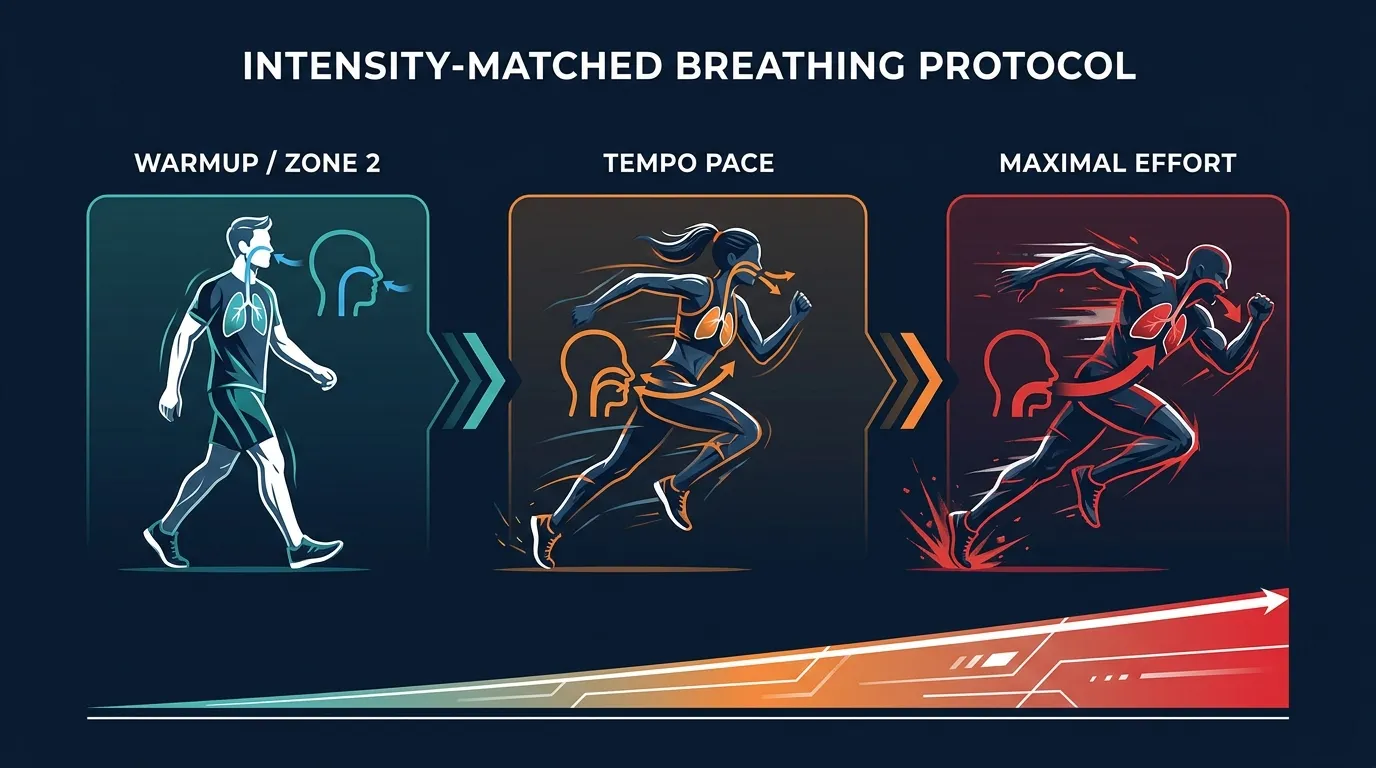
1. Default to nasal breathing for warm-up and zone 2. The efficiency gains the Eser, LaComb, and Lee studies describe sit in this intensity range. Resistance is low enough that the work cost is trivial, gas exchange is sufficient, and the slower respiratory frequency supports a calmer autonomic state. This is where the popular protocols are not exaggerating.
2. Switch to oronasal (both) when you cross the talk test. The talk test is roughly: you can speak short phrases but not full sentences. That is the inflection point in Lee et al.'s data where nasal-only starts driving VE/VCO2 up. Opening the mouth is not failure; it is the system using the route it has.
3. Use mouth-dominant breathing for intervals, sprints, and any effort above about 85 percent of max heart rate. Mapelli et al.'s BreathWISE trial is unambiguous here. Trying to do max-effort work through the nose alone capped VO2 by 16 percent in healthy adults. If your training session is built around hard intervals (Tabata, Norwegian 4x4, sprints), the mouth is doing required work.
4. If you want to adapt to nasal-dominant breathing, ramp slowly over months, not weeks. The Dallam et al. participants had at least six months of nasal-restricted training before they hit VO2max parity. There is no evidence that a two-week mouth-tape challenge will get you there, and meaningful evidence (BreathWISE) that the acute experience is performance-suppressing. If you want the long-term benefit, treat it as a slow adaptation, ideally in the easy-run portion of your week first.
5. Skip the mouth tape during sleep without a sleep evaluation. The popular protocol bundles "tape your mouth at night" with daytime nasal breathing as if they were the same intervention. They are not. The 2024 Eser cardiac data and the 2010 Sanchez Crespo NO data are about active nasal inhalation during waking exercise, not nocturnal mouth obstruction in untested sleep apnea risk profiles. Different question, different evidence base, different risk profile. Talk to a clinician about sleep breathing if it is on your mind.
Common Nasal Breathing Misconceptions
Misconception 1: "Nasal-only breathing will raise my VO2max"
Not directly. Nasal-only breathing during a test caps VO2max in untrained subjects (BreathWISE, 16 percent reduction at peak). Trained nasal breathers reach the same VO2max they would have via oral breathing (Dallam et al., 2018). What raises VO2max is sustained progressive training, regardless of the breathing route you use to do it. If you do most of your easy work nasally and your hard work with the mouth open, your VO2max trajectory is determined by the training stimulus, not by which orifice the air enters.
Misconception 2: "Nasal breathing is always more efficient"
At submaximal effort, yes. At maximal effort, no. The intensity gradient in Lee, Seo, and Lee (2025) is the clearest demonstration: efficiency is preserved or improved at 5 to 7 km/h, and degrades at 10 to 11 km/h. The Eser cardiac patient data shows the efficiency benefit is real where it matters clinically. The BreathWISE peak data shows the cost is real where peak performance matters. Both can be true. Use the right tool for the right intensity.
Misconception 3: "The nasal nitric oxide effect is huge"
It is real and biologically interesting (Sanchez Crespo et al., 2010, in the Journal of Applied Physiology). It is clinically meaningful in heart failure and pulmonary hypertension contexts where pulmonary vascular tone is already abnormal. In healthy recreational exercisers, the practical performance effect is modest and gets dwarfed by training-stimulus differences. The wellness pitch frequently lifts the cardiac mechanism and applies it to healthy populations as if it transferred linearly. It does not.
Misconception 4: "If you have to mouth breathe, you are out of shape"
No. Mouth breathing during high-intensity exercise is the appropriate physiological response to high ventilatory demand, in fit and unfit people alike. Elite endurance athletes mouth-breathe at race pace; that is not a fitness failure, it is matched ventilation. The shame around mouth breathing during hard work comes from conflating the daytime nasal-breathing protocols (which are about resting and easy-effort patterns) with hard-effort breathing. They are different physiological situations.
Who Nasal Breathing Helps Most
The benefit signal is strongest for three groups:
Cardiac and pulmonary rehab populations. The Eser et al. (2024) data is the clearest direct evidence: heart failure patients gained about 9 percent ventilatory efficiency from nasal breathing at submaximal effort. Six patients with exercise oscillatory ventilation, a poor-prognosis pattern, showed marked improvement during nasal breathing. This is a clinical conversation worth having with a cardiologist.
Beginners doing zone 2 cardio. The slower, deeper breathing pattern enforced by nasal-only at low intensity makes the talk test self-pacing. You cannot push too hard if you have to breathe through your nose. That is a useful guardrail for people who do not yet have a feel for sustainable aerobic pace. Our zone 2 cardio at home guide covers the practical setup.
Recreational endurance athletes who want a longer-term nasal adaptation. The Dallam et al. result, while small in sample size, suggests it is possible to train into nasal-only running without losing peak capacity. The ramp is months, not weeks, and most of the adaptation needs to happen in the easy-run zone.
Who benefits least: someone trying to crush a sprint interval session through their nose. The data is clean here. Mouth breathing during peak effort is not a moral failing; it is the route the body needs at that flow rate.
What the Research Suggests Going Forward
The nasal breathing literature is small but converging. Acute exclusive nasal breathing caps peak performance in untrained subjects. Adapted nasal breathers hold VO2max but the adaptation takes months. Submaximal ventilatory efficiency is consistently better with nasal breathing across populations, with the largest clinical effect sizes in cardiac patients. The nitric oxide story is real but modest in practical performance terms.
Limitations worth flagging:
- Sample sizes are small. Most of the trials in this area have between 10 and 60 participants. Effect sizes are precise enough to identify direction but not to pin down exact magnitudes.
- Most studies are short. Eight to twelve weeks at most for training studies. We do not know what year-long nasal-restricted training does to peak performance or injury risk.
- Self-selection is heavy. The Dallam et al. participants had already trained nasal-only for six months. People who tolerate that intervention are not representative of the general training population.
- Strength and intermittent sports are barely studied. Almost all the data is from cycle ergometer or treadmill protocols. The picture in lifting and field sports is open.
The honest synthesis: nasal breathing is a useful, intensity-matched tool. Use it for warm-up, easy aerobic, and zone 2. Open the mouth when the work demands it. Do not bet your training adaptation on which orifice the air enters; bet it on whether you keep showing up. If you are curious about other under-the-hood breathing levers, our inspiratory muscle training research writeup covers a separate, complementary intervention with its own evidence base.
References
- Mapelli M, Salvioni E, Mattavelli I, Grilli G, Zerboni G, Nava A, Capra N, Galotta A, Biroli M, Bellini G, Dall'Asta M, Pasini E, De Paola A, Torzolini L, Mani N, Turri S, Campodonico J, Agostoni P. "Nasal vs. oral BREATHing WIn Strategies in healthy individuals during cardiorespiratory Exercise testing (BreathWISE)." PLOS ONE. 2025;20(7):e0326661. doi:10.1371/journal.pone.0326661
- Eser P, Calamai P, Kalberer A, Stuetz L, Huber S, Kaesermann D, Guler S, Wilhelm M. "Improved exercise ventilatory efficiency with nasal compared to oral breathing in cardiac patients." Frontiers in Physiology. 2024;15:1380562. doi:10.3389/fphys.2024.1380562
- Dallam GM, McClaran SR, Cox DG, Foust CP. "Effect of Nasal Versus Oral Breathing on Vo2max and Physiological Economy in Recreational Runners Following an Extended Period Spent Using Nasally Restricted Breathing." International Journal of Kinesiology and Sports Science. 2018;6(2):22-29. doi:10.7575/aiac.ijkss.v.6n.2p.22
- Lee SH, Seo Y, Lee DT. "Ventilatory Responses to Progressive Treadmill Speeds in Women: A Comparative Analysis of Nasal, Oral, and Oronasal Breathing Conditions." International Journal of Environmental Research and Public Health. 2025;22(5):718. doi:10.3390/ijerph22050718
- LaComb CO, Tandy RD, Lee S, Young JC, Navalta JW. "Oral versus Nasal Breathing during Moderate to High Intensity Submaximal Aerobic Exercise." International Journal of Kinesiology and Sports Science. 2017;5(1):8-16. journals.aiac.org.au/IJKSS/article/3079
- Sanchez Crespo A, Hallberg J, Lundberg JO, Lindahl SGE, Jacobsson H, Weitzberg E, Nyren S. "Nasal nitric oxide and regulation of human pulmonary blood flow in the upright position." Journal of Applied Physiology. 2010;108(1):181-188. doi:10.1152/japplphysiol.00285.2009
Frequently Asked Questions
Is nasal breathing during exercise actually better?
At low and moderate intensities, often yes. At maximal intensity, no. A 2025 PLOS ONE trial by Mapelli and colleagues (the BreathWISE study, 12 healthy adults) found that exclusive nasal breathing during a maximal cardiopulmonary exercise test reduced peak VO2 by roughly 16 percent and peak ventilation by about 37 percent compared with usual breathing. At rest and during submaximal effort, however, the differences were minor. A separate 2024 Frontiers in Physiology study by Eser and colleagues in 57 cardiac and healthy participants found that nasal breathing actually improved exercise ventilatory efficiency, dropping VE/VCO2 by about 9 percent in heart failure patients. The honest read: nose for easy and steady, mouth opens up as soon as the work gets hard.
Does nasal breathing increase VO2max over time?
Probably not directly, but it does not seem to hurt it either. A 2018 study by Dallam and colleagues in the International Journal of Kinesiology and Sports Science followed 10 recreational runners who had spent at least six months training with nasally restricted breathing. After the adaptation period, their VO2max during a nasal-only treadmill test was statistically identical to their oral-breathing VO2max. They also showed improved ventilatory equivalents during steady-state work. Translation: trained nasal breathers do not lose ceiling, but acute nasal-only restriction in untrained participants (like the BreathWISE trial) clearly does cap peak performance.
Why does nasal breathing feel harder during exercise?
Because the nose adds resistance. The nasal airway is narrower and more turbulent than the mouth, so breathing through it costs more inspiratory work per liter of air. The 2025 BreathWISE trial measured this directly: exclusive nasal breathing increased inspiration and expiration times, raised Borg dyspnea scores, and reduced peak ventilation by about 37 percent. The 2025 IJERPH study by Lee, Seo, and Lee in 10 women on a treadmill found that at 10 to 11 km/h, nasal breathing showed lower respiratory frequency but elevated VE/VCO2, a sign the body was working harder per breath. Below talk-test intensity, the resistance is fine. Above it, the cost outpaces the benefit.
What is the practical rule for nasal versus mouth breathing during a workout?
Use the nose when you can, open the mouth when you must. The research-supported pattern is: nose-only for warm-up, easy aerobic, zone 2 cardio, and most strength work between sets. Switch to oronasal (both) as soon as effort rises above the talk-test threshold (you can speak short phrases but not full sentences). Switch to mouth-dominant breathing for intervals, sprints, and any work above 85 percent of max heart rate. The Eser et al. (2024) data shows the ventilatory efficiency benefits sit at submaximal effort. The Mapelli et al. (2025) BreathWISE data shows trying to hold nasal-only at peak hurts performance. Match the breathing pattern to the intensity, do not force one across the whole session.
Is the nitric oxide benefit of nasal breathing real?
The biology is real; the size of the practical effect is smaller than the marketing suggests. Nitric oxide is produced in the paranasal sinuses and is autoinhaled during nasal breathing. Sanchez Crespo and colleagues (2010) in the Journal of Applied Physiology showed that this nasal NO contributes to local pulmonary vasodilation, especially in the upright position. The clinical implication is meaningful in cardiac patients, where Eser et al. (2024) found improved gas exchange efficiency. For healthy recreational exercisers, the practical effect on cardio performance is modest. Nasal breathing during easy work plausibly supports better gas mixing and a calmer autonomic state, but the day-to-day fitness payoff is closer to small than to transformational.