
Put a dozen of the best 10K runners in a region on a treadmill, and their VO2 max scores barely tell you who finished first. In a classic study by Conley and Krahenbuhl (1980) in Medicine & Science in Sports & Exercise, 12 men who all placed in the top 19 of a nationally prominent 10K averaged a VO2 max of 71.7 mL/kg/min, and VO2 max showed no meaningful relationship with their race times. The oxygen cost of running at fixed paces explained 65.4 percent of the variation in their finishing times.
That oxygen cost is running economy, and it's the part of endurance fitness most runners never think about. You can't feel it on a single run, and no watch displays it. Yet it decides how fast a given effort carries you, and it can keep improving for years after VO2 max has leveled off.
This review covers what running economy is, how it's measured, what the research says improves it, the popular fixes that don't hold up, and a dumbbell and bodyweight strength plan you can run at home. If you've been logging the same miles for a year and your pace won't budge, this is the lever you probably haven't pulled.
What Is Running Economy?
Running economy is the oxygen or energy cost of running at a given submaximal speed. Two runners moving at the same pace can use very different amounts of oxygen to do it, and the one who uses less is more economical. In their review in Sports Medicine, Saunders and colleagues (2004) define it as the energy demand for a given velocity of submaximal running, and they note that among elite runners with similar VO2 max, it predicts performance better than VO2 max does.
Think of it as the price of a pace. Your VO2 max is your budget, the most oxygen you can use per minute. Economy sets how much of that budget a particular speed costs. A cheaper pace leaves more of the budget free, so you can run faster at the same effort or hold the same speed for longer.
What sets your running economy
Economy reflects a mix of traits rather than one. Barnes and Kilding (2015), reviewing the field in Sports Medicine Open, group them into metabolic, cardiorespiratory, biomechanical and neuromuscular factors, and point out that many of them adapt to training. Saunders' review names three concrete ones: more mitochondria and oxidative enzymes in the working muscles, stiffer muscles and tendons that store and return elastic energy with each stride, and mechanics that waste less energy on braking and bouncing up and down.
That middle item matters most for what follows. Your calf and Achilles tendon work partly like a spring. A stiffer, stronger spring hands back more energy on every step, and that's the main reason strength and jump training keep showing up in the economy research.
How Running Economy Is Measured
The lab method is easy to describe. You run on a treadmill at several fixed speeds below your lactate threshold, about 4 to 5 minutes each, while a mask collects your breath. Oxygen uptake levels off into a steady state after the first few minutes, and the average from that plateau is your oxygen cost at that speed. The results get reported in three common ways:
- Oxygen uptake at a fixed speed, in mL/kg/min. The classic format. In the Conley study, steady-state values were 44.7, 50.3 and 55.9 mL/kg/min at 241, 268 and 295 meters per minute.
- Oxygen cost per distance, in mL/kg/km. Dividing those same numbers by speed gives about 185 to 190 mL of oxygen per kg per km for that elite group, and it lets you compare economy across different speeds.
- Energy cost, in kcal or joules per kg per km. This version also accounts for how much of your fuel comes from fat versus carbohydrate, which changes how much energy each liter of oxygen delivers.
How precise the test is
It's less precise than the changes people hope to see. In a second 2004 paper, Saunders and colleagues measured the typical error of a treadmill economy test in 11 elite male runners at 2.4 percent for oxygen uptake, and concluded that changes larger than about 2.4 percent are likely to be real. In trained distance runners, Shaw and colleagues (2013) found a typical error of about 2.75 percent, larger than the smallest worthwhile change of about 1.4 to 1.7 percent. A single before-and-after pair of tests can therefore miss a real improvement.
Can your watch measure running economy?
No. Wrist devices estimate fitness from heart rate and pace, but nothing on your wrist measures oxygen uptake. The best home proxy is your heart rate at a fixed pace on the same flat route in similar weather. If a pace that used to sit at 150 beats per minute now sits at 143, something improved. Heat, sleep and caffeine move heart rate too, so look for a trend across several weeks rather than one run.
The Research: What Improves Running Economy
Strength training: the best-supported fix
Balsalobre-Fernández, Santos-Concejero and Grivas (2016) pooled controlled trials of highly trained middle- and long-distance runners, all with a VO2 max above 60 mL/kg/min, in the Journal of Strength and Conditioning Research. Five studies with 93 runners met their criteria, and strength training had a large beneficial effect on running economy (standardized mean difference of -1.42). The programs were modest: two to four lower-body exercises at 40 to 70 percent of one-rep max plus up to 200 jumps and 5 to 10 short sprints, two to three times a week for 8 to 12 weeks.
Denadai and colleagues (2017) cast a wider net in Sports Medicine, with 20 effects from 16 studies. Adding strength work to endurance training improved economy by 3.93 percent on average. Explosive training (4.83 percent) and heavy weight training (3.65 percent) worked about equally well, isometric training produced no significant effect, and longer programs produced bigger improvements.
The most recent pooled analysis sharpens the picture. Llanos-Lagos and colleagues (2024), also in Sports Medicine, compared methods directly across 652 moderately to highly trained runners. High-load training, at 80 percent of one-rep max or more, produced small improvements, and combined methods produced moderate ones. Submaximal loads on their own and isometric training didn't beat running alone. The 2016 programs mixed moderate loads with jumps and sprints, so they belong in the combined category that worked. Load and the speed of the movement are what count.
For one clean example, Støren and colleagues (2008) had well-trained runners add four sets of four heavy half squats, three times a week for eight weeks, to their normal running. Running economy improved by 5 percent and time to exhaustion at maximal aerobic speed rose 21.3 percent, with no change in VO2 max or body weight. The common worry that lifting makes runners heavier didn't show up.
Plyometric and explosive training
Jumping trains the spring directly. In a study by Spurrs, Murphy and Watsford (2003), 17 male runners were randomly assigned to six weeks of plyometrics on top of their normal running or to normal running alone. The plyometric group improved economy at every tested speed, ran 2.7 percent faster over 3 km, and showed stiffer lower legs, with no change in VO2 max or lactate threshold. In an older trial, Paavolainen and colleagues (1999) swapped about a third of trained athletes' training for explosive work over nine weeks, and both 5K time and economy improved while VO2 max held steady.
Llanos-Lagos found that plyometrics improved economy at speeds of 12 km/h and slower, roughly 8-minute miles and beyond, which is where most recreational runners spend their time. Our review of plyometric training research covers jump programming and landing safety in more depth.
Cadence
Most runners settle close to their most economical stride without trying. Moore (2016), reviewing modifiable running mechanics in Sports Medicine, found that a runner's preferred stride length is usually economical, with strides up to about 3 percent shorter costing nothing extra. Less vertical bounce and greater leg stiffness also went with better economy.
One training study points further. In Quinn and colleagues (2021), 11 well-trained women practiced running at 180 steps per minute for 15 minutes a day over 10 days. Their self-chosen step rate rose about 7 percent, and they used about 11 percent less oxygen at two test speeds, while 11 controls didn't change. It's a single small trial with an effect larger than anything else in this research, so treat it as promising rather than settled. Our running cadence research review covers who benefits from a step-rate change and how to make one safely.
Shoes with carbon plates and new foams
Footwear is the one change that works on day one. Hoogkamer and colleagues (2018) tested 18 high-caliber runners at 14, 16 and 18 km/h in a prototype racing shoe that paired a highly compliant, resilient midsole foam with a stiff embedded carbon-fiber plate. Compared with two established marathon racing shoes of matched weight, the new design lowered the energy cost of running by about 4 percent on average, and it helped all 18 runners.
The average hides a wide spread. Knopp and colleagues (2023) tested world-class Kenyan runners and European amateurs in three plated shoe models and a traditional racing flat. Individual results ranged from an 11.3 percent drawback to an 11.4 percent benefit among the Kenyan runners, and from a 1.1 percent drawback to a 9.7 percent benefit among the amateurs, even though the pooled effect favored the new shoes. A 2026 meta-analysis by Xiao and colleagues of 17 crossover trials with 281 runners found these shoes moderately reduced oxygen consumption and modestly improved time-trial results.
Weight on your feet counts as well. Franz, Wierzbinski and Kram (2012) found oxygen uptake rose about 1 percent for every 100 grams added to each foot. If you try plated shoes, check your own response over a few runs at a fixed effort instead of assuming the average applies to you.
Years of consistent running
Economy also improves slowly with years in the sport. In a case study of the women's marathon world-record holder, Jones (2006) reported a 15 percent improvement in her running economy between 1992 and 2003, across more than a decade of structured training. Changes that large build over years rather than training blocks, so staying consistent is a quiet economy strategy of its own.
Get an evidence-based plan built for you
FitCraft, our mobile fitness app, pairs you with an AI coach who builds you a personalized plan around your goals, schedule, and fitness level. Every FitCraft program is designed by Domenic Angelino, MPH (Brown University) and NSCA-CSCS, with research published in the Journal of Strength and Conditioning Research and Medicine & Science in Sports & Exercise.
Take the Free Assessment Free • 2 minutes • No credit cardCommon Misconceptions: What Doesn't Improve Running Economy
Misconception 1: "Stretching makes you more economical, or ruins your run"
Neither claim holds up. A 2025 meta-analysis by Warneke and colleagues pooled 15 studies with 181 participants and found that stretching, whether static, dynamic or PNF, didn't change running economy in the short term in either direction. Long-term studies were too few to pool. Stretch if it helps you feel ready to run, and don't expect it to make your pace any cheaper.
Misconception 2: "Switching to a forefoot strike will make you more efficient"
A 53-study review by Anderson and colleagues (2020) found no difference in economy between habitual heel strikers and habitual forefoot strikers, and economy got worse in the short term when heel strikers were told to switch. Our guide on how to improve running form covers the technique changes with better evidence behind them.
Misconception 3: "Running barefoot is the most economical option"
Going by weight alone, it should be. In the Franz study, though, experienced barefoot runners with a midfoot strike were no more economical barefoot than in lightweight cushioned shoes. When the shoes and bare feet were matched for weight with small added strips, shod running cost 3 to 4 percent less oxygen.
Misconception 4: "Any strength training will do"
Light circuits and high-rep bodyweight sets are good for general fitness, but in the Llanos-Lagos analysis, submaximal loads on their own and isometric holds didn't improve economy beyond running alone. Heavy loads and fast, explosive movements are what moved the number. That's the principle behind the plan below.
A Dumbbell and Bodyweight Strength Plan for Runners
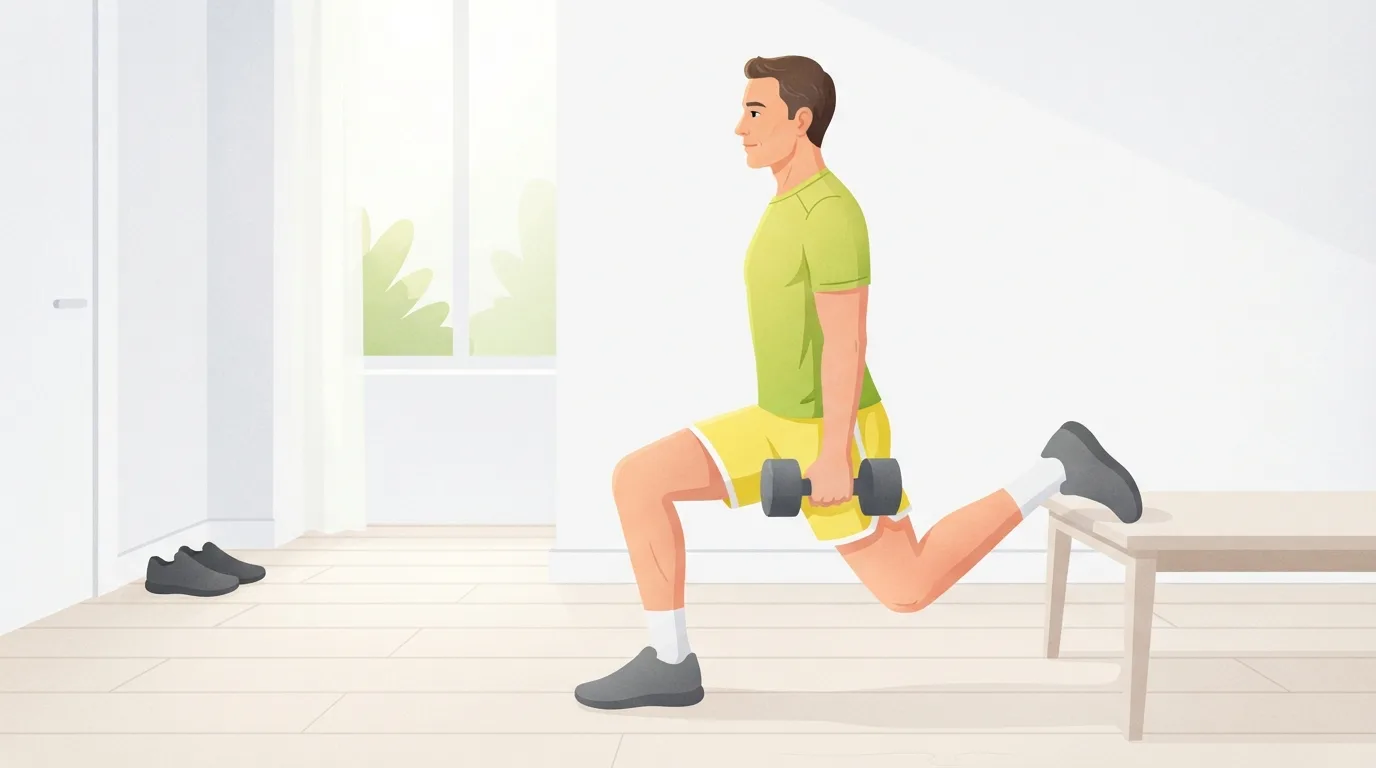
Most of the strength trials used barbells in a gym. You can reproduce the two ingredients that worked, heavy loading and explosive jumping, at home with a pair of dumbbells and a sturdy bench or chair. Single-leg exercises are the key. Holding two dumbbells in a Bulgarian split squat puts most of the load through one leg, so a modest pair of weights can reach the heavy, low-rep zone the evidence supports. Pairing that with jumps makes the plan the combined method that produced the largest effects.
Do two sessions a week for 8 to 12 weeks. Put them on the same day as a hard run, after the run, or the day after an easy run, and never on the day before a key session. Session A is heavy and Session B is explosive. Each takes about 30 minutes after a 5-minute warm-up of easy movement.
Session A: heavy strength
| Exercise | Sets x reps | How heavy |
|---|---|---|
| Bulgarian split squat, dumbbells at your sides | 3 x 5 to 6 per leg | A weight where 2 more reps would be very hard |
| Single-leg Romanian deadlift, dumbbells | 3 x 6 per leg | Same, with a slow 3-second lowering |
| Dumbbell step-up onto a knee-high box or bench | 3 x 6 per leg | Drive through the top foot, no push from the bottom one |
| Single-leg calf raise holding one dumbbell | 3 x 8 to 10 per leg | Pause 1 second at the top, lower slowly |
| Pogo hops, bodyweight | 3 x 15 | Quick, springy contacts with nearly straight knees |
Rest 2 to 3 minutes between heavy sets. That feels long, and it's what lets each set stay heavy. When you can finish the top of the rep range with two reps still in the tank, pick up heavier dumbbells, or slow the lowering to 4 seconds if you've run out of weight.
Session B: explosive and plyometric
| Exercise | Sets x reps | Focus |
|---|---|---|
| Squat jumps, bodyweight | 3 x 5 | Jump as high as you can, land softly, reset each rep |
| Split-squat jumps | 3 x 4 per leg | Switch legs in the air, stay tall on landing |
| Single-leg hops in place | 2 x 8 per leg | Short, quick contacts on the ball of the foot |
| Goblet squat, one dumbbell | 3 x 6 | Lower under control, stand up as fast as you can |
| Pogo hops, bodyweight | 2 x 15 | Same springy rhythm as Session A |
Session B totals about 100 foot contacts. Rest a full minute or more between jump sets so every rep stays fast. If a set gets slow or your landings get loud, stop the set there.
How to progress over 12 weeks
- Weeks 1 and 2: two sets of everything, stopping well short of failure, while you learn the movements.
- Weeks 3 to 8: full sets. Add weight in Session A whenever the reps feel easy, and keep the jumps crisp rather than adding more of them.
- Weeks 9 to 12: drop Session A to 4 or 5 reps with heavier dumbbells, and keep Session B the same.
- Race week: one short session early in the week at about half the usual sets, or skip it.

How Long Does It Take to Improve Running Economy?
Plan on 8 to 12 weeks for strength work. The programs in the pooled analyses ran from 6 to 24 weeks, and Denadai's analysis found longer programs produced larger gains. Plyometric improvements appeared within six weeks in the Spurrs trial. Cadence changes may move faster, but that evidence is thin.
Because a lab test is only precise to about 2 to 3 percent, a single re-test can miss a real change. Heart rate at a fixed pace, checked every couple of weeks on the same route, is the more useful signal at home. If you'd like the strength days laid out and progressed for you, a dumbbell workout app can carry that structure: FitCraft's AI coaches demonstrate each exercise in interactive 3D and adapt your workouts as you progress.
What the Research Suggests Going Forward
The strongest conclusion is also the least glamorous. Two or three short, hard strength sessions a week lower the cost of running, and they do it without adding body weight. Plyometrics add to that, especially at the slower speeds most people run. Cadence and footwear changes help some runners a lot and others not at all.
The limits are real. Most trials are small, many enrolled trained young men, and economy is measured on a treadmill at fixed speeds, which isn't the same as running outdoors on tired legs late in a race. Individual responses vary widely, as the footwear data show most clearly. Expect a few percent rather than a transformation, and expect it to pay off on every run you do afterward. The open questions are how well these gains hold up in slower recreational runners, in women and in older runners, and whether economy measured fresh predicts economy in the final third of a long race.
References
- Conley DL, Krahenbuhl GS. "Running economy and distance running performance of highly trained athletes." Medicine & Science in Sports & Exercise 12.5 (1980): 357-360. doi:10.1249/00005768-198012050-00010
- Saunders PU, Pyne DB, Telford RD, Hawley JA. "Factors affecting running economy in trained distance runners." Sports Medicine 34.7 (2004): 465-485. doi:10.2165/00007256-200434070-00005
- Barnes KR, Kilding AE. "Running economy: measurement, norms, and determining factors." Sports Medicine Open 1.1 (2015): 8. doi:10.1186/s40798-015-0007-y
- Saunders PU, Pyne DB, Telford RD, Hawley JA. "Reliability and variability of running economy in elite distance runners." Medicine & Science in Sports & Exercise 36.11 (2004): 1972-1976. doi:10.1249/01.mss.0000145468.17329.9f
- Shaw AJ, Ingham SA, Fudge BW, Folland JP. "The reliability of running economy expressed as oxygen cost and energy cost in trained distance runners." Applied Physiology, Nutrition, and Metabolism 38.12 (2013): 1268-1272. doi:10.1139/apnm-2013-0055
- Balsalobre-Fernández C, Santos-Concejero J, Grivas GV. "Effects of strength training on running economy in highly trained runners: a systematic review with meta-analysis of controlled trials." Journal of Strength and Conditioning Research 30.8 (2016): 2361-2368. doi:10.1519/JSC.0000000000001316
- Denadai BS, de Aguiar RA, de Lima LC, Greco CC, Caputo F. "Explosive training and heavy weight training are effective for improving running economy in endurance athletes: a systematic review and meta-analysis." Sports Medicine 47.3 (2017): 545-554. doi:10.1007/s40279-016-0604-z
- Llanos-Lagos C, Ramirez-Campillo R, Moran J, Sáez de Villarreal E. "Effect of strength training programs in middle- and long-distance runners' economy at different running speeds: a systematic review with meta-analysis." Sports Medicine 54.4 (2024): 895-932. doi:10.1007/s40279-023-01978-y
- Støren O, Helgerud J, Støa EM, Hoff J. "Maximal strength training improves running economy in distance runners." Medicine & Science in Sports & Exercise 40.6 (2008): 1087-1092. doi:10.1249/MSS.0b013e318168da2f
- Spurrs RW, Murphy AJ, Watsford ML. "The effect of plyometric training on distance running performance." European Journal of Applied Physiology 89.1 (2003): 1-7. doi:10.1007/s00421-002-0741-y
- Paavolainen L, Häkkinen K, Hämäläinen I, Nummela A, Rusko H. "Explosive-strength training improves 5-km running time by improving running economy and muscle power." Journal of Applied Physiology 86.5 (1999): 1527-1533. doi:10.1152/jappl.1999.86.5.1527
- Moore IS. "Is there an economical running technique? A review of modifiable biomechanical factors affecting running economy." Sports Medicine 46.6 (2016): 793-807. doi:10.1007/s40279-016-0474-4
- Quinn TJ, Dempsey SL, LaRoche DP, Mackenzie AM, Cook SB. "Step frequency training improves running economy in well-trained female runners." Journal of Strength and Conditioning Research 35.9 (2021): 2511-2517. doi:10.1519/JSC.0000000000003206
- Hoogkamer W, Kipp S, Frank JH, Farina EM, Luo G, Kram R. "A comparison of the energetic cost of running in marathon racing shoes." Sports Medicine 48.4 (2018): 1009-1019. doi:10.1007/s40279-017-0811-2
- Knopp M, Muñiz-Pardos B, Wackerhage H, Schönfelder M, Guppy F, Pitsiladis Y, Ruiz D. "Variability in running economy of Kenyan world-class and European amateur male runners with advanced footwear running technology: experimental and meta-analysis results." Sports Medicine 53.6 (2023): 1255-1271. doi:10.1007/s40279-023-01816-1
- Xiao Y, Hu X, Tian D, Qiu A. "Effects of advanced footwear technology on running economy and endurance performance: a meta-analysis." International Journal of Sports Medicine 47.2 (2026): 81-94. doi:10.1055/a-2637-7283
- Franz JR, Wierzbinski CM, Kram R. "Metabolic cost of running barefoot versus shod: is lighter better?" Medicine & Science in Sports & Exercise 44.8 (2012): 1519-1525. doi:10.1249/MSS.0b013e3182514a88
- Jones AM. "The physiology of the world record holder for the women's marathon." International Journal of Sports Science & Coaching 1.2 (2006): 101-116. doi:10.1260/174795406777641258
- Warneke K, Zechner M, Siegel SD, Jochum D, Brunssen L, Konrad A. "Acute and chronic effects of stretching on running economy: a systematic review with meta-analysis." Sports Medicine Open 11.1 (2025): 61. doi:10.1186/s40798-025-00859-0
- Anderson LM, Bonanno DR, Hart HF, Barton CJ. "What are the benefits and risks associated with changing foot strike pattern during running? A systematic review and meta-analysis of injury, running economy, and biomechanics." Sports Medicine 50.5 (2020): 885-917. doi:10.1007/s40279-019-01238-y
Frequently Asked Questions
What is running economy?
Running economy is the amount of oxygen or energy you use to run at a given steady pace below your threshold. A more economical runner uses less oxygen at the same speed, so that pace feels easier and can be held longer. Among elite runners with similar VO2 max, economy explained about 65 percent of the differences in 10K times in a classic 1980 study.
What is a good running economy?
There's no universal cutoff, because lab values depend on the speed, the equipment and the protocol, so numbers only compare fairly within one lab. As a reference point, the elite 10K runners in a classic 1980 study used about 185 to 190 mL of oxygen per kg of body weight per km. For your own running, what matters is whether the cost of a fixed pace drops over time, which you can follow at home through your heart rate at the same pace on the same route.
How do you improve running economy?
Lift heavy and jump. Meta-analyses find strength training improves running economy by about 4 percent on average, with heavy and explosive programs working about equally well and light or isometric programs falling short. Two to three sessions a week for 8 to 12 weeks is the usual dose. Years of consistent running, a slightly quicker step rate for some runners, and plated racing shoes can add more.
Can I get in shape just by running?
Running alone builds aerobic fitness well, but it leaves strength and power largely untrained. That matters for runners too: in a 2008 trial, adding heavy squats three times a week for eight weeks improved running economy by 5 percent and time to exhaustion at maximal aerobic speed by 21 percent, with no gain in body weight. Two short strength sessions a week fill the gap.
What is exercise economy?
Exercise economy is the same idea applied to any endurance activity: the oxygen or energy cost of moving at a given speed or power output. In cycling the related measure is usually called efficiency. Running economy is the most studied version, because small differences in it separate runners whose VO2 max values are nearly identical.
Do carbon-plated shoes improve running economy?
On average, yes. In a 2018 study, a prototype racing shoe with a resilient foam and a stiff carbon-fiber plate lowered the energy cost of running by about 4 percent, and it helped all 18 high-caliber runners tested. Individual responses vary widely, though: in a 2023 study, changes ranged from roughly an 11 percent benefit to an 11 percent drawback. Test your own response at a fixed effort before racing in them.