Most people meet Tabata in a class or a video where everyone is doing burpees and jump squats at full speed. Four minutes sounds easy. By round three your legs burn, your lungs are on fire and your form is falling apart, and by round five you're wondering what you signed up for.
If that's how your first Tabata went, you didn't fail it. The workout you tried was built for someone else. The famous version came out of a lab where physically active young men pedaled an exercise bike at an effort most people never reach, and the social-media version fills the rounds with jumping moves that pound new knees and ankles. Neither one starts where you are, so it's no surprise that a lot of people try Tabata once and quietly go back to nothing.
This guide starts where you are. You'll get the tabata exercises that work without jumping, six beginner Tabata routines with bodyweight or dumbbells, the effort to aim for in each round, and a four-week plan that begins with four rounds instead of eight.
What Is a Tabata Workout?
A Tabata workout is eight rounds of 20 seconds of hard work followed by 10 seconds of rest, which adds up to 4 minutes. That 4-minute block is called one Tabata. A full session wraps it in a warm-up and a cool-down, and more experienced people string two to four Tabatas together with a minute of rest between them.
| Part of the session | Beginner version | Time |
|---|---|---|
| Warm-up | Marching, arm circles, slow squats and a few practice reps of each move | 5 min |
| Work rounds | 20 seconds at 7 to 8 out of 10 effort, alternating two moves | 20 sec each |
| Rest rounds | 10 seconds standing still, breathing and setting up the next move | 10 sec each |
| Rounds | 4 in week 1, building to 8 (one full Tabata) by week 3 | 2 to 4 min |
| Cool-down | Easy walking, then stretches for the calves, hips and chest | 3 to 5 min |
So a first session takes about 10 to 12 minutes from start to finish, and only 2 of those minutes are hard. That's on purpose. The hard minutes grow week by week, and the warm-up and cool-down stay the same.
Is Tabata Good for Beginners?
Yes, as long as you scale the moves and the effort. You don't have to be an athlete to get fitter from short 20-second intervals, and three small studies show it.
- One Tabata, one bodyweight move. McRae and colleagues (2012), in Applied Physiology, Nutrition, and Metabolism, split 22 recreationally active women in their early twenties among 30 minutes of treadmill running, a single Tabata of one move (burpees, jumping jacks, mountain climbers or squat thrusts) and no training, with the two training groups exercising 4 days a week for 4 weeks. Aerobic fitness rose about 8% after the Tabata and about 7% after the running. Only the Tabata group got better at muscular endurance: push-ups rose 135% and sit-ups 64%. Enjoyment and the intention to keep going both went up after the four weeks.
- Bodyweight moves matched running. Menz and colleagues (2019), in the Journal of Sports Science and Medicine, gave 15 moderately trained adults 14 sessions of three to four Tabatas, using either running or whole-body moves. VO2 max rose about 13% with running and about 11% with the bodyweight moves, a difference too small to be meaningful, even though heart rate ran lower in the bodyweight group.
- Inactive adults can reach the zone. Poon and colleagues (2023), in the same journal, tested 14 physically inactive adults. A session of twelve 30-second bodyweight intervals pushed their heart rate to about 87% of maximum at its peak, felt about as hard overall as 30 minutes of moderate cycling, and got positive ratings from the people doing it.
Keep the limits in view. All three studies were small and short, all three used young adults, and the bodyweight sessions included jumping moves. None tested people over 50 or people with health conditions. So the fair summary is that short 20-second intervals can raise fitness in people who aren't athletes, and the no-jump beginner version on this page is a careful scaling of that idea rather than a protocol a trial has tested.
How Hard Should a Beginner Tabata Feel?
The original study is why Tabata is famous, and it's also why beginners get the wrong idea about it. In the 1996 trial by Tabata and colleagues, 7 physically active young men rode an exercise bike at about 170% of their VO2 max, more power than the aerobic system can supply, 4 days a week for 6 weeks, and their VO2 max rose about 13%. When Emberts and colleagues (2013) measured a bodyweight Tabata session instead, heart rate averaged about 86% of maximum: vigorous exercise, but far below that all-out ride. Our review of the Tabata protocol research walks through each study.
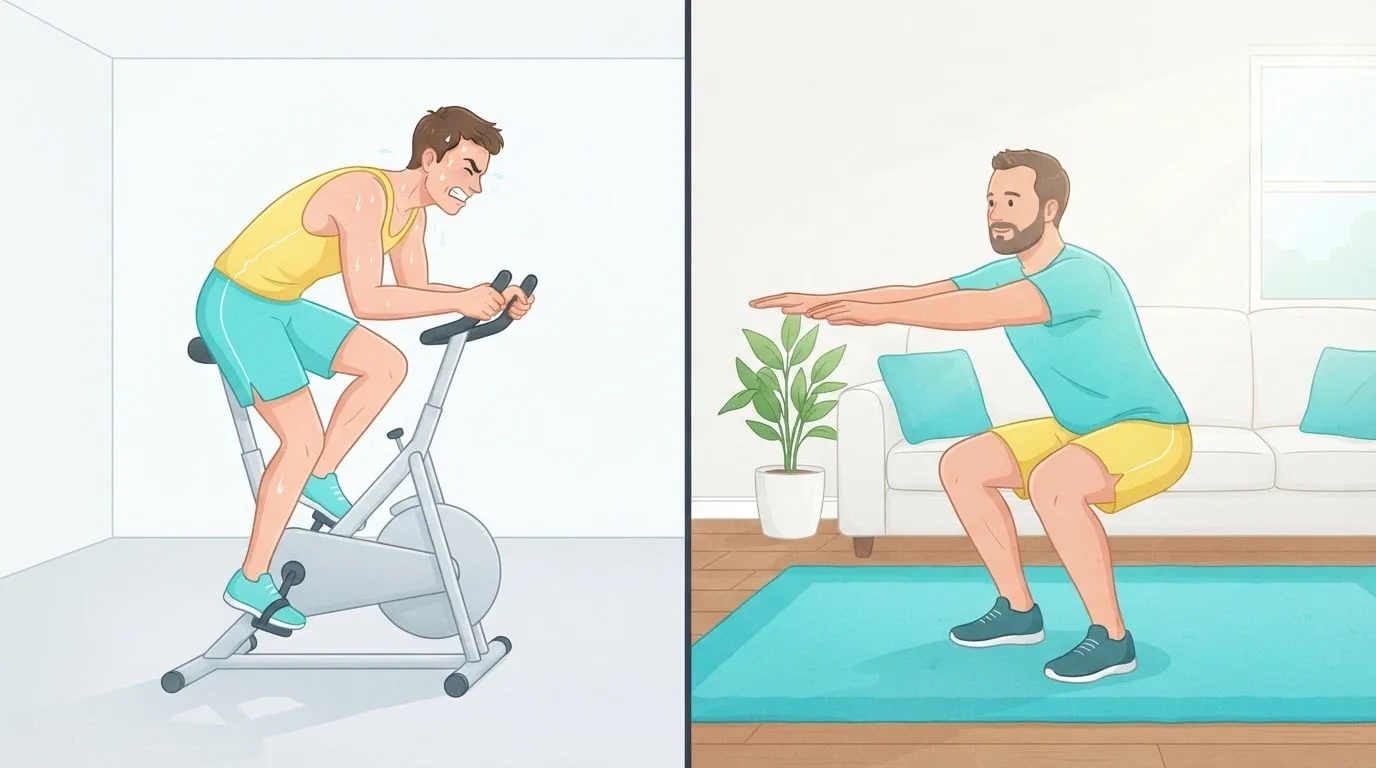
So aim lower than all-out and higher than comfortable. Rate each round on a 1 to 10 effort scale, the rate of perceived exertion, where 1 is sitting on the couch and 10 is the hardest effort you could possibly give:
| Rounds | Target effort | What it feels like |
|---|---|---|
| 1 and 2 | 6 to 7 out of 10 | Breathing hard, but you could still say a short sentence |
| 3 to 6 | 7 to 8 out of 10 | A few words at a time; you want the 10-second rest |
| 7 and 8 | 8 out of 10 | Hard, with every rep still clean and controlled |
Use your rep count as a check. Count your reps in round 1. If your count in the last round drops by more than a third, you started too fast. If it matches round 1 and you feel fresh, move a little faster next time. The beginner Tabata you can repeat twice a week, with good form every round, is worth more than the all-out one you dread.
How to Do a Tabata Workout for Beginners
Every one of the tabata routines for beginners below runs the same way:
- Warm up for 5 minutes. March in place, circle your arms, do 10 slow squats and a few practice reps of both moves you're about to use.
- Pick two moves. Call them A and B, and alternate them: A, B, A, B. Pair a leg move with an upper-body or core move so one part rests while the other works.
- Set a timer. Our free Tabata timer counts the rounds and beeps at the end of each one, and its Beginner level has no jumping moves. Any interval timer set to 20 and 10 works too.
- Work for 20 seconds. Move at 7 to 8 out of 10, with full range and clean form. Count your reps in round 1.
- Rest for 10 seconds. Stand tall, breathe out slowly and get into position for the next move.
- Repeat for your rounds. Four rounds in week 1, six in week 2 and the full eight in week 3.
- Cool down for 3 to 5 minutes. Walk until your breathing settles, then stretch your calves, hips and chest.
10 Tabata Exercises for Beginners (No Jumping)
These ten tabata exercises keep at least one foot on the floor and suit a small room. Each one has a harder version to use once the beginner version feels easy, so the same list carries you from your first Tabata to your tenth.
| # | Exercise | Equipment | Main target | Harder version later |
|---|---|---|---|---|
| 1 | Fast feet march | None | Heart and lungs, calves | High knees |
| 2 | Step jacks | None | Heart and lungs, shoulders | Jumping jacks |
| 3 | Bodyweight squat | A chair to sit back to, if needed | Thighs, glutes | Jump squat |
| 4 | Standing cross-body knee drive | None | Abs, obliques, hip flexors | Mountain climbers |
| 5 | Incline push-up | A kitchen counter, table or sturdy bench | Chest, shoulders, triceps | Floor push-up |
| 6 | Alternating reverse lunge | None, or a wall for balance | Thighs, glutes, balance | Dumbbell reverse lunge |
| 7 | Glute bridge | A mat | Glutes, hamstrings | Single-leg or dumbbell glute bridge |
| 8 | Dumbbell goblet squat | One light dumbbell | Thighs, glutes, upper back | Dumbbell squat to press |
| 9 | Dumbbell bent-over row | One or two light dumbbells | Upper back, rear shoulders, biceps | A heavier dumbbell, slower lowering |
| 10 | Light dumbbell punches | A pair of very light dumbbells | Shoulders, heart and lungs | Punches with a squat between combinations |
Three of them need a cue:
- Step jacks: step your right foot out as both arms rise overhead, bring it back as your arms come down, then step out with the left. Move quickly and stay light on your feet.
- Cross-body knee drive: stand tall with your hands up by your ears, lift your right knee toward your left elbow and twist to meet it, then switch sides. Brace your stomach as if you're about to be poked.
- Bent-over row: hinge at the hips with a flat back and soft knees, then pull the dumbbells toward your hips. In a fast round, keep the hinge still and let your arms do the moving. If your lower back complains, row one arm at a time with your free hand on a bench.
Find out what's really holding you back
FitCraft, our mobile fitness app, pairs you with an AI coach who builds you a personalized plan around your goals, schedule, and fitness level. Every FitCraft program is designed by Domenic Angelino, MPH (Brown University) and NSCA-CSCS, with research published in the Journal of Strength and Conditioning Research and Medicine & Science in Sports & Exercise.
Take the Free Assessment Free • 2 minutes • No credit card6 Tabata Workouts for Beginners
Each workout below is one Tabata: 8 rounds that alternate move A and move B, so you do each move four times. In week 1, stop after 4 rounds. For the dumbbell workouts, pick a weight you could lift 15 to 20 times when fresh, because a 20-second round gives you about 8 to 12 reps and the last rounds should still look clean.
| # | Workout | Move A | Move B | Best for |
|---|---|---|---|---|
| 1 | Low-impact cardio (bodyweight) | Fast feet march | Step jacks | Your very first Tabata, or a quiet apartment |
| 2 | Legs and core (bodyweight) | Bodyweight squat | Cross-body knee drive | Building leg endurance |
| 3 | Full body (bodyweight) | Incline push-up | Alternating reverse lunge | Upper and lower body in 4 minutes |
| 4 | Full body (dumbbell) | Goblet squat | Bent-over row | Adding strength to your cardio |
| 5 | Lower body (dumbbell) | Dumbbell reverse lunge | Dumbbell glute bridge | Glutes and thighs |
| 6 | Cardio and shoulders (dumbbell) | Light dumbbell punches | Bodyweight squat | Raising your heart rate with no impact at all |
1. Low-impact cardio Tabata (bodyweight)
Alternate a fast feet march, driving your knees to about hip height while you swing your arms, with step jacks. Neither move leaves the floor, so it's the quietest and gentlest way to learn the 20/10 rhythm. To make it harder, pick up the pace and lift your arms higher, not your feet.
2. Legs and core Tabata (bodyweight)
Alternate bodyweight squats with standing cross-body knee drives. On the squats, sit your hips back as if reaching for a chair and stand up fully at the top. If deep squats bother your knees, squat to a real chair and touch it lightly each rep.
3. Full-body Tabata (bodyweight)
Alternate incline push-ups with your hands on a counter or sturdy table, and alternating reverse lunges. The higher your hands, the easier the push-up, so lower the surface over the weeks. Keep a hand on a wall during the lunges if your balance wobbles once you're tired.
4. Full-body Tabata (dumbbell)
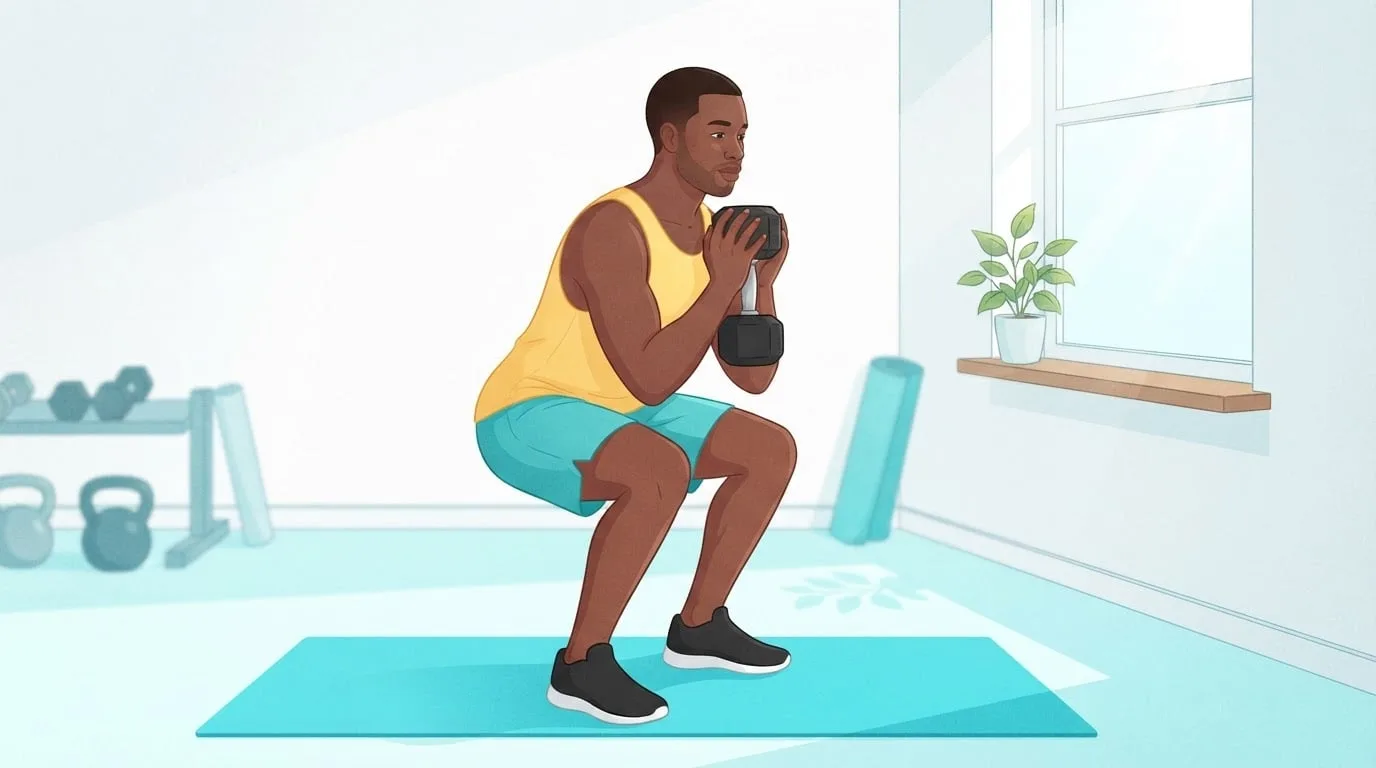
Alternate goblet squats, holding one dumbbell vertically at your chest, with bent-over rows. It's the closest thing on this list to a strength workout on a cardio clock. Set the dumbbell down during the 10-second rest if your grip is tiring.
5. Lower-body Tabata (dumbbell)
Alternate reverse lunges with a light dumbbell in each hand and dumbbell glute bridges, lying on your back with one dumbbell resting across your hips. Use the 10-second rest to get down to the mat or back up. If the floor transition feels rushed, swap the glute bridge for a goblet squat.
6. Cardio and shoulders Tabata (dumbbell)
Alternate punches with very light dumbbells, the kind you could hold out in front of you for a full minute, and bodyweight squats. Punch straight ahead, alternating arms, and turn your back foot slightly as you punch. It's the only workout here with no impact and no floor work, which makes it a good choice for sore knees or a hot day.
How to Progress From 4 Rounds to a Full Tabata
Build the number of rounds first, then the speed, then the difficulty of the moves. Changing one thing at a time tells you what's working, and it keeps sore joints from sneaking up on you.
| Week | Sessions | Rounds of 20/10 | Tabatas per session | Focus |
|---|---|---|---|---|
| 1 | 2 | 4 (2 min) | 1 | Learn workouts 1 and 2 at 7 out of 10 |
| 2 | 2 | 6 (3 min) | 1 | Same moves, a little faster |
| 3 | 2 or 3 | 8 (4 min) | 1 | Your first full Tabata; try workout 3 or 4 |
| 4 | 2 or 3 | 8 (4 min) | 2, with 1 to 2 min of walking between | Pair one bodyweight and one dumbbell Tabata |
After week 4, make one change every week or two: add a third Tabata, shorten the walk between Tabatas to 1 minute, use a slightly heavier dumbbell, or swap in a harder version from the exercise table. Save jumping moves for when you can land quietly with your knees in line with your toes, and add them one at a time.
If even 4 rounds of 20/10 leaves you dizzy or wrecked, start with an easier format. Use 20 seconds on and 20 seconds off for two weeks, or spend a few weeks walking briskly most days first. The short 10-second rest is what makes Tabata hard, so it's fine to work up to it.
How Long Should a Beginner Tabata Workout Be?
A 10-minute Tabata workout for beginners
Ten minutes covers a 3-minute warm-up, one full Tabata and a 3-minute cool-down. That's the right size for weeks 1 to 3 and for busy days after that.
Is a 20 minute Tabata workout enough?
For a beginner, yes. A 20-minute session holds a 5-minute warm-up, two or three Tabatas with rests between them and a cool-down, and two or three of those a week is a solid start. It still covers only part of what the Physical Activity Guidelines for Americans (Piercy et al., 2018) recommend: 150 to 300 minutes of moderate activity or 75 to 150 minutes of vigorous activity a week, plus muscle-strengthening work on at least 2 days. Let Tabata be your hard cardio, and add walks and two strength sessions around it. Back-to-back Tabatas for a full 20 minutes of intervals are an intermediate goal, not a starting point.
Tabata for Beginners Over 50
The plan above works at any age, with three adjustments. First, start with workout 1 or 6, which have no floor work and no impact. Second, use 20 seconds on and 20 seconds off for the first two weeks so your heart rate has longer to settle. Third, make every move easier to balance: squat to a chair, do incline push-ups at a kitchen counter and keep a hand on the wall for lunges. Recovery between hard sessions can take longer after 50, so leave at least one full day between Tabatas.
A screening step matters more than age. The American College of Sports Medicine's screening guidance (Riebe et al., 2015) bases the decision on three things: how active you are now, whether you have known heart, metabolic or kidney disease or symptoms of it, and how hard you plan to exercise. Healthy people who have been inactive can start with light to moderate exercise and build up gradually. Anyone with one of those diseases, or symptoms such as chest pain or unusual breathlessness, should get medical clearance before vigorous work like Tabata.
Who Should Not Do Tabata?
Hold off on Tabata, or get a professional's advice first, in these situations:
- Known heart, metabolic or kidney disease, or symptoms during effort. Chest pain or pressure, unusual breathlessness, dizziness or a racing, irregular heartbeat all call for medical clearance before intervals.
- A long stretch of inactivity. Healthy but inactive people should build a base of easier exercise first, such as brisk walking most days for a few weeks, then start at week 1 of the plan.
- Pregnancy and the months after birth. Follow your care team on how hard to work and which moves to use.
- A current joint injury. Stick to the moves that don't hurt, use workout 6 or the low-impact cardio Tabata, or wait until the injury settles.
Stop the session right away if you feel chest pain, faintness, sharp joint pain or a heartbeat that feels wrong, and get checked before you try again.
Can You Lose Weight Doing Tabata?
Tabata can help, but its effect on body fat is modest and no bigger than other cardio. Viana and colleagues (2019), in the British Journal of Sports Medicine, pooled 36 trials lasting at least 4 weeks. Interval training cut body fat by about 1.5 percentage points and fat mass by about 1.6 kg, and moderate continuous cardio cut body fat by about the same percentage. Wewege and colleagues (2017), in Obesity Reviews, looked at 13 trials in adults with overweight or obesity: interval and moderate training reduced fat mass and waist size equally, intervals took about 40% less time, and body weight itself barely changed.
So treat Tabata as a time-efficient way to get fitter that supports fat loss. The calorie deficit that drives most weight loss still comes mainly from what you eat. Pair your Tabatas with strength training to keep muscle, plenty of walking and a modest deficit you can live with.
What's Harder, Tabata or HIIT?
A beginner Tabata of step jacks and squats usually feels easier than a home HIIT session built on 40-second work intervals, because each 20-second round ends before your legs fill up. HIIT is the umbrella term for any workout that alternates hard work with recovery, and Tabata is one format inside it. Done the way the original lab study did it, as an all-out bike ride at about 170% of VO2 max, it ranks among the hardest HIIT formats there is. If you'd like longer intervals with more rest once Tabata feels comfortable, our HIIT workout at home guide lays out three routines and their work-to-rest ratios.
How to Stick With a Beginner Tabata Plan
The hardest part of a Tabata plan for beginners is the third week, when the novelty is gone and the session gets skipped once, then twice. That's a design problem, and it has design fixes: the same two days every week, a session short enough that "I don't have time" stops being true, and a visible record of the sessions you've done.
FitCraft builds that structure in. Its workouts include cardio and strength sessions with dumbbells and bodyweight, and an AI coach demonstrates each move on an interactive 3D model you can rotate and zoom, which helps when you're learning a squat or a row before you speed it up. Workouts adjust as you progress, and streaks and leaderboards give you a reason to come back for the next session. If you're starting from zero, our page on the best fitness app for beginners shows how FitCraft works for someone just getting started.
The Bottom Line
A Tabata workout for beginners keeps the 20/10 clock and changes everything else: no-jump moves, an effort of 7 to 8 out of 10 instead of all-out, and 4 rounds before 8. Do it twice a week, add rounds before speed and speed before jumps, and by week 4 you'll be doing two full Tabatas with bodyweight or dumbbells. It won't reproduce the lab results of the original study, and it doesn't need to. It will make you fitter in a few minutes a session, and it's a workout you can keep doing.
As Katie, a FitCraft user, put it: "I've tried everything. This is the first time I've stuck with something past two weeks." You don't need more willpower to get there. You need a starting point that fits.
Frequently Asked Questions
Is Tabata workout good for beginners?
Yes, once you scale it. Use no-jump moves such as step jacks, squats and incline push-ups, work at about 7 to 8 out of 10 rather than all-out, and start with 4 rounds instead of 8. In a small 2012 study, one 4-minute Tabata of a single bodyweight move, done 4 days a week for 4 weeks, raised aerobic fitness about as much as 30 minutes of treadmill running.
How many rounds of Tabata should a beginner do?
Start with 4 rounds of 20 seconds on and 10 seconds off, which takes 2 minutes. Add 2 rounds a week until you reach the full 8 rounds, then add a second Tabata with 1 to 2 minutes of easy walking between them. If 4 rounds is still too much, use 20 seconds on and 20 seconds off for the first two weeks.
Can you lose weight doing Tabata?
Tabata can help, but the effect on its own is modest. A 2019 meta-analysis found interval training cut body fat by about 1.5 percentage points, the same as moderate continuous cardio, and a 2017 review found it got there in about 40% less training time. Weight loss still depends mostly on what you eat, so pair Tabata with strength training, walking and a modest calorie deficit.
Is a 20 minute Tabata workout enough?
For a beginner, yes. A 20-minute session with a warm-up, two Tabatas and a cool-down is a full workout, and two or three of them a week is a solid start. It still covers only part of the weekly guideline of 75 to 150 minutes of vigorous activity, so add walks and two days of strength training.
What are 10 examples of exercises to use for Tabata?
Ten beginner-friendly Tabata exercises with no jumping are fast feet marching, step jacks, bodyweight squats, standing cross-body knee drives, incline push-ups, alternating reverse lunges, glute bridges, dumbbell goblet squats, dumbbell bent-over rows and light dumbbell punches. Pair two of them, one for the legs and one for the upper body or core, and alternate them for 8 rounds.
Who should not do Tabata?
Get medical clearance before Tabata-style intervals if you have heart, metabolic or kidney disease, or symptoms such as chest pain, unusual breathlessness or dizziness during effort. If you've been inactive but are healthy, start with easier exercise and build up over a few weeks. Pregnant people should follow their care team, and anyone with a joint injury should stick to no-jump moves that don't hurt.
Is a Tabata workout for beginners different for women?
No. Women can use the same moves, effort and 4-week plan. The 2012 study behind the one-Tabata approach was done in women, who improved aerobic fitness by about 8% and push-up endurance by 135% in 4 weeks. Pick dumbbell weights and push-up heights that match your current strength.
What's harder, Tabata or HIIT?
A beginner Tabata with step jacks and squats is usually easier than a typical HIIT class, because each work interval lasts only 20 seconds. Since Tabata is a kind of HIIT, the comparison depends on the workout: the original lab protocol, an all-out bike ride at about 170% of VO2 max, is among the hardest HIIT formats there is.