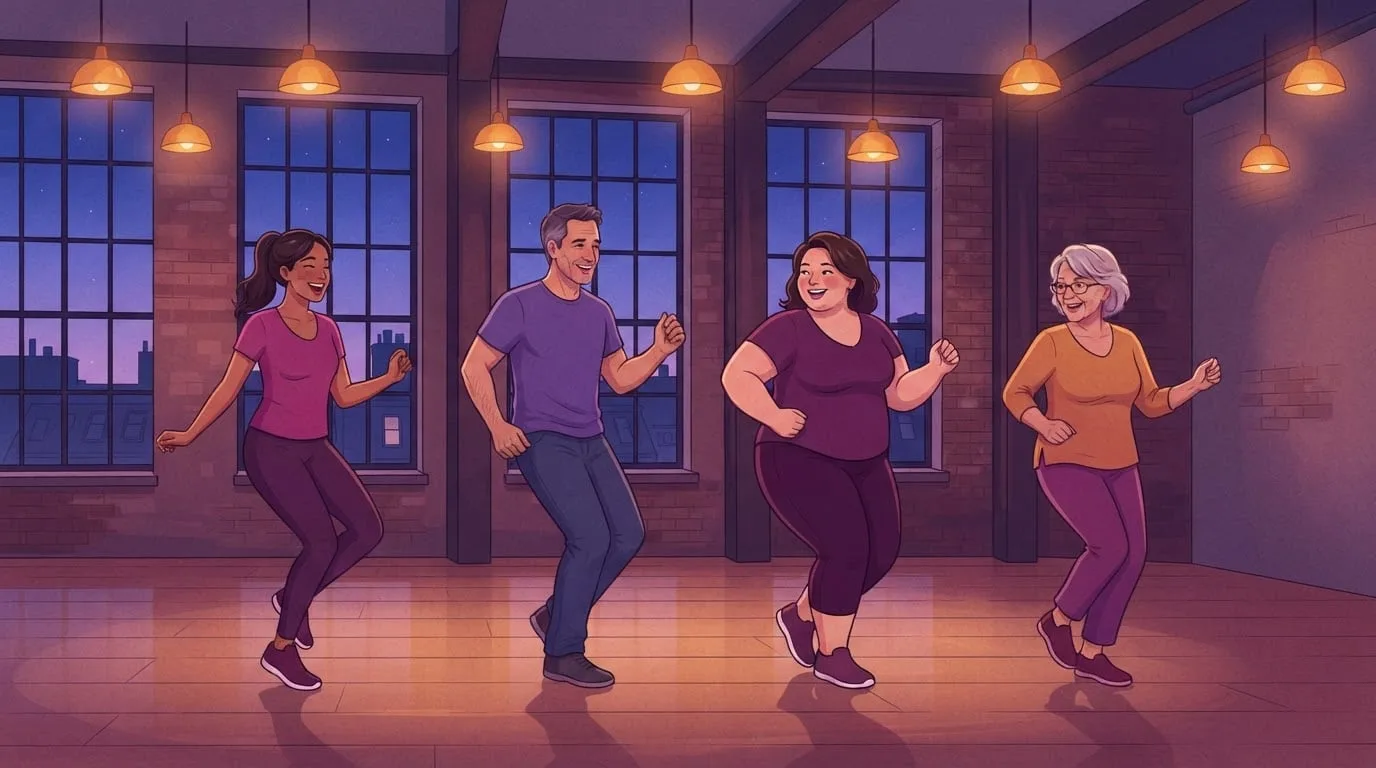
Zumba gets judged harshly from both directions. Fans say a class burns up to 1,000 calories and reshapes your whole body. Skeptics call it a dance party rather than real training. If you've walked out of a class drenched and smiling, you'll want to know which side is right before you build your week around it.
Zumba fitness is one of the better-studied group classes, so this question can be answered with trial data rather than opinion. This page covers what Zumba is, how hard a class really is and why the calorie numbers disagree, what the trials show for weight loss and body shape, the downsides and injury risk, how Zumba compares with walking and the gym, and how often to go.
What Is Zumba?
Zumba is a dance fitness class, sometimes called Zumba dance exercise, that turns aerobic exercise into a string of Latin and international dance steps set to music. Alberto "Beto" Pérez, an aerobics instructor in Cali, Colombia, created it in the 1990s after he forgot his usual music one day and taught the class to his own tapes of salsa and merengue. He and two business partners launched Zumba as a fitness company in 2001. By 2013, researchers in a survey by Inouye and colleagues put participation at about 14 million people in 150 countries.
A class usually runs 45 to 60 minutes. The instructor mostly cues the steps with gestures rather than words, mixing salsa, merengue, cumbia, reggaeton and other styles. The playlist alternates faster and slower songs, so your effort rises and falls in loose intervals. A standard class needs no equipment. Lower-intensity versions for older adults and beginners, versions with light hand weights and pool classes also exist.
How Hard Is a Zumba Class?
A class is hard enough to count as cardio for most people. How hard it is for you depends on your fitness, your body size and how much you put into each song, which is why published calorie numbers vary so much.
What the studies measured
- Young, experienced dancers. The study most often quoted, funded by the American Council on Exercise, tested 19 college-age women who already did Zumba (Luettgen and colleagues, 2012). Their classes averaged 39 minutes at 79 percent of maximum heart rate. Based on heart rate, the researchers estimated 9.5 calories a minute, or 369 calories per class. That's 8.8 METs, where one MET is the energy you use sitting still.
- Inactive women in community classes. In 24 physically inactive women aged 22 to 56, a one-hour class burned about 411 calories and included 51 minutes of moderate to vigorous activity and about 6,800 steps, roughly double the energy of a partnered salsa class (Domene and colleagues, 2016).
- Women of different sizes, measured by movement. Accelerometers on 61 women during a one-hour class recorded an average of only 3.6 METs, with about 54 percent of the class at moderate or vigorous intensity (Yáñez-Sepúlveda and colleagues, 2018). Women with obesity took about 3,760 steps in the class against 5,180 for women of normal weight and spent less time at the higher intensities.
- Live class against a DVD. Fifteen women burned 6.8 calories a minute in live classes and 5.6 doing the same routine to a DVD, and they spent 14.7 percent of class time above 85 percent of their heart rate reserve against 1.7 percent at home (Delextrat and Neupert, 2016).
Why the numbers disagree
Two things drive the spread. The first is method. Heart-rate estimates can read high in dance classes, because arm work, a hot room and excitement all push heart rate up, while a hip-worn accelerometer misses much of what your arms and torso do. The second is who's dancing. Fit, experienced dancers move bigger and faster, while beginners and people carrying more weight tend to take fewer steps, which the 2018 accelerometer study showed directly.
For a planning number, the 2024 Adult Compendium of Physical Activities rates a Zumba group class at 6.5 METs and a Zumba home video at 5.5 METs. Here's what that works out to in an hour, with brisk walking for comparison.
| Body weight | Zumba group class (6.5 METs) | Zumba home video (5.5 METs) | Brisk walking, 3.5 to 3.9 mph (4.8 METs) |
|---|---|---|---|
| 130 lb (59 kg) | About 385 calories | About 325 calories | About 285 calories |
| 160 lb (73 kg) | About 470 calories | About 400 calories | About 350 calories |
| 190 lb (86 kg) | About 560 calories | About 475 calories | About 415 calories |
Calories per hour calculated as METs times body weight in kilograms, using 2024 Compendium values. The totals include the energy you'd burn at rest anyway, about 1 MET.
What about the 600 to 1,000 calories an hour you see quoted online? The hardest-working dancer in the ACE-funded study burned an estimated 15.3 calories a minute, which would come to about 900 an hour. That was the top of the range, in a young, experienced dancer, estimated from heart rate. For most adults, about 350 to 550 calories an hour is a realistic figure.
Is Zumba a Good Workout to Lose Weight?
Zumba helps, but less than the calorie numbers suggest. The randomized trials agree that it raises fitness. They disagree a little on fat, and none found large losses without other changes.
- 12 weeks, 107 hospital employees. Two or three one-hour sessions a week raised aerobic fitness (peak VO2) by 5 percent and cut fat mass by 0.6 kg compared with controls (Barene and colleagues, 2014).
- 40 weeks, 118 hospital employees. With two sessions a week encouraged, the Zumba group gained 2.2 mL/kg/min of VO2 max and reduced its fat mass and body fat percentage compared with controls (Barene and colleagues, 2014).
- 8 weeks, 20 inactive women with overweight. One or two classes a week raised VO2 max by 3.1 mL/kg/min and lowered body fat by 1.2 percentage points (Domene and colleagues, 2016).
- 16 weeks, 28 women with overweight or obesity, half with type 2 diabetes. Three classes a week produced a weight loss of about 1 kg and a body fat drop of 1.2 percentage points (Krishnan and colleagues, 2015).
- 8 weeks, 44 healthy women. Three classes a week raised aerobic fitness by 3.6 percent, with no change in body composition (Delextrat and colleagues, 2016).
The two meta-analyses reflect the same split. Chavarrias and colleagues (2020) pooled 8 randomized trials lasting 8 to 16 weeks and found no significant change in body fat, though aerobic fitness did improve. The evidence quality was rated low. A 2026 meta-analysis by Ma and colleagues, limited to 7 trials in women who were insufficiently active, found a significant gain in aerobic fitness and a drop in body fat of 5.1 percentage points, with no change in BMI. That fat figure is far larger than any single trial above reported, so treat it as the optimistic end of the range.
A realistic expectation from Zumba alone is about a kilogram of fat, or a point of body fat, over two to four months. What you eat and how much you move on other days decide the rest. Pilates shows a similar modest pattern for a much lower-energy class, as our look at whether Pilates is good for weight loss explains.
What can 1 month of Zumba do?
No trial has tested only 4 weeks. The shortest trials ran 8 weeks and found body fat dropped by about a percentage point at most, while fitness rose more clearly. After a month of regular classes, expect to notice better stamina and less breathlessness in class before you see much change on the scale.
Knowing what to do is the easy part.
FitCraft, our mobile fitness app, pairs you with an AI coach who builds you a personalized plan around your goals, schedule, and fitness level. Every FitCraft program is designed by Domenic Angelino, MPH (Brown University) and NSCA-CSCS, with research published in the Journal of Strength and Conditioning Research and Medicine & Science in Sports & Exercise.
Take the Free Assessment Free • 2 minutes • No credit cardCan Zumba Change Your Body Shape?
It can, a little, mostly through fat loss and some added strength in the legs and trunk. The longest look at muscle comes from a 9-month randomized trial of 107 female hospital employees aged 25 to 63 (Barene and colleagues, 2016). The Zumba group trained two or three times a week for 3 months, then once a week for 6 months. Compared with controls, their trunk extension (lower back) strength rose by 3.1 kg at 3 months, and by 9 months they had gained 0.4 kg of lean mass in the legs and steadier balance. Jump height and flexibility didn't change.
A systematic review by Vendramin and colleagues (2016) of 11 studies and 586 participants reached the same conclusion: Zumba improves aerobic capacity, brings small benefits for body weight and has only limited evidence for gains in muscular strength or flexibility. In the 8-week trial of healthy women above, participants rated their own physical strength 16 percent higher afterward, even though their body composition hadn't changed. Feeling stronger and fitter came first.
What muscles does Zumba work?
- Legs and glutes. Bouncing, stepping, lunging and squatting steps keep the quadriceps, hamstrings, glutes and calves working through most songs.
- Hips and trunk. Hip rolls, twists and shimmies work the obliques, lower back and hip muscles, which fits the gains in back strength and balance above.
- Shoulders and arms. Arm patterns keep them moving, but with no load beyond the weight of your arms.
- Heart and lungs. The muscle that gets the biggest training effect is your heart.
To change your shape with visible muscle, you need resistance that increases over time, which Zumba doesn't provide. Barre makes the opposite trade, building muscular endurance with very little cardio, as our answer to whether barre is a good workout explains.
What Are the Downsides of Zumba?
The main downside is injury risk, mostly to the knees, and it rises with how often you go. In the survey by Inouye and colleagues in Hawaii, 14 of 49 regular participants (29 percent) reported 21 Zumba-related injuries, and half of those injured saw a medical provider. Knees accounted for 42 percent of the injuries, ankles for 14 percent and shoulders for 14 percent. The injured participants averaged 3.8 classes a week against 2.7 for everyone else, and more classes a week remained linked to injury after accounting for age, gender and how long people had been dancing.
A larger online survey puts the risk in context. Among 138 women, 16 percent of class participants and 58 percent of instructors had been injured during Zumba in the past year (Domene and colleagues, 2017). That came to about 3.9 injuries per 1,000 hours of class for participants, most of them minor, and the authors called Zumba a low injury risk overall. Instructors were hurt more because they danced far more hours.
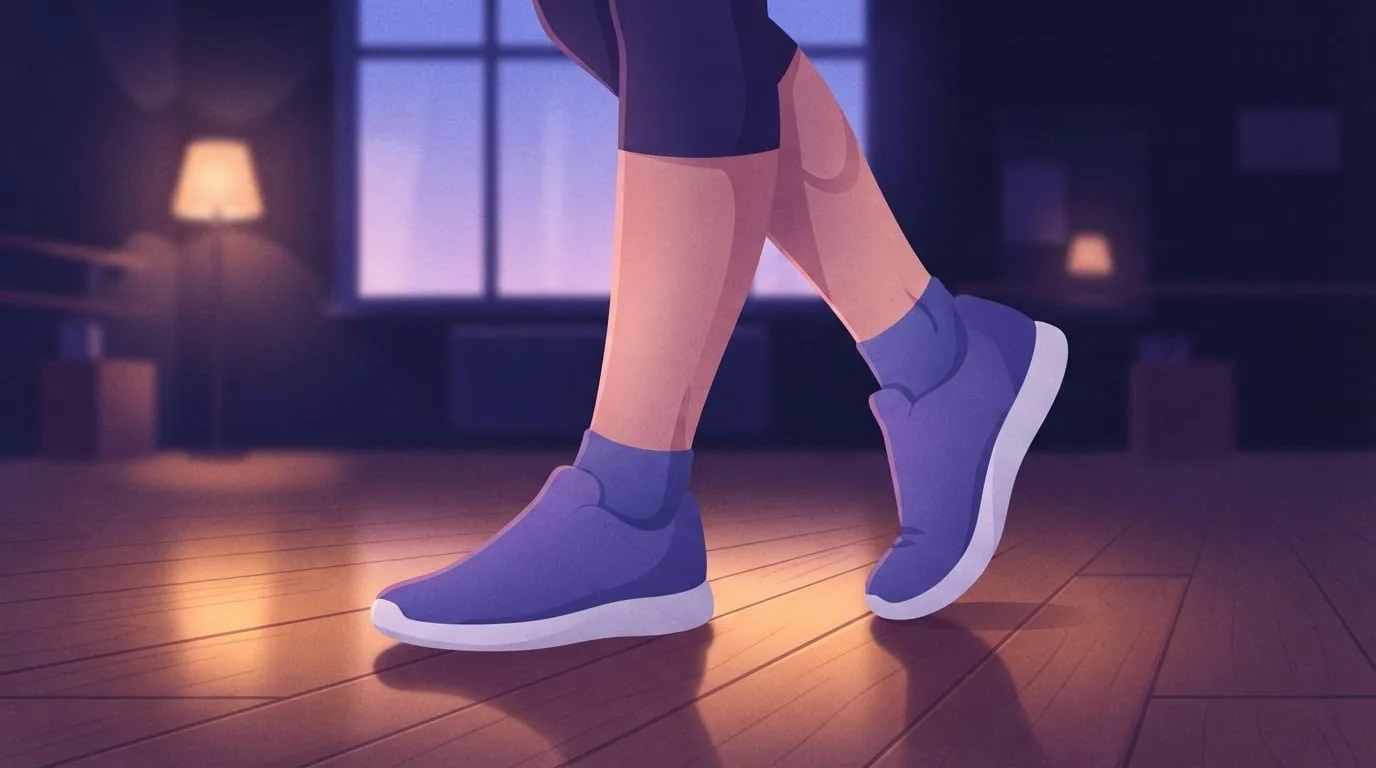
The other downsides are smaller but real:
- Grippy shoes and fast turns. Thick running-shoe treads can catch on a studio floor during pivots. Cross-training or dance sneakers with a smoother sole are a better match.
- Less intensity for some bodies. As the accelerometer study showed, heavier participants tend to move less and spend less time at the intensities that build fitness, so the class may feel hard while delivering less than the averages suggest.
- Little for strength or bone. In the 40-week hospital trial, the soccer group, not the Zumba group, improved bone density in the legs. Zumba isn't a substitute for strength training.
- Dependence on a class. The live class burned about 20 percent more per minute than the same routine on a DVD, so the effect partly depends on getting to a class you like.
Which Is Better, Zumba or Walking?
Zumba burns more per minute, and walking is easier to do every day. The Compendium rates a Zumba group class at 6.5 METs, brisk walking at 3.5 to 3.9 mph at 4.8 METs and walking at a moderate 2.8 to 3.4 mph at 3.8 METs. At 160 pounds, that's about 470 calories an hour for Zumba, 350 for a brisk walk and 275 for a moderate walk, so an hour of Zumba burns roughly a third more than an hour of brisk walking.
Walking wins on access and impact. It needs no class, no music and no choreography, it's gentler on sore knees and ankles, and it fits into a lunch break. Zumba wins on intensity, coordination and fun, and the faster songs push your heart rate higher than most people reach on a walk. The better choice is the one you'll do more often, and plenty of people do both: Zumba two or three times a week, and walking on the other days.
Which Is Better, Gym or Zumba?
They do different jobs, so the answer for most people is both. The World Health Organization's 2020 guidelines ask adults for 150 to 300 minutes of moderate aerobic activity a week, or 75 to 150 minutes of vigorous activity, plus muscle-strengthening work for all major muscle groups on two or more days. Zumba covers the aerobic part well. It barely touches the strength part.
That strength part doesn't need a gym. Two 30- to 40-minute sessions a week with dumbbells or your body weight, such as squats, lunges, rows, presses and hip hinges, done with enough load that the last couple of reps are hard, will cover what Zumba leaves out. If what keeps you dancing is that Zumba doesn't feel like a workout, look for the same quality in your strength days. Our roundup of fun workout apps compares apps built around that idea. FitCraft adds game mechanics to strength and cardio workouts at home: a 3D AI coach demonstrates each exercise and says your name, and streaks, leaderboards and collectible cards reward you for showing up.
Is Zumba a Good Workout for Beginners and Older Adults?
Yes, with a few adjustments. If you're new, stand near the back, march or step-touch through steps you don't know yet, skip the jumps and fast turns, and keep your arms lower when you need a breather. Coordination comes after a few classes. If a full class is too much at first, the routines in our guide to low impact cardio at home build the base without any choreography.
For older adults, balance is the standout benefit. In a randomized trial by Ben Waer and colleagues (2024), 57 postmenopausal women aged 50 to 60 were assigned to Zumba, Pilates or no training. The Zumba group improved its postural control on a firm floor and on foam, with eyes open and closed, which are the harder conditions that mimic uneven ground and low light. That fits the steadier balance in the 9-month hospital trial. Lower-intensity Zumba classes designed for older adults slow the tempo and drop the jumps.
How Many Times a Week Should You Do Zumba?
Two or three classes a week is the sweet spot. Twice a week was enough to raise VO2 max over 40 weeks in the hospital trial, and three a week produced the fat and fitness changes in the 16-week trial. Going much beyond that adds injury risk faster than results: the injured dancers in the Hawaii survey averaged nearly four classes a week. If you're new, start with one or two a week for the first month.
Here's a week that keeps Zumba at the center and covers the gaps:
- Monday: Zumba class.
- Tuesday: strength, 30 to 40 minutes with dumbbells or body weight.
- Wednesday: Zumba class, or a brisk 30- to 45-minute walk.
- Thursday: rest or an easy walk.
- Friday: strength again, adding a little weight or a rep where you can.
- Saturday: Zumba class.
- Sunday: rest.
What This Means for You
Zumba is a good workout for your heart and lungs, your balance and your mood. In inactive women, a single class raised positive well-being and lowered psychological distress, and the 8-week trial in women with overweight found large gains in energy and emotional well-being. Those effects matter more than they sound, because the workout you enjoy is the one you'll still be doing next spring.
Zumba isn't a complete program, though. It does little for strength and bone, and its fat-loss effect is modest on its own. Keep the classes you love, keep them to two or three a week, and add two short strength sessions. As Matt put it after finally sticking with a routine: "The real win is I actually want to work out now. That's never happened before."
Frequently Asked Questions
Is Zumba cardio?
Yes. Zumba is aerobic exercise set to dance music, and the 2024 Compendium rates a group class at 6.5 METs, which is vigorous for most adults. In an ACE-funded study, young, experienced dancers averaged 79 percent of their maximum heart rate across a class, inside the range recommended for building aerobic fitness.
How many calories does a 1-hour Zumba class burn?
About 380 to 560 calories for adults weighing 130 to 190 pounds, based on the Compendium's 6.5 METs for a group class. Measured classes range widely: 411 calories in an hour for inactive women in one study, and less for people who move less during the class. Claims of 1,000 calories an hour don't match what studies have measured for most people.
Can Zumba help you lose belly fat?
Only as part of losing fat overall, because no workout burns fat from one spot. Zumba trials of 8 to 16 weeks found body fat dropped by about a percentage point or less, with bigger changes when eating habits change too. Regular classes plus a modest calorie deficit are what shrink a waistline.
Is Zumba bad for your knees?
Not for most people, but the knee is the most common injury site. In a survey of Zumba regulars, 42 percent of reported injuries were to the knee, and people who took more classes a week were more likely to be hurt. Wear shoes with smoother soles that let you pivot, skip jumps and fast turns until you know the steps, and limit classes to two or three a week at first.
Can you do Zumba at home?
Yes, but expect a lighter workout. The Compendium rates a home video at 5.5 METs against 6.5 for a group class, and in one study women burned about 18 percent fewer calories a minute doing the same workout to a DVD. Clear floor space, supportive shoes and a non-slip surface matter more at home than in a studio.
Does Zumba improve your mood?
The evidence says yes. In inactive women, a single class raised positive well-being and lowered psychological distress, and an 8-week trial found large gains in energy and emotional well-being. Those social and mood effects are a big reason people stick with Zumba longer than with workouts they dread.