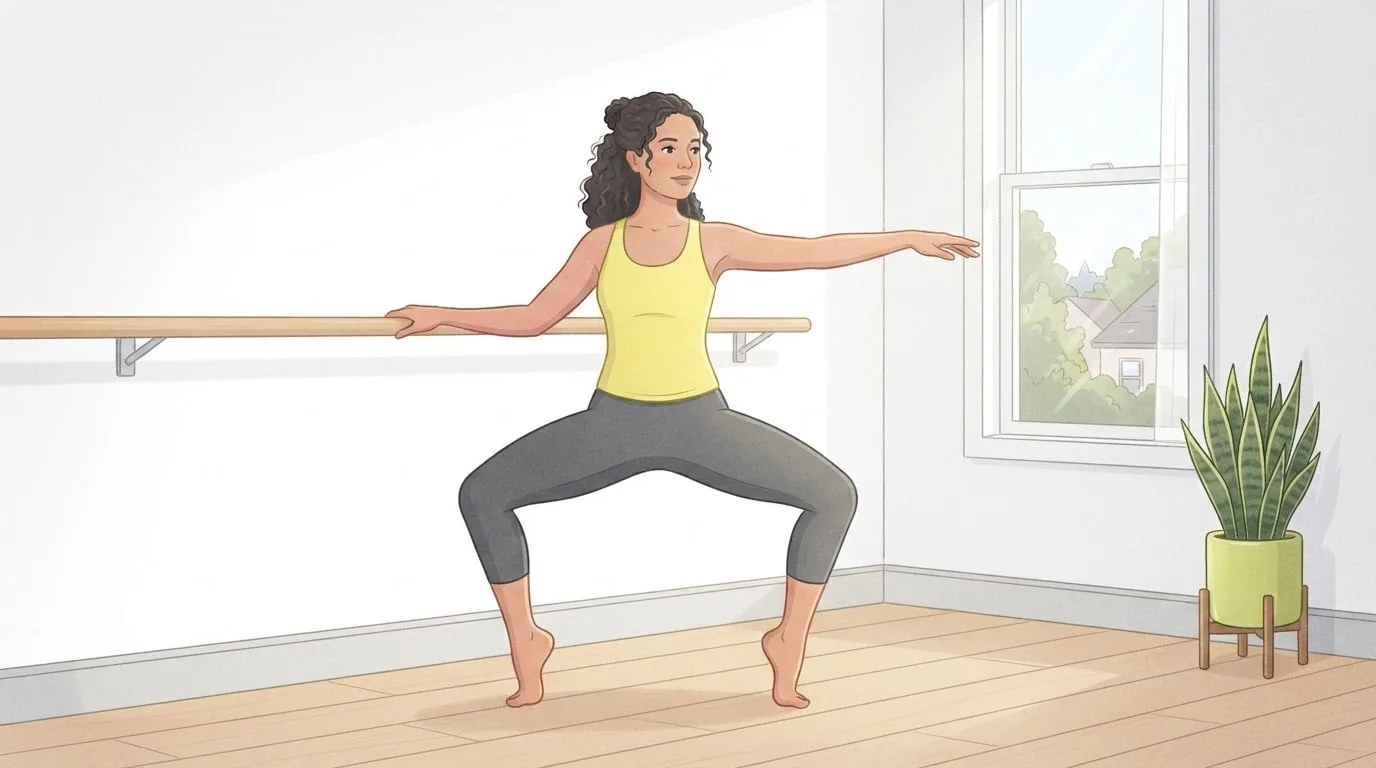
If you've ever finished a barre class with your thighs shaking, you've probably wondered whether that burn adds up to real fitness. Barre fans swear by it, and the barre before and after photos on social media look convincing. Then someone at the gym tells you that tiny pulses with 2-pound weights don't count as training. The research supports parts of both views.
So is barre a good workout? I answer it the way I'd answer a client: by what barre trains well, what it leaves out, and who it suits. This page covers what a barre class is, the muscles it works, the small amount of barre research that exists, whether barre builds muscle or bone, whether it helps with belly fat, what realistic before-and-after changes look like, and how to build a week around it.
What Is Barre Fitness?
Barre fitness is a group exercise class built on ballet positions. You stand at a waist-high rail and work against your body weight, light hand weights of 1 to 3 pounds and often a small soft ball squeezed between your knees. A typical 45- to 60-minute class runs through a warm-up, an arm series with the light weights, thigh work at the barre, a glute series, a short core block on the mat and a stretch.
The signature moves are the plie (a knee bend with the legs turned out), the relevé (rising onto the balls of the feet), pulses of an inch or two, long holds at the bottom of a position and small tucks of the pelvis. Classes are usually set to music, and the instructor counts you through sets that run far longer than a typical set in the gym.
Is barre the same as Pilates? No, though studios often blend the two. Barre puts most of its work into the legs and glutes with small, repeated movements, while Pilates works from the trunk outward with slower movements timed to the breath. Barre usually feels harder in the first class, and Pilates takes longer to do well. Our barre vs Pilates guide covers where each method came from, how they compare for difficulty and calories, and how hybrid classes work, so this page sticks to barre itself.
What Muscles Does Barre Work?
Barre works most of the lower body hard and the upper body lightly. Here's where you'll feel it:
- Front of the thighs (quadriceps). Plies, chair holds and lunges at the barre keep them working for much of the class. This is where the famous shake starts.
- Glutes, including the side of the hip. Leg lifts to the side and back work the gluteus maximus of the moving leg and the gluteus medius of the standing leg, which keeps your pelvis level.
- Inner thighs. Turned-out plies and squeezing a ball between the knees load the adductors.
- Calves. Every relevé is a calf raise, and a class can include a hundred or more of them.
- Shoulders, upper back and triceps. The arm series uses very light weights for long, high-rep sets.
- Core. Tucks, planks and curls on the mat, plus the constant job of holding your trunk upright while you balance on one leg.
- Pelvic floor. Many instructors cue a gentle lift of the pelvic floor during tucks and ball squeezes.
Most of that work trains local muscular endurance, which is a muscle's ability to repeat or hold a light effort for a long time. Much of it is also isometric, meaning the muscle works without changing length, as in a held plie. Endurance is a real fitness quality, but it's a different one from strength, power or aerobic fitness. That difference explains most of what barre can and can't do for you.
What Does the Research Say About Barre?
Not much, and most of it is small. Barre has far less published research than Pilates, yoga or ordinary strength training, so some of the best evidence for what it does comes from neighboring fields.
The one randomized barre trial we could find
Parhonlakan and Masodsai (2024) randomized 30 sedentary female office workers aged 30 to 45 to barre classes three times a week or to their usual routine. After 8 weeks, the barre group had improved its leg and core muscular endurance and strength more than the controls. The published summary gives no effect sizes, and the comparison was doing nothing at all. It shows that barre beats sitting still, which is a fair starting point for anyone who is currently inactive.
Barre and the pelvic floor
The most interesting barre-specific finding is about bladder control. In a 2023 observational study by Briskin and Luck, 25 women with urinary incontinence who were new to barre filled in validated symptom questionnaires before and after 10 classes taken within 2 months. Every score improved. The median severity score on the Michigan Incontinence Symptom Index fell from 13 to 7, and stress incontinence scores roughly halved, from 5.2 to 2.5.
That study had no control group, and the women were recruited at a single studio chain, so it can't separate barre from the effect of time or of simply paying attention to the problem. Training the pelvic floor muscles directly has far stronger evidence. A Cochrane review by Dumoulin and colleagues (2018) found that women with stress incontinence who did pelvic floor muscle training were eight times more likely to report a cure than untreated women, 56 percent against 6 percent. If leaking is your reason for trying barre, see a pelvic health physical therapist as well.
Balance: the closest evidence comes from ballet
Ballet classes share barre's plies, relevés and single-leg work, and they add turns and traveling steps. In a randomized trial by Harrison and colleagues (2024), 44 women with an average age of about 69 took 12 weeks of online ballet or online wellness classes, twice a week for 45 minutes. Both groups improved their balance scores and walking speed. The ballet group also had steadier backward walking and fewer falls than the wellness group.
In a smaller single-group study, Letton and colleagues (2024) taught 10 weeks of ballet to 22 women with an average age of 56. Their leg strength improved on a sit-to-stand test, balance improved on one leg only, and the women who finished attended 95 percent of their classes. These are ballet results, not barre results. They do suggest that the slow single-leg work at a barre is the part of the class most likely to protect your balance as you age.
Knowing what to do is the easy part.
FitCraft, our mobile fitness app, pairs you with an AI coach who builds you a personalized plan around your goals, schedule, and fitness level. Every FitCraft program is designed by Domenic Angelino, MPH (Brown University) and NSCA-CSCS, with research published in the Journal of Strength and Conditioning Research and Medicine & Science in Sports & Exercise.
Take the Free Assessment Free • 2 minutes • No credit cardIs Barre a Good Workout to Build Muscle?
Barre builds muscle well for a beginner, and less so after the first few months. Light weights can build muscle, but only up to a point, and barre often works right at that point.
The good news comes from a 2017 meta-analysis by Schoenfeld and colleagues of 21 studies. When every set was taken to failure, light loads of 60 percent of a one-rep max or less built about as much muscle as heavy loads. Heavy loads still won for maximal strength. So the high-rep style of barre isn't a fake form of training. A set that leaves your muscles shaking can be a real growth signal.
There's a floor, though. Lasevicius and colleagues (2018) trained 30 men twice a week for 12 weeks. One arm and leg did three sets to failure at 20 percent of their one-rep max, and the other limb lifted 40, 60 or 80 percent with the total volume matched. At 20 percent, the thigh muscle grew 8.9 percent and the arm flexors 11.4 percent. At 80 percent, they grew 19.5 and 25 percent. For the shoulders and arms of anyone who has trained for a while, barre's 1- to 3-pound hand weights often sit near or below that 20 percent line.
The extreme version of barre's approach has been tested too. Ramírez-Campillo and colleagues (2013) had 11 young adults do one set of 960 to 1,200 leg presses with one leg, at 10 to 30 percent of their max, three times a week for 12 weeks. The trained leg gained no measurable lean mass. The study was small, but it shows that adding reps to a very light load eventually stops adding muscle.
Holds are a partial exception. A 2019 systematic review of isometric training by Oranchuk and colleagues found that holds at long muscle lengths, such as the bottom of a deep plie or a low lunge, built more muscle than holds at short lengths. It also found that tendons need hard contractions of about 70 percent of maximum or more to adapt, which a body-weight hold rarely reaches for strong legs.
Barre vs strength training
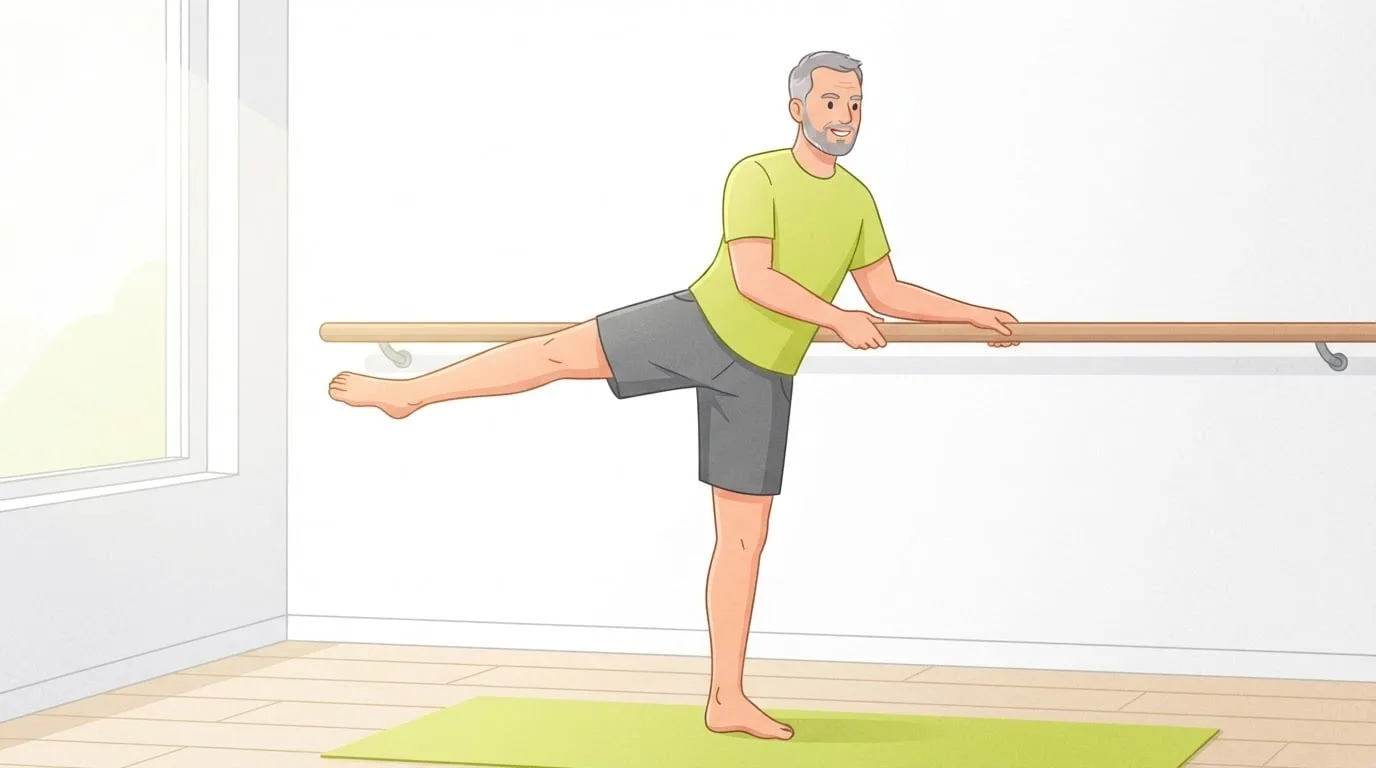
Strength training with dumbbells lets you add load in small steps for years, which is called progressive overload. Barre mostly progresses by adding reps, time and depth, and those run out of room. For strength and muscle size, dumbbells win once you're past the beginner stage. For muscular endurance, balance on one leg and an enjoyable class you'll actually attend, barre does a job most lifting plans skip. You don't have to pick one.
How to make barre harder
- Pick up heavier hand weights for the arm series. Many people can use 5 to 8 pounds once the 2-pound set feels easy.
- Add light ankle weights for leg lifts and the glute series.
- Go single-leg. A plie or chair hold on one leg roughly doubles the load on that leg.
- Slow the lowering and pause at the bottom, the long-muscle-length position that grows the most muscle.
- Stop when the set is truly hard, not when the song ends. The last few reps are the ones that build muscle.
Does Barre Build Bone Density?
Barre probably does little for bone density. Bone adapts to high strain, from heavy lifting or from impact like jumping and landing, and a barre class has neither. No study has measured bone density after barre, so this is a judgment from the bone research rather than a tested result.
The benchmark trial shows how much load bone needs. In the LIFTMOR trial, Watson and colleagues (2018) randomized 101 postmenopausal women with low bone mass to supervised heavy lifting at over 85 percent of their max plus impact drop landings, or to a light home program, twice a week for 8 months. Spine bone density rose 2.9 percent in the heavy group and fell 1.2 percent in the light group. A barre class works at a small fraction of those loads with no impact at all.
Barre still has a place on a bone-health plan, because better balance means fewer falls, and falls are what break weakened bones. Keep it for that, and add impact and heavier lifting for the bone itself. Our page on bone density exercises at home lays out a plan you can do without a gym. If you already have osteoporosis, ask a physical therapist about the curls and deep forward folds that are common in barre's core block.
Is Barre Good for Belly Fat?
Barre won't burn belly fat in particular, because no exercise burns fat from the area it works. Vispute and colleagues (2011) had 24 sedentary adults do seven abdominal exercises five days a week for 6 weeks. Their curl-up endurance improved, reaching 47 reps against 32 in the control group, but belly fat, waist size and body fat percentage didn't change. The leg study above found the same pattern: the fat that left came from the arms and trunk, not from the leg that did 1,000 reps.
Fat loss comes from your total energy balance across the week, and barre's share is modest. The 2024 Adult Compendium of Physical Activities has no entry for a fitness barre class. Its "ballet barre and floor exercises" entry, at 6.3 METs, describes a ballet technique class with jumps and traveling steps that a barre workout leaves out. The better match is light to moderate body-weight exercise, at 2.8 to 3.8 METs. At 150 pounds, that works out to roughly 190 to 260 calories for an hour of barre.
For comparison, brisk walking at 3.5 to 3.9 mph is rated at 4.8 METs, about 325 calories an hour at the same weight, and a Zumba class at 6.5 METs, about 440. Our answer to whether Zumba is a good workout looks at that higher-energy option. If belly fat is the goal, barre is a fine part of the plan. The deficit itself has to come from more movement across the week and from what you eat.
Barre Before and After: What Changes, and When
Barre before and after photos tend to compress months into one image, so here's what usually happens in order.
- Weeks 1 to 4. The shaking eases, you hold positions longer and your form gets steadier. Most of this is your nervous system learning the moves and your muscles' endurance rising. Endurance can climb fast, as the 6-week curl-up gains in the belly fat study above show.
- Weeks 4 to 12. Measurable gains in leg and core endurance, as in the 8-week barre trial, and some new muscle if you're a beginner and your sets are hard. Your thighs and glutes may feel firmer before they look different.
- Month 3 and beyond. Visible change depends mostly on body fat. If it drops, the muscle you've built shows. If it doesn't, the shape changes slowly. This is also when the light weights stop being enough, and progress stalls unless the load goes up.
The barre body, with its long, lean muscles, is a marketing phrase rather than a training effect. A muscle's ends are anchored to bone by tendons, so no class can make it visibly longer. A lean, toned look comes from some added muscle plus less fat over it, the same as with any training. Our explainer on what toned actually means goes through the science. Photos also flatter the after shot with posture, lighting and a post-class pump.
Who Is Barre a Good Workout For?
A barre person is often someone who likes music, a teacher counting them through and a workout that leaves them feeling worked but not wrecked. That describes plenty of people. Barre suits you if you are:
- New to exercise or coming back after a long break. The moves are simple, there's no jumping and the rail is there for balance.
- Looking for low impact. One foot usually stays on the floor and nothing lands hard.
- Older and working on balance. The single-leg standing work is close to what helped in the ballet trials.
- Dealing with mild bladder leaks, alongside pelvic floor training from a physical therapist.
- Motivated by a group. A class you look forward to beats a better program you skip.
Barre needs something added if your main goals are strength, muscle size, bone density, heart and lung fitness or weight loss. And if deep knee bends on your toes hurt your knees, keep your heels down, bend less and tell the instructor. If you're pregnant or recently gave birth, ask your doctor or a pelvic health physical therapist which moves to change.
How to Build a Week Around Barre
The World Health Organization's 2020 guidelines ask adults for 150 to 300 minutes of moderate aerobic activity a week, or 75 to 150 minutes of vigorous activity, plus muscle-strengthening work for all major muscle groups on two or more days. Barre counts toward the strength part. Its estimated energy cost sits around the line where moderate activity starts, so don't count on it for the aerobic part.
Here's a simple week that keeps barre and covers the gaps:
- Monday: barre class.
- Tuesday: dumbbell strength, 30 to 40 minutes. Goblet squats, Romanian deadlifts, rows, presses and lunges, 3 sets of 8 to 15 reps with a weight that makes the last two reps hard.
- Wednesday: brisk walk, 30 to 45 minutes.
- Thursday: barre class.
- Friday: dumbbell strength again, adding a little weight or a rep where you can.
- Saturday: a longer walk, a bike ride or a dance class.
- Sunday: rest.
The strength days are the ones people tend to drop, because nobody is counting them through. If you'd rather not plan them yourself, a dumbbell workout app that progresses your program can handle the load increases. In FitCraft, a 3D AI coach demonstrates every dumbbell and bodyweight exercise, the program adapts as you progress, and your streak shows you every session you've kept.
What This Means for You
Barre is a good workout for what it trains: muscular endurance in the legs, glutes and core, steadier balance on one leg, and a low-impact class many people genuinely enjoy. It isn't a complete program. The light loads stop building muscle once your body adapts, the lack of impact leaves your bones alone, and the calorie burn is lower than a brisk walk.
That's not a reason to quit. It's a reason to give barre a clear job. Keep the classes you love, add two days where the weights get heavier over time, and walk briskly on the days in between. Sarah, 27, described the app that finally stuck for her this way: "First app that made exercise feel like something I chose, not forced." A week you choose, built around a class you like, is one you'll keep.
Frequently Asked Questions
Is barre a good workout for beginners?
Yes. Barre is one of the easier classes to start, because most of its moves are small versions of a squat, a lunge and a calf raise, there's no jumping and you hold a rail for balance. Expect sore thighs after the first few classes. If deep knee bends on your toes bother your knees, keep your heels down and bend less.
Is barre a good workout for weight loss?
Barre helps a little. A class likely burns about 190 to 260 calories an hour at 150 pounds, based on the 2024 Compendium's values for light to moderate body-weight exercise, which is less than brisk walking. Weight loss depends on your total week of activity and eating, so treat barre as one part of the plan rather than the plan itself.
Is barre cardio?
Mostly, it isn't. Your heart rate rises during long thigh and glute sets, but barre's estimated energy cost of 2.8 to 3.8 METs sits around the line where moderate activity starts at 3.0. Count it as muscle-strengthening work and get your cardio from brisk walking, cycling, swimming or a dance class.
How often should you do barre to see results?
Two to three classes a week is enough. The one randomized barre trial we could find used three classes a week and found better leg and core endurance after 8 weeks. You'll usually notice longer holds and less shaking within the first month, while visible changes take longer and depend mostly on body fat.
Is barre or Pilates better for toning?
Neither is better on its own. A toned look comes from building some muscle and carrying little enough fat for it to show. Barre works the thighs, glutes and calves harder, while Pilates works the trunk harder. Adding heavier dumbbell work twice a week will build visible muscle faster than either class alone.
Is barre the same as Pilates?
No. Barre loads the legs and glutes with small, repeated movements at a rail, while Pilates works from the trunk outward with slower movements timed to the breath, on a mat or a reformer. Many studios blend the two, but Pilates has far more research behind it.
Can you do barre at home?
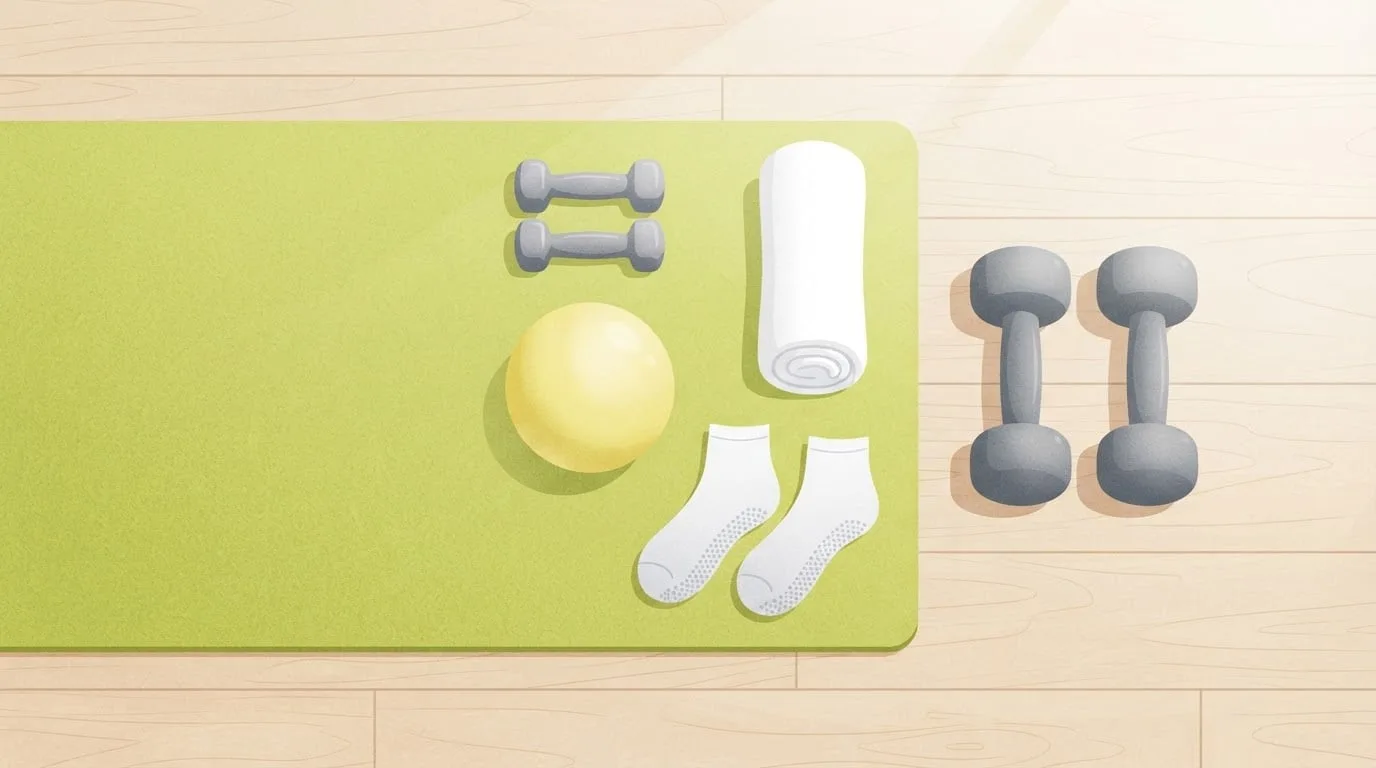
Yes. A sturdy kitchen counter or the back of a heavy chair works as the barre, and you need only a mat, light hand weights and optionally a small soft ball. Use a surface that won't slide or tip when you lean on it, and wear grip socks or go barefoot on a non-slip floor.