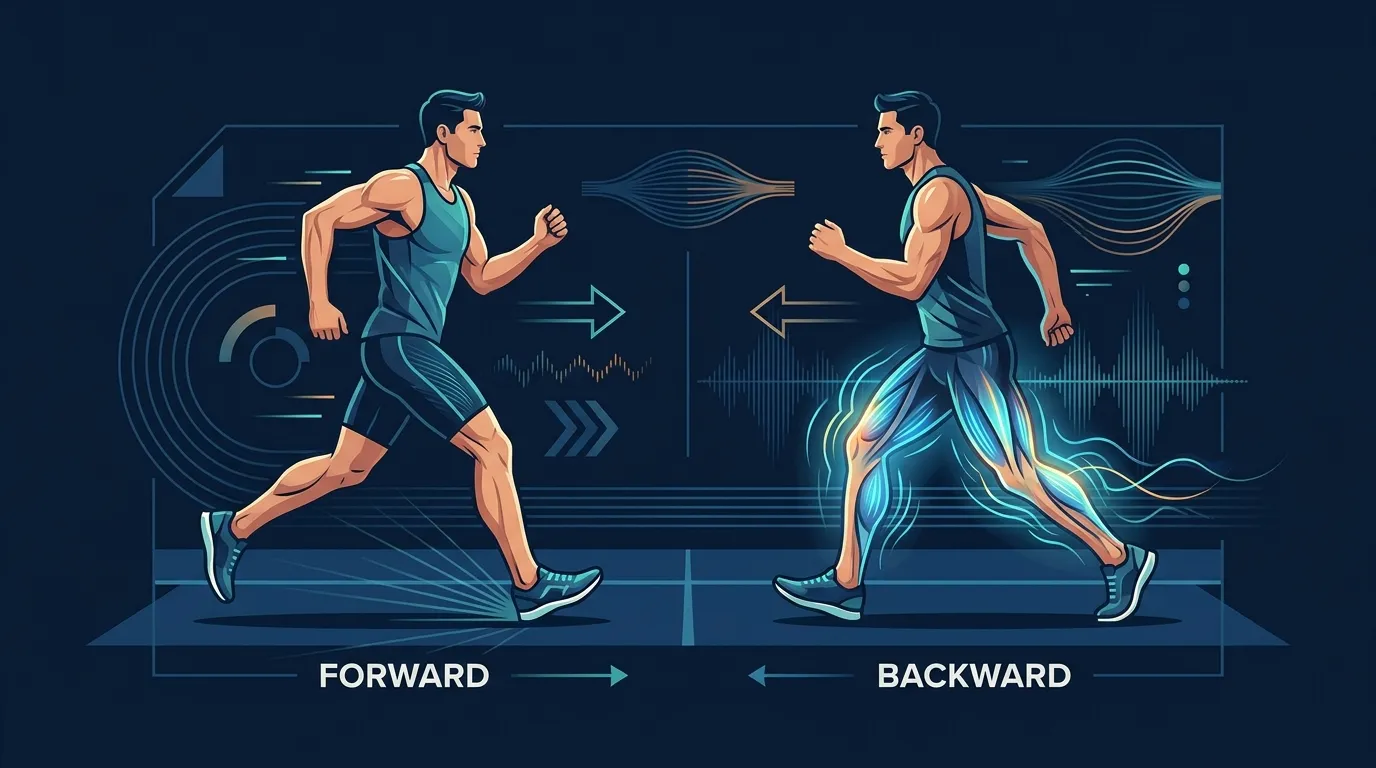
Retro-walking is having a moment. Physical therapists have prescribed it for decades, but the broader culture caught up around 2024, when TikTok videos of people on backward treadmills started racking up tens of millions of views. The pitch is straightforward. Walk backward, burn more calories, save your knees, train your balance, get the brain workout you have been missing.
Most of those claims have research behind them. Some are overstated. A few are clean clinical findings that have been quietly sitting in physical-therapy journals since the 1990s. The trend caught up to the science, more or less.
Here is what the controlled research actually shows, what it does not, and how to use backward walking if you decide to add it.
The Research: What Studies Show
Alghadir et al. (2019): Knee Osteoarthritis RCT
This is the cleanest piece of evidence on the topic. Alghadir and colleagues at King Saud University randomized 68 adults (mean age 55.6 years, 38 female) with diagnosed knee osteoarthritis into three groups: retro-walking plus conventional therapy, forward walking plus conventional therapy, and conventional therapy alone. Walking sessions ran 10 minutes per session, three sessions per week, for 6 weeks.
The retro-walking group showed significantly greater reductions in pain on the visual analog scale, lower functional disability scores on the WOMAC questionnaire, higher quadriceps muscle strength on isokinetic testing, and faster performance on a timed 10-meter walk and stair-climb compared with both control groups. The forward-walking group also improved over conventional therapy alone, but by less.
Two things make this study load-bearing. First, it is a properly randomized controlled trial with a clinical population, not a lab study on healthy 22-year-olds. Second, the outcomes are the ones knee OA patients actually care about: less pain, more function, more strength. The mechanism is reasonable. Backward walking lands toes-first with the heel arriving last, which reduces peak compressive force on the patellofemoral joint and shifts work toward the quadriceps through the eccentric phase of each step.
Citation: Alghadir AH, Anwer S, Sarkar B, Paul AK, Anwar D. Effect of 6-week retro or forward walking program on pain, functional disability, quadriceps muscle strength, and performance in individuals with knee osteoarthritis: a randomized controlled trial. BMC Musculoskelet Disord. 2019;20:159.
Flynn et al. (1994): The Cardiopulmonary Cost
The metabolic-cost numbers people quote on social media usually trace back here. Flynn and colleagues measured oxygen consumption, heart rate, and ventilation in 15 healthy adults during forward and backward walking and running at matched speeds. Backward walking at a given speed elicited higher VO2 and higher heart rate than forward walking, with the gap widening at higher speeds.
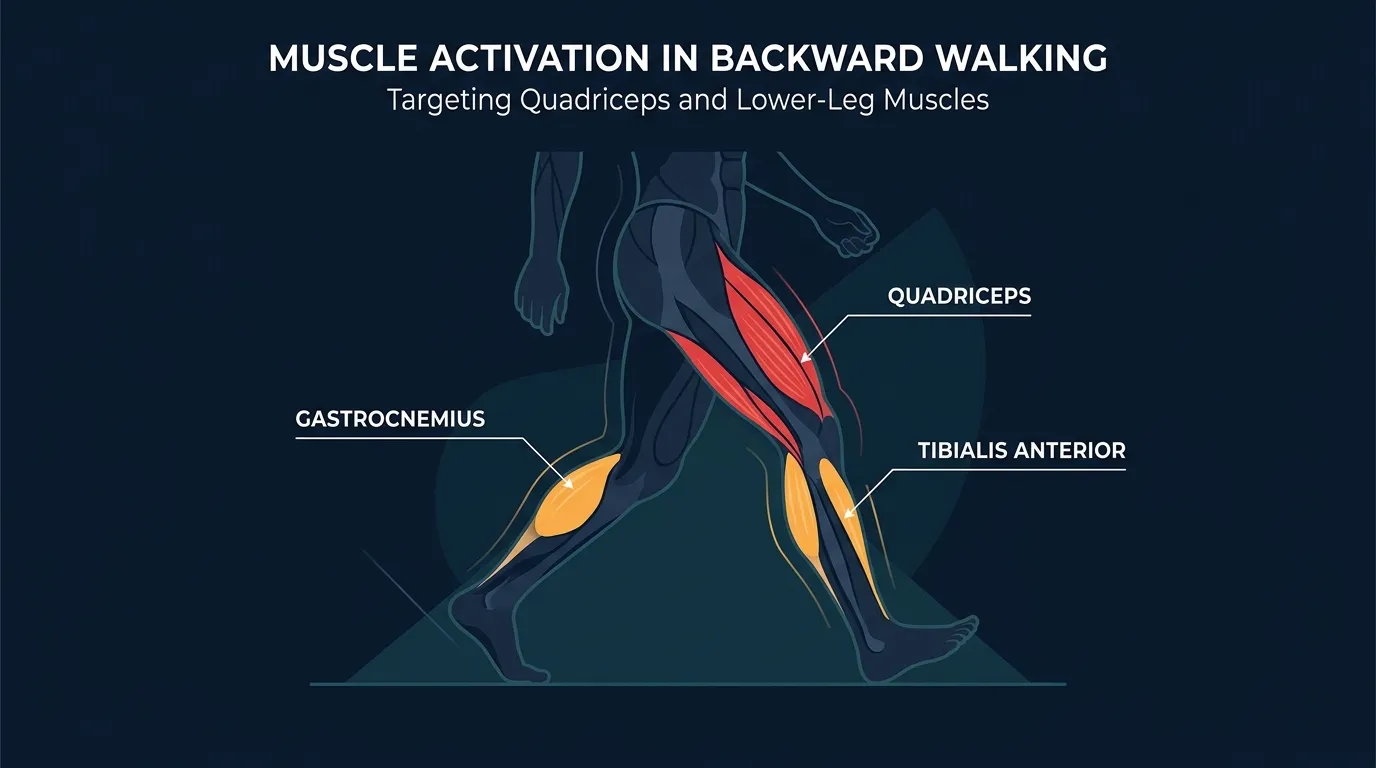
The Compendium of Physical Activities, which translates these lab measures into MET values for public-health use, lists backward walking at 3.5 mph at roughly 6.0 METs, versus forward walking at the same speed at 4.3 METs. That is a real 30 to 40 percent jump in energy cost at the same pace. The extra work happens in the quadriceps, the tibialis anterior, and the calves, all of which have to do more eccentric and concentric work when the foot lands toes-first.
Plain-English version: if you backward-walk for 30 minutes, you burn what 40 to 42 minutes of forward walking at the same pace would burn. Not a free lunch, but a real efficiency advantage if your time, not your effort, is the limiting factor.
Citation: Flynn TW, Connery SM, Smutok MA, Zeballos RJ, Weisman IM. Comparison of cardiopulmonary responses to forward and backward walking and running. Med Sci Sports Exerc. 1994;26(1):89-94. PMID: 8133744.
Terblanche et al. (2005): Body Composition in Young Women
Terblanche and colleagues recruited 26 healthy female university students (aged 18 to 23) and put 13 of them through a 6-week backward run/walk program while 13 served as activity-matched controls. The training group ran progressive intervals on a treadmill, finishing at roughly 25 minutes of backward locomotion per session, three times per week.
The training group showed a 32% drop in oxygen consumption during submaximal backward exercise and a 30% drop during forward exercise at matched intensity. Body fat dropped 2.4%, the sum of skinfolds dropped 19.7%, and predicted VO2 max from the 20-meter shuttle run improved 5.2%. Control-group changes were not significant.
The transferable point is that backward training produces forward-walking and forward-running fitness gains. The cardiorespiratory adaptations carry across. This is a small trial in young, mostly healthy women, but the direction of effect matches the energy-cost data: harder work per unit time produces more cardiovascular adaptation, even when delivered backward.
Citation: Terblanche E, Page C, Kroff J, Venter RE. The effect of backward locomotion training on the body composition and cardiorespiratory fitness of young women. Int J Sports Med. 2005;26(3):214-219.
Soman et al. (2023): Retro-Walking and Inflammation
A more recent randomized comparative trial. Soman and colleagues assigned 106 untrained overweight and obese young adults to either retro-walking (n=53) or forward walking (n=53) on a treadmill, four sessions per week for 12 weeks. They measured C-reactive protein (a marker of systemic inflammation and a cardiovascular risk factor), body mass index, and blood pressure.
Both groups improved on all three outcomes (p<0.001). The retro-walking group improved significantly more, with larger drops in CRP, BMI, and blood pressure than the forward group. The protocol was matched on duration but not on intensity. The retro arm was working harder, which probably explains most of the differential gain.
This study is useful as a real-world test. It used a sedentary population, a longer 12-week protocol, and outcomes that map to cardiometabolic disease risk rather than to lab measures alone. The CRP drop, in particular, is the kind of finding that suggests backward walking is doing real systemic work, not just local quad strengthening.
Citation: Soman A, Joshi N, Naik V, et al. Retro walking treadmill training reduces C-reactive protein levels in overweight and obese young adults: A randomized comparative study. Health Sci Rep. 2023;6(4):e1169.
Wen and Wang (2022): Stroke Rehab Meta-Analysis
Wen and Wang pooled nine randomized trials of backward walking training in stroke patients, with searches through August 2021. Outcomes included the 10-meter walk test, Berg Balance Scale, stride length, gait cycle, cadence, paretic step length, paretic single support time, and total double support time.
Backward walking training significantly improved 10-meter walk speed, Berg Balance Scale scores, stride length, and paretic single-support time compared with conventional gait training alone. The meta-analysis concluded that backward walking should be considered a useful adjunct in post-stroke gait rehabilitation, especially for patients with hemiparesis-related balance and stride asymmetry.
This is the most established clinical use of backward walking. It is not a self-directed program in this population. Trials were run with physical-therapist supervision, often with parallel bars or a treadmill harness for safety. The takeaway for general readers is that the proprioceptive and quadriceps benefits scale into clinically meaningful outcomes when applied to the right population.
Citation: Wen H, Wang L. Backward Walking Training Impacts Positive Effect on Improving Walking Capacity after Stroke: A Meta-Analysis. Int J Environ Res Public Health. 2022;19(6):3370.
Why This Matters for Your Fitness
Backward walking sits in a strange niche. It is too low-intensity to compete with structured cardio at building VO2 max. The Norwegian 4x4 protocol moves cardiorespiratory fitness faster, and brisk forward walking captures most of the walking-speed mortality benefit without the proprioceptive complexity. So why has the research been quietly persistent?
Mostly because it does two things that forward walking does not. First, it shifts mechanical load. Backward walking reduces peak knee compressive force and shifts the gait cycle toward quadriceps-dominant eccentric work. That makes it useful when forward walking and running aggravate the knees, which is common in mid-life adults with patellofemoral pain, mild knee OA, or recovery from minor injury. The Alghadir 2019 trial demonstrated this clinically. The mechanism plus the trial outcomes both point in the same direction.
Second, it loads the proprioceptive and balance systems harder. Walking without visual lead is genuinely cognitively demanding, especially in the first few sessions. That demand recruits ankle, hip, and trunk stabilizers that get a free pass during forward walking, and it cross-trains the same systems that drive fall-risk reduction in older adults. It is not a substitute for a structured balance program, but it adds proprioceptive load to time you would otherwise spend on autopilot.
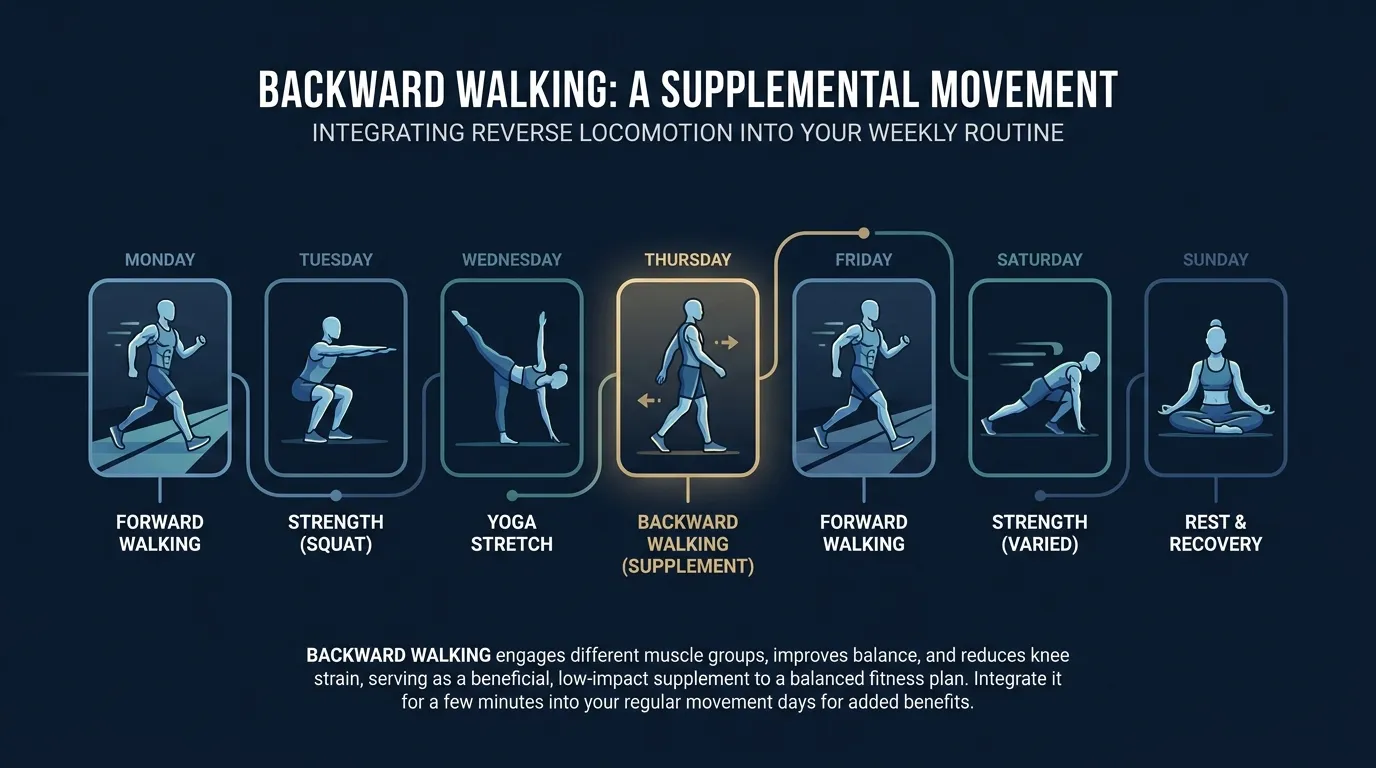
The honest framing: backward walking is a useful spice, not the meal. It earns a place in a weekly program because it adds load with low impact and tests systems forward walking ignores. It does not replace strength training, structured cardio, or dedicated balance work.
How to Apply This in Practice
If you want to add backward walking, here is what the data argues for:
- Start indoors, with a wall or counter within reach. The first few sessions feel awkward, balance-wise. Use a hallway, the empty side of a gym floor, or a treadmill at the lowest speed while holding the handrails. Outdoor walks without spotters are a fall risk for at least the first week.
- Begin with 5 to 10 minutes added onto a regular walk. Most published protocols use 10 to 30 minutes per session, 3 to 5 sessions per week, for 6 to 12 weeks. Build to that range. Adding 5 minutes of backward walking to the end of a 25-minute forward walk is a sensible starting point.
- Use slow speeds (1.5 to 2.5 mph) at first. On a treadmill, drop the speed well below forward walking pace. The cognitive demand is higher and the recovery position from a misstep is harder. Faster speeds compound the fall-risk side faster than they compound the training side.
- If you have knee OA or anterior knee pain, ask your clinician first. The Alghadir 2019 protocol was supervised by physical therapists. The data is encouraging, but applying it to your specific knee deserves a real conversation with your physical therapist or physician, especially if you have ligament instability, recent surgery, or balance problems.
- Treat it as a supplement, not a replacement. Backward walking is a useful add-on for low-impact knee-friendly cardio and balance load. It does not replace structured cardio (Zone 2, intervals, brisk walking) for cardiorespiratory adaptation, and it does not replace resistance training for muscle and bone outcomes.
For a beginner adding it for the first time, two sessions per week of 10 minutes each, slotted in after regular forward walking, is a low-risk starting dose. Build duration before speed.
Get an evidence-based plan built for you
FitCraft, our mobile fitness app, pairs you with an AI coach who builds you a personalized plan around your goals, schedule, and fitness level. Every FitCraft program is designed by Domenic Angelino, MPH (Brown University) and NSCA-CSCS, with research published in the Journal of Strength and Conditioning Research and Medicine & Science in Sports & Exercise.
Take the Free Assessment Free • 2 minutes • No credit cardCommon Misconceptions
Misconception: "Backward walking burns way more calories than forward walking"
It burns more, not way more. The Flynn 1994 cardiopulmonary data and the Compendium of Physical Activities MET values both put backward walking at roughly 30 to 40 percent higher energy cost than forward walking at the same speed. That is a real bump, but it is the gap between a brisk walk and an easy walk, not the gap between a walk and a run. Social-media claims of "double the calories" or "burns more than running" misread the data.
Misconception: "Backward walking is safer than forward walking"
It is safer for the knee joint at matched speed. It is not safer overall. The fall-risk side flips the opposite direction. You cannot see what is behind you, the cognitive demand is higher, and recovery from a stumble is harder when the body is moving in reverse. The Wen and Wang 2022 stroke meta-analysis was conducted in supervised clinical settings with parallel bars or treadmill safety equipment for that exact reason. For healthy adults, the risk is manageable. For older adults or anyone with balance issues, it is not negligible.
Misconception: "You have to do it on a treadmill"
No. The published trials used both treadmill and overground protocols. Treadmills add convenience and pace control, but they are not magic. A hallway, an empty gym floor, or a flat outdoor space without obstacles works just as well, with the caveat that visual scanning over the shoulder gets tiring fast. If you have a treadmill with handrails, that is the lowest-friction setup. If you do not, a 10-meter indoor lane works fine.
What the Research Suggests Going Forward
Three things are reasonably settled. First, backward walking costs more energy per unit time than forward walking, and that extra cost concentrates in the quadriceps and lower-leg muscles. Second, in adults with knee osteoarthritis, a structured 6-week retro-walking protocol produces clinically meaningful pain and function improvements. Third, in stroke patients, backward walking training improves gait speed and balance more than conventional gait training alone.
What is less settled is whether retro-walking adds anything meaningful in healthy adults who already do structured cardio and resistance training. The body-composition findings in Terblanche 2005 came from previously untrained young women. Whether a trained 40-year-old who already walks, runs, and lifts would see additional adaptation is genuinely unknown. The reasonable default is that backward walking is a useful adjunct for specific goals (knee-friendly cardio, balance load, time-efficient calorie burn), not a base layer to build a program on.
For most readers, the right framing is the one the physical therapists have used for thirty years. Add it in small doses, slot it after forward walking, and treat it as one tool in a broader movement strategy. The TikTok version oversells. The 1990s journal version still holds up.
Honest Limitations
A few caveats worth flagging. The clearest clinical evidence (Alghadir 2019, Wen and Wang 2022) comes from clinical populations under supervised conditions. The lab-only studies (Flynn 1994 on metabolic cost, Cipriani 1995 on muscle activation) describe the mechanism well but say less about what happens over months in real life. The body-composition trial (Terblanche 2005) used a small, young, female sample. The inflammation trial (Soman 2023) compared two arms but did not control for total volume of work, so the differential CRP drop might reflect intensity differences as much as the backward-versus-forward distinction.
The cognitive and proprioceptive benefits are biologically plausible and consistent across multiple smaller studies, but the dose-response curve is not well characterized. Whether 10 minutes per session matches 20 minutes, or whether 3 sessions per week match 5, has not been systematically tested. Stick to the protocols from published trials and adjust based on how the body responds.
And the fall risk is the part most online enthusiasts gloss over. Backward walking outdoors, on uneven ground, or without a spotter is a real injury hazard for older adults or anyone with balance issues. The clinical trials had safety equipment in place. Real-world programs should respect that.
References
- Alghadir AH, Anwer S, Sarkar B, Paul AK, Anwar D. "Effect of 6-week retro or forward walking program on pain, functional disability, quadriceps muscle strength, and performance in individuals with knee osteoarthritis: a randomized controlled trial (retro-walking trial)." BMC Musculoskeletal Disorders 20 (2019): 159. doi:10.1186/s12891-019-2537-9
- Soman A, Joshi N, Naik V, Sundaram K, Sirasanagandla SR. "Retro walking treadmill training reduces C-reactive protein levels in overweight and obese young adults: A randomized comparative study." Health Science Reports 6.4 (2023): e1169. doi:10.1002/hsr2.1169
- Wen H, Wang L. "Backward Walking Training Impacts Positive Effect on Improving Walking Capacity after Stroke: A Meta-Analysis." International Journal of Environmental Research and Public Health 19.6 (2022): 3370. doi:10.3390/ijerph19063370
- Terblanche E, Page C, Kroff J, Venter RE. "The effect of backward locomotion training on the body composition and cardiorespiratory fitness of young women." International Journal of Sports Medicine 26.3 (2005): 214-219. PMID: 15776337
- Flynn TW, Connery SM, Smutok MA, Zeballos RJ, Weisman IM. "Comparison of cardiopulmonary responses to forward and backward walking and running." Medicine and Science in Sports and Exercise 26.1 (1994): 89-94. PMID: 8133744
Frequently Asked Questions
Does backward walking really help knee pain?
Yes, in adults with knee osteoarthritis. Alghadir et al. (2019) randomized 68 adults with knee OA to 6 weeks of retro-walking or forward walking. The backward group showed significantly greater reductions in pain, reduced functional disability, and improved quadriceps strength compared with the forward control. The likely mechanism is reduced compressive force on the knee joint during heel-up landing, plus higher quadriceps activation through the eccentric phase of each step.
How many calories does backward walking burn compared to forward walking?
Roughly 30 to 40 percent more at matched speed. Flynn et al. (1994) measured cardiopulmonary responses to forward and backward walking at the same pace and found backward walking elicited higher VO2 and higher heart rate. The Compendium of Physical Activities lists backward walking at 3.5 mph at roughly 6.0 METs versus 4.3 METs for forward walking at the same speed. The extra cost comes from greater muscle activation through the quadriceps and lower-leg muscles.
How long should I walk backward to see results?
Most published trials use 10 to 30 minutes per session, 3 to 5 times per week, for 6 to 12 weeks. Alghadir et al. (2019) used a 6-week protocol for knee OA. Terblanche et al. (2005) used 6 weeks of backward run/walk training in young women and saw significant changes in body composition and VO2 max. Soman et al. (2023) used 12 weeks of treadmill retro-walking to reduce C-reactive protein. Start with 5 to 10 minutes added onto a regular walk and build from there.
Is backward walking safe for older adults?
It can be, but the fall-risk consideration is real. Start indoors with a hand on a stable wall or counter, or use a treadmill at low speed while holding the handrails. Backward walking has been studied as both a balance and proprioception trainer and as a screening tool for fall risk. The same proprioceptive demand that makes it useful as training also makes early sessions feel unstable. Build slowly and stop if balance feels uncertain. See our coverage of balance training and fall prevention for the broader context.
Does backward walking work for stroke rehabilitation?
Yes. A 2022 meta-analysis by Wen and Wang pooled nine RCTs of backward walking training in stroke patients and found significant improvements in 10-meter walk speed, Berg Balance Scale scores, stride length, and paretic single-support time compared with conventional gait training. Backward walking is now a common adjunct in neurorehab gait protocols. It should be done under supervision in this population, not as a self-directed program.
Does FitCraft program backward walking?
FitCraft programs cover yoga, mobility, strength (dumbbells, resistance bands, bodyweight), and cardio. The free FitCraft assessment builds a personalized program around your goals, schedule, and fitness level, and an AI coach demonstrates every exercise through interactive 3D models. If knee-friendly cardio or balance work is part of your plan, backward walking on a treadmill or in a hallway is a sensible addition. Talk to a physical therapist first if you have an active knee or balance issue.