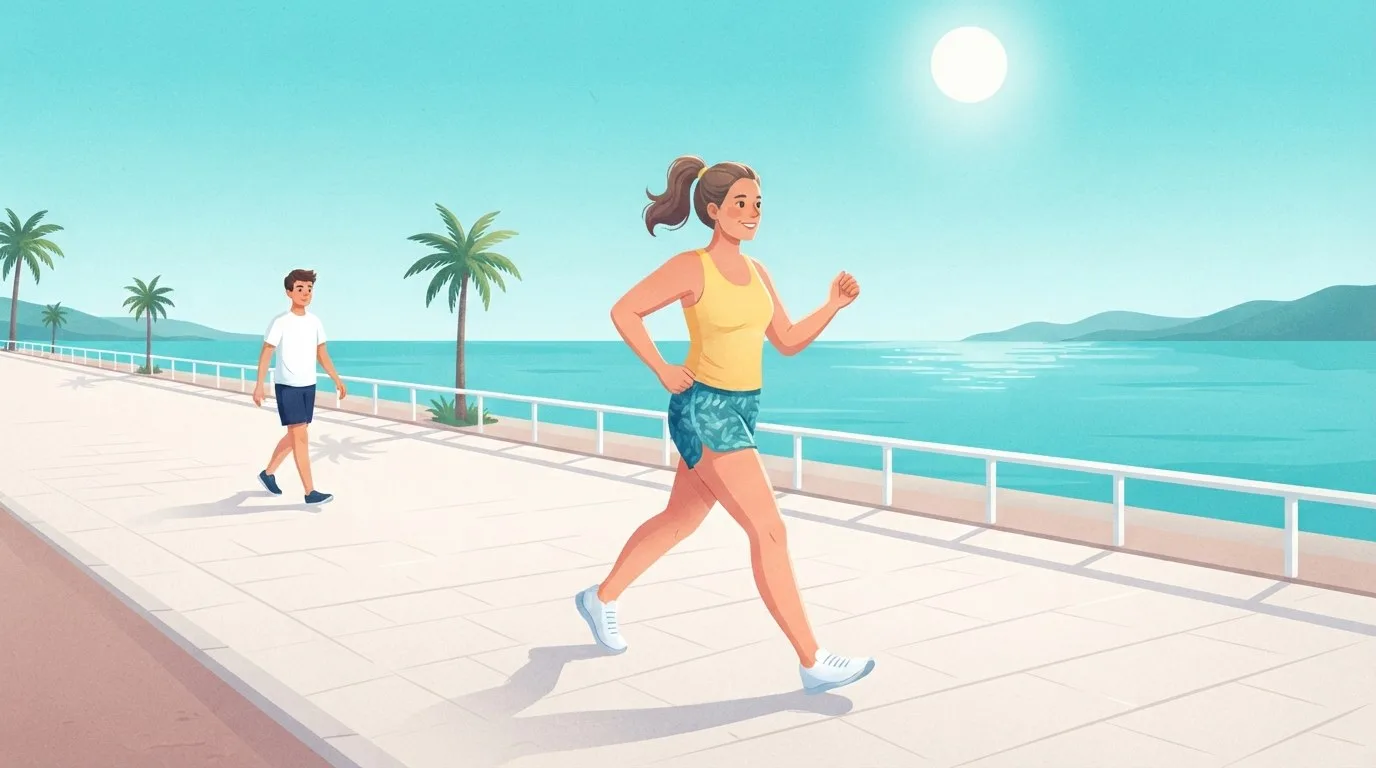
If you walk most days, you've probably wondered whether it's doing anything for your legs besides getting you places. Maybe you've added thousands of steps for months and your thighs look about the same. Or you've seen a lifelong walker with defined calves and wondered whether the walking did that or genetics did.
The answer depends on how you walk and where you're starting from. For someone who's been inactive, and for most people over 60, walking is a real training stimulus for the leg muscles. For a fit 30-year-old strolling on flat pavement, it's mostly cardio. This page goes through the studies that measured leg muscle in walkers, explains which kinds of walking work your legs harder, and covers what else toned thighs need.
What "Toned Legs" Actually Means
To a physiologist, muscle tone is the slight tension a relaxed muscle holds at rest. In everyday speech, toned legs means visible muscle shape with a thin enough layer of fat over it that the shape shows through. That gives walking two possible jobs: build some muscle, and help lose some fat. It does the second more reliably than the first. Our explainer on whether toned is a real thing covers the language and the myths around it, so this page sticks to what walking does for each half.
Which Leg Muscles Does Walking Work?
Every step uses the same chain of muscles. Your glutes and hamstrings pull the leg back under you. Your quadriceps, the front thigh muscles, steady the knee as your weight lands. Your calves push you off from the ball of the foot, and the muscle along the front of your shin lifts your toes clear for the next step.
On flat ground at an ordinary pace, none of them works close to its limit. That's what makes walking easy to repeat every day, and it's also why walking trains endurance far more than size. A muscle grows when it's pushed hard relative to its strength, and a stroll is gentle for most healthy legs. The weaker your legs are to begin with, the harder each step is in relative terms, which is why the walking studies that found muscle changes were done in older adults.
What the Studies Found About Walking and Leg Muscle
Three weeks of easy walking: no muscle growth
When researchers have used ordinary walking as a comparison group in short trials, it hasn't changed leg muscle size. Abe and colleagues (2006) had nine men walk slowly on a treadmill twice a day, six days a week, for three weeks. MRI showed no change in their thigh muscle. A second group did the same walking with pressure cuffs restricting blood flow from the legs and gained 4 to 7 percent in thigh muscle size, which shows the stimulus mattered more than the walking itself. Our review of whether running builds muscle covers that trial and a similar one in older adults in detail.
Six months of walking in older adults: thicker hamstrings and shins
Longer trials in older people tell a different story. Kubo and colleagues (2008) put 35 older adults through six months of walking training and compared them with 10 who didn't train. Measured by ultrasound, the hamstrings and the shin muscle got significantly thicker, and the hamstrings, shin and calf muscles all got stronger. The quadriceps were the exception: a few of the eight measuring sites thickened, but the front thigh as a whole didn't change much, and neither did its strength. Nothing changed in the group that didn't walk.
Interval walking: stronger thighs in five months
The strongest walking result comes from changing the pace. In the trial by Nemoto and colleagues (2007), 60 men and 186 women with an average age of 63 were split into three groups for five months: no training, steady walking at about half their aerobic capacity for 8,000 or more steps a day, and interval walking. The interval group repeated at least five rounds of 3 minutes of slow walking and 3 minutes of fast walking, four or more days a week. Their knee extension strength (the front thigh) rose 13 percent and knee flexion strength (the back thigh) rose 17 percent. Both gains were significantly bigger than in the steady walkers. The method is now popular as Japanese walking, and our look at the Japanese walking method covers how to set up your first session.
What the reviews conclude
Ozaki and colleagues (2013) reviewed whether walking and jogging can grow leg muscle in older adults. Older people who spend more of their day in at least moderate activity have bigger, better-working leg muscles. Short training studies conflict, but walking, jogging or intermittent running for more than about six months can increase leg muscle size in older adults. Put the evidence together and the rule is simple: walking builds leg muscle when the walking is hard for the legs doing it. That's why the clearest gains show up in older or less active people, and in brisk, interval and uphill walking.
How to Make Walking Work Your Legs Harder
How fast is considered brisk walking?
About 100 steps a minute or more. In the CADENCE-Adults study, Tudor-Locke and colleagues (2019) found that about 100 steps a minute marks moderate intensity in adults aged 21 to 40, and about 130 marks vigorous intensity, which is close to 4 mph. Count your steps for 15 seconds and multiply by four. If you're under 100, you're strolling. For your legs, the fast stretches of an interval walk should feel hard enough that talking gets choppy. In the Nemoto trial they were set above 70 percent of each person's peak walking capacity.
Walk uphill
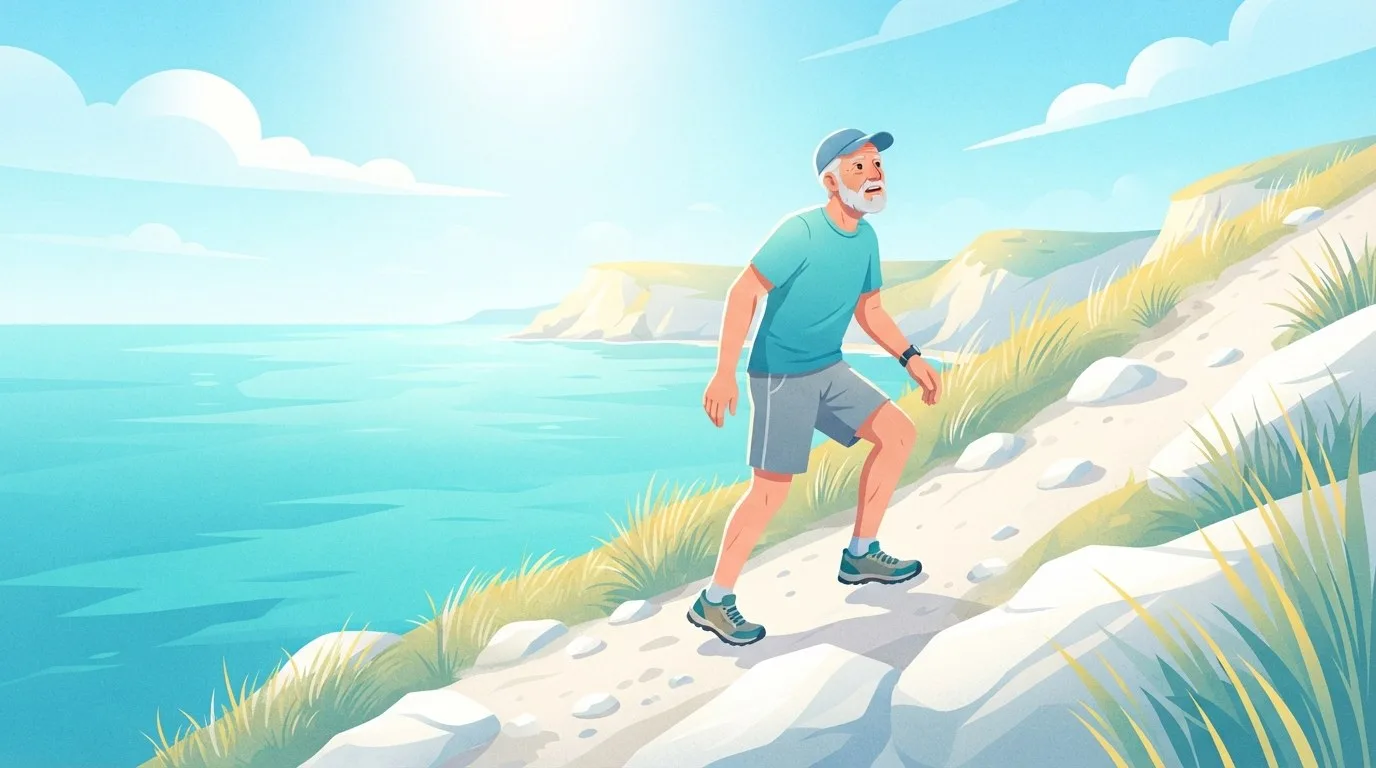
Hills change which muscles do the work more than any other tweak. Franz and Kram (2012) recorded leg muscle activity in 10 young adults walking on a treadmill at different slopes and speeds. Compared with level walking, walking up a 9-degree slope raised hamstring activity by 635 percent and glute activity by 345 percent. The inner quadriceps rose by 366 percent and the calves by 136 to 175 percent. The jumps got bigger at faster speeds. A 9-degree slope is about a 16 percent grade, steeper than many treadmills go, but even moderate hills move the work toward your hips and thighs. Walking downhill shifts more of the work to the front thighs, which brake every step. Our incline walking research review covers grades, calories and how to build up.
Does walking tone your butt?
Only modestly on flat ground, where the glutes mostly steady your pelvis. They take over a much bigger share of the work on hills and stairs, which is the 345 percent jump in the slope study above. If firmer glutes are the goal, put your walks on hilly routes or a treadmill incline, take the stairs when you can, and add glute bridges to your strength days. The incline review linked above goes further into whether walking builds glutes.
Add load, carefully
Carrying weight makes every step heavier for your legs. A weighted vest is the usual way to do it, and it suits people who already walk comfortably for 30 minutes or more. Start light and build up slowly. Our guide to weighted vest walking covers how much weight to start with and who should skip it.
Knowing what to do is the easy part.
FitCraft, our mobile fitness app, pairs you with an AI coach who builds you a personalized plan around your goals, schedule, and fitness level. Every FitCraft program is designed by Domenic Angelino, MPH (Brown University) and NSCA-CSCS, with research published in the Journal of Strength and Conditioning Research and Medicine & Science in Sports & Exercise.
Take the Free Assessment Free • 2 minutes • No credit cardWill My Thighs Get Thinner From Walking?
A little, if walking lowers your overall body fat, but your thighs don't get first claim on the fat you lose. In a meta-analysis of 24 randomized controlled trials, Murphy and colleagues (2007) found that regular brisk walking lowered body weight, BMI and body fat percentage in previously inactive adults. Where that fat comes from is up to your body.
Working a muscle doesn't burn the fat over it. Ramirez-Campillo and colleagues (2013) had 11 young adults train one leg only, with 960 to 1,200 light leg presses three times a week for 12 weeks. Fat mass fell in their arms and trunk but not in the trained leg. Thigh fat also tends to be among the last stores to shrink, especially in women, and our guide on how to lose thigh fat explains why. If losing weight is part of your goal, our review of whether you can lose weight by walking covers the weekly walking dose the trials used.
Can Old Flabby Legs Be Toned?
Yes, and older legs often respond more to walking than younger ones do. Muscle loss with age is concentrated in the legs. In MRI scans of 468 adults aged 18 to 88, Janssen and colleagues (2000) found that a noticeable drop in muscle mass appeared by about age 50 and came mainly from the lower body. That loss is a big part of why legs look softer with age.
It's also reversible to a striking degree. In a classic study by Fiatarone and colleagues (1990), 10 frail nursing home residents with an average age of 90 did eight weeks of high-intensity leg strength training. The nine who finished more than doubled their strength, with gains averaging 174 percent. Their mid-thigh muscle area grew by 9 percent, and their heel-to-toe walking speed improved by 48 percent. Add the walking trials above, which found their clearest gains in people in their 60s and 70s, and the answer for older legs is a clear yes. Loose skin after large weight loss is a separate issue that muscle can only partly fill out.
How Long Does It Take for Walking to Tone Your Legs?
Expect months, not weeks. The walking trials that found changes ran for five months (Nemoto) and six months (Kubo), and the review by Ozaki's group put the window for muscle growth from walking at more than half a year. Strength usually shows up first: most people feel steadier on hills and stairs within a month or two of regular brisk or interval walking. Visible change takes longer, because it also depends on body fat coming down, and that happens slowly. Adding two strength sessions a week speeds up the muscle side, and that's the next section.
How to Tone Your Thighs and Legs: Add Two Strength Sessions
If you want toned thighs faster than walking can deliver, add resistance. The World Health Organization's 2020 guidelines, summarized by Bull and colleagues (2020), recommend muscle-strengthening work on at least two days a week alongside aerobic activity like walking. For the legs, that can be a 20-minute session at home with a pair of dumbbells or just your body weight:
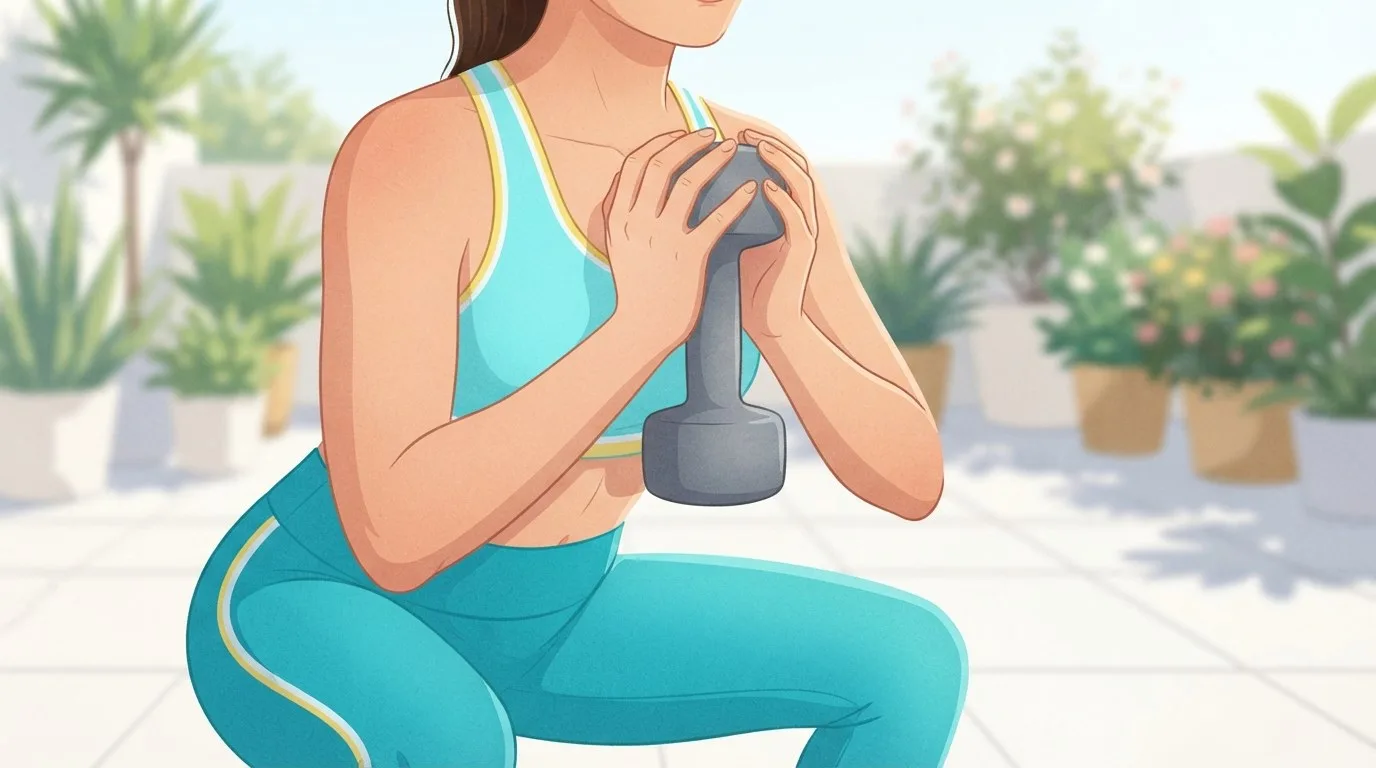
- Goblet squat. Hold one dumbbell at your chest and sit back and down between your heels. It works the front thighs and glutes, so it's the core of any front thigh workout.
- Reverse lunge. Step back, lower the back knee toward the floor, then drive up through the front foot. It trains each leg on its own and hits the glutes harder than a squat.
- Single-leg deadlift. Hold a dumbbell, hinge forward on one leg with a soft knee, and stand back up by squeezing the glute. This is the main move for the back of the thigh.
- Side lunge. Step wide to one side and sit back into that hip, keeping the other leg straight. It works the inner thighs, and our list of the best inner thigh exercises has more options for inner thigh toning.
- Glute bridge. Lie on your back with knees bent and drive your hips up. Hold a dumbbell across your hips once body weight gets easy.
- Calf raise. Rise onto the balls of your feet on a step and lower slowly below the step.
Do two or three sets of 8 to 15 reps of each, and pick a weight or variation that leaves the last two or three reps of each set hard. When 15 reps feel easy, add weight or slow the lowering phase. That progression is what walking can't supply on its own, and it's the quickest honest answer to how to tone your legs. If you'd like an app to lay the sessions out for you, our comparison of the best dumbbell workout apps looks at which ones teach form and which ones keep you coming back.
Is It Better to Walk for 1 Hour or Run for 30 Minutes?
For calories, it's close to a tie. The 2024 Adult Compendium of Physical Activities (Herrmann and colleagues) rates brisk walking at 3.5 to 3.9 mph at 4.8 METs and running at 6 mph at 9.3 METs. An hour of the walk adds up to 4.8 MET-hours and 30 minutes of the run to 4.65, so the energy cost is almost the same. Our comparison of walking vs running for weight loss covers the rest of that trade-off.
For your legs, running loads each step harder, but it doesn't reliably build muscle either. The Ozaki review notes that regular high-intensity distance running in young and middle-aged adults may not grow leg muscle, probably because the legs don't fully recover between hard runs. So pick the one you'll keep doing, and let the two strength sessions do the shaping. An hour of brisk walking is easier on the joints, and 30 minutes of running fits a tighter schedule.
Will running make my legs look better?
Running can firm up an untrained person's legs and helps lower body fat, but it's not a dependable muscle builder. Sprinters' legs come from sprinting and heavy strength work. If you enjoy running, keep it, and pair it with the strength routine above.
What This Means for You
Walking does tone your legs a little, and you can make it do a lot more. Walk briskly enough to pass 100 steps a minute, swap one walk a week for 3-minute fast and slow intervals, and put hills on your route. Then give your legs two short strength sessions a week, because that's where the visible shape comes from. Walking keeps the fat coming down, and the strength work builds what shows when it does.
The hard part is still doing the strength sessions in week six, when the walks feel automatic and the squats still feel like a chore. That's a consistency problem, and it gets solved by making the routine simple and a little rewarding rather than by trying harder. As Stacy, 41, put it: "After my second kid, I needed something stupidly simple." In FitCraft, 3D AI coaches demonstrate each dumbbell and bodyweight exercise so you can check your form, your coach calls you by name during workouts, and a streak gives you a reason to show up for the next session.
Frequently Asked Questions
Does walking tone your legs?
A little. Brisk, uphill and interval walking strengthen the calves, hamstrings and glutes, and in older adults they can add some muscle over five to six months. Easy walking on flat ground rarely builds enough muscle to change how legs look, so pair walking with two short strength sessions a week.
Will my thighs get thinner from walking?
Possibly, if walking lowers your overall body fat. Walking trials show modest drops in body weight and body fat in previously inactive adults, but the body decides where the fat comes from, and thigh fat is often among the last to go. Working your legs doesn't burn the fat on them specifically.
How fast is considered brisk walking?
About 100 steps a minute or more, which researchers use as the threshold for moderate intensity. Around 130 steps a minute, close to 4 mph, is vigorous. Count your steps for 15 seconds and multiply by four to check your pace.
What are the benefits of a daily walk?
In a meta-analysis of 24 randomized trials, regular brisk walking raised aerobic fitness and lowered body weight, body fat and diastolic blood pressure in previously inactive adults. Done briskly, in intervals or uphill, a daily walk also strengthens the leg muscles, especially in older adults.
Will running make my legs look better?
Running can firm up untrained legs and helps lower body fat, but it isn't a dependable way to build leg muscle, and regular hard distance running may not grow muscle at all. For more defined legs, pair running with two strength sessions a week.
Can old flabby legs be toned?
Yes. Leg muscle responds to training at any age. In one study, frail adults with an average age of 90 more than doubled their leg strength and grew their thigh muscle by 9 percent in eight weeks of strength training. Brisk and interval walking help older legs too.
Is it better to walk for 1 hour or run for 30 minutes?
They burn about the same energy: an hour of brisk walking at 3.5 to 3.9 mph is about 4.8 MET-hours and 30 minutes of running at 6 mph is about 4.65. Choose the one you'll stick with. Walking is easier on the joints, and running takes half the time.
Does walking tone your butt?
Only a little on flat ground. Walking uphill raises glute activity several times over, by 345 percent on a 9-degree slope in one study, so hills, stairs and treadmill inclines tone the glutes far better than level walking. Glute bridges on strength days add more.