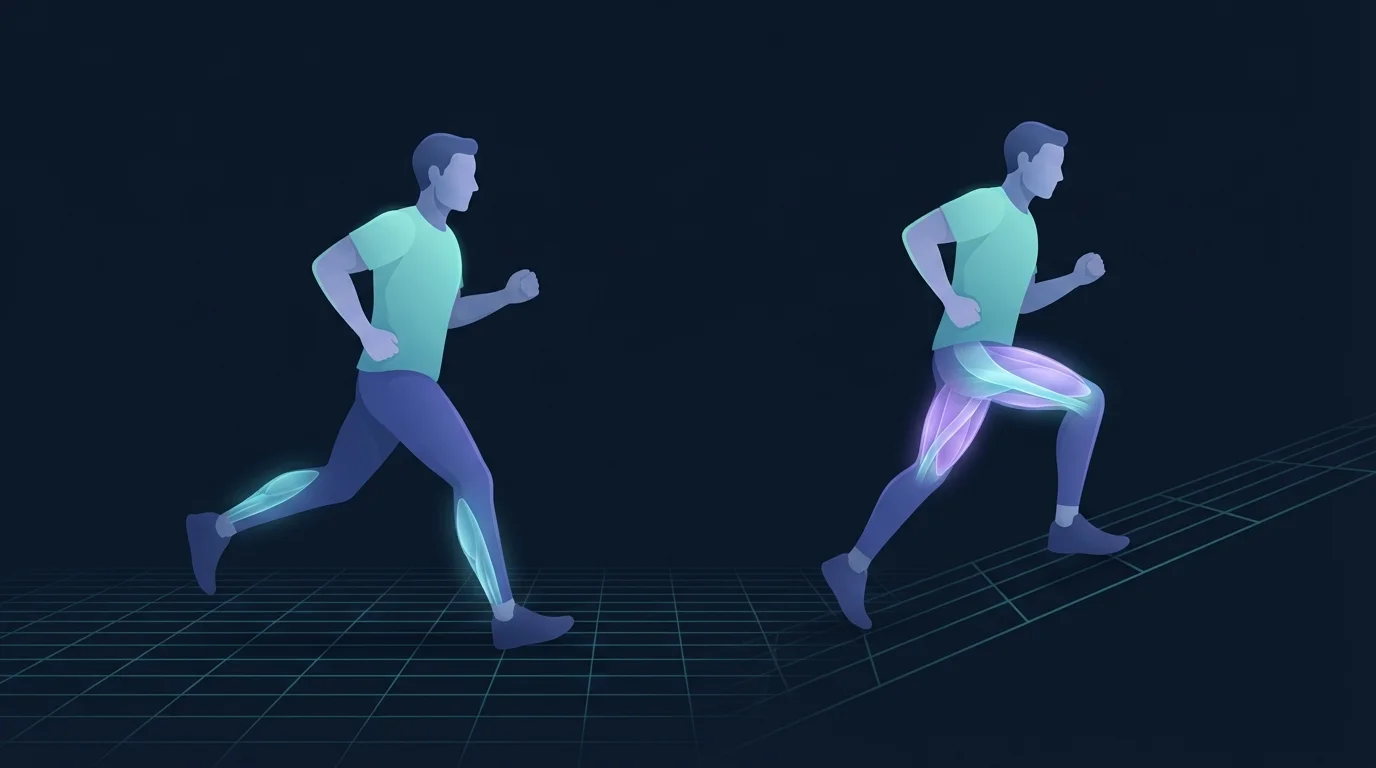
Distance runners are lean, and lean reads as muscular in photographs, which is most of why this question exists. Look at a track sprinter and the conclusion seems obvious. Look at a marathon field and it seems obvious in the opposite direction. Both groups run. Only one of them looks built.
The literature is unusually clear here because the running population has been biopsied more than almost any other athletic group. What the muscle tissue shows is that running does load leg muscle, but at a force per repetition low enough that the adaptation goes almost entirely into endurance machinery rather than contractile size, unless you change the gradient or the speed enough to change the mechanics.
What follows is the running-specific evidence: what happens to fibre size across a marathon block, how much hypertrophy aerobic training produces in people who start untrained, what downhill and uphill work do differently, whether walking counts, and why running specifically (not cardio in general) costs you gym gains. If you want the general "which non-lifting modalities grow muscle" picture, our review of whether Pilates builds muscle covers the shared principle in full: any modality builds muscle only to the extent it applies progressive mechanical tension, and endurance-biased, low-load, high-repetition work reliably builds endurance instead. This page does not repeat that argument. It applies it to running. Swimming gets the same treatment in does swimming build muscle.
The Research: What Running Does to Muscle Size
Grgic 2019: Aerobic Training Versus Resistance Training, Head to Head
The direct comparison comes from Grgic, McIlvenna, Fyfe, Sabol, Bishop, Schoenfeld and Pedisic (2019) in Sports Medicine. The team systematically reviewed 21 studies of good or moderate methodological quality and ran three separate meta-analyses: whole-muscle knee extensor size, type I fibre cross-sectional area, and type II fibre cross-sectional area.
- Whole muscle (knee extensors): Hedges g of 0.66 favouring resistance training (95% CI 0.41 to 0.90).
- Type I fibre area: Hedges g of 0.99 favouring resistance training (95% CI 0.44 to 1.54).
- Type II fibre area: Hedges g of 1.44 favouring resistance training (95% CI 0.93 to 1.95).
Note the ordering. The gap is smallest at the whole-muscle level and largest in the fast-twitch fibres, which is exactly what a mechanical-tension model predicts. Aerobic work recruits and adapts slow fibres well. It rarely produces the high-threshold recruitment that grows type II fibres, so the fibres with the most growth potential are the ones running touches least. The authors concluded that single-mode aerobic training does not promote the same skeletal muscle hypertrophy as resistance training.
Trappe 2006: Thirteen Weeks of Marathon Training Made Fibres Smaller
The most striking running-specific data is Trappe, Harber, Creer and colleagues (2006) in the Journal of Applied Physiology. Seven recreational runners had gastrocnemius biopsies taken before training, after 13 weeks of marathon preparation, and again after a 3-week taper. Single fibres were analysed for size, peak force, shortening velocity and power.
Fibre size declined by approximately 20 percent in both MHC I (slow) and MHC IIa (fast) fibres after the training block. Peak force per fibre was maintained despite the smaller cross-section, which means force per unit of cross-sectional area went up sharply. After the taper, that normalised force had risen more than 60 percent in both fibre types. Shortening velocity in the slow fibres increased 28 percent with training, and peak power rose in both fibre types.
Read that carefully, because it's the whole answer to this question in one dataset. High-volume running made the muscle smaller and substantially better. The adaptation was a quality improvement in the contractile apparatus and a reduction in the tissue being carried, which is precisely what you would engineer if the goal were moving a body over 42 kilometres. It is precisely the opposite of hypertrophy.
Konopka and Harber 2014: Aerobic Training Does Grow Muscle in Beginners
The counterweight is real and worth stating plainly. Konopka and Harber (2014) in Exercise and Sport Sciences Reviews assembled the evidence that aerobic exercise acutely and chronically alters muscle protein metabolism, challenging the older view that it does nothing for muscle size. Twelve weeks of aerobic training in previously untrained men produced roughly a 4 square centimetre increase in quadriceps cross-sectional area, alongside about a 22 percent rise in basal muscle protein synthesis over a 16-week window.
Two details decide how much weight to give that. First, the participants were previously untrained, which is the condition under which almost any loading produces adaptation. Second, the older men in that work (around 74 years) showed hypertrophy comparable to the young men despite completing less total work, suggesting greater anabolic sensitivity with age. That makes aerobic training a genuinely useful anti-atrophy tool for deconditioned and older populations, which is a different claim from "running builds muscle" for a 28-year-old who already lifts.

Bontemps 2022: Downhill Running Is a Hypertrophy Stimulus
The sharpest exception in the running literature is gradient. Bontemps, Gruet, Louis, Owens, Miric, Erskine and Vercruyssen (2022) in the European Journal of Applied Physiology put 12 healthy adults through 10 downhill running sessions across 4 weeks, at grades of minus 5, minus 10 and minus 15 percent, at 60 to 65 percent of VO2 max, with session duration progressing from 15 to 30 minutes.
| Measure (vastus lateralis / knee extensors) | Change after 2 weeks | Change after 4 weeks |
|---|---|---|
| Muscle volume | +2.5% | +6.6% |
| Anatomical cross-sectional area | +2.9% | +7.1% |
| Physiological cross-sectional area | not reported | +3.8% |
| Fascicle length | not reported | +2.7% |
| Pennation angle | not reported | +5.8% |
| Eccentric maximal voluntary torque | +8.6% | +15.2% |
| Isometric maximal voluntary torque | not reported | +9.7% |
A 6.6 percent increase in muscle volume in four weeks is a larger short-term hypertrophy response than most resistance-training trials of the same length report, and the authors explicitly noted that it resembles what high-intensity eccentric resistance training produces. The mechanism is not mysterious: running downhill forces the quadriceps to decelerate the body on every ground contact, which is a high-force eccentric contraction repeated hundreds of times per session.
The caveats are large. The sample was 12 people over 4 weeks, so this is a signal rather than a settled dose-response. Downhill running is also the single most reliable way to produce severe delayed-onset muscle soreness, and the first sessions in that protocol were deliberately short for exactly that reason. It is not a stimulus to add casually to an existing training week.
Callahan 2021: Sprint and Interval Work Sits in Between
Callahan, Parr, Hawley and Camera (2021) in Sports Medicine reviewed whether high-intensity interval work can promote skeletal muscle anabolism. Their framing is useful for runners: intervals at or above the speed that elicits maximal aerobic capacity place high tensile stress on muscle and partly resemble the demands of resistance exercise, but the evidence that this translates into meaningful hypertrophy is much thinner than the evidence for oxidative adaptation. Resistance training remains the reference standard for size.
The practical translation for runners is that a session of hill repeats loads the legs far more per stride than a steady run does, and the force is concentric rather than eccentric, so it costs less recovery than downhill work. Our hill sprints guide covers how to program them without wrecking the rest of the training week. Expect them to build power and stride force. Do not expect them to substitute for squatting.
Why Running Costs Gym Gains More Than Cycling Does
Running is the cardio modality with the strongest interference signal in the concurrent-training literature, and the reason connects directly to the Bontemps finding above. Wilson, Marin, Rhea and colleagues (2012) pooled 21 concurrent-training studies in the Journal of Strength and Conditioning Research and found that running impaired both strength and hypertrophy gains when combined with resistance training, while cycling did not produce statistically significant interference.
The modality difference is mechanical rather than metabolic. Cycling is concentric-dominant: the pedal never asks the quadriceps to absorb a landing, and swimming removes ground contact altogether. Running is eccentric-loaded at every ground contact, at roughly two to three times body weight, several hundred times per kilometre. That eccentric load is a genuine hypertrophy stimulus in isolation, which is the point of the downhill data, and it's also a genuine recovery cost that lands on exactly the muscles your leg day is trying to grow. The same mechanism produces both results.
Two consequences follow for anyone doing both. Distance matters more than duration, because eccentric loading scales with ground contacts rather than minutes, which makes a 40-minute run more costly to the legs than a 40-minute ride. And gradient matters in both directions: descending adds the most eccentric load, so hilly routes the day before a heavy squat session are the specific combination to avoid. We cover the full programming picture, including session spacing and the modern meta-analyses that have narrowed the effect, in the concurrent training and interference effect review and in does cardio kill your gains. If you want to keep the aerobic volume and lose most of the interference, cycling versus running lays out the trade.
Get an evidence-based plan built for you
FitCraft, our mobile fitness app, pairs you with an AI coach who builds you a personalized plan around your goals, schedule, and fitness level. Every FitCraft program is designed by Domenic Angelino, MPH (Brown University) and NSCA-CSCS, with research published in the Journal of Strength and Conditioning Research and Medicine & Science in Sports & Exercise.
Take the Free Assessment Free • 2 minutes • No credit cardDoes Walking Build Muscle?
Walking is the cleanest test case in this whole literature, because two well-designed trials used ordinary walking as the control condition and measured what it did to muscle with MRI. The answer in both was nothing.
Abe, Kearns and Sato (2006) in the Journal of Applied Physiology had nine men walk on a treadmill with blood flow restriction and nine walk without it. The protocol was five sets of 2-minute bouts at 50 metres per minute, twice a day, six days a week, for three weeks. Oxygen uptake averaged under 20 percent of maximum, so this was genuinely easy walking. The restricted group gained 4 to 7 percent in MRI-measured thigh muscle cross-sectional area and volume and 8 to 10 percent in dynamic and isometric strength. The unrestricted walking group showed no change in muscle size or strength at all.
Ozaki and colleagues (2011) in The Journals of Gerontology Series A ran the same design in older participants over a longer block: 20 minutes of treadmill walking at 45 percent of heart rate reserve, four days a week, for 10 weeks. The blood-flow-restriction group gained 3.7 percent in thigh muscle volume, 3.1 percent in cross-sectional area, 5.9 percent in maximal isometric strength and up to 22 percent in isokinetic strength. The plain walking group gained none of it.
Ten weeks, four sessions a week, in the population with the most room to improve, and ordinary walking moved no muscle-size outcome. That is about as direct an answer as exercise science gives. What changed the result was adding a mechanical variable, in this case restricted venous return raising local metabolic stress at a trivial external load.
The honest framing is that walking does other things extremely well. It's the largest single contributor to daily energy expenditure for most people, it improves cardiovascular and metabolic health, and it preserves function in populations at risk of losing it. It's also, for a deconditioned person, sometimes enough to produce small strength and function gains simply because their everyday loads sit close to their maximum. But it does not supply progressive mechanical tension, and tension is what grows muscle. If you want walking to do more, the levers are gradient, load and duration under load rather than more flat minutes. Our incline walking research covers the gradient version, and the how many miles should I walk a day guide covers the dose for the outcomes walking genuinely delivers.
Common Misconceptions
Misconception: "Sprinters are muscular, so sprinting builds muscle"
Elite sprinters lift heavily, and have done so for years, and are also selected for a body type that made them fast before they trained. The direction of causation in that photograph is not what it looks like. Sprint training does place far higher forces on muscle than distance running, and the Callahan 2021 review treats that tensile stress as genuinely resistance-like, but the controlled evidence that sprinting alone produces large hypertrophy is thin. The muscle in an Olympic 100 metre final is not primarily a running adaptation.
Misconception: "Running will make you lose all your muscle"
The Trappe fibre-size decline came from 13 weeks of marathon preparation, which is a very high dose at a very high proportion of available training time. Two or three moderate runs a week alongside resistance training is a different stimulus entirely, and the modern concurrent-training meta-analyses have narrowed the interference effect considerably from where the 1980s literature left it. The risk scales with running volume, running frequency, and how close the sessions sit to your lifting.
Misconception: "Running builds your glutes"
Flat running uses the glutes primarily for hip extension at moderate force and stabilisation against pelvic drop, both of which are endurance-quality demands. Uphill running raises the demand meaningfully. Neither matches the force or range of a loaded hip hinge or a split squat. If glute development is the goal, running is a supporting activity, not the primary tool.
Misconception: "If running doesn't build muscle, it's pointless for body composition"
Muscle size is one outcome. Running is excellent at several others: cardiorespiratory fitness, energy expenditure, bone loading through impact, and the kind of adherence that comes from an activity requiring no equipment and no booking. The reasonable conclusion is not to drop running. It's to stop expecting a hypertrophy result from it and to add two resistance sessions a week that actually deliver one.
What the Research Suggests Going Forward
The defensible summary is narrow. Running produces small leg hypertrophy in previously untrained and older adults, produces essentially none in people who already resistance train, and at high endurance volumes produces measurable fibre atrophy alongside large efficiency gains. Gradient is the variable that changes the answer: sustained downhill running is a legitimate eccentric hypertrophy stimulus with a recovery cost to match, and uphill work sits between the two.
Where the evidence needs work: the downhill running hypertrophy data rests on small, short trials, and nobody has established how much descending is useful before the damage cost outweighs the adaptation. Sprint-specific hypertrophy evidence in humans is thin relative to how confidently the internet asserts it. And almost all of the fibre-level running data comes from young recreational male runners, so the fibre response in women and in masters runners is largely extrapolated rather than measured.
For a reader deciding how to spend a training week: keep running for what it's good at, and add resistance training for what it isn't. Two sessions a week covering the major movement patterns is enough to change the muscle outcome, and putting them on different days from your longest or hilliest runs removes most of the interference cost. If you want that structure built for you rather than assembled from meta-analyses, our roundup of the best strength training apps covers the options honestly, including where other apps beat us.
References
- Grgic J, McIlvenna LC, Fyfe JJ, Sabol F, Bishop DJ, Schoenfeld BJ, Pedisic Z. "Does Aerobic Training Promote the Same Skeletal Muscle Hypertrophy as Resistance Training? A Systematic Review and Meta-Analysis." Sports Medicine 49.2 (2019): 233-254. doi:10.1007/s40279-018-1008-z
- Trappe S, Harber M, Creer A, Gallagher P, Slivka D, Minchev K, Whitsett D. "Single muscle fiber adaptations with marathon training." Journal of Applied Physiology 101.3 (2006): 721-727. doi:10.1152/japplphysiol.01595.2005
- Konopka AR, Harber MP. "Skeletal muscle hypertrophy after aerobic exercise training." Exercise and Sport Sciences Reviews 42.2 (2014): 53-61. doi:10.1249/JES.0000000000000007
- Bontemps B, Gruet M, Louis J, Owens DJ, Miric S, Erskine RM, Vercruyssen F. "The time course of different neuromuscular adaptations to short-term downhill running training and their specific relationships with strength gains." European Journal of Applied Physiology 122.4 (2022): 1071-1084. doi:10.1007/s00421-022-04898-3
- Callahan MJ, Parr EB, Hawley JA, Camera DM. "Can High-Intensity Interval Training Promote Skeletal Muscle Anabolism?" Sports Medicine 51.3 (2021): 405-421. doi:10.1007/s40279-020-01397-3
- Abe T, Kearns CF, Sato Y. "Muscle size and strength are increased following walk training with restricted venous blood flow from the leg muscle, Kaatsu-walk training." Journal of Applied Physiology 100.5 (2006): 1460-1466. doi:10.1152/japplphysiol.01267.2005
- Ozaki H, Sakamaki M, Yasuda T, Fujita S, Ogasawara R, Sugaya M, Nakajima T, Abe T. "Increases in thigh muscle volume and strength by walk training with leg blood flow reduction in older participants." The Journals of Gerontology Series A 66A.3 (2011): 257-263. doi:10.1093/gerona/glq182
- Wilson JM, Marin PJ, Rhea MR, Wilson SM, Loenneke JP, Anderson JC. "Concurrent Training: A Meta-Analysis Examining Interference of Aerobic and Resistance Exercises." Journal of Strength and Conditioning Research 26.8 (2012): 2293-2307. doi:10.1519/JSC.0b013e31823a3e2d
Frequently Asked Questions
Does running build muscle?
Running builds a small amount of leg muscle in people who were previously untrained, and almost none in people who already train. The gradient decides most of it. Grgic et al. (2019) pooled 21 studies in Sports Medicine and found resistance training produced substantially more knee-extensor hypertrophy than aerobic training, with a Hedges g of 0.66 at the whole-muscle level and 1.44 for type II fibre area. At the other extreme, Trappe et al. (2006) biopsied recreational runners before and after 13 weeks of marathon training and found gastrocnemius fibre size fell by roughly 20 percent in both fibre types. Running is a cardiovascular tool that produces modest early leg hypertrophy in beginners and net fibre atrophy at high endurance volumes.
Does walking build muscle?
Ordinary walking does not measurably build muscle in healthy adults, and the cleanest evidence comes from the trials that used walking as the control condition. Ozaki et al. (2011) had older adults walk on a treadmill at 45 percent of heart rate reserve for 20 minutes, four days a week for 10 weeks. The blood-flow-restriction group gained 3.7 percent thigh muscle volume and 5.9 percent isometric strength. The plain walking group gained neither. Abe et al. (2006) found the same split in young men over 3 weeks. Walking maintains muscle, improves cardiovascular health and burns energy, all of which matter. It does not supply the mechanical tension that drives growth unless you add load, gradient or restriction.
Can walking build muscle in deconditioned or older adults?
In someone starting from a very low baseline, walking can produce small strength and function gains, because a low starting point means everyday loads are a meaningful percentage of maximum. Even there, the muscle-size evidence is weak. In Ozaki et al. (2011), older adults walking four days a week for 10 weeks showed no increase in thigh muscle volume without added blood flow restriction. The practical implication for anyone worried about age-related muscle loss is that walking is the wrong tool on its own. Adding a gradient, a weighted vest, or two short resistance sessions a week is what changes the muscle outcome.
Does swimming build muscle?
Swimming has less direct hypertrophy evidence behind it than running does, but the same framework answers it. The stroke loads the lats, shoulders and upper back far more than running loads anything above the waist, so a previously untrained swimmer can pick up a small amount of upper-body size early, consistent with what Konopka and Harber (2014) documented for aerobic training in general. What swimming cannot do is progress the load. Water resistance scales with how fast you move through it rather than with a weight you choose, so the stimulus stays high-repetition and submaximal, which is the profile Grgic et al. (2019) found falls well short of resistance training, most of all in type II fibre area. Swimming does have one advantage over running for anyone who also lifts: with no eccentric ground contact it carries much less of the recovery cost that Wilson et al. (2012) traced specifically to running.
Why does running build calves but not quads?
The calves absorb and return the most elastic energy per stride, so they take the highest relative mechanical load in flat running, which is why runners often have visibly developed lower legs. That development is mostly a lean, low-body-fat presentation of a muscle doing high-frequency low-load work rather than large fibre hypertrophy. Trappe et al. (2006) measured gastrocnemius fibres directly across 13 weeks of marathon training and found them roughly 20 percent smaller, while force per unit of cross-sectional area rose more than 60 percent after the taper. The muscle got better at its job by becoming more efficient, not bigger.
Do hill sprints or downhill running build more muscle than flat running?
Yes, and downhill running has the clearest evidence. Bontemps et al. (2022) in the European Journal of Applied Physiology put 12 adults through 10 downhill running sessions over 4 weeks at grades of minus 5 to minus 15 percent. Vastus lateralis volume rose 6.6 percent, anatomical cross-sectional area rose 7.1 percent, and eccentric knee-extensor torque rose 15.2 percent, which the authors noted resembles what high-intensity eccentric resistance training produces. Uphill sprinting raises force per stride and is the most resistance-like form of running, though the direct hypertrophy evidence for sprint work is thinner. Both are far more demanding to recover from than equivalent flat running.
Does running make it harder to build muscle in the gym?
Running is the cardio modality with the strongest interference signal in the concurrent-training literature. Wilson et al. (2012) pooled 21 studies in the Journal of Strength and Conditioning Research and found running impaired both strength and hypertrophy gains when combined with resistance training, while cycling did not produce statistically significant interference. The most likely explanation is the eccentric load of ground contact, the same load that makes downhill running a hypertrophy stimulus in its own right. It creates a recovery cost that lands on the same muscles you are trying to grow. Swapping running for cycling on lifting days, or separating the sessions, removes most of the problem. Our interference effect review covers the spacing rules.