
Walk past any competitive pool and the answer looks settled. The people climbing out have wide backs, square shoulders and arms that clearly do something for a living. Then you meet the person who has swum three mornings a week for five years and looks precisely the way they looked in 2021, and the settled answer stops looking settled.
This question matters more than most training trivia because swimming is what people fall back on when everything else hurts. Bad knees. A disc that objects to running. A hip replacement. Pregnancy. Forty extra pounds and a doctor who said start with something low impact. If swimming builds muscle, it is close to a complete program for a lot of those people. If it does not, they deserve to know before they spend two years finding out on their own.
So here is the evidence in order: what water can actually load and what it structurally cannot, what happened to lean mass in the trials that measured it, which muscles each stroke works, why the swimmer's physique is partly a selection story, and what to add if you want both the water and the muscle.
Water Pushes Back Harder the Faster You Go, and That Is the Problem
Muscle grows when a fiber is repeatedly exposed to high mechanical tension, close enough to its limit that the body treats its current size as inadequate for the job. That's the whole mechanism, and it does not care what the load is made of: a dumbbell, a band, your own body weight, or a wall of water. What matters is how much tension the fiber sees and whether that tension keeps climbing over weeks. Our research review of whether Pilates builds muscle works through the identical question for a different low-load modality, and the answer there has the same shape as the answer here. Running, the modality with the largest interference literature, gets its own review in does running build muscle.
Water is an unusual load because the resistance it offers isn't fixed. Drag rises with roughly the square of velocity, so a hand moving twice as fast meets around four times the force. That's genuinely useful, up to a point. It means a sprint set is meaningfully harder than an easy lap, and it means the water auto-scales to whatever effort you put in. It's why aquatic resistance work gets prescribed in rehab settings where a barbell would be reckless.
It also hides the trap. A load that scales to your effort is a load you can never progressively overload in the way muscle growth requires. With a dumbbell you add weight and the tension goes up even though the movement stays the same. In water there's no dial. The only way to increase force is to move faster, and you can only move so fast before your stroke rate becomes the limit rather than your muscles. Worse, the thing that makes you a better swimmer shrinks the stimulus. An efficient stroke moves more water with less muscular cost. Six months in, you're faster and the water is loading you less than it did in month one.
Then there's the half of the rep that never happens. A swim stroke is almost entirely concentric: you pull, you recover the arm through air or with the palm turned to slice, and you pull again. There is no controlled lowering under load, because water offers nothing to lower against. That matters. Roig and colleagues (2009) in the British Journal of Sports Medicine pooled 20 randomized trials on eccentric versus concentric training and found that when eccentric work was performed at higher intensities, total strength and eccentric strength rose significantly more than with concentric work alone. The lengthening phase is a meaningful share of the growth signal, and swimming does not have one.
What Actually Happened to Lean Mass in the Swim Trials
None of that means zero. It means bounded. The cleanest read comes from Lahart and Metsios (2018) in Sports Medicine, who screened 6,712 records and pooled 29 eligible trials of pool swim training in non-elite participants. Against control groups, swimming produced a mean lean mass increase of 1.96 kg (95% CI 0.21 to 3.71) and a mean body fat reduction of 1.92%. Roughly four and a half pounds of lean tissue, in people who were mostly sedentary when they started, from swimming and nothing else.
That fits the broader aerobic-hypertrophy picture. Konopka and Harber (2014) in Exercise and Sport Sciences Reviews assembled the evidence that aerobic training does grow muscle, on the order of 5 to 15%, and were specific about who it happens to: previously untrained and older adults, where any repeated loading is new information for tissue that has been getting none. The same 45 minutes given to a trained lifter does approximately nothing, because their fibers already see far more tension three times a week.
Put swimming directly against a barbell and the gap is unambiguous. Grgic, McIlvenna, Fyfe and colleagues (2019) pooled 21 studies in Sports Medicine comparing aerobic with resistance training on muscle size. Resistance training won at every level of measurement: whole-muscle cross-sectional area (Hedges' g = 0.66), type I fiber area (g = 0.99), and type II fiber area (g = 1.44). That last number is the one that matters for how a body looks. Type II fibers are the fast, high-force ones that carry most of the visible size, they respond best to near-maximal contractions, and a swim stroke never asks for one. Our review of whether light weights build muscle covers the load threshold question in more detail, and the honest summary is that light loads work when they are taken close to failure. A swim set does not get close to failure in the way a set of 25 with a light dumbbell does.
So here is the practical shape of the answer: if you have not trained in years, expect a genuine and visible change in your first few months of swimming. If you have been lifting for two years, expect swimming to preserve what you have and add nothing.
Which Muscles Each Stroke Actually Works
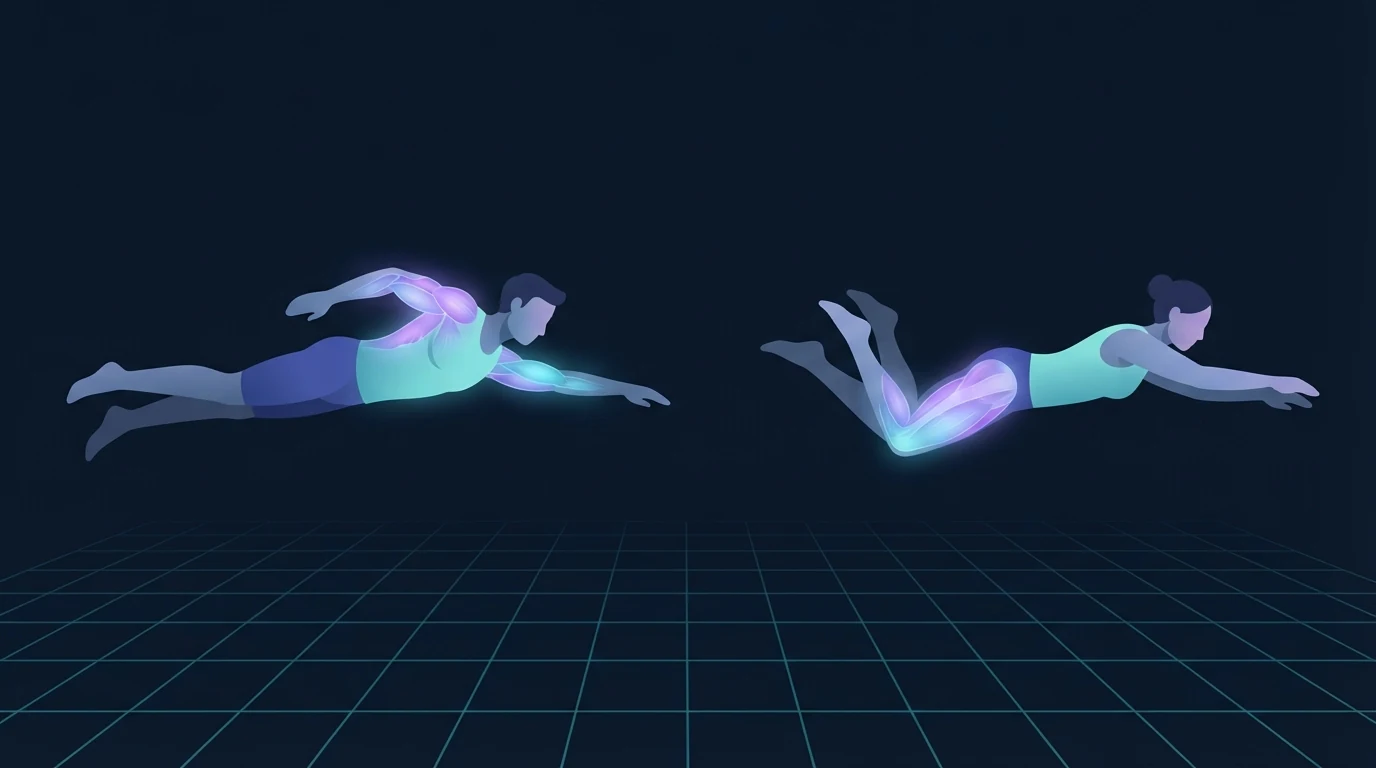
Martens, Figueiredo and Daly (2015) in the Journal of Electromyography and Kinesiology ran the systematic review of surface EMG across all four competitive strokes. The through-line: swimming is an upper-body pulling sport with a leg component that varies enormously by stroke, and that the latissimus dorsi and pectoralis major carry the propulsive phase in every one of them.
Freestyle
Lats and pecs drive the pull, triceps finish the push past the hip, and the deltoids handle the recovery over the water. The quieter finding is in the shoulder blade. Pink, Perry, Browne and colleagues (1991) in the American Journal of Sports Medicine put fine-wire electrodes into twelve shoulder muscles of pain-free competitive swimmers and found serratus anterior and subscapularis active through almost the entire stroke cycle rather than in bursts. Those are stabilisers, and they are working continuously at a moderate level for however long the session lasts. That is an endurance stimulus, not a size one, but it is a large part of why swimmers have unusually resilient shoulders until they overdo the volume.
Backstroke
Same pulling machinery from the other side. Lats and pecs still dominate, with more posterior deltoid and more demand on the external rotators of the shoulder because of the arm's position overhead at catch. The core works constantly to hold body-roll and prevent the hips from sinking.
Breaststroke
The one stroke where the legs genuinely produce the propulsion. The kick loads adductors, glutes and quadriceps in a pattern nothing on land quite reproduces, which is why breaststrokers have visibly different legs from freestyle specialists. The arm pull is shorter and higher, so it works pecs and lats over a smaller range.
Butterfly
The highest whole-body demand and the shortest useful sets. Lats, pecs and triceps fire near-simultaneously in a double-arm pull, and the dolphin kick recruits the whole posterior chain from the calves up through the spinal erectors. It's also the stroke most likely to hurt you if your thoracic spine and shoulders are not ready for it, so it belongs at the end of a training history, not the start.
In freestyle and backstroke the kick contributes far less propulsion than most swimmers assume. Its main job is holding the body flat and high so the arms have something rigid to pull against. That is part of why a swimmer's legs rarely change much while their back changes a lot.
The Swimmer's Body Is Mostly Selection, Not Adaptation
The strongest visual argument for swimming as a muscle builder is the elite swimmer's silhouette: long torso, broad shoulders, narrow hips, a back that tapers to a V. It's also the weakest one, because the sport chose those people at least as much as the training shaped them.
Pan, Zhu, Qiu and Cai (2023) in PeerJ measured 254 freestyle swimmers, 89 of them elite and 165 not, and built a discriminant model from body dimensions alone. Twelve anthropometric variables separated elite from non-elite with an area under the curve of 0.926, which is a very good classifier for something that involves no performance data at all. The variables that mattered were torso length, a small head circumference, and low waist-to-chest and waist-to-hip ratios: a streamlined shape that costs less drag at any given speed.
Read that honestly in both directions. Skeletal muscle mass was also one of the discriminating variables, and some of that is training. But torso length and head circumference are not trainable, and they sorted elite from non-elite almost as well as anything else in the model. A sport that rewards long levers and a low drag coefficient will fill its top ranks with people who already had them. What you're looking at on the pool deck is a shape that was selected, then trained, and the training is the smaller half.
Knowing what to do is the easy part.
FitCraft, our mobile fitness app, pairs you with an AI coach who builds you a personalized plan around your goals, schedule, and fitness level. Every FitCraft program is designed by Domenic Angelino, MPH (Brown University) and NSCA-CSCS, with research published in the Journal of Strength and Conditioning Research and Medicine & Science in Sports & Exercise.
Take the Free Assessment Free • 2 minutes • No credit cardWhy Competitive Swimmers Lift on Land
If swimming built all the muscle a swimmer needed, nobody would spend their afternoons doing pull-ups and med-ball work. Every serious program has a dryland component, and it exists because the pool does not supply what it supplies.
The classic trial here is instructive in an awkward way. Tanaka, Costill, Thomas and colleagues (1993) in Medicine and Science in Sports and Exercise took 24 intercollegiate male swimmers through a 14-week season. Both groups swam together six days a week; one also did eight weeks of resistance training three days a week. The resistance group increased the loads they could handle by 25 to 35%, which is a large, real strength gain. Their swimming performance and swim power were no different from the group that only swam.
That result usually gets quoted as evidence against dryland training, and for pure sprint transfer it is. But read it the other way and it tells you something about our question. Six days a week of high-volume swimming left those athletes with 25 to 35% of headroom on land-based strength. The pool had not been building it. If elite swimmers doing more swimming than you will ever do still have that much room on a strength test, the water is not going to take a recreational swimmer to a strength ceiling either.
Modern programs still run dryland for shoulder durability, trunk stiffness and land-based power, they just stopped expecting it to buy tenths off a 100m time on its own.
Swimming for Weight Loss Has an Odd Track Record
Swimming's reputation for fat loss is worse than its evidence, and both are worth knowing. The source of the reputation is Gwinup's 1987 trial in the American Journal of Sports Medicine, which had mildly to moderately obese women progress to 60 minutes a day of walking, stationary cycling or lap swimming without changing their diets. Over six months the walkers lost about 17 lb, the cyclists about 19 lb, and the swimmers gained about 5 lb. That single result has been repeated in fitness writing for nearly forty years.
It deserves caveats. The study was small, was not randomized, and predates almost everything we now know about compensation. The pooled modern picture is kinder: the 29 trials in Lahart and Metsios (2018) showed swim training cut body fat by 1.92% against controls, which is a normal exercise-sized effect.
The popular explanation for the Gwinup result, that cold water makes you ravenous afterwards, does not survive testing. King, Wasse and Stensel (2011) in the Journal of Obesity had 14 men either swim for 60 minutes or rest, then measured appetite every 30 minutes and acylated ghrelin at seven timepoints across the following six hours, with buffet meals to measure actual intake. Ghrelin was suppressed during the swim, and food intake afterwards was statistically no different between the swimming and resting trials (9,749 kJ versus 9,161 kJ). Swimming did not make them eat more.
The likelier explanations are duller. Swimming is non-weight-bearing, so an hour of it costs a heavy person far fewer calories than an hour of carrying that same body up a hill. And swimming is skill-limited, so beginners spend a lot of their pool time resting at the wall. If fat loss is the goal, our guide to low-impact cardio at home covers the options that avoid both problems without needing a pool.
How to Make Swimming Build More Muscle
You cannot turn a pool into a weight room, but you can bias it toward force. Four things move the needle:
- Sprint sets over steady laps. Since drag rises with the square of hand speed, a 25m all-out effort loads the pulling muscles far harder than 25m of cruising. Short distances with long rest is the format: think 8 to 12 efforts of 25m with a full minute between them, not a continuous 400.
- Hand paddles and a pull buoy. Paddles increase the surface area your hand drags through the water, which raises force at the same stroke speed. The buoy takes the legs out so the arms carry the whole load. Build into these slowly. They are also the fastest route to a shoulder problem if your volume jumps.
- Vertical kicking. Treading water in a streamlined vertical position with the arms held out of the water turns the kick into a continuous, unrelieved effort. It's the closest thing swimming has to a set taken near failure.
- Two short land sessions a week. This is the one that actually changes the answer. Pushing movements, a hinge, a squat pattern and a carry, with dumbbells or just body weight, covers everything the pool structurally cannot: eccentric loading, near-maximal contractions, and bone-loading through the legs and spine. If you want that half programd rather than improvised, our roundup of the best strength training apps compares the ones built for it.
Note what is missing from that list: swimming more. Volume is what makes you a better swimmer, and a better swimmer pays less per stroke. More laps is the one change that reliably reduces the per-stroke muscular demand.
What This Means for You
If you're coming off years of not training, swimming is a genuinely good first move and you will see some of what you came for. Broader upper back, more shape through the shoulders and triceps, less body fat, and a cardiovascular base built without a single impact through a sore knee. The 1.96 kg of lean mass in the pooled trials is the kind of change that shows up in a mirror.
Then plan for the plateau, because it is coming and it is not your fault. Around the point where your stroke starts to feel smooth, the water stops being a meaningful load and becomes transport. That's the moment to add the two land sessions rather than the moment to swim an extra day. People who make that switch keep both things: the joints stay happy and the muscle keeps arriving. People who skip it usually conclude, six months later, that they have plateaued at a level they are not thrilled with, and they're right. If you're worried about the opposite problem, that the cardio is eating your gains, our post on whether cardio burns muscle covers that anxiety directly, and the short version is that it mostly does not.

Frequently Asked Questions
Does swimming build muscle?
Yes, in people who are not already strength training. Lahart and Metsios (2018) pooled 29 swim-training trials in non-elite swimmers and found lean mass rose by an average of 1.96 kg (about 4.3 lb) against controls, with body fat down 1.92%. The gains land mostly in the upper back, shoulders and arms, and they arrive early then flatten. If you already lift, swimming will not add much size on top of that: pooled across 21 studies, resistance training beat aerobic training for whole-muscle growth with a Hedges' g of 0.66 (Grgic et al., 2019).
Which muscles does swimming work the most?
The pulling muscles of the upper body. Across the four competitive strokes, the systematic EMG review by Martens, Figueiredo and Daly (2015) found latissimus dorsi and pectoralis major carry the propulsive phase in every stroke, with triceps finishing the push. Pink and colleagues (1991) recorded serratus anterior and subscapularis firing through nearly the entire freestyle cycle, which is why swimmers develop unusually durable shoulder blades. The legs work hardest in breaststroke; in freestyle and backstroke the kick mostly holds body position rather than driving you forward.
Is swimming good for weight loss?
It works, but it has a worse track record than walking or cycling for the same time commitment. In Gwinup's 1987 trial, women who walked lost about 17 lb and women who cycled lost about 19 lb over six months, while the swimming group gained about 5 lb. That study was small and not randomized, and the pooled modern evidence is friendlier: Lahart and Metsios (2018) found swim training cut body fat by 1.92% against controls. The old rebound-hunger explanation does not hold up either. King, Wasse and Stensel (2011) found 60 minutes of swimming suppressed acylated ghrelin during the swim and did not increase food intake for the rest of the day.
Does walking build muscle?
Barely, and only in people starting from very low fitness. Konopka and Harber (2014) reviewed the aerobic hypertrophy literature and reported muscle growth in the range of 5 to 15% from aerobic training, concentrated in previously sedentary and older adults where any loading is new loading. Walking sits at the bottom of that range because the load is your own body weight at a speed you can sustain for an hour. It maintains leg muscle, it does not build it. Swimming outperforms walking here because the arms are doing genuine work against a resistance your legs never meet on a footpath.
How long does it take to see muscle from swimming?
Most of the swim-training trials in the Lahart and Metsios (2018) pool ran 8 to 12 weeks, and that is roughly when visible change shows up in someone who has not been training: broader upper back, more definition across the shoulders and triceps. The curve is steep at first and flat after. Once your stroke is efficient you are moving faster for the same muscular effort, which means the water is loading you less, not more. That plateau usually arrives somewhere in the first six months.
Is swimming better than lifting weights for building muscle?
No, and the gap is widest exactly where people want it to be smallest. Grgic and colleagues (2019) pooled 21 studies and found resistance training produced larger whole-muscle growth than aerobic training (Hedges' g = 0.66), larger type I fiber growth (g = 0.99) and much larger type II fiber growth (g = 1.44). Type II fibers are the fast, high-force ones that carry most of the size a person is looking for. Swimming is a poor stimulus for them because the stroke never asks for a maximal contraction.
Can swimming replace strength training?
For cardiovascular fitness, endurance and joint-friendly conditioning, yes. For muscle and bone, no. Swimming is non-weight-bearing, which is exactly why it is prescribed for painful knees and hips, and also why it does not load the skeleton the way a squat or a carry does. Competitive swimmers train on land for this reason. The practical answer is two short resistance sessions a week alongside your swimming, which is enough to cover what the water misses without eating into pool time.