
Search this question and you will land on a calculator. Type in your weight, pick a stroke, get a number to the nearest calorie, and go and eat something in proportion to it. That number will land somewhere between 250 and 1,000 an hour depending on which calculator you found, which is a wide enough spread that it's worth knowing where any of these figures come from.
They all come from the same place: a published MET value multiplied by your body weight and the time you were in the pool. That's the entire mechanism, and once you can see it you can work out how many calories you burn swimming for your own body, your own stroke and your own session length, and you can also see exactly where the estimate goes wrong.
So here is the whole thing in order: the per-stroke table, the same numbers scaled to four body weights, the formula every swimming calorie calculator runs, the three reasons your real burn differs from the table, and what any of it means for fat loss.
How many calories does swimming burn per hour, by stroke
The reference document is the compendium of physical activities, most recently updated by Herrmann and colleagues (2024) in the Journal of Sport and Health Science. The team screened 32,173 abstracts and 1,507 full-text papers to extract 2,356 measured energy expenditure values from 701 studies, then assigned a MET value to each of 1,114 activities. Swimming gets nineteen separate codes, which tells you how much the answer depends on what you are doing in there.
The table below uses a 155 lb (70 kg) adult. One MET is conventionally one calorie per kilogram of body weight per hour, so these are simply the MET value multiplied by 70.
| Stroke and effort | METs | 30 min | 60 min |
|---|---|---|---|
| Treading water, moderate effort | 3.5 | 123 kcal | 245 kcal |
| Backstroke, recreational | 4.8 | 168 kcal | 336 kcal |
| Breaststroke, recreational | 5.3 | 186 kcal | 371 kcal |
| Freestyle laps, slow or recreational | 5.8 | 203 kcal | 406 kcal |
| Leisure swimming, not laps | 6.0 | 210 kcal | 420 kcal |
| Front crawl, about 50 yd/min | 8.0 | 280 kcal | 560 kcal |
| Backstroke, training or competition | 9.5 | 333 kcal | 665 kcal |
| Freestyle laps, fast and vigorous | 9.8 | 343 kcal | 686 kcal |
| Treading water, fast and vigorous | 9.8 | 343 kcal | 686 kcal |
| Breaststroke, training or competition | 10.3 | 361 kcal | 721 kcal |
| Front crawl, about 75 yd/min | 10.5 | 368 kcal | 735 kcal |
| Butterfly | 13.8 | 483 kcal | 966 kcal |
Two things jump out of that table. The first is the size of the range: treading water and butterfly differ by a factor of four, and both of them count as "swimming" in casual conversation. The second is that recreational breaststroke, the stroke most adults default to because it keeps their head dry, sits near the bottom at 5.3 METs. Competitive breaststroke sits at 10.3. Same stroke, double the price, and the difference is entirely how hard you are willing to work.
Calories burned swimming by body weight and duration
Body mass is the other big lever, and it is close to linear. A heavier swimmer displaces more water, carries more tissue to warm and move, and pays proportionally more for every length.
| Body weight | 30 min easy (5.8) | 30 min steady (8.0) | 30 min hard (9.8) | 60 min steady (8.0) |
|---|---|---|---|---|
| 130 lb (59 kg) | 171 kcal | 236 kcal | 289 kcal | 472 kcal |
| 155 lb (70 kg) | 203 kcal | 280 kcal | 343 kcal | 560 kcal |
| 185 lb (84 kg) | 244 kcal | 336 kcal | 412 kcal | 672 kcal |
| 210 lb (95 kg) | 276 kcal | 380 kcal | 466 kcal | 760 kcal |
One honest note on every cell above. These are numbers for continuous swimming. A recreational lap session is rarely continuous: you swim a length, you arrive at the wall, you have a conversation with your goggles, you push off again. Twenty minutes of actual swimming inside a forty-minute session is normal, and it halves the answer. If you want the table to be true for you, the fix is to time the swimming rather than the visit.
Swimming calorie calculator: the formula behind every one of them
Every swimming calorie calculator on the internet runs the same three-term multiplication. Once you know it you can calculate calories burned swimming on the back of a receipt.
Calories = METs × body weight in kg × hours in the water
Worked example. You weigh 185 lb, which is 84 kg. You swim front crawl at a steady pace for 45 minutes, which is 0.75 hours, and the compendium rates that at 8.0 METs. So 8.0 × 84 × 0.75 = 504 calories. To go from pounds to kilograms, divide by 2.205.
If you would rather not do the arithmetic, our calories burned calculator runs the same compendium values for swimming and around fifty other activities, and shows its working so you can see which MET value it used.
Now the caveat that belongs on every calculator and appears on almost none of them. The 1 MET convention was derived from the resting oxygen uptake of a single 70 kg, 40-year-old man. Byrne, Hills, Hunter, Weinsier and Schutz (2005) in the Journal of Applied Physiology measured resting metabolic rate in 769 adults ranging from 35 to 186 kg and found the standard 1 MET value overstates real resting energy expenditure by about 20% on a per-calorie basis and 35% expressed as oxygen uptake. Body composition explained 62% of the variance in resting oxygen uptake; age explained only 14%. Practically, that means every figure on this page is a central estimate with a genuine margin around it, and the margin is largest for people furthest from that original 70 kg reference man.
Knowing what to do is the easy part.
FitCraft, our mobile fitness app, pairs you with an AI coach who builds you a personalized plan around your goals, schedule, and fitness level. Every FitCraft program is designed by Domenic Angelino, MPH (Brown University) and NSCA-CSCS, with research published in the Journal of Strength and Conditioning Research and Medicine & Science in Sports & Exercise.
Take the Free Assessment Free • 2 minutes • No credit cardWhy your real number is probably not the table's number
Swimming has wider person-to-person variation in energy cost than any other common endurance activity, and there are three separate reasons for it.
Technique moves the number more than effort does
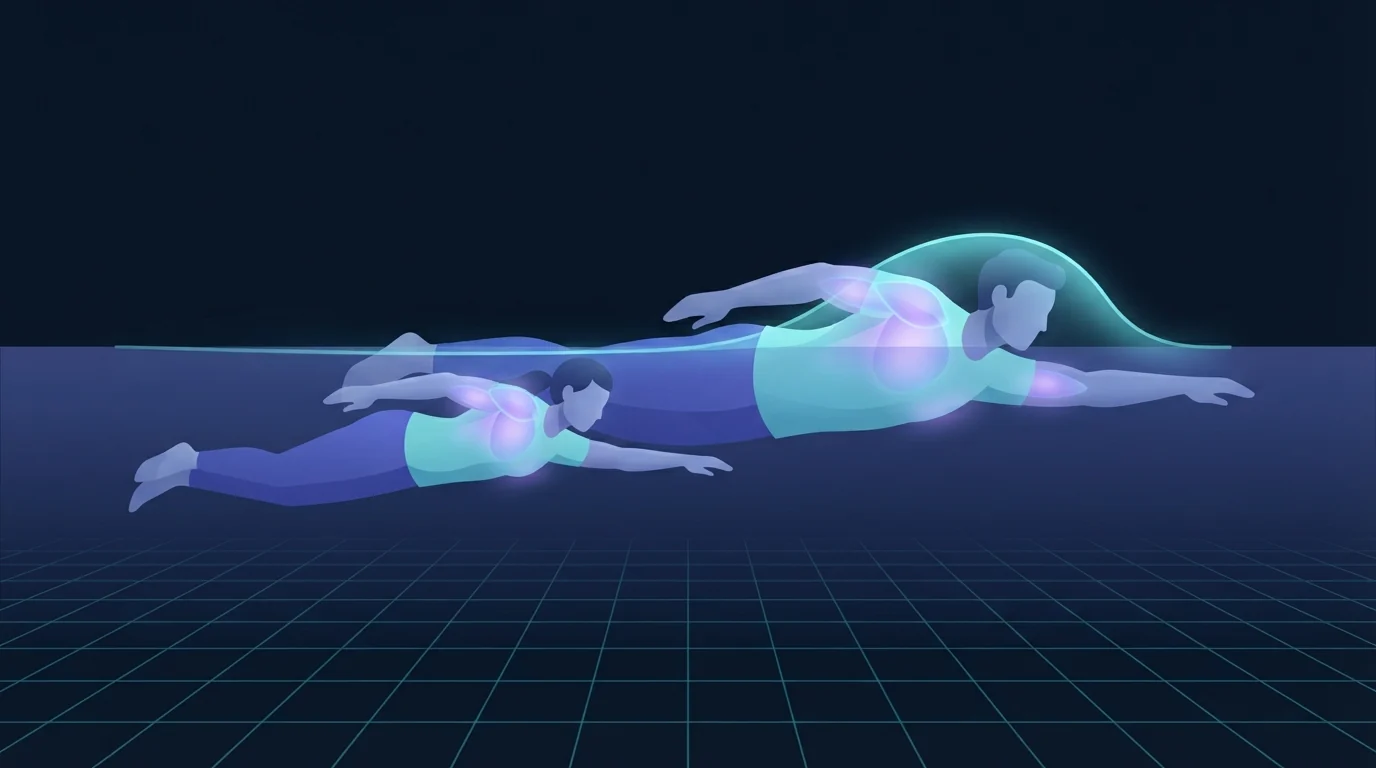
Zamparo, Cortesi and Gatta (2020) reviewed the energy cost of swimming in the European Journal of Applied Physiology and reduced the whole question to two variables. The first is drag, the resistive force you have to overcome, which is far larger in water than the aerodynamic resistance a runner or cyclist faces at the same speed. The second is propelling efficiency, the fraction of the force you generate that actually sends you forward rather than sideways or downward. Those two parameters explain the difference between land and water locomotion, and they also explain the differences within swimming: between strokes, and between swimmers of different age, sex and technical level.
This is the opposite of how running works. Two people running at 6 mph pay roughly similar prices for it. Two people swimming at the same speed can differ enormously, because one of them is slipping through a small hole in the water and the other is dragging a wide, tilted, sinking body through a much bigger one. A beginner often burns more calories than a trained swimmer covering the same distance, which isn't the consolation prize most beginners want.
Body size and drag
The mass term in the formula is only half of the body size story. Drag depends on the frontal area you present and on how level you float, so a swimmer whose legs sink pays a surcharge on every length. Practically, the swimmers who get closest to the table's higher numbers are often the ones with the least polished technique, because inefficiency is expensive by definition. Get better and the same workout costs less, which is a real effect our post on whether swimming builds muscle works through for the muscle side of the same question.
Why your watch disagrees
O'Driscoll, Turicchi, Beaulieu and colleagues (2020) in the British Journal of Sports Medicine pooled 60 validation studies producing 104 effect sizes, comparing wrist and arm-worn monitors against indirect calorimetry, room calorimeters and doubly labelled water. Accuracy varied substantially by activity type, heterogeneity between devices was large, and adding heart rate or heat-sensing to the accelerometer improved matters but didn't fix them.
Swimming is the hardest case in that literature. The optical sensor is fighting water between the skin and the diode, and the accelerometer sees an arm cycling through a stroke pattern rather than a body travelling through a pool. Use the watch to log that you swam and for how long. Use the table for the calories, and hold both loosely.
Swimming for burning calories: does it actually produce fat loss?
It does, with one trap specific to the pool.
Lahart and Metsios (2018) in Sports Medicine pooled 29 swim-training trials in non-elite swimmers and found body fat fell by 1.92% against controls, with lean mass up 1.96 kg. That is a normal, respectable exercise-sized effect, and it is the same size of result you would expect from an equivalent dose of any other aerobic training.
The trap is appetite in cold water. White, Dressendorfer, Holland, McCoy and Ferguson (2005) in the International Journal of Sport Nutrition and Exercise Metabolism had 11 men exercise for 45 minutes at 60% of VO2max on a submerged cycle ergometer, once in 33 degree water and once in 20 degree water, then gave them free access to food for an hour. Energy expenditure was essentially identical across the two trials, 505 and 517 calories. Energy intake afterwards was not: 877 calories after the cold trial, 44% higher than after the neutral one and 41% higher than after resting.
So a cold pool does not burn more. It makes you eat more. If your pool runs cool and you finish sessions ravenous, that's a documented physiological response rather than a discipline failure, and the fix is a planned post-swim meal rather than an improvised one. Our research review of whether sweating burns calories pulls apart a related myth about heat and energy cost from the other direction.
The rest is ordinary arithmetic. A 500-calorie swim three times a week is 1,500 calories, roughly 0.2 kg of fat if your eating holds steady, and the "if" is where most swimming-for-weight-loss plans quietly come apart. Our review of what a calorie deficit actually is covers how large the gap has to be before a scale notices, and how to keep track of your TDEE while your training load changes.
Swimming versus running and walking
Per minute, hard swimming is right at the top of the aerobic pile. Fast freestyle is 9.8 METs against 9.3 for running at 6 mph and 4.8 for a brisk walk. Butterfly at 13.8 outruns almost everything on land short of sprinting.
Per session, running usually still wins, for two unglamorous reasons. Most recreational swimmers cannot sustain 9.8 METs for anything like an hour, whereas most recreational runners can sustain 9.3 for 40 minutes. And running has no wall to stand at. An hour on a road is an hour of work; an hour at a pool is often 25 minutes of work spread over an hour.
Where swimming wins outright is the price your joints pay for the calories. Nothing else on this list gives you 9 METs with zero impact, which is exactly why it gets prescribed for painful knees, hips and backs. If you want that property without a pool, our guide to low-impact cardio at home covers the alternatives.
What this means for you
Stop asking how many calories the session burned and start asking how many minutes of it were actually swimming. That single change does more for the number than any choice of stroke. A 30-minute session where you genuinely swim for 25 of them beats a 60-minute session with 20 minutes of wall time, at any body weight, in any stroke.
Then bias the session toward effort rather than distance. Short repeats with short rest keep you nearer the top of that MET range for longer than a continuous cruise does: eight lots of 50 metres with 30 seconds rest will sit closer to 9.8 METs than a straight 400 ever will, and it's also more interesting. Count laps, not minutes, and try to beat last week's count in the same time.
And treat the poolside hour as part of the workout. The swim is 500 calories. The vending machine on the way out is 400. That's the whole game, and it isn't decided in the water. If the structure around the training is what keeps slipping, our roundup of the best workout apps for weight loss compares the ones built to hold a plan together between sessions.

Frequently Asked Questions
How many calories does swimming burn?
For a 155 lb (70 kg) adult, roughly 400 calories in an hour of slow recreational freestyle, 560 at a steady front crawl of about 50 yards a minute, 686 swimming fast freestyle and 966 for butterfly. Those figures come from the MET values in the 2024 Adult Compendium of Physical Activities. Multiply by about 1.2 if you weigh 185 lb and by about 0.85 if you weigh 130 lb.
How many calories does 30 minutes of swimming burn?
About 203 calories for a 155 lb (70 kg) adult swimming easy freestyle, 280 at a steady front crawl and 343 swimming hard. A 185 lb (84 kg) adult burns roughly 244, 336 and 412 for the same three efforts. Those are numbers for 30 minutes of continuous swimming, so subtract the time you actually spend standing at the wall.
Which swimming stroke burns the most calories?
Butterfly, by a wide margin. The 2024 Adult Compendium rates it at 13.8 METs against 10.3 for competitive breaststroke, 9.8 for fast freestyle and 9.5 for competitive backstroke. Almost nobody can hold butterfly long enough for that to matter, though. For most swimmers the highest-burning stroke is whichever one they can swim continuously for 30 minutes, which is usually freestyle or breaststroke.
How many calories do you burn swimming a mile?
Roughly 300 to 450 calories for most adults, and the interesting part is how little that number moves with speed. A 155 lb (70 kg) adult covering a mile at about 50 yards a minute takes 35 minutes at 8.0 METs and spends around 330 calories. The same person swimming slowly at 5.8 METs takes nearly 50 minutes and spends around 340. Covering the distance has a fairly fixed price. Swimming faster mostly buys you time back.
Does swimming burn more calories than running?
Per minute they are close at matched effort. Fast freestyle is 9.8 METs in the 2024 Adult Compendium and running at 6 mph is 9.3, so an hour of hard swimming edges out an hour of steady running for the same body weight. Per session, running usually wins, because most recreational swimmers cannot hold hard freestyle for an hour and spend a good share of their pool time resting at the wall.
Why does my watch say I burned fewer calories swimming?
Because wrist-worn devices estimate energy expenditure poorly, and swimming is their worst case. O'Driscoll and colleagues (2020) pooled 60 validation studies in the British Journal of Sports Medicine and found accuracy varied widely by activity type, with large heterogeneity between devices. In water an optical heart-rate sensor struggles, and the accelerometer sees an arm cycling through a stroke rather than a body moving through a pool. Treat the watch as a consistency log, not a calorie meter.
Is swimming good for weight loss?
It works, with one specific trap. Lahart and Metsios (2018) pooled 29 swim-training trials in non-elite swimmers and found body fat fell by 1.92% against controls, a normal exercise-sized effect. The trap is appetite in cold water. White and colleagues (2005) had 11 men exercise at matched intensity in 33 degree and 20 degree water, burning almost identical calories, and the cold trial was followed by 44% more food intake in the next hour.