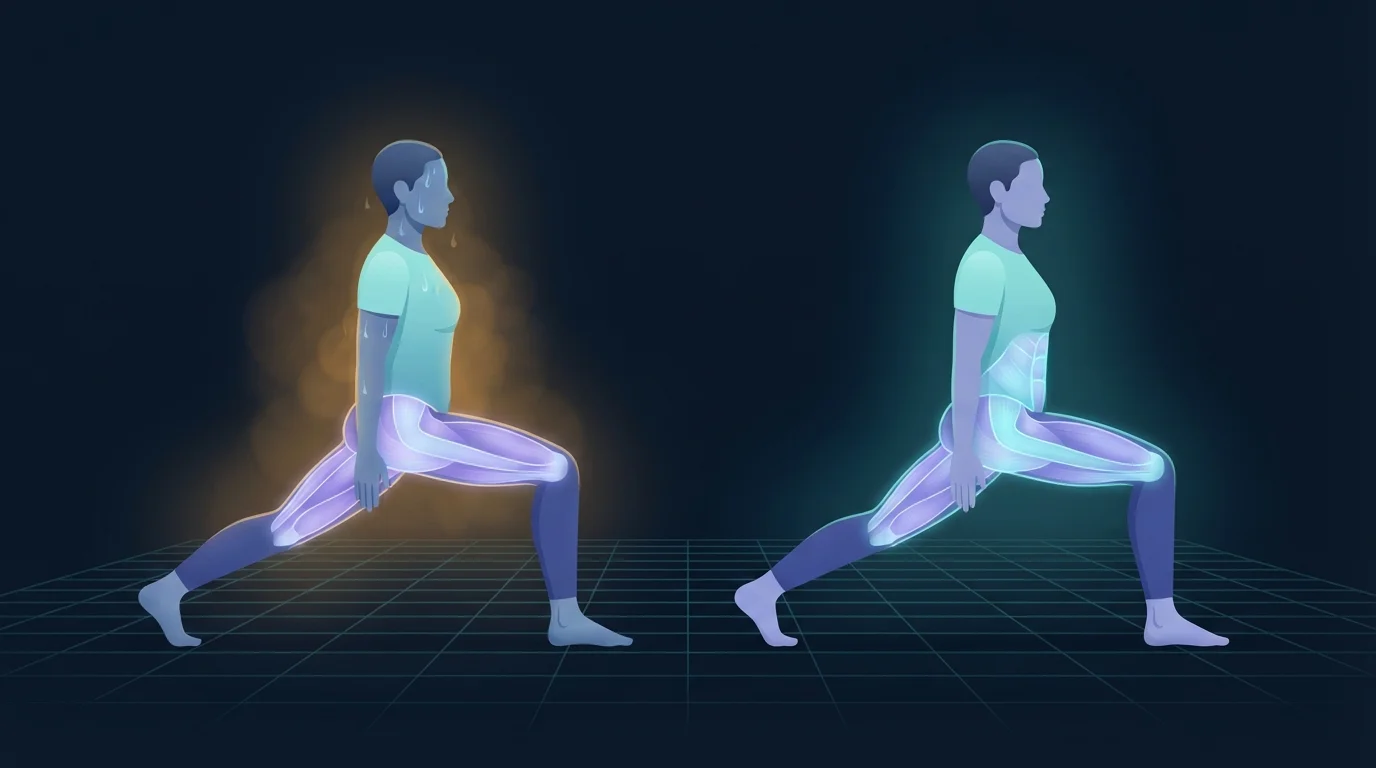
You finish a class dripping, step on the scale, and it's down two pounds. That feels like evidence. By the next morning it's back, and the obvious conclusion is that something went wrong overnight. Nothing went wrong. You replaced the water you lost, which is what the two pounds always were.
The belief that sweat measures calorie burn is one of the most durable ideas in fitness, and it survives because it has a kernel of truth wrapped around a mistake. Hard work does produce heat, and heat does produce sweat, so sweat and effort are genuinely correlated inside a single person on a single day. The mistake is treating the correlation as a measurement. Change the room temperature, the humidity, the fan, or the shirt, and sweat moves a lot while the calorie cost sits still.
This page works through the physiology, the trial that isolated the variable cleanly, why the scale drops and then rebounds, whether heat adds any real metabolic cost, and what actually drives calorie burn. If you want the companion question of why you personally sweat more than the person next to you, our post on why you sweat so much when you work out covers the individual variation. This page is about the energy accounting.
What Sweat Actually Is: A Cooling System, Not a Calorie Counter
Muscle is an inefficient engine. Somewhere around 20 to 25% of the chemical energy you spend during exercise becomes mechanical work, and the rest becomes heat. That heat has to go somewhere, or core temperature climbs until performance collapses. At rest and in cool air, radiation and convection handle most of it. Once you're working hard, or once the air is close to skin temperature, evaporation of sweat becomes the dominant route.
Here's the part people invert. Evaporating sweat absorbs a large amount of heat. Wenger (1972) in the Journal of Applied Physiology worked through the thermodynamics for human sweat and established the value physiologists still use: evaporating a liter of sweat from the skin carries away roughly 580 kilocalories of heat.
That number looks like a jackpot until you ask where the heat came from. It came from the work you already did. Sweating is the disposal mechanism for energy your muscles spent seconds earlier, not a second withdrawal from the account. If you could somehow stop sweating during the same workout, you wouldn't burn 580 fewer calories. You'd overheat.
Wenger's analysis carries one more practical implication. Only evaporated sweat cools you. Sweat that rolls off your face onto the floor carries away almost nothing, which is why a humid room makes you sweat far more for less cooling benefit. Dripping is a sign the cooling system is being overwhelmed, not a sign it's succeeding.
The Research: Same Workout, Hotter Room, Same Oxygen Cost
The reason this question stayed muddy for so long is that most comparisons confound effort with environment. Hot yoga classes are not the same sequence as room-temperature classes. Summer runs are rarely at the same pace as winter runs. To isolate heat, you need the identical session twice.
Boyd, Lannan, Zuhl, Mora-Rodriguez, and Nelson (2018) did exactly that. Fourteen participants completed two identical roughly 20-minute yoga sessions in randomized crossover order: one in a hot room (35.3C, 20.5% humidity) and one thermo-neutral (22.1C, 27.8% humidity). The researchers recorded oxygen consumption and heart rate as objective intensity measures and rating of perceived exertion as the subjective one.
- Oxygen consumption: 30.9% of maximum in the heat versus 30.5% thermo-neutral. No significant difference (p = 0.68).
- Heart rate: 67.0% of maximum in the heat versus 60.8% thermo-neutral. Significantly higher (p = 0.01).
- Perceived exertion: 12 in the heat versus 11 thermo-neutral. Significantly higher (p = 0.04).
- Intensity classification: light-intensity exercise by oxygen uptake in both conditions, even though heart rate and perceived exertion pushed the hot session into the moderate band.
Oxygen consumption is how exercise physiology actually measures energy expenditure, because the body burns roughly 5 kilocalories per liter of oxygen consumed. If VO2 doesn't move, calorie burn doesn't move. Heart rate rose because blood was being redirected to the skin for cooling and plasma volume was falling, a phenomenon called cardiovascular drift. It felt harder. It was not more work.
That single trial is worth more than a stack of before-and-after anecdotes, because it holds everything constant except the one variable in question. It also explains why heart-rate-based calorie estimates on watches and chest straps overestimate burn in hot conditions. The device sees an elevated heart rate and infers effort that isn't there.
Why the Scale Drops After a Sauna, and Why It Comes Back
Body mass change during exercise is the standard field method for estimating fluid loss, precisely because sweat is water and water has predictable mass. The American College of Sports Medicine position stand on exercise and fluid replacement (Sawka et al., 2007) builds its recommendations on that relationship: roughly one kilogram of body mass lost equals roughly one liter of fluid lost. Cheuvront and Kenefick (2014) in Comprehensive Physiology reviewed the assessment methods and the performance consequences of arriving at a session already down that liter.
Podstawski and colleagues (2014) put numbers on the sauna version. They studied 674 sedentary students, 326 women and 348 men aged 19 to 20, through two 10-minute dry sauna sessions separated by a five-minute break. Body mass loss varied systematically: underweight participants lost the least, normal-weight more, and overweight and obese participants the most. Their conclusion was a hydration warning, not a weight-loss finding. People with higher body mass index are at greater risk of dehydration and need to replace more fluid.
Run the arithmetic against fat and the gap is obvious. A pound of body fat stores roughly 3,500 kilocalories. Twenty minutes in a sauna might cost you a kilogram on the scale and something on the order of tens of calories in actual metabolic expense. The scale moved 30 times more than the energy budget did, and one large bottle of water undoes all of it.
This is also the mechanism behind sauna suits and neoprene waist wraps. They work exactly as advertised, and what they're advertising is dehydration. Weight class athletes use controlled versions of this deliberately to make a number before a weigh-in, then rehydrate immediately. For anyone trying to change body composition, it's motion without progress.
Get an evidence-based plan built for you
FitCraft, our mobile fitness app, pairs you with an AI coach who builds you a personalized plan around your goals, schedule, and fitness level. Every FitCraft program is designed by Domenic Angelino, MPH (Brown University) and NSCA-CSCS, with research published in the Journal of Strength and Conditioning Research and Medicine & Science in Sports & Exercise.
Take the Free Assessment Free • 2 minutes • No credit cardDoes Training in the Heat Burn More? The Honest Answer
The strict answer is that heat does change metabolism, just not in the direction or magnitude the sweat-equals-calories story implies.
Febbraio (2001) in Sports Medicine reviewed the substrate data and documented a clear shift under heat stress: muscle glycogen breakdown accelerates and carbohydrate oxidation rises relative to the same work in cooler conditions. Fuel mix changes. That's a real physiological effect, and it's part of why hot sessions feel like they empty the tank faster.
A shift in fuel mix is not the same as a shift in total energy cost, though. Burning proportionally more carbohydrate and less fat at the same oxygen uptake means the same calories from a different source. And Périard, Eijsvogels, and Daanen (2021) in Physiological Reviews lay out the consequence that usually gets ignored: heat stress degrades performance. Time to exhaustion falls, sustainable power output falls, and pace slows. Whatever small metabolic premium the heat adds per minute, most people give back by doing less total work.
There's a separate and better reason to train in the heat, which is adaptation. Repeated heat exposure expands plasma volume, lowers core temperature at a given workload, and improves sweat efficiency, all of which make cool-weather performance better too. That's a performance argument rather than a calorie argument, and we cover it on our heat acclimation training research page.
What Actually Determines How Many Calories You Burn
If sweat is the wrong gauge, it helps to know what the right ones are. Four inputs do almost all the work, and none of them is visible on a shirt.
- Body size. A larger body costs more to move and more to maintain. It also produces more heat and sweats more, which is one reason the sweat correlation seems to hold and then falls apart between people.
- Duration. Thirty minutes of steady work beats eight drenching minutes on total expenditure almost every time.
- Intensity, measured as external work. Pace, load, and repetitions completed. Not how red your face is.
- Everything outside the session. Basal metabolic rate is 60 to 75% of daily burn, and non-exercise activity thermogenesis, the walking and fidgeting and stair-climbing you never log, routinely dwarfs the workout itself.
Our review of how to boost metabolism works through the full energy budget, including how little of it a single session actually represents. And if you want a rough number for a specific session, our calories burned calculator uses body mass, duration and activity intensity, which is the honest input set. It does not ask how much you sweated, because that would not improve the estimate.
One more piece of the puzzle gets mis-sold alongside sweat: the afterburn. Post-exercise oxygen consumption is real and it's much smaller than the marketing suggests, typically a few percent of the session's own cost. Our EPOC afterburn review puts realistic numbers on it.
Common Misconceptions
Misconception: "Sweating detoxes your body"
Baker (2019) reviewed sweat gland physiology across nearly fifty pages in Temperature and reached a blunt conclusion: sweating's role in eliminating waste products and toxicants is minor compared with the kidneys and the gastrointestinal tract. Eccrine glands do not adapt to increase excretion rates, either by concentrating sweat or by raising overall sweat rate, and studies implying a larger clearance role appear to be artifacts of methodology rather than evidence of selective transport. Sweat is more than 99% water, with sodium and chloride as the main solutes. Detoxification is a kidney and liver job.
Misconception: "If I'm not sweating, the workout isn't working"
Sweat rate depends on ambient temperature, humidity, airflow, clothing, body surface area, hydration status, heat acclimation state and individual sweat gland density. Baker (2017) in Sports Medicine reviewed how widely sweat rate varies both between athletes and within the same athlete across conditions. A heavy set of squats in a cold garage taxes you far more than a warm stretching class that leaves you damp. Judge the session by what you moved, for how long, and how it compares to last week.
Misconception: "Hot yoga burns way more than regular yoga"
This is the specific claim Boyd's crossover trial tested, and it did not survive. Identical sequence, 13 degrees of temperature difference, statistically identical oxygen consumption. Both conditions classified as light-intensity exercise by oxygen uptake. The heat raised heart rate and made the session feel harder, which is a real experience and a poor proxy for energy expenditure.
Misconception: "Saunas and sweat suits are a fat loss tool"
Saunas earn their keep somewhere else entirely. Laukkanen and colleagues (2015) followed 2,315 middle-aged Finnish men for a median of 20.7 years in JAMA Internal Medicine and found frequent sauna bathing associated with substantially lower cardiovascular and all-cause mortality. Hussain and Cohen (2018) reviewed the clinical literature and found consistent benefits for blood pressure and vascular function. We cover that evidence, including its observational limits, on our sauna and cardiovascular health page. None of it is fat loss from sweating.
What the Research Suggests Going Forward
The core answer here is settled by physics and confirmed by controlled crossover data, so it's unlikely to be overturned. A few edges are genuinely open.
First, the Boyd trial is small, 14 participants doing light-intensity yoga. Whether the same null result holds at vigorous intensities, where the cooling demand is much larger and cardiovascular strain is higher, has not been tested with the same clean design. It's plausible that heat adds a slightly larger metabolic premium when the cooling system is genuinely maxed out, and nobody has isolated it well.
Second, the practical consequence for wearables deserves more attention than it gets. Most consumer calorie estimates lean heavily on heart rate, and heat inflates heart rate without inflating energy cost. That means the devices people trust are systematically biased upward in exactly the sessions that already feel the most productive. Validation studies of wrist-worn estimates under heat stress are thin.
Third, heat acclimation as a training tool deserves separating from heat as a calorie strategy. The adaptation literature is promising and the fat loss framing is a distraction from it.
For practical purposes today, the change is simple. Stop grading sessions by how wet your shirt is. Grade them by what you lifted, how far you went, how long you kept going, and whether you came back three days later. Consistency is the variable that actually predicts body composition change over months, and it's the one that sweat has never measured. If keeping a routine alive is the harder problem, our roundup of the best workout apps for weight loss compares the tools built around that specific problem.
References
- Boyd CN, Lannan SM, Zuhl MN, Mora-Rodriguez R, Nelson RK. "Objective and subjective measures of exercise intensity during thermo-neutral and hot yoga." Appl Physiol Nutr Metab. 2018;43(4):397-402. doi:10.1139/apnm-2017-0495
- Wenger CB. "Heat of evaporation of sweat: thermodynamic considerations." J Appl Physiol. 1972;32(4):456-459. doi:10.1152/jappl.1972.32.4.456
- Baker LB. "Physiology of sweat gland function: The roles of sweating and sweat composition in human health." Temperature (Austin). 2019;6(3):211-259. doi:10.1080/23328940.2019.1632145
- Baker LB. "Sweating Rate and Sweat Sodium Concentration in Athletes: A Review of Methodology and Intra/Interindividual Variability." Sports Med. 2017;47(Suppl 1):111-128. doi:10.1007/s40279-017-0691-5
- Podstawski R, Boraczyński T, Boraczyński M, Choszcz D, Mańkowski S, Markowski P. "Sauna-induced body mass loss in young sedentary women and men." ScientificWorldJournal. 2014;2014:307421. doi:10.1155/2014/307421
- Périard JD, Eijsvogels TMH, Daanen HAM. "Exercise under heat stress: thermoregulation, hydration, performance implications, and mitigation strategies." Physiol Rev. 2021;101(4):1873-1979. doi:10.1152/physrev.00038.2020
- Febbraio MA. "Alterations in energy metabolism during exercise and heat stress." Sports Med. 2001;31(1):47-59. doi:10.2165/00007256-200131010-00004
- Sawka MN, Burke LM, Eichner ER, Maughan RJ, Montain SJ, Stachenfeld NS. "American College of Sports Medicine position stand. Exercise and fluid replacement." Med Sci Sports Exerc. 2007;39(2):377-390. doi:10.1249/mss.0b013e31802ca597
- Cheuvront SN, Kenefick RW. "Dehydration: physiology, assessment, and performance effects." Compr Physiol. 2014;4(1):257-285. doi:10.1002/cphy.c130017
- Laukkanen T, Khan H, Zaccardi F, Laukkanen JA. "Association between sauna bathing and fatal cardiovascular and all-cause mortality events." JAMA Intern Med. 2015;175(4):542-548. doi:10.1001/jamainternmed.2014.8187
- Hussain J, Cohen M. "Clinical Effects of Regular Dry Sauna Bathing: A Systematic Review." Evid Based Complement Alternat Med. 2018;2018:1857413. doi:10.1155/2018/1857413
Frequently Asked Questions
Does sweating burn calories?
Sweating itself burns a negligible number of calories. Sweat is how the body sheds heat it has already produced, not an additional energy cost. The cleanest test comes from Boyd and colleagues (2018), who had 14 people complete two identical 20-minute yoga sessions, one at 35.3C and one at 22.1C. Oxygen consumption, the standard laboratory measure of calorie burn, was statistically identical between conditions (30.9% versus 30.5% of maximal oxygen uptake). Heart rate and perceived exertion were both higher in the heat. The session felt harder and produced far more sweat while costing the same energy.
Why do you lose weight after a sauna or a very sweaty workout?
That weight is water, and it comes back with the next few glasses you drink. One liter of sweat weighs about one kilogram, which is why the American College of Sports Medicine position stand on fluid replacement (Sawka et al., 2007) uses body mass change during exercise as the standard estimate of fluid loss. Podstawski and colleagues (2014) measured body mass loss in 674 sedentary young adults across two 10-minute dry sauna sessions and found the amount lost scaled with body mass index, not with anything resembling fat oxidation. Losing a pound of body fat requires roughly a 3,500-calorie deficit, which no amount of sweating can produce on its own.
Does exercising in the heat burn more calories than exercising in a cool room?
Slightly, at most, and usually not enough to notice. Heat stress raises heart rate, core temperature and cardiovascular strain at the same workload, and Febbraio (2001) documented a shift toward greater muscle glycogen use and carbohydrate oxidation in the heat. But Boyd and colleagues (2018) found no measurable difference in oxygen consumption during identical yoga sessions at 35.3C versus 22.1C. Périard and colleagues (2021) note that heat also degrades performance, so most people end up doing less total work in a hot room, which cancels any small metabolic premium.
Is sweating a good measure of workout intensity?
No. Sweat rate is driven by air temperature, humidity, airflow, clothing, body size, heat acclimation and individual sweat gland density as much as by effort. Baker (2017) reviewed the variability in sweat rate between and within athletes and found it ranges widely for reasons unrelated to how hard the session was. A heavy lifting session in a cold garage can be far more demanding than a hot yoga class that leaves you drenched. Use pace, load, repetitions, heart rate or rating of perceived exertion instead.
Does sweating detox your body?
Not meaningfully. Baker (2019) reviewed sweat gland physiology in Temperature and concluded that the role of sweating in eliminating waste products and toxicants is minor compared with excretion through the kidneys and gastrointestinal tract. Eccrine sweat glands do not adapt to increase excretion rates, and studies suggesting a larger detoxification role appear to reflect methodological artifacts. Sweat is over 99% water with sodium, chloride and small amounts of other electrolytes. Its job is temperature control.
Are saunas and sweat suits useful for anything, then?
Saunas have a real evidence base, just not for fat loss. Laukkanen and colleagues (2015) followed 2,315 middle-aged Finnish men for a median of 20.7 years in JAMA Internal Medicine and found that frequent sauna bathing was associated with substantially lower cardiovascular and all-cause mortality. Hussain and Cohen (2018) reviewed the clinical literature and found benefits for blood pressure and cardiovascular function. Deliberate heat exposure is also the basis of heat acclimation training. What none of that evidence shows is fat loss from sweating.