Search for infrared sauna benefits and most of what ranks is written by spas that sell sessions. Their lists run long: detox, weight loss, glowing skin, lower cholesterol, better sleep, a stronger heart. Some of those claims have decent trial evidence behind them. Some have none, and one, cholesterol, has been tested and come up empty.
If you're paying for sessions or thinking about putting a cabin in the spare room, it's worth knowing which half you're buying. That matters even more if you've quietly hoped the heat might do some of what your workouts haven't. We get it. Sitting in a warm, quiet room is a lot easier to keep doing than a training plan you keep restarting.
This review explains what an infrared sauna is and how it works, then goes through the controlled trials one benefit at a time: blood vessels and blood pressure, heart failure, pain, recovery and cortisol, sleep and mood. After that come the claims that don't hold up, the downsides and who should skip it. The Finnish studies linking frequent traditional sauna use with fewer heart deaths have their own page, our review of sauna and cardiovascular health.
What Is an Infrared Sauna and How Does It Work?
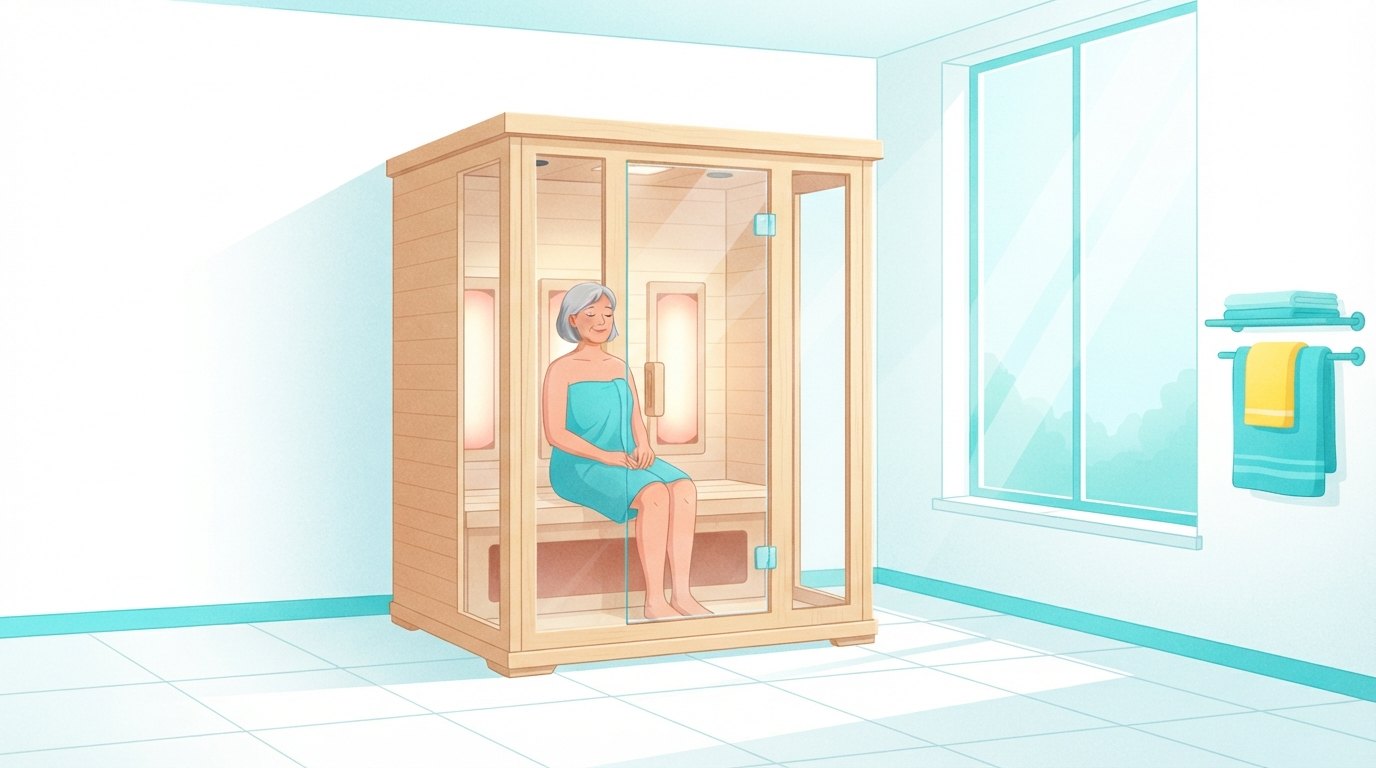
An infrared sauna is a heated cabin that warms your body mainly with radiant heat from panels in the walls, rather than by heating the air until it's very hot. A traditional Finnish sauna works the other way round: a stove heats the air, and the hot air heats you. In his review of the far-infrared evidence, Beever (2009) in Canadian Family Physician put the typical air temperature at about 60 °C (140 °F) for a far-infrared cabin and about 85 °C (185 °F) for a traditional sauna, with the panels emitting heat at a wavelength of around 10 micrometres.
That cooler air is why an infrared session feels gentler and easier to breathe. It can also mean a smaller dose of heat. Atencio et al. (2025) in the American Journal of Physiology put 20 healthy young adults through three kinds of passive heating on separate days and measured what each one did to the body:
| Heat session | What it involved | Core temperature | Heart rate | Sweat lost |
|---|---|---|---|---|
| Far-infrared sauna | 45 minutes, measured air about 45 °C | No meaningful rise | +26 beats/min | About 0.4 kg |
| Traditional sauna | Three 10-minute rounds at 80 °C | +0.4 °C | +34 beats/min | About 0.7 kg |
| Hot tub | 45 minutes in water at 40.5 °C | +1.1 °C | +39 beats/min | About 0.9 kg |
The heart pumped about 1.6 extra litres of blood a minute in the infrared cabin, 2.3 in the traditional sauna and 3.7 in the hot water. Only the hot tub produced a measurable immune response in the blood. The authors suggested one reason the infrared session did so little: they used a large conventional cabin in which people weren't surrounded by panels, unlike the compact cabins in the Japanese clinical trials. So the way you use the cabin matters. Sitting close to the panels in a small cabin delivers more heat than sitting in a roomy cabin with panels on one wall.
What do 30 minutes in an infrared sauna do?
Your heart speeds up, the blood vessels in your skin widen to shed heat, and you start to sweat. In the Atencio comparison, 45 minutes in a far-infrared cabin raised heart rate by 26 beats a minute and cost about 0.4 kg of sweat, while core temperature barely moved. Half an hour does a smaller version of the same thing. That's a heart-rate rise in the range of an easy walk, but without any muscle work, so it isn't exercise. Much of the relaxed feeling comes from the warmth and from 30 minutes of sitting still with nothing to do.
Infrared sauna vs red light sauna
A red light sauna is usually a different product. Most infrared cabins use far-infrared heaters, which you feel as warmth and can't see. Red light and near-infrared LED panels give off visible red light and shorter infrared wavelengths, and they're sold for skin and joint effects under the label photobiomodulation. Some cabins combine both. Their evidence is separate from the sauna trials on this page, so don't assume the heart and pain results below carry over to a light panel.

Infrared Sauna Benefits for Blood Vessels and Blood Pressure
The best-supported benefit of repeated infrared sessions is better function in the endothelium, the inner lining of your arteries that controls how well they widen. Imamura et al. (2001) in the Journal of the American College of Cardiology gave 25 men with at least one coronary risk factor (high cholesterol, high blood pressure, diabetes or smoking) 15 minutes in a 60 °C far-infrared sauna and then 30 minutes under blankets, once a day for two weeks. Flow-mediated dilation, an ultrasound test of how much the arm artery widens when blood rushes back into it, rose from 4.0 to 5.8 percent. A comparison group of 10 healthy men without risk factors started at 8.2 percent, so the sauna closed part of the gap.
Blood pressure moved in a small randomized trial from the same research group. Masuda et al. (2004) in the Japanese Heart Journal assigned 28 people with coronary risk factors to daily far-infrared sauna or to resting at room temperature for two weeks. Systolic pressure in the sauna group fell from 125 to 110 mmHg and ended below the control group's 122 mmHg. Diastolic pressure, heart rate and body mass index didn't change, and neither did cholesterol, triglycerides or fasting glucose.
Read those numbers with their limits in mind. Both trials lasted two weeks, both came from one university hospital in Kagoshima, Japan, and nobody was blinded. In the heart failure meta-analysis covered next, infrared sessions had no significant effect on systolic or diastolic pressure. Beever graded the blood pressure evidence as limited. The long-running data on sauna and heart outcomes come from Finland, from traditional saunas and from observational cohorts, which is why we cover them separately.
Infrared Sauna and Heart Failure: The Waon Therapy Trials
The strongest clinical work on infrared heat comes from Japan, where a protocol called Waon therapy, meaning "soothing warmth", has been tested in people with chronic heart failure for more than two decades. The routine stays the same from study to study: 15 minutes in a far-infrared dry sauna at 60 °C, then 30 minutes resting under a blanket to hold the warmth, usually once a day.
Kihara et al. (2002) in the Journal of the American College of Cardiology treated 20 patients with moderate heart failure (New York Heart Association class II or III) this way for two weeks and compared them with 10 matched patients who lay in a 24 °C room. Symptoms improved in 17 of the 20 treated patients. Their artery function improved, and blood levels of BNP, a hormone the heart releases when it's under strain, fell. Nothing changed in the untreated group.
The larger test was the multicentre WAON-CHF trial. Tei et al. (2016) in Circulation Journal randomized 149 hospitalized patients with advanced heart failure, average age 66, at 19 hospitals to 10 days of daily Waon therapy or usual care. The primary outcome, the change in BNP, didn't reach statistical significance between groups. Symptom class, six-minute walk distance and heart size on chest X-ray did improve with Waon therapy, and neither group had any serious adverse events.
Källström et al. (2018) in Clinical Cardiology then pooled the controlled studies. Of 1,444 studies screened, nine met their criteria and seven went into the meta-analysis, and every qualifying study used an infrared sauna. Sessions at 60 °C for 15 minutes plus 30 minutes of warm rest, five times a week for two to four weeks, were linked with lower BNP, a smaller heart on X-ray and a better ejection fraction, the share of blood the left ventricle pumps out with each beat. The authors rated the strength of that evidence from moderate to insufficient and described the effect as a short-term improvement.
Two facts keep this from being a home remedy. These were hospital programs with nurses, monitoring and stable medication, and the benefits were measured over days to weeks, not years. If you have heart failure, infrared heat is something to raise with your cardiologist, not something to start on your own.
Get an evidence-based plan built for you
FitCraft, our mobile fitness app, pairs you with an AI coach who builds you a personalized plan around your goals, schedule, and fitness level. Every FitCraft program is designed by Domenic Angelino, MPH (Brown University) and NSCA-CSCS, with research published in the Journal of Strength and Conditioning Research and Medicine & Science in Sports & Exercise.
Take the Free Assessment Free • 2 minutes • No credit cardInfrared Sauna for Pain Relief and Inflammation
Pain relief is the benefit spas lead with, and it has some trial support, mostly from small studies. Oosterveld et al. (2009) in Clinical Rheumatology gave 17 people with rheumatoid arthritis and 17 with ankylosing spondylitis eight infrared sessions over four weeks. Pain and stiffness dropped significantly during each session, and fatigue eased too. Across the four weeks the improvements were large enough to notice but didn't reach statistical significance. Disease activity scores stayed flat, which matters: the heat didn't set off flares.
Masuda et al. (2005) in Psychotherapy and Psychosomatics studied 46 hospitalized patients with chronic pain. All of them got a program of cognitive behavioural therapy, rehabilitation and exercise, and 22 of them also got daily far-infrared sauna for four weeks. Pain scores fell in both groups. Two years later, 77 percent of the sauna group were back at work, compared with 50 percent of the group without it.
For fibromyalgia, Matsushita et al. (2008) in Internal Medicine gave 13 women Waon therapy two to five days a week. Their pain dropped by about half after the first session and stayed lower through 10 sessions. There was no control group, so expectations and the attention of the clinic staff could explain part of that.
Does infrared sauna help with inflammation?
Probably not in the way the word "anti-inflammatory" implies. In Oosterveld's arthritis patients, disease activity didn't move while pain fell, which points to symptom relief rather than a change in the underlying inflammation. In Atencio's lab comparison, only the hot water raised the inflammatory messenger IL-6 or shifted immune cells, and the far-infrared session changed neither. Heat can make sore, stiff joints feel better for a few hours. That's a real benefit, and it's a different claim from treating inflammation.
Recovery, Relaxation and Cortisol
Infrared cabins are also the type most often tested after training. A 10- to 20-minute session after a hard workout eased next-day soreness a little in those trials and didn't interfere with muscle growth. Our post on whether a sauna is good after a workout goes through each of those studies, along with timing and hydration.
Do infrared saunas lower cortisol?
Not at first. Ahokas et al. (2025) in Temperature followed 40 female team-sport athletes through six weeks of training, with half of them sitting in an infrared sauna at 50 °C for 10 minutes after their sessions. After the first sauna, salivary cortisol rose by 5.1 nmol/L by the next morning, a sign of extra stress on the body, while the control group's didn't change. By the final week the cortisol response had faded and the athletes' overnight heart rate measures had settled, which the authors read as the body adapting to the heat. Muscle soreness 36 hours after the first session rose only in the group that skipped the sauna.
So an infrared sauna starts out as a mild stressor that the body gets used to within a few weeks. If you feel calmer afterward, that feeling is real. It just isn't evidence that the sauna lowered your cortisol.
Infrared Sauna for Relaxation, Sleep and Mood
Relaxation is the main reason people use saunas at all. The Global Sauna Survey by Hussain et al. (2019) in Complementary Therapies in Medicine analysed 482 responses from regular sauna users, most of whom bathed once or twice a week. Relaxation and stress relief topped their reasons, and 83.5 percent said they slept better after sauna use. That's self-report from people who already like saunas, and it mixed infrared and traditional users. We couldn't find a controlled trial that measured sleep as the main outcome of infrared sessions.
Mood has slightly better data. Masuda et al. (2005) in Psychosomatic Medicine randomized 28 mildly depressed inpatients to 20 far-infrared sessions over four weeks or to no heat therapy. The sauna group's physical complaints, appetite and relaxation scores improved significantly more than the comparison group's, and their mental complaints improved slightly.
The heat-for-depression trial people cite most often isn't a sauna study. Janssen et al. (2016) in JAMA Psychiatry randomized 34 adults with major depression to one session of whole-body hyperthermia, a medical setup that heated the chest with infrared lamps until core temperature reached about 38.5 °C, or to a sham session without the intense heat. A week later, depression scores on the Hamilton scale were 6.5 points lower in the heat group than in the sham group, and the gap was still 4.3 points at six weeks. It's an intriguing result. It also used a far bigger heat dose than a typical infrared cabin delivers, since Atencio's 45-minute infrared session barely changed core temperature.
What Infrared Saunas Don't Do: Detox, Calorie Burn and Weight Loss
Detox
Sweat is mostly water and salt. The detox pitch says sitting in the heat flushes out heavy metals, but the comparison that would test it points the other way. Kuan et al. (2022) in the International Journal of Environmental Research and Public Health collected sweat from 12 university students after 20 minutes of steady sweating, once while running on a treadmill and once while sitting in a sauna cabinet. Nickel, lead, copper and arsenic concentrations were significantly higher in the exercise sweat, and mercury was the same either way. If sweating were the route to detox, a run would beat the sauna. In reality your liver and kidneys clear what your body needs to get rid of, with or without either one.
Calorie burn
You'll see claims that an infrared session burns several hundred calories. We couldn't find a measurement behind any figure like that. The lab data show a heart-rate rise of about 26 beats a minute while you sit still, and the drop on the scale afterward is sweat that comes back when you drink. Our review of whether sweating burns calories explains why a hotter, sweatier hour doesn't burn meaningfully more energy.
Infrared sauna benefits for weight loss
The weight-loss evidence is a single small study. Biro et al. (2003) in Experimental Biology and Medicine reported that 10 people with obesity lost weight and body fat after two weeks of daily sauna sessions, but Beever's review notes they were also on an 1,800-calorie diet. With no diet-only group to compare against, there's no way to tell what the sauna added, and Beever rated it weak evidence. His review also found consistent evidence that far-infrared sauna doesn't lower cholesterol or triglycerides.
What Is the Downside to an Infrared Sauna?
For healthy adults the risk is low. Beever found no adverse effects reported in any of the far-infrared studies he reviewed, WAON-CHF recorded no serious adverse events in patients with advanced heart failure, and Oosterveld's arthritis patients tolerated their sessions without flares. In the Global Sauna Survey, problems were mostly minor, though two respondents reported chest pain or eye irritation that needed hospital care.
The downsides worth knowing about:
- Dehydration and light-headedness. You lose water through sweat while your blood vessels widen, so blood pressure can dip when you stand up. Drink water and get up slowly.
- Lower sperm counts. Heat reduces sperm production. In Garolla et al. (2013) in Human Reproduction, 10 healthy men who used a traditional sauna at 80 to 90 °C for 15 minutes twice a week for three months had significantly lower sperm counts and motility, and the changes fully reversed six months after they stopped. Infrared cabins run cooler and haven't been tested this way, but if you're trying to conceive, cutting back is sensible.
- Pregnancy. Overheating in early pregnancy is a known risk, so skip saunas while pregnant unless your obstetrician says otherwise.
- Alcohol and some medications. Alcohol in the heat raises the risk of fainting and heart rhythm problems. Medicines that lower blood pressure or change how you sweat can make heat harder to tolerate.
- Unstable heart disease. Unstable angina, a recent heart attack and severe aortic stenosis are reasons to stay out of any sauna until a cardiologist clears you.
- Reduced heat sensation. Nerve damage from diabetes or other conditions can stop you feeling when your skin is getting too hot.

How to Use an Infrared Sauna: Session Length, Temperature and Frequency
If you want to copy the routine behind the clinical results, it's the Waon protocol: 15 minutes at about 60 °C, then 30 minutes resting while wrapped in a towel or blanket to hold the warmth, five days a week in most of the trials. For general use, these steps keep an infrared sauna session comfortable:
- Start with 10 to 15 minutes and build toward 20 to 30 minutes over a couple of weeks.
- Sit close to the panels. Distance matters more in an infrared cabin than in a traditional sauna.
- Drink a glass or two of water afterward, and more if you weighed yourself and dropped more than half a kilo.
- Skip it after drinking alcohol, when you're unwell, or straight after a long, hard session in hot weather.
- Get out if you feel dizzy, nauseous or develop a headache.
Is an infrared sauna good every day?
For most healthy adults, yes. Daily sessions are what the clinical trials used, with Waon therapy given once a day, usually five days a week, for two to four weeks, and no serious problems reported. Three or four sessions a week is plenty if you're using it to unwind. Daily use calls for more attention to hydration, and for men trying to start a family, heat on most days is the pattern most likely to lower sperm counts.
Should you shower after a sauna?
A lukewarm or cool shower once you've cooled down for a few minutes is a good idea. It rinses off sweat and helps bring your skin temperature down. There's no evidence that it changes any of the benefits above, and a cold plunge is optional. Have some water before you get dressed.
Infrared Sauna or Exercise: Where the Bigger Benefit Is
Here's the part the spa pages leave out. The benefits with the best trial support, better artery function and lower blood pressure, are things regular exercise also delivers, and exercise builds the muscle, strength and fitness a sauna can't. Heat is a reasonable add-on. It's a poor substitute.
If the sauna has become the easy part of your week and the workouts are the part you keep skipping, you're not alone, and it isn't a willpower problem. Plans fail when they ask too much on day one and give you nothing to come back for. A personalized training program that fits your schedule fixes the first part. Streaks, levels and a 3D AI coach who demonstrates every exercise and says your name fix the second. As Katie, a FitCraft user, put it: "I've tried everything. This is the first time I've stuck with something past two weeks."
What the Research Suggests Going Forward
The infrared literature is small, and most of it comes from one research program in Kagoshima. The trials are short, usually two to four weeks. The groups are tiny, and real blinding is close to impossible, because everyone knows whether they sat in a hot cabin. Only WAON-CHF enrolled more than 100 people, and its primary outcome missed. Nobody has run the trial that matters most: whether years of infrared sessions change rates of heart attack, stroke or death.
What you can take from it today: infrared heat appears to improve artery function and heart failure symptoms over a few weeks, eases pain for a while, and is safe for most healthy adults. The detox, calorie and weight-loss claims aren't supported. If you enjoy it, it's a fine habit to keep. Just don't let it take the place of the training that delivers more of the same benefits.
References
- Atencio JK, Reed EL, Wiedenfeld Needham K, Lucernoni KM, Comrada LN, Halliwill JR, Minson CT. "Comparison of thermoregulatory, cardiovascular, and immune responses to different passive heat therapy modalities." American Journal of Physiology: Regulatory, Integrative and Comparative Physiology 329.1 (2025): R20-R35. DOI: 10.1152/ajpregu.00012.2025
- Beever R. "Far-infrared saunas for treatment of cardiovascular risk factors: summary of published evidence." Canadian Family Physician 55.7 (2009): 691-696. PMC2718593
- Imamura M, Biro S, Kihara T, et al. "Repeated thermal therapy improves impaired vascular endothelial function in patients with coronary risk factors." Journal of the American College of Cardiology 38.4 (2001): 1083-1088. DOI: 10.1016/s0735-1097(01)01467-x
- Masuda A, Miyata M, Kihara T, Minagoe S, Tei C. "Repeated sauna therapy reduces urinary 8-epi-prostaglandin F(2alpha)." Japanese Heart Journal 45.2 (2004): 297-303. DOI: 10.1536/jhj.45.297
- Kihara T, Biro S, Imamura M, et al. "Repeated sauna treatment improves vascular endothelial and cardiac function in patients with chronic heart failure." Journal of the American College of Cardiology 39.5 (2002): 754-759. DOI: 10.1016/s0735-1097(01)01824-1
- Tei C, Imamura T, Kinugawa K, et al. "Waon therapy for managing chronic heart failure: results from a multicenter prospective randomized WAON-CHF study." Circulation Journal 80.4 (2016): 827-834. DOI: 10.1253/circj.CJ-16-0051
- Källström M, Soveri I, Oldgren J, et al. "Effects of sauna bath on heart failure: a systematic review and meta-analysis." Clinical Cardiology 41.11 (2018): 1491-1501. DOI: 10.1002/clc.23077
- Oosterveld FG, Rasker JJ, Floors M, et al. "Infrared sauna in patients with rheumatoid arthritis and ankylosing spondylitis. A pilot study showing good tolerance, short-term improvement of pain and stiffness, and a trend towards long-term beneficial effects." Clinical Rheumatology 28.1 (2009): 29-34. DOI: 10.1007/s10067-008-0977-y
- Masuda A, Koga Y, Hattanmaru M, Minagoe S, Tei C. "The effects of repeated thermal therapy for patients with chronic pain." Psychotherapy and Psychosomatics 74.5 (2005): 288-294. DOI: 10.1159/000086319
- Matsushita K, Masuda A, Tei C. "Efficacy of Waon therapy for fibromyalgia." Internal Medicine 47.16 (2008): 1473-1476. DOI: 10.2169/internalmedicine.47.1054
- Ahokas EK, Kyröläinen H, Ihalainen JK, Hanstock HG. "Salivary cortisol response to post-exercise infrared sauna declines over time." Temperature 12.3 (2025): 281-295. DOI: 10.1080/23328940.2025.2493460
- Hussain JN, Greaves RF, Cohen MM. "A hot topic for health: results of the Global Sauna Survey." Complementary Therapies in Medicine 44 (2019): 223-234. DOI: 10.1016/j.ctim.2019.03.012
- Masuda A, Nakazato M, Kihara T, Minagoe S, Tei C. "Repeated thermal therapy diminishes appetite loss and subjective complaints in mildly depressed patients." Psychosomatic Medicine 67.4 (2005): 643-647. DOI: 10.1097/01.psy.0000171812.67767.8f
- Janssen CW, Lowry CA, Mehl MR, et al. "Whole-body hyperthermia for the treatment of major depressive disorder: a randomized clinical trial." JAMA Psychiatry 73.8 (2016): 789-795. DOI: 10.1001/jamapsychiatry.2016.1031
- Kuan WH, Chen YL, Liu CL. "Excretion of Ni, Pb, Cu, As, and Hg in sweat under two sweating conditions." International Journal of Environmental Research and Public Health 19.7 (2022): 4323. DOI: 10.3390/ijerph19074323
- Biro S, Masuda A, Kihara T, Tei C. "Clinical implications of thermal therapy in lifestyle-related diseases." Experimental Biology and Medicine 228.10 (2003): 1245-1249. DOI: 10.1177/153537020322801023
- Garolla A, Torino M, Sartini B, et al. "Seminal and molecular evidence that sauna exposure affects human spermatogenesis." Human Reproduction 28.4 (2013): 877-885. DOI: 10.1093/humrep/det020
Frequently Asked Questions
Are infrared saunas good for you?
For most healthy adults, yes, within limits. Controlled trials found that two weeks of daily far-infrared sessions improved artery function in people with coronary risk factors, and a 2018 meta-analysis linked infrared sauna to short-term improvements in heart function in heart failure. Small trials also found short-term pain relief. The benefits are modest and short-term studies dominate, and claims about detox, weight loss and lower cholesterol aren't supported.
Is an infrared sauna better than a traditional sauna?
Neither is better across the board. An infrared sauna runs at roughly 45 to 60 °C and feels easier to breathe in, and the heart failure and pain trials used infrared cabins. A traditional sauna runs closer to 80 to 90 °C, delivers a bigger heat dose, and carries the long-term Finnish data on heart outcomes. In a 2025 lab comparison, a traditional sauna raised core temperature by 0.4 °C while a 45-minute infrared session barely moved it.
How long should an infrared sauna session be?
Start with 10 to 15 minutes and build toward 20 to 30 minutes over a couple of weeks. The clinical trials used 15 minutes at about 60 °C followed by 30 minutes resting under a blanket, once a day. Get out sooner if you feel dizzy, nauseous or develop a headache, and drink water afterward.
Do infrared saunas help you lose weight?
Not in any meaningful way. The weight you lose in a session is sweat, and it returns when you drink. The only weight-loss study, 10 people with obesity over two weeks, combined the sauna with an 1,800-calorie diet and had no diet-only comparison group, so it can't show what the sauna added. A 45-minute infrared session raises heart rate by about 26 beats a minute while you sit still, which is nowhere near a workout.
Does an infrared sauna detox your body?
No good evidence says it does. Sweat is mostly water and salt, and when researchers compared sweat from running with sweat from sitting in a sauna, the exercise sweat carried more nickel, lead, copper and arsenic. Your liver and kidneys handle clearing waste and toxins whether or not you sweat.
Can an infrared sauna help with joint pain?
It can ease joint pain for a while. In a pilot study of 34 people with rheumatoid arthritis or ankylosing spondylitis, eight infrared sessions over four weeks cut pain and stiffness significantly during each session without triggering flares, though the four-week improvements didn't reach statistical significance. It relieves symptoms rather than treating the disease, so ongoing joint pain still needs a proper diagnosis.