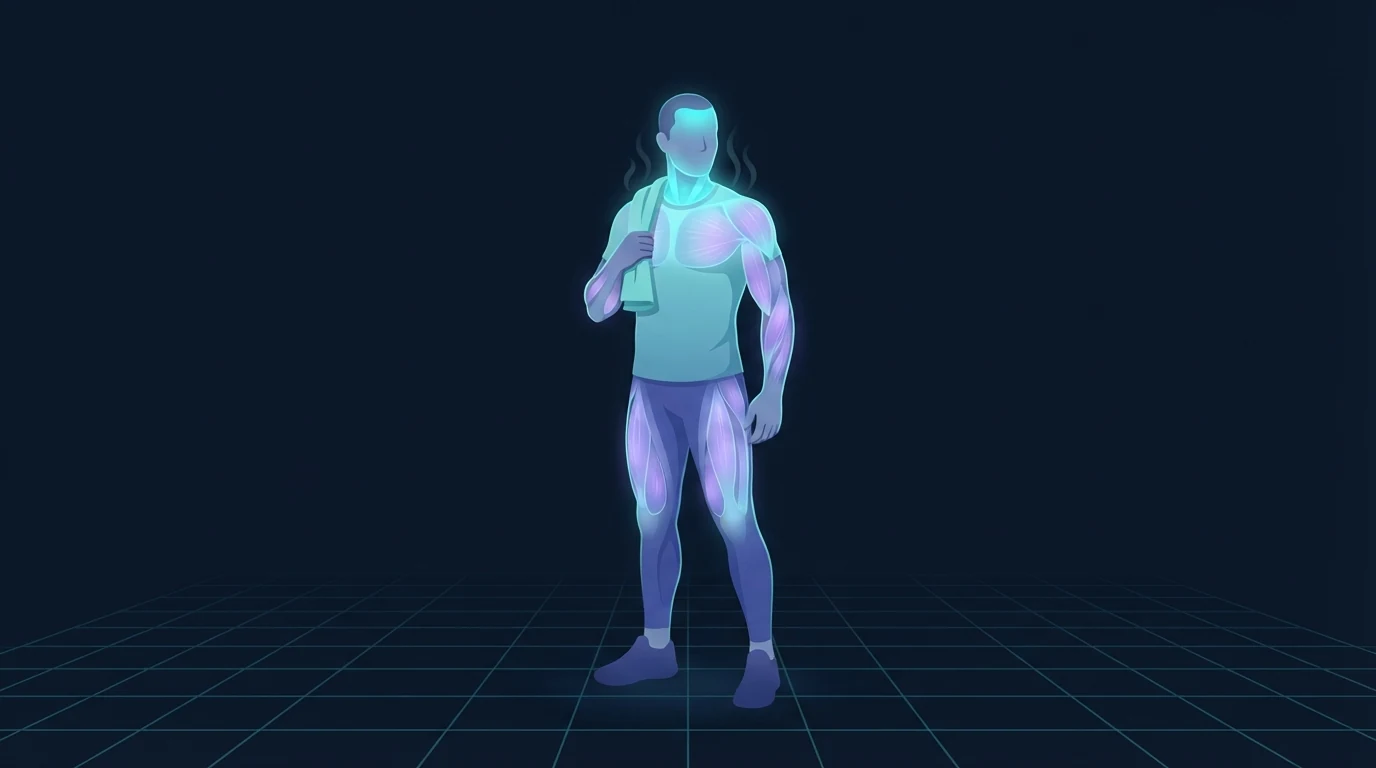
You finish a 30-minute session and your shirt is soaked through. The person beside you did the same class and looks like they walked in off the street. It’s hard not to read that as a verdict on your fitness.
It usually is a verdict, just not the one you think. In most cases the person sweating harder is the one whose cooling system is working better, or the one carrying more body mass through the same workout, or the one standing in a pocket of the room where the air is not moving. None of those are conditioning failures.
Here is what actually sets your sweat rate, what heavy sweating does and does not tell you about your workout, how to work out what you personally need to drink, and the specific situations where sweating is worth a conversation with a doctor.
How sweating actually works
Your muscles are inefficient engines. Most of the energy you spend during exercise becomes heat rather than movement, and that heat has to leave or your core temperature climbs. Once you are working hard, evaporating sweat off your skin is the main way it leaves.
The critical word is evaporating. Sweat sitting on your skin does nothing. Sweat turning into vapour pulls a substantial amount of heat off the body with it, which is why a breeze feels like relief and a humid room feels like punishment even at the same temperature. When you drip, that liquid is heat you produced but did not manage to dump.
The sweat comes from eccrine glands, and you have millions of them distributed very unevenly. Taylor and Machado-Moreira (2013) in Extreme Physiology and Medicine compiled the regional maps and the spread is remarkable: about 530 functioning glands per square centimeter on the volar surface of the fingers, and about 16 per square centimeter on the upper lip. During passive heating the forehead produced the highest local sweat flow at 0.99 mg per square centimeter per minute, while the medial thighs and front of the lower leg produced the least at 0.12. That regional map explains a lot of the everyday weirdness, like a soaked forehead above a dry shin, or hands that get slippery on a pull-up bar long before anything else does.
Baker (2019) in Temperature reviewed the whole system and puts typical whole-body sweat rates during exercise across a wide range, with plenty of healthy adults sitting anywhere between roughly 0.5 and 2.0 liters per hour depending on intensity, heat and individual physiology. That’s a fourfold spread among people who are all completely normal.
Reason 1: You are fitter than you give yourself credit for
This is the finding that surprises people most. Training does not reduce sweating. It increases it, and it makes it start sooner.
Buono and Sjoholm (1988) used pilocarpine iontophoresis to measure sweat gland output directly in 40 volunteers: 10 sedentary men, 10 endurance-trained men, 10 sedentary women, 10 endurance-trained women. Peripheral sweat rate was 6.9 grams per square meter per minute in trained men versus 3.1 in sedentary men, and 6.1 versus 2.5 in women. Sweat rate correlated with maximal oxygen uptake at r = 0.73. Training improved the secretory machinery of the gland itself.
Repeated heat exposure pushes the same adaptations further. Periard, Racinais and Sawka (2015) in the Scandinavian Journal of Medicine and Science in Sports describe heat acclimation producing earlier sweat onset, improved cholinergic sensitivity, larger and more efficient eccrine glands, and resistance to hidromeiosis so that high sweat rates can be sustained rather than fading. Our review of heat acclimation training research goes deeper into how many sessions that takes and what it does to performance.
So when the fit person and the unfit person are both drenched after the same class, they got there by different roads. The fit one is dumping heat efficiently at a comfortable effort. The unfit one is working at a much higher percentage of their capacity, producing more heat relative to what they can handle, and sweating as a consequence rather than as an adaptation.
Reason 2: You are bigger, so you make more heat
Two people doing the same workout are not doing the same amount of work. Carrying a larger body through a squat, a run or a stair climb costs more energy, and more energy spent means more heat produced.
Cramer and Jay (2015) in the Journal of Applied Physiology tested this directly by having subjects exercise across a wide range of heat production rates and evaporation requirements. Their finding was that absolute evaporation requirement and evaporation requirement relative to body surface area primarily determine whole-body and local sweat rate. Once you account for metabolic heat production and body size, aerobic fitness and body fat percentage explain very little of the remaining variation.
That’s a genuinely useful reframe. The heavier person in the class is not sweating because they are unfit. They are sweating because they are moving more mass, generating more heat, and their body is correctly increasing sweat output to deal with it. Height plays into it too, through surface area. A tall, lean 95 kg person and a shorter 95 kg person will not sweat identically.
It also means sweat is a poor comparison tool between people and a decent one within a person. Your own sweat output at a given pace, in a given room, is a reasonable gauge of how hard you are working. Comparing your shirt to someone else's tells you almost nothing.
Reason 3: The room is hotter than you think, and humidity is worse
Air temperature is the obvious variable. Humidity is the one that actually decides how wet you get.
Sweat cools you by evaporating. When the air is already close to saturated, evaporation slows down, so your body responds to a still-rising core temperature by producing even more sweat, which then also fails to evaporate. You end up dripping and still overheating. That’s why a 24 degree Celsius room at 80 percent humidity wrecks people who are fine at 29 degrees in dry air, and why a garage session in August is a different animal from an air-conditioned gym at the same reading on the thermostat.
The practical levers, roughly in order of how much they help:
- Move air across your skin. A fan is the single highest-value purchase for home training. Moving air strips the saturated layer sitting against you and lets evaporation restart.
- Wear less, and wear fabric that lets sweat evaporate. A soaked cotton shirt is an insulating layer that has stopped doing its job.
- Train earlier or later in hot months. Early morning is usually cooler and less humid than late afternoon.
- Pre-cool for very hot sessions. A cold drink or a cool shower beforehand buys you a little headroom on core temperature.
- Give yourself two weeks to adapt to a new climate. Heat acclimation is real and it’s fast, which is precisely why you sweat more, earlier, after a couple of weeks of hot training.
The same physics shows up outdoors, which is why running in the cold feels so much easier for the same pace. We worked through that trade-off in our post on whether it is easier to run in cold or heat.
Knowing what to do is the easy part.
FitCraft, our mobile fitness app, pairs you with an AI coach who builds you a personalized plan around your goals, schedule, and fitness level. Every FitCraft program is designed by Domenic Angelino, MPH (Brown University) and NSCA-CSCS, with research published in the Journal of Strength and Conditioning Research and Medicine & Science in Sports & Exercise.
Take the Free Assessment Free • 2 minutes • No credit cardReason 4: Genetics and sweat gland density
After training status, body size and environment, there’s a residual chunk of variation that’s just you. Baker (2019) reviews the sources: the number of glands you recruit, how much each one secretes, how sensitive they are to the nerve signal that switches them on, and how those glands are distributed across your body.
Total gland count is largely set in early life and does not change with training. What changes is how many of them you actively recruit and how productive each one becomes. Two people with similar gland counts can have very different outputs because one has trained the system and the other has not.
Distribution is inherited too, and it’s why sweating patterns run in families and cluster in odd ways. Some people go through shirts and keep dry hands. Some have palms that slip on a dumbbell in a cool room. Some sweat almost entirely from the head and neck, which is a purely cosmetic problem that happens to be extremely visible, given the forehead is the highest-output region on the body in the Taylor and Machado-Moreira map.
The honest conclusion is that within a very wide band there’s no correct amount of sweat. If you have always been a heavy sweater, that’s a stable trait rather than a symptom. What matters clinically is change, not level.
What heavy sweating does not mean
A few beliefs are worth dismantling directly, because they drive some genuinely unhelpful behaviour.
Sweat is not a measure of calories burned
Sweat is water and electrolytes, and it leaves in response to heat, not in proportion to energy expended. You can sweat heavily sitting in a sauna while burning very little. You can burn a large amount of energy on a cold hike and barely sweat at all. Two sessions with identical energy cost will produce wildly different laundry depending on humidity, airflow and clothing. A soaked shirt is a signal about the thermal environment, not about the work.
Sweating does not burn fat off any body part
Sweat glands sit in the skin. They have no mechanism for pulling fat out of the tissue beneath them, and no amount of sweating over a particular area does anything to the fat stored there. Fat loss happens through a sustained energy deficit across the whole body, and where your body draws from is not something local heat can influence. Waist trainers, sauna suits and heated wraps produce a scale change that is entirely water.
The weight you lose during a workout is fluid
Step on a scale after a hot session and you may be down a kilogram or two. That’s sweat loss, and it returns as soon as you rehydrate. Treating it as fat loss leads people to under-drink on purpose, which makes the next session worse and the one after that worse again. If the number on the scale after training is what is confusing you, our post on why you might be gaining weight while working out untangles water weight from actual body composition change.
Sweat does not detox you
Your liver and kidneys handle that work. Sweat is mostly water and sodium chloride with trace amounts of other substances. Baker (2019) reviewed the proposed non-thermoregulatory roles of sweat and the evidence for meaningful elimination of toxins through the skin is weak. Sweat cools you. That’s the job.
How much to drink, based on your own sweat rate
Generic advice about a fixed number of glasses a day ignores the single biggest variable, which is how much you personally lose. Fortunately you can measure it in one session with a bathroom scale.
The weigh-in method:
- Weigh yourself with no clothes on, right before a typical workout, after using the bathroom.
- Train as normal. Note any fluid you drink during the session.
- Towel off, weigh yourself again with no clothes on, immediately after.
- Sweat loss is roughly: weight before minus weight after, plus whatever you drank during the session. A kilogram of body mass lost is close to a liter of sweat.
Do that two or three times in different conditions, a cool session and a hot one, and you will know your personal range far better than any general rule could tell you. Rates of 0.5 to 2.0 liters per hour are all within normal territory depending on the person and the conditions.
What to do with the number, following the ACSM position stand from Sawka and colleagues (2007):
- Aim to keep in-session losses under about 2 percent of body mass. Past that, performance and thermoregulation start to suffer measurably. For an 80 kg person that’s about 1.6 kg, which a hot hour can reach easily.
- Replace roughly 1.25 to 1.5 liters per kilogram lost. The extra above one-for-one covers what you will lose in urine while rehydrating.
- Spread it over a few hours. Drinking a liter in five minutes mostly produces a trip to the bathroom.
- Include sodium if the session was long or very sweaty. Salty food works. So does an electrolyte drink. White salt crusts on your clothing or a stinging sensation in your eyes are useful signs that your sweat runs salty.
- Use urine colour as a rough daily check. Pale straw is the target. Consistently dark suggests you are behind.
Do not overcorrect. Drinking far beyond your losses during long endurance events can dilute blood sodium, which is a genuine medical emergency. The goal is matching what you lost, not maximizing intake.
When heavy sweating is worth a doctor's visit
Sweating hard during hard exercise in a warm room is normal physiology. Sweating hard without that context is a different thing, and it has a name.
Primary hyperhidrosis is excessive sweating not driven by heat or exertion. It usually shows up on the palms, soles, underarms or face, tends to be symmetrical, and typically begins in childhood or adolescence. It is far more common than most people assume. Doolittle, Walker, Mills and Thurston (2016) surveyed a nationally representative sample of 8,160 people in Archives of Dermatological Research and put United States prevalence at 4.8 percent, roughly 15.3 million people. Seventy percent described their excessive sweating as severe in at least one body area, and only about half had ever raised it with a healthcare professional. It’s treatable, and most people never ask.
Signs that are worth booking an appointment for:
- New, unexplained heavy sweating that is a clear change from your normal pattern, especially in adulthood.
- Night sweats that soak your bedding, particularly with fever or unintended weight loss.
- Sweating on one side of the body only, or in one clearly asymmetric patch.
- Sweating with chest pain, a racing or irregular heartbeat, shortness of breath, or lightheadedness. Treat this as urgent rather than a fitness question.
- Sweating with tremor, heat intolerance, unexplained weight change or anxiety symptoms, which can point to thyroid or hormonal causes.
- Sweating that stops during hard work in the heat while you feel hot, dizzy, nauseated or confused. Stop, cool down and seek help, because that pattern can signal heat illness. Our post on feeling sick after working out covers where that line sits.
- Sweating that is interfering with your life, work, relationships or willingness to exercise at all. That alone is a valid reason to seek treatment.
What this means for you
The most useful thing you can do with all of this is stop reading your shirt as a scorecard. Sweat volume tells you about heat and environment. It does not rank you against the person on the next mat, and it does not measure the value of the session you just finished.
What it can do is give you your own baseline. Learn your sweat rate with two weigh-ins, set up a fan, dress for evaporation rather than modesty, and drink back what you actually lost. Those four things will make hot sessions feel dramatically better within a couple of weeks, partly because you are managing the heat and partly because heat acclimation is quietly doing its work in the background.
And if self-consciousness about sweating is the thing keeping you out of a class or out of the gym entirely, training at home removes the audience without removing the workout. If that sounds like the version you would actually stick with, our roundup of the best fitness apps for beginners compares the options built for people starting from zero at home.
Frequently Asked Questions
Why do I sweat so much when I workout?
Usually because you are fitter, bigger, or training somewhere hotter than you realize, and often all three. Sweat is how your body dumps the heat your muscles generate, and training makes that system better at its job. Buono and Sjoholm (1988) measured peripheral sweat production in 40 adults and found trained men and women sweating at roughly twice the rate of sedentary men and women, with sweat rate correlated to maximal oxygen uptake at r = 0.73. Body size matters too, because a larger body produces more heat at the same workload. Sweating a lot during exercise is almost always a working cooling system, not a broken one.
Does sweating more mean you are burning more calories?
No. Sweat is water and electrolytes leaving your skin to carry heat away, and the weight you lose during a sweaty session is fluid that comes straight back when you drink. You can sweat heavily in a sauna while burning almost nothing, and you can burn a lot of energy on a cold walk while barely sweating at all. Heat production and energy expenditure are related, but sweat rate is not a measurement of either, because humidity, clothing, airflow and your own sweat gland output all change how much liquid ends up on your skin for the same amount of work.
Does sweating a lot mean you are out of shape?
Usually the opposite. Trained people start sweating sooner, at a lower core temperature, and at a higher rate. Periard, Racinais and Sawka (2015) describe heat acclimation producing exactly those adaptations: earlier sweat onset, larger and more efficient eccrine glands, and higher sustainable sweat rates. So the fit person and the unfit person doing the same class can both end up soaked for opposite reasons. The fit one is cooling efficiently, and the unfit one is working at a far higher percentage of their capacity to keep up.
Why do I sweat so much more than other people at the gym?
Four things account for most of it: training status, body size, where the heat has to go, and your own sweat gland biology. Cramer and Jay (2015) found that metabolic heat production and body surface area explain most of the variance in whole-body sweat rate, with aerobic fitness and body fat adding little once size and heat production are accounted for. Gland density and output vary a lot between people and across the body. Taylor and Machado-Moreira (2013) mapped 530 glands per square centimeter on the fingers versus 16 on the upper lip. Some of that variation is simply inherited.
How much water should I drink after a sweaty workout?
Measure instead of guessing. Weigh yourself without clothes before and after a typical session, note anything you drank during it, and the difference is close to your sweat loss for that session. The ACSM position stand from Sawka and colleagues (2007) recommends replacing roughly 1.25 to 1.5 liters of fluid for every kilogram of body mass lost, spread over the following few hours rather than swallowed at once. Add sodium through food or an electrolyte drink if the session was long, very sweaty, or left white salt marks on your clothing.
Is it bad if I do not sweat much during exercise?
Not on its own. Light sweating in a cool, dry, breezy room can mean the sweat is evaporating as fast as it appears, which is the system working perfectly. What is worth attention is a sudden change: if you stop sweating during hard work in the heat and start feeling hot, dizzy, confused or unusually flushed with dry skin, stop immediately and cool down, because that combination can signal heat illness. Certain medications and skin or nerve conditions can also reduce sweating, so a persistent unexplained drop is worth raising with a clinician.
When is excessive sweating a medical problem?
When it happens without a reason. Primary hyperhidrosis is excessive sweating that is not driven by heat or exertion, typically on the palms, soles, underarms or face, often symmetrical, often starting before adulthood. Doolittle and colleagues (2016) surveyed a nationally representative United States sample and put prevalence at 4.8 percent, roughly 15.3 million people, and found only about half had ever raised it with a healthcare professional. See a doctor if the sweating is new and unexplained, wakes you at night, is one-sided, or comes with fever, unintended weight loss, a racing heart or chest symptoms.