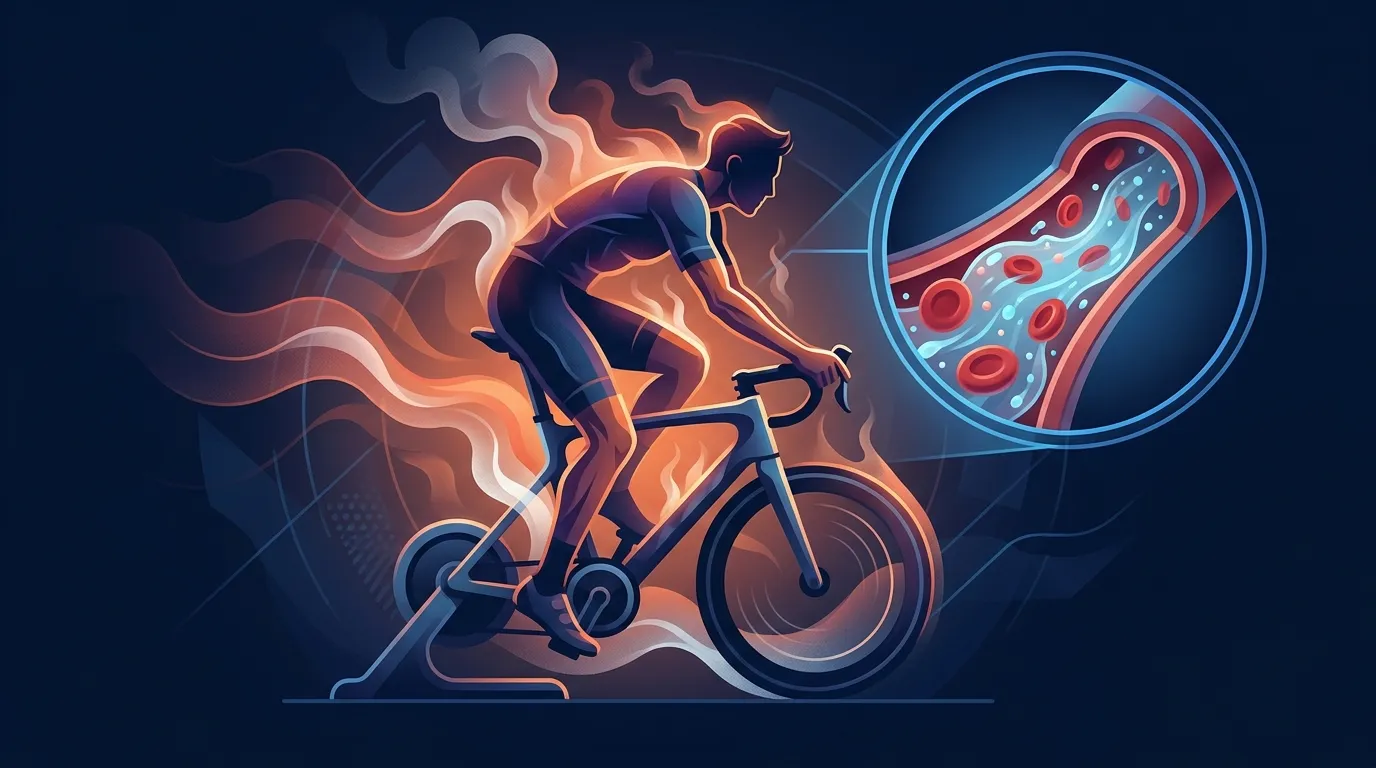
Heat acclimation sits in an interesting spot in the endurance training toolkit. Most athletes think of it as something you do in the two weeks before a hot race, and then never think about again. That framing undersells it. The adaptations are genuinely large in the heat itself (an average +144 seconds of time-to-exhaustion in the heat, with a Hedges' g of 0.86 in the 2019 Benjamin meta-analysis, is bigger than what most nutritional interventions deliver) and they arrive on a predictable timeline. Two weeks in, you have a different cardiovascular system for hot conditions than you had when you started.
The mechanism is unusually clean for a training adaptation. Exercise in the heat forces the body to solve two problems at once. It has to move blood to the working muscles to deliver oxygen. And it has to move blood to the skin to dump heat through sweating and skin vasodilation. Repeated exposure over 10 to 14 days improves both sides of that tradeoff. Plasma volume expands, giving the heart more preload and a bigger effective circulating volume. Sweat starts earlier and runs at a higher rate for the same core temperature. Skin blood flow increases. The heart works less hard for the same output. All of this compounds.
The short version, in case you skip the rest: 10 to 14 daily sessions of roughly 60 to 90 minutes of exercise in a hot environment (about 35 to 40 degrees Celsius) drives the full adaptation. If you cannot access that environment, 30 to 45 minutes in a sauna or hot bath immediately after a normal training session reproduces most of the physiological adaptations, though with less certain performance transfer. Two to three heat sessions per week maintains the adaptation. Expect a large benefit in hot-weather performance, and a small or absent benefit in cool weather.
The Research: What Studies Show
Benjamin 2019: The Meta-Analysis of Performance Change
The most useful synthesis of the performance side of the literature is Benjamin, Sekiguchi, Fry, and Casa (2019), published in Frontiers in Physiology. Their meta-analysis and meta-regression pooled trials that measured exercise performance before and after heat acclimation and grouped the outcomes by test type. Five test categories emerged with meaningful sample sizes.
Time-to-exhaustion in the heat showed the largest effect (Hedge's g 0.86, roughly a 144-second gain on average). Time-trial performance in the heat showed a moderate effect (g 0.49, about 46 seconds faster on the tested distance). Mean power output (g 0.37, +12 watts on average), VO2 max (g 0.30, +1.32 ml/kg/min), and peak power (g 0.29, +15 watts) all showed smaller but still positive changes. The pattern is what you would expect from the mechanism: capacity measures (how long can you hold a hard pace before failing?) respond more strongly than pure-speed measures (how fast can you go over a fixed distance?), because the added plasma volume and improved cooling relieve the cardiovascular limiter that ends a hot session, but do not fundamentally raise the ceiling on maximal power.
Benjamin and colleagues also situated the performance changes against the well-established physiological signatures of heat acclimation. Consistent with the classical literature they cite, internal body temperature at a given workload typically drops by an average of about 0.31 degrees Celsius after a completed block, and heart rate at the same workload drops by roughly 12 beats per minute. Those two numbers are the classic thermoregulatory fingerprints of a completed heat acclimation block.
Those sweat adaptations are also why so many people notice they start dripping earlier after a few weeks of hot training, a question our post on why you sweat so much during a workout takes apart in plain terms.
Rahimi 2019: The RCT-Only Physiological Synthesis
A separate meta-analysis, restricted to randomized controlled trials, ran in parallel. Rahimi, Albanaqi, Van der Touw, and Smart (2019), publishing in the Journal of Sports Science & Medicine, pooled 11 RCTs and 215 participants (mean age 26, 91 percent male). The tighter inclusion criteria produced a more conservative estimate of some of the physiological changes, but the direction held.
Time-trial performance improved significantly (p=0.04). Maximum heart rate dropped by an average of 7 beats per minute (p=0.03). Exercise heart rate at submaximal loads and plasma volume changes did not reach significance in this restricted RCT-only pool, though this contrasts with the broader literature and likely reflects the smaller number of trials and the shorter protocols in some of the included studies. When the observational and non-randomized trials are included (as in Benjamin 2019 and the wider Periard 2015 review), plasma volume expansion of 5 to 7 percent is one of the most consistent findings in the field.
The takeaway from the two 2019 meta-analyses read together: performance in the heat improves reliably, and the physiological adaptations that drive that improvement (lower core temperature, lower cardiovascular strain, better sweat response) are real, even if the RCT-only pool sometimes underpowers the individual physiological outcomes.
Solomon & Laye 2025: The Passive Heat Question
A more recent question in the literature is whether you actually need to train in the heat to get most of the benefit. The Solomon and Laye (2025) systematic review and meta-analysis, published in BMC Sports Science, Medicine and Rehabilitation, tackled that question directly. They pooled 10 studies covering 199 participants and asked what post-exercise passive heat exposure (typically a sauna session or hot water immersion for 30 to 40 minutes immediately after a normal workout) does for endurance performance in the heat.
The pooled ratio of means came in at 1.04, which the authors correctly labeled a "trivial" effect on performance. The certainty of evidence across all measured outcomes was rated low. That is a more honest read of the passive-heat literature than most fitness content offers. The physiological adaptations from passive heat exposure (plasma volume expansion, thermoregulatory changes) are well documented, but they do not reliably translate into the same magnitude of performance improvement that active exercise-heat acclimation produces.
Passive post-exercise heat is not useless. It is a legitimate substitute when you cannot train in the heat directly (winter athletes preparing for a summer race, athletes recovering from an injury, athletes without access to a climate chamber or hot outdoor environment). But if the outdoor or garage-gym option is available, active heat acclimation is the higher-yield protocol.
Periard 2015: The Mechanistic Reference
The reference physiology review for the field is Periard, Racinais, and Sawka (2015), published in the Scandinavian Journal of Medicine & Science in Sports as part of a special issue on competitive sports in the heat. It is not a meta-analysis; it is a synthesis of the mechanistic literature, and it is the paper most working exercise physiologists cite when they need to explain what heat acclimation is actually doing at the tissue level.
The core adaptations Periard and colleagues describe: plasma volume expands by roughly 5 to 7 percent within the first week, driven by aldosterone-mediated sodium retention and albumin synthesis; total body water rises by 2 to 3 liters; exercising heart rate falls at the same submaximal workload; core and skin temperatures at a given intensity both drop; sweating begins at a lower core temperature and reaches a higher peak rate; the sweat itself becomes more dilute (lower sodium concentration, sparing electrolytes); and stroke volume rises to defend cardiac output despite lower heart rate. The cardiovascular adaptations are the load-bearing piece for performance in the heat. Better plasma volume means better preload, better cooling means less blood diverted to the skin per unit of heat produced, and the two together mean a bigger fraction of cardiac output can go where it needs to go: to working muscle.
Richard 2025: Maintaining the Adaptation
One of the most practically important recent studies is Richard and colleagues (2025), published in Physiological Reports. It addressed a gap in the literature: most trials look at the loading block, few look at what happens next. Richard and colleagues randomized 15 endurance-trained females (ages 18 to 55, 11 in the experimental arm and 4 in the control arm) to complete 10 sessions of home-based heat adaptation over 2 weeks (50 minutes of stationary cycling at 70 to 75 percent max heart rate while overdressed to trap heat), then had the experimental arm do 9 heat maintenance sessions across the next 3 weeks.
The result: heat adaptation was not just maintained, it was potentiated. The 3-week maintenance block preserved the gains from the loading block and, on some measures, added to them. The practical implication is important. Athletes worried that they cannot sustain daily 60-to-90-minute heat sessions for months on end can load hard for 10 to 14 days, then transition to 2 or 3 sessions per week and hold the adaptation indefinitely. It also validates the low-tech home protocol (a stationary bike, overdressing, and a garage) as a legitimate acclimation stimulus for people without access to a heat chamber.
How Heat Acclimation Actually Works
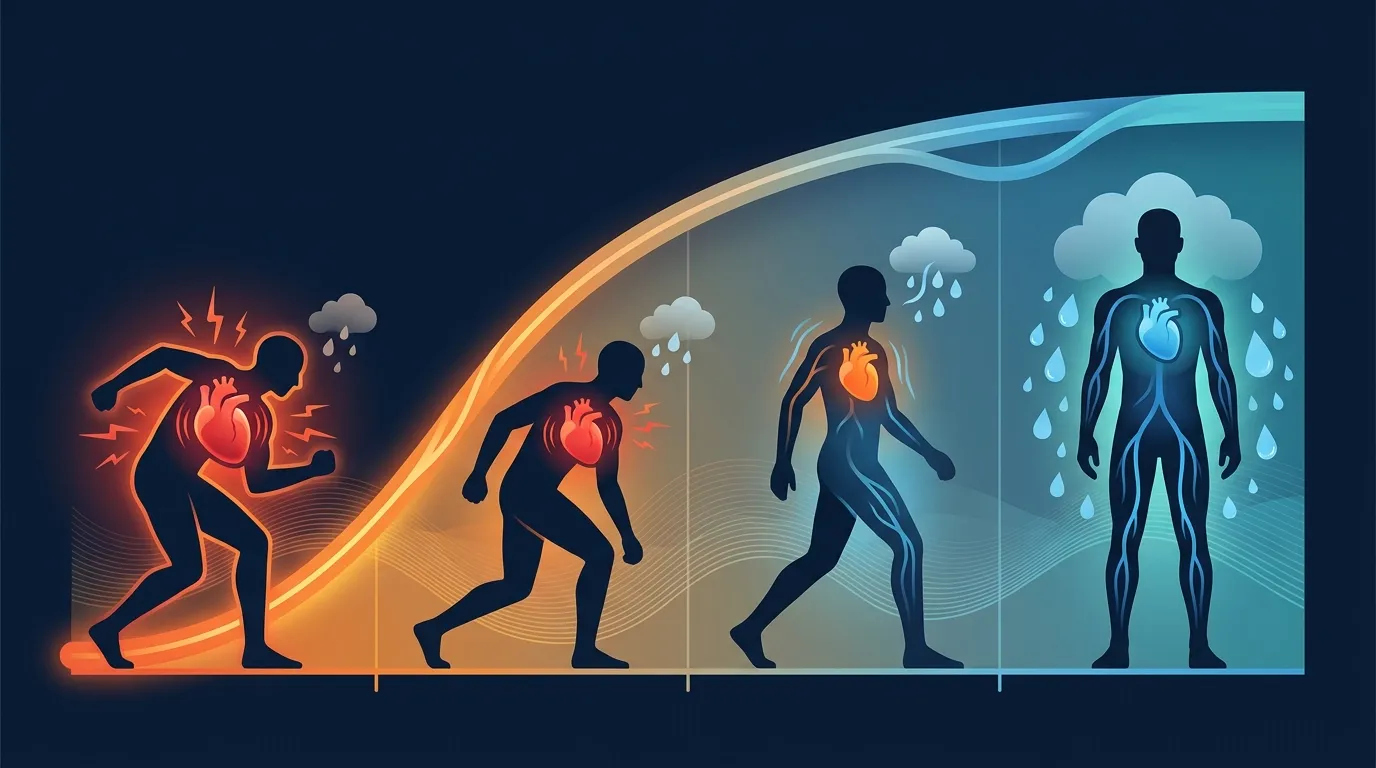
The chain of adaptations is worth walking through step by step, because it explains both the timeline and the ceiling.
The first thing that happens, within the first three to five sessions, is plasma volume expansion. Repeated exercise-heat stress raises aldosterone, which drives the kidneys to retain sodium, which pulls water into the vascular space. Albumin synthesis in the liver also rises, which increases plasma oncotic pressure and holds fluid in circulation. The net effect is a 5 to 7 percent expansion of plasma volume within the first week. That expansion is doing most of the work behind the visible cardiovascular changes: more circulating volume means better cardiac preload, better stroke volume, and a lower heart rate at any given workload.
The second wave of adaptation shows up in the sweat response. In an unacclimated person, sweating begins only after core temperature has already climbed meaningfully. In an acclimated person, sweating begins earlier (at a lower core temperature) and reaches a higher peak rate. The sweat also becomes more dilute, because the sweat glands get better at reabsorbing sodium before the sweat reaches the skin. That is why heat-acclimated athletes can defend their electrolyte balance better than unacclimated athletes even while sweating substantially more volume.
The third adaptation is skin blood flow. The vasculature at the skin becomes better at diverting blood to the surface for radiative and evaporative cooling at any given core temperature, and it does so with less overshoot. This is what lowers the perceived exertion at a given workload in the heat, and it is what allows sustained pace where an unacclimated athlete would need to slow down to keep core temperature under control.
The fourth adaptation, which the Periard review emphasizes, is the metabolic side. There is some evidence, though less consistent than the cardiovascular data, that acclimated muscle uses glycogen slightly more sparingly at a given submaximal power output, which would preserve fuel later into a long effort. This is one of the proposed mechanisms behind the (contested) cool-weather transfer.
All four adaptations peak somewhere in the 10-to-14-day window with daily training. Longer loading blocks (15+ sessions) produce more complete sudomotor adaptations, particularly around sweat sodium concentration, but the cardiovascular changes are largely done by the two-week mark. This is why the reference protocol in the literature is 10 to 14 days of daily exercise-heat exposure. It is the shortest block that captures the bulk of the benefit.
Get an evidence-based plan built for you
FitCraft, our mobile fitness app, pairs you with an AI coach who builds you a personalized plan around your goals, schedule, and fitness level. Every FitCraft program is designed by Domenic Angelino, MPH (Brown University) and NSCA-CSCS, with research published in the Journal of Strength and Conditioning Research and Medicine & Science in Sports & Exercise.
Take the Free Assessment Free • 2 minutes • No credit cardRunning the Protocol in the Real World
Three protocols cover most real-world use cases. Pick based on access.
Option 1: Active Exercise-Heat Acclimation (Highest Yield)
The gold standard. Ten to fourteen consecutive daily sessions of 60 to 90 minutes of exercise (cycling, running, or rowing) in a hot environment: roughly 35 to 40 degrees Celsius (95 to 104 Fahrenheit) ambient, 40 to 60 percent relative humidity. Intensity is moderate: 50 to 65 percent VO2 max, or something in the zone 2 to low zone 3 range. Core temperature should climb to about 38.5 to 39 degrees Celsius (101.3 to 102.2 Fahrenheit) during the session. That is a normal exertional range, not a fever range.
Access options without a chamber: outdoor training in summer heat, a heated garage gym, a wearable heat-retaining suit or extra layers over a normal indoor session, or an indoor cycling setup in a small enclosed room with the heat cranked. The Richard 2025 protocol used overdressing on a stationary bike as the heat retention method, which reliably drove core temperature into the target range with equipment most home exercisers already own.
Hydration matters more than usual during a loading block. Drink to thirst plus a small margin, include sodium (400 to 800 mg per liter of fluid), and weigh in before and after each session to track fluid loss. A large session can pull 1 to 2 liters of sweat; replacing 80 to 100 percent of that between sessions is a workable rule.
Option 2: Post-Exercise Passive Heat (Moderate Yield)
After a normal moderate-intensity training session, spend 30 to 45 minutes in a sauna (around 80 to 90 degrees Celsius) or a hot bath (around 40 degrees Celsius). Do this 4 to 6 days per week for 3 to 4 weeks. Physiological adaptations (plasma volume expansion, thermoregulatory changes) are reproducible with this approach. Performance transfer is smaller and more variable than with active heat, as the 2025 Solomon & Laye meta-analysis showed. Use this when active heat is not accessible.
The safety envelope is narrower with passive heat. Do not extend a sauna session past 20 to 30 minutes in one sitting, split longer exposures with cool-off breaks, drink through the session, and stop early on any dizziness, nausea, or unusual cardiovascular symptoms. Passive heat combined with post-workout fatigue and dehydration is the setting where most sauna-related medical events happen.
Option 3: Maintenance After a Loading Block
Once you have completed a 10-to-14-day loading block, drop to 2 or 3 heat sessions per week to maintain the adaptation. This can be a mix of exercise-in-the-heat sessions and post-exercise sauna or hot bath sessions. The Richard 2025 data show that 3 sessions per week over 3 weeks not only maintained the loading-block gains but modestly potentiated them. Adaptations meaningfully decay after roughly 2 to 4 weeks of fully thermoneutral training, so maintenance is the difference between a two-week peak and an indefinite baseline.
Cool-Weather Transfer: What the Evidence Actually Says
The single most oversold claim about heat acclimation in the popular fitness literature is that it works like altitude training in reverse and gives you a "free" boost to sea-level, cool-weather performance. The evidence is more nuanced than that.
The mechanistic case is real. Plasma volume expansion is a general cardiovascular upgrade, not a hot-weather-only adaptation. A bigger circulating volume means better stroke volume, better cardiac preload, and more oxygen delivery even in temperate conditions. That is why some researchers (notably Minson and Cotter) have argued that heat acclimation should give a modest cool-weather boost. The proposed pathways include plasma volume expansion, glycogen sparing, improved lactate threshold, and improved skeletal muscle function.
The empirical case is weaker and contested. Multiple trials in well-trained male cyclists have found that VO2 peak and time-trial performance in cool conditions are unchanged after 10 to 14 days of active heat acclimation. Other trials report modest gains of a few percent. The current consensus, best captured in the Periard review, is that heat acclimation may confer small cool-weather benefits in some athletes and some conditions, but it is not a reliable replacement for altitude training, standard periodization, or targeted VO2 max work. Do not skip your normal training and do a heat block expecting a big cool-weather PR. Do add a heat block before a hot race and expect a large hot-weather PR.
Common Misconceptions
Misconception 1: "Sweating means you're acclimating."
Not quite. Sweating means your body is producing heat and dumping it, which happens whether you are acclimated or not. What changes with acclimation is the timing (sweat starts at a lower core temperature), the volume (sweat rate rises), and the composition (sweat becomes more dilute). An unacclimated person can sweat heavily in the heat and still be at high thermal strain. Acclimation is measured by lower core temperature and heart rate at the same workload, not by how visibly sweaty you get.
Misconception 2: "A few sauna sessions a week gives you full acclimation."
The 2025 meta-analysis by Solomon and Laye is the cleanest counter to this. Post-exercise passive heat reliably produces some of the physiological adaptations (plasma volume expansion is the most consistent) but the performance transfer is trivial on average. If your goal is to reliably lower your finish time in a hot race, active exercise-heat acclimation for 10 to 14 daily sessions is the higher-confidence intervention. Sauna alone is a maintenance tool or an access-limited substitute, not a full replacement.
Misconception 3: "Heat acclimation is like altitude training in reverse."
The analogy is intuitive but the evidence does not fully support it. Altitude training reliably improves hemoglobin mass and cool-weather sea-level performance in the athletes who respond. Heat acclimation reliably improves hot-weather performance but the cool-weather transfer is small, contested, and inconsistent across trials. Treat the two as complementary tools with distinct primary purposes, not as substitutes.
Misconception 4: "You lose all the adaptation the moment you stop."
Decay is real but slower than most people assume. The plasma volume gains dissipate over about 2 to 4 weeks of fully thermoneutral training. The Richard 2025 data show that just 2 to 3 heat sessions per week is enough to maintain and even potentiate the adaptation. This means a summer-primed athlete who moves indoors in autumn does not lose everything after a bad week. It also means that a low-frequency year-round heat protocol (a post-workout sauna twice a week, for example) can hold a partial adaptation without a full re-loading block.
What the Research Suggests Going Forward
The heat acclimation literature is unusually mature for a training intervention. The direction (large improvement in hot-weather performance, small and contested cool-weather transfer), the mechanism (plasma volume expansion, improved sweat response, lower cardiovascular strain), the timeline (bulk of the adaptation in 10 to 14 daily sessions), and the maintenance envelope (2 to 3 sessions per week to hold gains) are all well characterized. The 2019 meta-analyses from Benjamin and Rahimi anchor the effect sizes. The 2015 Periard review anchors the mechanism.
What is still open:
- Whether the cool-weather transfer, when it appears, is driven primarily by plasma volume expansion or by additional mechanisms like improved myocardial function or metabolic changes. Better-controlled trials in well-trained athletes with adequate control groups would help resolve this.
- How much the female data set changes the picture. Most classical heat acclimation trials ran in young men. The 2025 Richard trial in trained females is one of a small but growing set of female-specific studies. Whether hormonal cycling, baseline plasma volume differences, and sweat characteristics modify the ideal protocol is an active area of research.
- Whether the Solomon & Laye 2025 "trivial performance effect" of passive post-exercise heat can be improved by combining it with specific active training (e.g., higher intensity, longer sessions, or targeted intervals) rather than the standard-intensity workouts most of the included trials used.
- Whether heat-plus-hypoxia cross-adaptation is meaningfully additive or largely redundant. Early cross-adaptation reviews are encouraging but the trial base is still small.
- What the older adult response looks like. Most acclimation trials are in adults under 40. Whether the protocol works the same way, at the same magnitude, in adults over 60 (whose thermoregulatory capacity is generally reduced) is not well established.
The practical takeaway for someone deciding whether to add heat acclimation: if you have a hot race, expedition, tournament, or outdoor summer job coming up, a 10-to-14-day loading block is one of the highest-yield short-term training interventions available. The effect size on hot-condition endurance is larger than what most nutritional or supplement interventions deliver. If your goal is a cool-weather PR, the case is weaker and the evidence more mixed, and your training time is better spent on zone 2 base work, threshold intervals, and standard periodization.
And if you are not training consistently in the first place, no amount of heat exposure closes that gap. The habit is the multiplier, and it costs nothing to build.
References
- Solomon TPJ, Laye MJ. "The effect of post-exercise heat exposure (passive heat acclimation) on endurance exercise performance: a systematic review and meta-analysis." BMC Sports Sci Med Rehabil. 2025;17(1):4. doi:10.1186/s13102-024-01038-6
- Benjamin CL, Sekiguchi Y, Fry LA, Casa DJ. "Performance Changes Following Heat Acclimation and the Factors That Influence These Changes: Meta-Analysis and Meta-Regression." Front Physiol. 2019;10:1448. doi:10.3389/fphys.2019.01448
- Rahimi GRM, Albanaqi AL, Van der Touw T, Smart NA. "Physiological Responses to Heat Acclimation: A Systematic Review and Meta-Analysis of Randomized Controlled Trials." J Sports Sci Med. 2019;18(2):316-326. PMC6543994
- Periard JD, Racinais S, Sawka MN. "Adaptations and mechanisms of human heat acclimation: Applications for competitive athletes and sports." Scand J Med Sci Sports. 2015;25(Suppl 1):20-38. doi:10.1111/sms.12408
- Richard NA, Cheung SS, Koehle MS, Claydon VE, Fenuta AM, Cote AT. "Three weeks of heat maintenance potentiates the benefits of heat acclimation in trained females." Physiol Rep. 2025;13(21):e70631. doi:10.14814/phy2.70631
Frequently Asked Questions
How long does it take to become heat-acclimated?
The bulk of the useful adaptations show up within 10 to 14 daily sessions of roughly 60 to 90 minutes of exercise in a hot environment (about 35 to 40 degrees Celsius, roughly 95 to 104 degrees Fahrenheit). Plasma volume expands within the first week (Periard et al., 2015). Exercising heart rate drops, core temperature at a given workload falls by about 0.31 degrees Celsius, and time-to-exhaustion in the heat improves substantially after the full 2-week block (Benjamin et al., 2019, reported +144 seconds on average, Hedges' g 0.86). Short-term protocols under 7 days give partial adaptations. Long-term protocols beyond 15 sessions produce the most complete sudomotor changes.
Does post-exercise sauna or hot bath give the same benefit as training in the heat?
Partially. Passive post-exercise heat exposure (sauna or hot water immersion for roughly 30 to 45 minutes after a normal workout) reliably reproduces the plasma volume and thermoregulatory adaptations, but the 2025 meta-analysis by Solomon and Laye pooled 10 studies and 199 participants and found only a trivial effect on hot-condition endurance performance (ratio of means 1.04, low certainty). Passive heat is a legitimate option for athletes who cannot train in the heat, but the performance transfer is smaller and less reliable than active training-in-the-heat protocols.
Does heat training help you in cool weather too?
The cool-weather transfer is real but small and contested. The main mechanism is plasma volume expansion (roughly 5 to 7 percent, per Periard et al., 2015), which theoretically improves cardiac output and cooling capacity even in temperate conditions. Some trials in trained cyclists show no VO2 max or time-trial gain in cool conditions after 10 to 14 days of heat acclimation, while other trials report modest gains. The takeaway from the current literature: expect a large benefit in the heat, and a small or absent benefit in the cool. Heat acclimation is not a replacement for altitude training or standard periodization.
How do I keep the adaptations once I stop the daily heat exposure?
The adaptations decay over about 2 to 4 weeks if you go back to fully thermoneutral training. Richard and colleagues (2025) showed that trained females who completed 10 heat sessions and then did just 3 heat sessions per week for 3 weeks retained and even potentiated the initial gains. Practically: two or three heat sessions per week (whether training in the heat, using a hot bath, or a sauna after a normal workout) is enough to hold the adaptation between full re-loading blocks.
Is heat acclimation safe for a recreational exerciser?
For a healthy adult, yes, with sensible dosing. Rectal core temperature during a heat session typically climbs to about 38.5 to 39 degrees Celsius, which is normal exertional territory. The risks come from doing too much too soon (heat exhaustion, hyponatremia from over-drinking, syncope) or heat-stacking on top of dehydration, illness, or medications that impair heat dissipation. Start with shorter sessions (30 to 45 minutes), drink to thirst plus electrolytes, and stop early on any dizziness, nausea, cramping, or unusually elevated heart rate. Anyone with cardiovascular disease, uncontrolled hypertension, or a history of heat illness should clear the protocol with a clinician first.