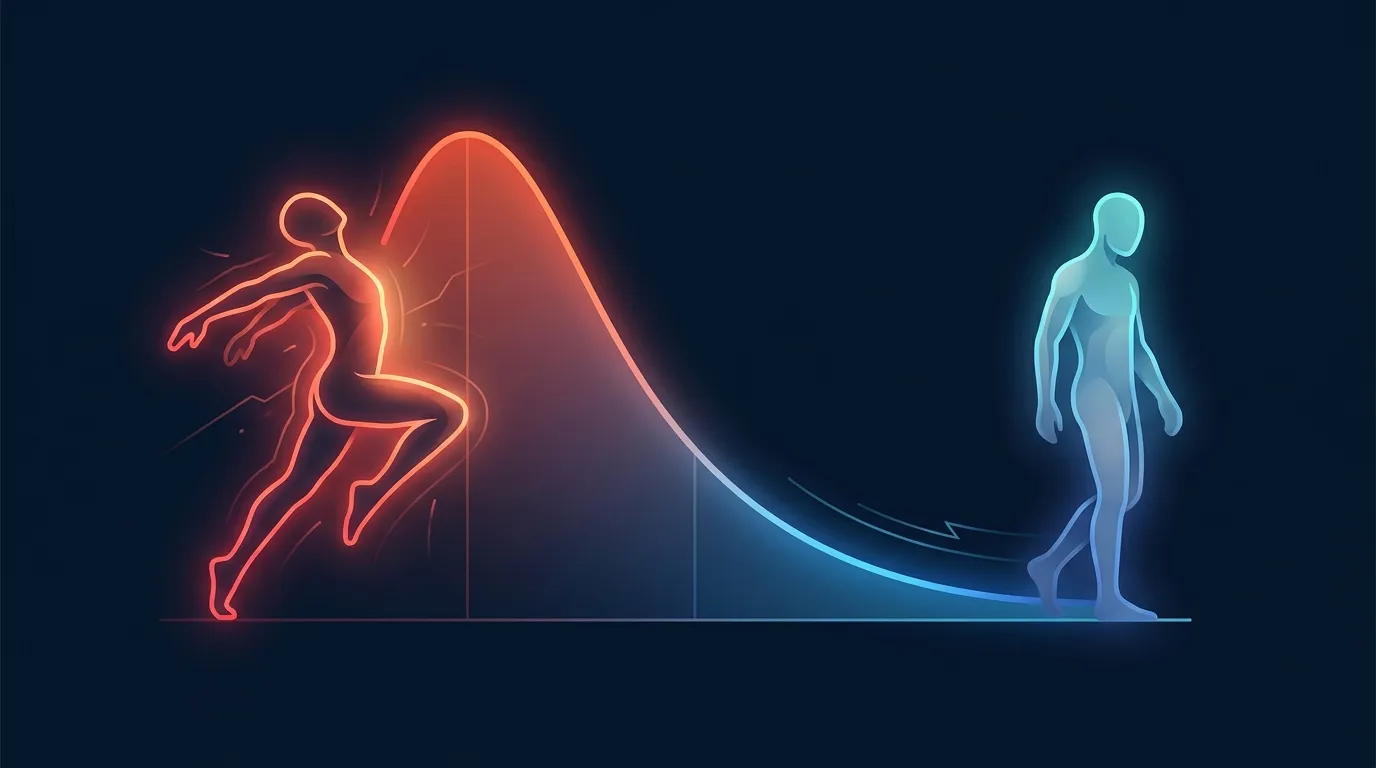
You have probably seen the claim. "HIIT keeps burning calories for 24 hours after you stop." It is the marketing hook for half the cardio classes ever invented and most of the high-intensity apps on the App Store. The mechanism it points to is real. The size of the effect is not what the ads suggest.
Excess post-exercise oxygen consumption (EPOC) is the period after a workout when your body keeps using more oxygen than it would at rest. That extra oxygen costs calories. The pitch wraps a kernel of true physiology in a layer of inflated numbers. The kernel is right. The layer needs unwrapping.
This piece walks through the actual data. How big is EPOC, how long does it last, which modalities produce more of it, and what it means for someone trying to lose fat or stay consistent. We covered the related question of which workout type wins for fat loss in our piece on HIIT vs steady-state cardio; this article zooms in on the specific afterburn mechanism.
The Research: What Studies Show
LaForgia 2006: The 6 to 15 Percent Rule
The most-cited synthesis of the EPOC literature is LaForgia, Withers, and Gore (2006) in the Journal of Sports Sciences. The team reviewed decades of EPOC research and put a number on it: across submaximal and supramaximal exercise, EPOC accounts for only 6 to 15 percent of the net total oxygen cost of the exercise that produced it. So if a workout burns 300 kcal during the session, EPOC adds another 18 to 45 kcal afterward. That is not nothing. It is also not the calorie inferno some marketing implies.
The review also clarified the dose-response. Prolonged EPOC (lasting 3 to 24 hours) requires either submaximal work of at least 50 minutes at 70 percent of VO2 max or supramaximal intervals of at least 6 minutes total at 105 percent of VO2 max. Those are not casual conditions. A typical 25-minute moderate workout falls well below the threshold for a long-tail afterburn.
Important context. The 6 to 15 percent figure is across the literature, not a ceiling on every workout. Some sessions land at the higher end. Most fall in the middle. None of the reviewed work supports an afterburn that doubles or triples session calories.
Borsheim and Bahr 2003: Intensity Drives It More Than Duration
Earlier and equally influential is Borsheim and Bahr (2003) in Sports Medicine. The team mapped the relationship between exercise variables and EPOC across the full available literature. Two findings stand out.
First, the relationship between intensity and EPOC is curvilinear. Doubling intensity does more than double the EPOC. So an all-out interval session of the same total work as a moderate steady jog will produce more afterburn. The math favors intensity, but it favors it within real biological limits, not the cartoon numbers in HIIT marketing.
Second, the relationship between duration and EPOC is roughly linear, especially at higher intensities. Longer sessions produce more afterburn. The combined picture: high-intensity, longer-duration work produces the largest EPOC. Short, moderate sessions produce the smallest. Most app workouts that promise "explosive afterburn" are short, moderate sessions.
Borsheim and Bahr also documented something the marketing usually omits. The rapid phase of EPOC, which accounts for the bulk of the calorie effect, is mostly resolved within roughly an hour. The slower component can extend further but contributes far fewer calories per hour. The "24 hours of elevated metabolism" framing collapses these two phases together and treats the slow tail as if it had the magnitude of the early peak. It does not.
Skelly 2014: The 24-Hour Reality Check
The cleanest direct test of the HIIT-afterburn pitch is Skelly, Andrews, Gillen, Martin, Percival, and Gibala (2014) in Applied Physiology, Nutrition, and Metabolism. The team put participants in a metabolic chamber, the gold-standard tool for measuring 24-hour energy expenditure, and compared two days. One day they performed HIIT (4 sets of 30-second sprints with recovery, plus warmup and cooldown). The other day they performed 50 minutes of continuous moderate endurance cycling.
The result. Oxygen consumption during HIIT was lower than during the continuous session, because the continuous session was longer. But total oxygen consumption over the entire 24 hours was similar between the two days. The afterburn closed some of the gap from the shorter session, but it did not push HIIT above continuous. The headline framing should be "HIIT matches continuous on 24-hour calories despite less time exercising," not "HIIT torches calories all day while continuous does not." The magnitude of the difference was small in either direction.
Skelly's design is unusually rigorous. Metabolic chambers are sealed rooms that measure every breath in and out, so there is no measurement noise from wearable estimates or extrapolated formulas. When the chamber says 24-hour energy expenditure was similar, that is the actual answer.
Tucker 2016: A Concrete Number on the HIIT Afterburn Edge
For a single-session number, look at Tucker, Angadi, and Gaesser (2016) in the Journal of Strength and Conditioning Research. The team had aerobically fit participants complete bouts of HIIT, sprint interval training, and continuous steady-state exercise, then measured EPOC over the next several hours. HIIT produced a higher EPOC than continuous exercise, but the absolute size of the difference was about 18 kcal. Eighteen kilocalories is roughly the calorie content of two cashews. That is the entire bonus on top of the workout's own caloric cost.
This is the gap between the science and the sales pitch in one number. HIIT does win the EPOC contest. The trophy is two cashews. The decision about whether HIIT or steady cardio is right for you should hinge on enjoyment, joint tolerance, and time constraints, not the 18 kcal at the bottom of a regression table.
Greer 2015: Resistance and Intervals Beat Steady, A Little
One more: Greer, Sirithienthad, Moffatt, Marcello, and Panton (2015) in Research Quarterly for Exercise and Sport. The team had 10 men complete three isocaloric exercise sessions on different days: resistance training, intermittent aerobic (intervals), and steady-state aerobic. They then tracked resting metabolic rate at 12 and 21 hours post-exercise.
At 12 hours after the session, resting metabolic rate was higher after resistance training and after the intermittent aerobic session compared with the steady-state session. The same pattern held at 21 hours. So resistance work and intervals do produce a longer-lasting elevation than steady cardio when calories burned during the session are equated. The absolute differences were small, on the order of 0.3 to 0.5 mL of oxygen per kg per minute, which translates into single-digit kcal per hour for a typical body weight.
This is consistent with everything else. Modality matters at the margins. Modality does not transform fat loss outcomes through afterburn alone.
Why This Matters for Your Fitness
If your reason for choosing a workout type is "HIIT burns calories for 24 hours and steady cardio doesn't," the evidence does not support that decision. The session itself does between 85 and 94 percent of the calorie work. EPOC adds the rest. Choosing a modality you hate because the marketing promised an afterburn miracle is a trade you will lose.
The corollary is the better framing. Pick the workout type you will repeat consistently. The 200th repetition of a workout you tolerate beats the 30th repetition of a workout you dread, no matter what the EPOC math says. We argued the same thing in our guide on consistency over intensity: the variable that actually moves outcomes is not the optimum-on-paper protocol, it is the one you keep doing.
For people who genuinely enjoy intervals, this article is not a reason to stop. HIIT has real benefits beyond EPOC: time efficiency, VO2 max gains, mitochondrial adaptations, glucose handling. The Skelly chamber data shows it matches continuous cardio on 24-hour energy expenditure in much less session time, which is a genuine win. Just price the afterburn correctly. It is a small bonus, not the headline feature.
How EPOC Works in Practice
The mechanism breaks into two components. The fast component is over within roughly an hour and does most of the work.
The Fast Phase: Restoring the Engine
In the first hour after a hard session, your body is replenishing phosphocreatine, refilling oxygen bound to hemoglobin and myoglobin, clearing lactate, and bringing circulation, ventilation, and core temperature back to baseline. All of this costs oxygen. Borsheim and Bahr documented that this fast phase peaks within minutes of stopping and tapers fast. By the 60 to 90 minute mark, most of the rapid component is gone.
Two things shape how big the fast phase gets. Intensity, which determines how depleted your phosphocreatine and oxygen stores are, and how much lactate accumulated. And duration, which determines how thoroughly that depletion occurred. A 4-minute Tabata depletes you fast but briefly. A 60-minute steady ride depletes you slowly but thoroughly. The fast phases for those two sessions look different.
The Slow Phase: Triglyceride Cycling
After the fast phase wraps, a much smaller elevation can persist for hours, sometimes longer. The mechanism is partly the body's shift toward fat oxidation as a substrate, with associated triglyceride and fatty acid cycling that costs oxygen, and partly elevated catecholamines and core temperature. This is the part that produces the "elevated for hours" framing in marketing.
The honest description: the slow phase exists, but it is small per hour. Multiplied over many hours it adds up to a few extra kilocalories. The total calorie contribution of the slow phase is what landed LaForgia's review at the 6 to 15 percent figure.
What Triggers a Long Tail
For EPOC to extend beyond 3 hours, two things have to be true. The session has to be either prolonged at moderate-to-vigorous intensity or short and supramaximal. And the participant has to be reasonably trained, because untrained subjects often hit fatigue limits before they reach the metabolic stimulus that produces a long tail. A 20-minute moderate yoga flow does not produce a 24-hour afterburn. A 60-minute hard cycling session might. A 6-minute total of all-out sprints might too.
The implication. If your sessions are typically under 30 minutes and at moderate intensity, your EPOC is mostly the fast phase, mostly resolved by the time you eat lunch. That is not a criticism of those sessions. They are still doing the work the workout itself does. They just are not racking up an "all-day" afterburn.
Enjoying the article?
Start a new fitness routine today, written by me and coached by the AI I designed.
Take the Free Assessment Free • 2 minutes • No credit cardCommon Misconceptions
Misconception: "HIIT keeps burning calories for 24 hours after you stop"
For typical app or class HIIT sessions, no. The 24-hour numbers in the literature came from extreme protocols: at least 50 minutes at 70 percent of VO2 max, or supramaximal sets producing severe metabolic disruption. A 20-minute home HIIT class does not meet that threshold. Skelly et al. (2014) put HIIT and continuous endurance head-to-head in a metabolic chamber and the 24-hour totals were similar. The marketing framing collapses a small slow-phase tail into the magnitude of the fast-phase peak. They are not the same.
Misconception: "Afterburn is the main reason HIIT works for fat loss"
It is not. The session itself accounts for 85 to 94 percent of the calorie work. EPOC adds 6 to 15 percent on top. The reasons HIIT is useful for fat loss when it works are time efficiency, glucose disposal, mitochondrial gains, and appetite effects, plus whatever calorie deficit the program produces. The afterburn is real and modestly favorable to higher-intensity work, but it is not the engine. Treating it as the engine has led entire fitness brands to oversell sessions on a mechanism that contributes 18 kcal per workout.
Misconception: "Lifting weights melts fat by spiking your metabolism for days"
Resistance training does produce a slightly larger and longer afterburn than steady cardio when isocaloric (Greer 2015). The magnitude is small. The case for resistance training in fat loss is much stronger on different grounds: muscle preservation during a calorie deficit, metabolic flexibility, glucose handling, body composition, joint resilience. Those are all bigger levers than the EPOC delta. Lift because of those things, and let the small afterburn be a quiet bonus, not the pitch.
What the Research Suggests Going Forward
Three honest caveats are worth noting.
First, individual variation in EPOC magnitude exists. Trained subjects, men, and people who can hit higher absolute intensities tend to show larger EPOC values than untrained subjects, women, and people who cannot push as hard. Townsend, Couture, and Hazell (2014) compared running and cycling sprint intervals across sexes and reported that mode and sex did not meaningfully change the EPOC response within sprint interval training, which is reassuring. But the underlying magnitude still varies person to person. Average numbers from the literature are population-level averages, not personal forecasts.
Second, the 6 to 15 percent figure does not include changes to spontaneous activity. Hard sessions can leave people more sedentary the rest of the day, and that "compensation" can erase a meaningful chunk of the workout's caloric benefit, EPOC included. The same dynamic flagged in our piece on non-exercise activity thermogenesis applies here. The session is one input; the rest of the day is the bigger input. EPOC is the smallest of the three.
Third, "calories burned" is a useful frame but not the only frame. EPOC is associated with substrate shifts, especially toward fat oxidation in the hours after exercise. That has implications for substrate use that go beyond raw kcal accounting. The metabolic effects of training are broader than EPOC magnitude alone, and a small EPOC number does not mean the workout did nothing important.
The bottom line is unchanged. The afterburn is real. It is small. The session itself is the workout. Choose modalities you can repeat. Stop letting EPOC marketing pick your routine for you.
References
- LaForgia J, Withers RT, Gore CJ. "Effects of exercise intensity and duration on the excess post-exercise oxygen consumption." J Sports Sci. 2006;24(12):1247-1264. doi:10.1080/02640410600552064
- Borsheim E, Bahr R. "Effect of exercise intensity, duration and mode on post-exercise oxygen consumption." Sports Med. 2003;33(14):1037-1060. doi:10.2165/00007256-200333140-00002
- Skelly LE, Andrews PC, Gillen JB, Martin BJ, Percival ME, Gibala MJ. "High-intensity interval exercise induces 24-h energy expenditure similar to traditional endurance exercise despite reduced time commitment." Appl Physiol Nutr Metab. 2014;39(7):845-848. doi:10.1139/apnm-2013-0562
- Greer BK, Sirithienthad P, Moffatt RJ, Marcello RT, Panton LB. "EPOC Comparison Between Isocaloric Bouts of Steady-State Aerobic, Intermittent Aerobic, and Resistance Training." Res Q Exerc Sport. 2015;86(2):190-195. doi:10.1080/02701367.2014.999190
- Tucker WJ, Angadi SS, Gaesser GA. "Excess Postexercise Oxygen Consumption After High-Intensity and Sprint Interval Exercise, and Continuous Steady-State Exercise." J Strength Cond Res. 2016;30(11):3090-3097. doi:10.1519/JSC.0000000000001399
- Townsend LK, Couture KM, Hazell TJ. "Mode of exercise and sex are not important for oxygen consumption during and in recovery from sprint interval training." Appl Physiol Nutr Metab. 2014;39(12):1388-1394. doi:10.1139/apnm-2014-0145
Frequently Asked Questions
What is the afterburn effect (EPOC)?
EPOC stands for excess post-exercise oxygen consumption. After a workout your body keeps using more oxygen than it would at rest while it restores phosphocreatine, clears lactate, refills oxygen stores, and brings circulation, ventilation, and core temperature back to baseline. That extra oxygen burns extra calories, which is the afterburn. LaForgia, Withers, and Gore (2006) reviewed the literature and reported that EPOC accounts for only 6 to 15 percent of the net oxygen cost of the exercise that produced it. The session itself does most of the calorie work. The afterburn is real but small.
How long does EPOC actually last?
For most workouts, EPOC is mostly gone within 2 to 3 hours. Borsheim and Bahr (2003) reported a rapid component lasting roughly an hour and a slower component that can extend longer when the session is long and intense. The 24-hour numbers you see in marketing came from extreme protocols: 50 minutes or more above 70 percent of VO2 max, or supramaximal sprint sets. Most app workouts and gym sessions are not those protocols. Expect the bump to be over by lunch.
Does HIIT really burn more calories all day from EPOC?
Not by much. Skelly and colleagues (2014) put participants in a metabolic chamber and measured 24-hour oxygen consumption after HIIT and after a longer bout of moderate continuous endurance training. The 24-hour totals were similar even though HIIT involved much less time exercising. The within-session calories favored continuous training because the session was longer. EPOC partially closed the gap, not blew it open. The single-session EPOC difference reported in Tucker et al. (2016) was only about 18 kilocalories. That is the calorie content of two cashews.
Does resistance training cause more afterburn than cardio?
It can, when matched for calories. Greer and colleagues (2015) compared isocaloric resistance training, intermittent aerobic, and steady-state aerobic in 10 men. Both resistance training and intermittent aerobic showed elevated resting metabolic rate at 12 and 21 hours post exercise compared with steady-state aerobic. The absolute difference was small, in the range of one to two kcal per kg per hour. So resistance training does give you a larger and longer afterburn than steady cardio when calories burned during the session are equated, but the magnitude is modest. The session still drives most of the result.
Should I pick a workout type based on EPOC?
No. Pick whichever workout you will actually do consistently for years. EPOC is a small term in the energy-balance equation, and adherence is by far the largest. The session itself burns 85 to 94 percent of the total. The afterburn adds 6 to 15 percent. Trying to chase EPOC by switching to a workout you hate trades a large adherence gain for a tiny calorie bonus. The best workout for fat loss is the one your future self will repeat 200 times this year.