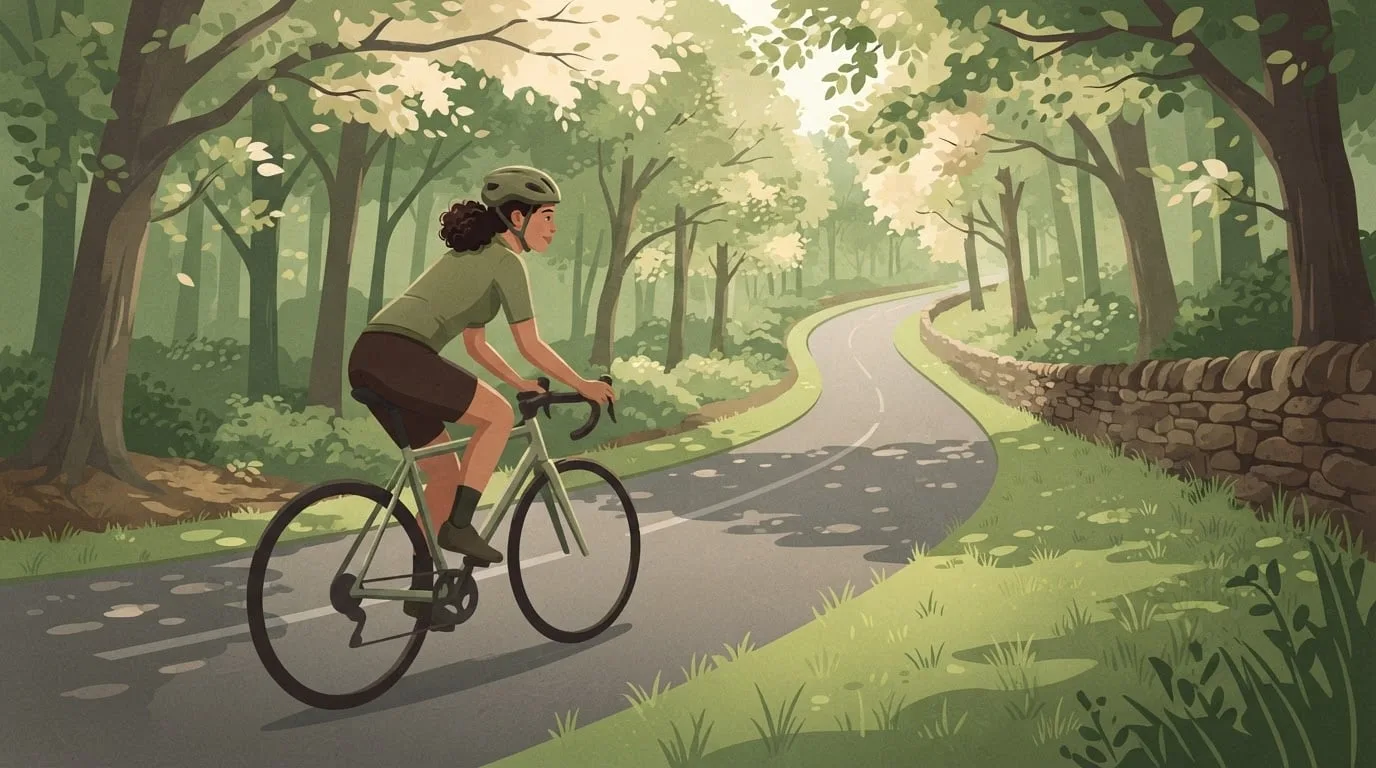
Does cycling build muscle? Ask a group of riders and you'll get two answers at once. The track sprinter with huge thighs says yes. The club rider who has ridden thousands of miles a year for a decade, and still has the same lean legs, says no. They're both describing what happened to them, and the research explains why their legs went in different directions.
The question matters most if a bike is the one kind of exercise your knees or back will tolerate, or if you've been riding for months and can't see a change. You may have heard that cardio does nothing for muscle, or that cycling will give you bulky legs. Neither is quite right, and that confusion makes it hard to know whether your riding is enough or what to add.
This page covers what the cycling trials actually measured, which leg muscles biking builds and which it skips, why steady riding builds so little, how sprint and big-gear riding change that, what cycling does for riders over 60, whether a stationary bike counts, and a simple plan for building more muscle around your rides.
Does Biking Build Leg Muscle? Yes, in the Quadriceps
The cleanest answers come from one research group at Ball State University, which put untrained adults on cycle ergometers for 12 weeks and measured their thigh muscle with MRI before and after. In Harber and colleagues (2012), seven young men (average age 20) and six older men (average age 74) completed 42 rides, three or four a week, building from 20 to 45 minutes at 60 to 80% of heart rate reserve. Quadriceps volume rose about 5% in the young men (1,052 to 1,101 cm³) and about 6% in the older men (930 to 984 cm³). Aerobic capacity climbed 16% and 13%.
So cycling can build leg muscle, and age didn't stop it. The biopsy data show what kind of growth it was. The slow-twitch fibers got bigger, while the fast-twitch fibers that carry the most size potential didn't change significantly. That's the fingerprint of an endurance stimulus: moderate force, repeated thousands of times.
That ceiling is the one every endurance sport runs into. Konopka and Harber (2014) put aerobic-training growth at roughly 5 to 15%, mostly in untrained and older adults, and Grgic and colleagues (2019) pooled 21 studies and found resistance training beat aerobic training for whole-muscle size and by a wider margin for fast-twitch fiber size. Our answer to does swimming build muscle walks through both papers. The rest of this page is about what's specific to the bike.
What Muscles Does Cycling Build, and Which Does It Skip?
The muscles that fire hardest on a bike aren't all the ones that grow. Ericson and colleagues (1985) recorded 11 leg muscles across 12 riding conditions and found the vastus medialis, vastus lateralis and the calf muscles (both gastrocnemius heads and the soleus) were the most active. Raising the workload increased activity in every muscle they tested. The review of pedaling EMG by Hug and Dorel (2009) describes how power output, cadence, body position and fatigue all shift which muscles carry the load.
Activity isn't the same thing as growth, though. Naruse and colleagues (2023), from the same Ball State group, scanned 17 separate leg muscles with MRI in six older men before and after 12 weeks of cycling at about 75 rpm. Only two clearly grew: the vastii, the three single-joint quadriceps muscles, by about 7%, and the sartorius by about 6%. The short head of the biceps femoris showed a possible 5% gain that didn't reach significance.
Everything else held still. The rectus femoris, the one quadriceps muscle that also crosses the hip, didn't grow. Neither did the adductors, the hamstrings as a group, or any of the seven lower-leg muscles, calves included. The authors concluded that cycling mainly builds the vastii and that the rest of the leg needs other exercises. The calves are the striking case. They're among the most active muscles on a bike, yet none of the seven lower-leg muscles grew. A muscle can work on every pedal stroke without ever working close to its limit.
| Muscle group | Change after 12 weeks of cycling | What to add at home |
|---|---|---|
| Vastii (three of the four quadriceps) | About 7% bigger | Nothing extra needed for growth; squats and lunges add strength |
| Sartorius | About 6% bigger | Nothing extra needed |
| Rectus femoris | No significant change | Reverse lunges, step-ups, sissy squats |
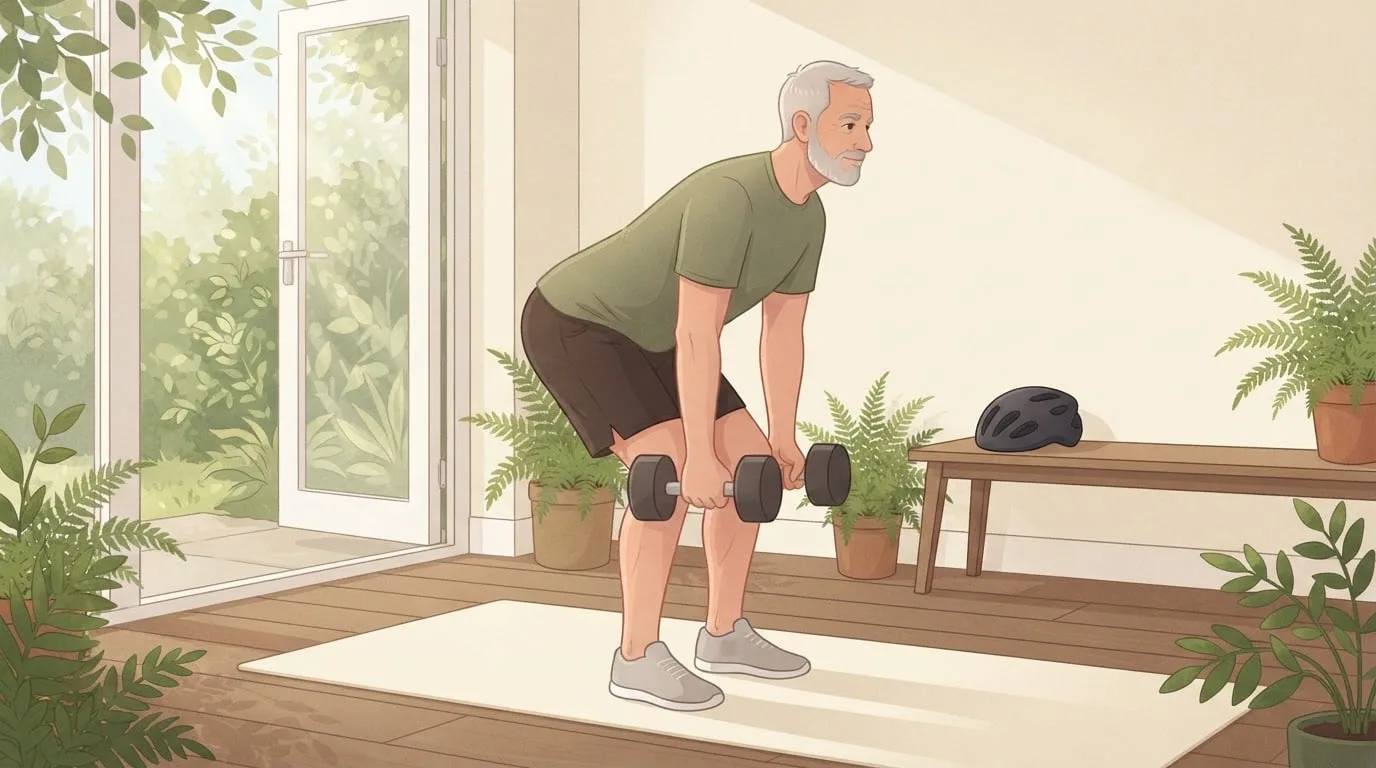
| Hamstrings | No significant change overall | Dumbbell Romanian deadlifts, sliding leg curls |
| Adductors (inner thigh) | No significant change | Wide-stance goblet squats, side lunges |
| Calves and the rest of the lower leg | No significant change in any of 7 muscles | Single-leg calf raises holding a dumbbell |
| Glutes | Not measured | Dumbbell hip thrusts, split squats |
Treat the table as a strong hint rather than a final verdict. Six men is a small sample, and the authors called it a preliminary study. But it lines up with what riders notice: cyclists' quads change, and their calves and hamstrings mostly don't.
Why Easy Riding Builds So Little Muscle
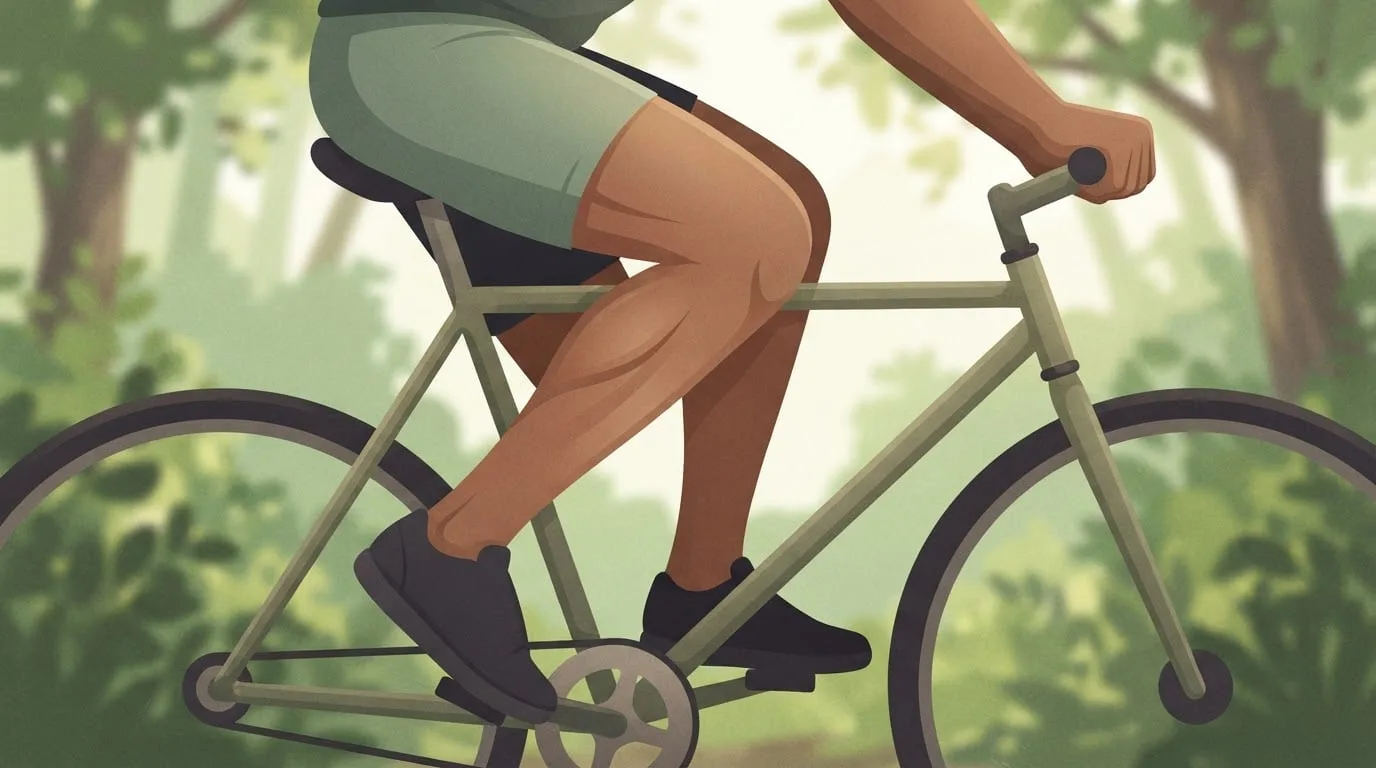
Muscle grows when a fiber is pushed close to its limit, and steady riding rarely gets there. The arithmetic shows why. Power on a bike is the force on the pedals multiplied by how fast the cranks turn. At 150 watts and 90 rpm, a typical steady effort for a fit recreational rider, the average force on a standard 172.5 mm crank works out to about 92 newtons over a full turn. That's roughly the weight of a 20-pound dumbbell. Each downstroke peaks above that average, but it's still a small fraction of what the same legs can push in a squat.
Riding longer doesn't change the force on each stroke. An hour at 150 watts asks the same thing of the quads as ten minutes does, just more times, which builds endurance rather than size. And as your fitness improves, the same speed costs you less effort, so the stimulus shrinks while the miles grow. Pedaling is also almost all shortening work with very little lowering under load, which our exercise bike research review explains alongside what a bike does and doesn't train.
Two levers do raise the force per stroke. The first is cadence. Hold the same 150 watts at 45 rpm instead of 90 and the average pedal force doubles to about 185 newtons. The second is raw power. A track sprinter producing 2,000 watts at around 125 rpm averages close to 900 newtons on the pedals, nearly ten times the easy ride. That's why the riders with the biggest legs are the ones who push the hardest, not the ones who ride the longest.
Sprint and Big-Gear Cycling Build More Muscle
Hard intervals turn a bike into something closer to a strength stimulus. In Osawa and colleagues (2014), seven healthy men rode 8 to 12 one-minute efforts above 90% of their peak oxygen uptake, each followed by a minute of easy spinning, twice a week for 16 weeks. Their quadriceps cross-sectional area grew 11% on MRI. A second group that split the same intervals between leg cycling and arm cranking grew the quads 5% and also grew some trunk muscle.
That study was small, the groups weren't randomized, and there was no comparison against lifting, so treat 11% as an encouraging upper estimate. Still, it was twice-weekly work with 16 to 24 minutes of intervals a session, and the gain was larger than the steady-riding trials reported from fewer sessions, though those trials studied different people.
Elite cyclists show the same pattern at the far end. Kordi and colleagues (2020) tested 35 elite cyclists, 17 sprinters and 18 endurance riders, and measured their thighs with MRI. Peak power ranged from 775 to 2,025 watts, and quadriceps volume correlated with it at r = 0.87. Quadriceps volume and the angle of the muscle fibers together explained 87% of the difference in peak power between riders. The sprinters produced 61% more peak power and carried larger quadriceps. That's a cross-sectional study, so it can't say how much of the muscle came from riding, but it shows how closely leg muscle and sprint power go together.
Knowing what to do is the easy part.
FitCraft, our mobile fitness app, pairs you with an AI coach who builds you a personalized plan around your goals, schedule, and fitness level. Every FitCraft program is designed by Domenic Angelino, MPH (Brown University) and NSCA-CSCS, with research published in the Journal of Strength and Conditioning Research and Medicine & Science in Sports & Exercise.
Take the Free Assessment Free • 2 minutes • No credit cardWhat Body Shape Does Cycling Give You?
Most riders end up lean, with defined quads and fairly slim calves and upper bodies. That's the typical cycling physique, and it reflects everything above: endurance riding builds the vastii a little, burns a lot of energy, and loads almost nothing else. The muscular cyclist with big thighs is usually a track sprinter, and sprint training includes serious gym work alongside the maximal efforts on the bike.
That gym work matters even for road riders. Rønnestad, Hansen and Raastad (2010) split 20 well-trained cyclists into two groups for 12 weeks. One kept riding as usual; the other added four lower-body strength exercises twice a week, three sets of 4 to 10 reps. The strength group's thigh muscle cross-sectional area grew more than the riding-only group's, without any increase in body weight. They also improved their sprint power and their 40-minute time-trial output. If you already ride a lot, strength training is what changes your legs, and it won't slow you down.
The other thing cycling leaves out is your skeleton. Riding is weight-supported, and road cyclists who only ride tend to have low bone density, particularly in the lower spine, which our comparison of cycling vs running covers in detail.
Does Biking Work Glutes?
Yes, biking works your glutes, and it works them hardest when you stand up out of the saddle. Li and Caldwell (1998) had eight riders hold 250 watts in three ways: seated on the flat, seated on an 8% climb, and standing on that climb. Climbing while seated changed little. Standing raised gluteus maximus activity and kept it working over more of each pedal stroke, along with the rectus femoris and vastus lateralis.
Duc and colleagues (2008) found the same thing in ten trained cyclists climbing at 80% of their maximal aerobic power. Standing increased both the intensity and the duration of gluteus maximus, quadriceps and hamstring activity, and it raised biceps, abdominal and lower-back activity too, because without the saddle your trunk and arms have to steady you. Ericson's group also found that faster pedaling raised glute activity.
What no cycling trial we found has done is measure glute growth. Naruse's MRI study scanned the thigh and lower leg but not the hips. And higher activity doesn't guarantee growth: in Plotkin and colleagues (2023), hip thrusts produced more glute EMG activity than squats, yet both exercises grew the glutes about equally over 9 weeks. If a firmer seat is your goal, standing climbs help, and a set of hard hip thrusts or split squats helps more.
Can a Stationary Bike Build Muscle?
Yes, and the strongest evidence on this page comes from one. Every trial above that measured muscle growth from cycling itself was done on a cycle ergometer, which is a lab-grade stationary bike. The 5 to 12% quadriceps gains and the 11% gain from intervals all happened indoors on a fixed bike, so an exercise bike builds leg muscle as well as riding outside does.
A stationary bike even has one advantage: the resistance knob. It's the closest thing cycling has to adding weight to a dumbbell, because it lets you raise the force per stroke week by week without needing a hill. Seated low-cadence efforts and standing intervals are both easy to run on a bike at home. What a stationary bike can't do is train your upper body or your balance, and the upright, recumbent or spin bike question matters less for muscle than how hard you push.
Cycling and Muscle After 60
Older adults get the most muscle out of cycling, which makes it a useful tool against sarcopenia, the gradual loss of muscle with age. In Harber and colleagues (2009), seven women averaging 71 years old rode cycle ergometers for 12 weeks. Their quadriceps volume rose 12% on MRI, their knee extensor power rose 55%, and their aerobic capacity rose 30%. The older men in the 2012 study gained about 6%, slightly more than the young men did in relative terms.
Knee extensor power is the strength you use to get out of a chair or climb stairs, so a 55% gain is a real-life change, not just a number on a scan. And a bike lets people with sore knees or poor balance train hard without impact or a fall risk.
The limits are the same ones the table shows. Cycling didn't build the hamstrings, the inner thighs or the calves in older men, it doesn't load the bones, and it doesn't train balance. Riders over 60 get the most from pairing the bike with two short strength sessions that include calf raises and a hinge, plus some balance work.
Does Cycling Build Muscle or Burn Fat?
For most riders, cycling is far better at burning fat than building muscle. Quist and colleagues (2018) randomized 130 inactive adults with overweight or obesity to six months of cycling to work, leisure-time exercise at moderate or vigorous intensity, or no change. Compared with the control group, the bike commuters lost about 4.2 kg (9 lb) of fat mass, more than the moderate-intensity group (2.6 kg) and about as much as the vigorous group (4.5 kg). The commuters also ate back less of the energy they burned than the moderate group did.
Fat loss and muscle gain can pull against each other on a bike. In Naruse's study, the one man who lost about 9% of his body weight during the 12 weeks also lost most of his quadriceps gain. That's a single case, not a finding, but it fits what's known about steep calorie deficits: if you ride a lot and eat little, the bike alone won't protect your muscle. Strength training and enough protein are what do. If fat loss is your main reason for riding, our comparison of the best workout apps for weight loss compares seven apps and explains why strength training belongs in a weight loss plan.
Cycling for Legs: How to Get More Muscle From Your Rides
You don't need to quit riding to build muscle. You need to change what some rides ask of your legs, then add the strength work the bike can't do. Here's a simple week:
- One interval ride. After a 10-minute warm-up, ride 8 to 12 one-minute efforts that feel very hard, each followed by one minute of easy spinning. This is the protocol that grew the quads 11% in the Osawa study.
- One big-gear ride. Ride 4 to 6 seated efforts of 3 to 5 minutes at 50 to 60 rpm in a heavy gear or high resistance, with easy spinning between them. No trial has tested this for size, but it raises the force per stroke, which is the variable that matters.
- Standing climbs. Add a few minutes out of the saddle to any ride for more glute work.
- Raise the resistance over the weeks. When an effort feels easier, add a notch of resistance or a heavier gear rather than more minutes.
- Two short strength sessions. 20 to 30 minutes with dumbbells or your body weight, built around what the table shows cycling skips: a hinge such as Romanian deadlifts, single-leg calf raises, a lunge or step-up, hip thrusts, and a push and a pull for the upper body. Take the last sets close to failure.
Keep the rest of your riding easy. If you're stacking hard rides and strength sessions, put a day between the hardest of each so your legs show up fresh.
What This Means for You
If you've been riding and wondering why your legs haven't changed much, nothing is wrong with you or your effort. Steady cycling does what it's built to do. It builds your heart, burns energy, and gives you a modest gain in your quads in the first few months, then it settles into endurance. Riding more of the same easy miles is the one change that won't move it.
The fix is small. Make one or two rides harder in the right way, and give the muscles the bike skips two short sessions a week. That's the step most people skip, because a plan you keep in your head is easy to put off. FitCraft's 3D AI coaches lead dumbbell and bodyweight strength workouts with interactive 3D exercise demos, and streaks make the two sessions something you look forward to rather than something you owe. As Mike, 23, put it after four months: "The streak system got me hooked. I didn't want to break my chain." Picture the next few months that way: rides you enjoy, stronger legs on the climbs, and a body that finally reflects the work.
Frequently Asked Questions
Does cycling build muscle?
Yes, cycling builds some muscle, mostly in the front of the thighs. In 12-week cycle ergometer trials, quadriceps volume rose about 12% in women around 71 and 5 to 6% in young and older men. The biggest gains go to people who weren't training before, and steady riding builds far less than strength training or hard sprint intervals do.
How long does it take to build muscle from cycling?
About 12 weeks is when the trials measured a change. Three or four rides a week of 20 to 45 minutes grew the quadriceps by 5 to 12% in untrained adults over that time. If you already ride a lot, more of the same riding won't add much; heavier gears, sprint intervals or strength work are what move it.
Does cycling build muscle in arms?
No, not in any meaningful way. Your arms and trunk hold you steady on the bars, and their activity rises when you stand on the pedals to climb, but that work is too light to grow them. Push-ups, rows and overhead presses with dumbbells cover the upper body that cycling leaves out.
Does cycling burn belly fat?
Cycling burns fat from your whole body, including your belly, but it can't target the belly alone. In a 6-month randomized trial, inactive adults with overweight who cycled to work lost about 4.2 kg (9 lb) of fat. Steady weekly riding plus sensible eating is what brings the waist down.
What are the health benefits of bike riding?
Bike riding builds aerobic fitness, strengthens the quadriceps and is easy on the joints. In a UK Biobank study of 263,450 adults, people who cycled to work had a 41% lower risk of dying from any cause over about five years than people who drove or took transit, along with lower rates of heart disease and cancer.
What exercise grows your bum the most?
Squats and hip thrusts grow the glutes about equally. In a 9-week randomized trial, both built similar glute muscle, and squats also grew the thighs more. At home, goblet squats, split squats and dumbbell hip thrusts taken close to failure train the same muscles, which easy cycling barely loads.
Will cycling make my thighs bulky?
Very unlikely. The cycling trials measured quadriceps gains of 5 to 12% over 12 weeks, which shows up as firmer, more defined thighs rather than bulk. The big thighs you see on track sprinters come from years of maximal efforts and heavy gym work, not from regular rides.