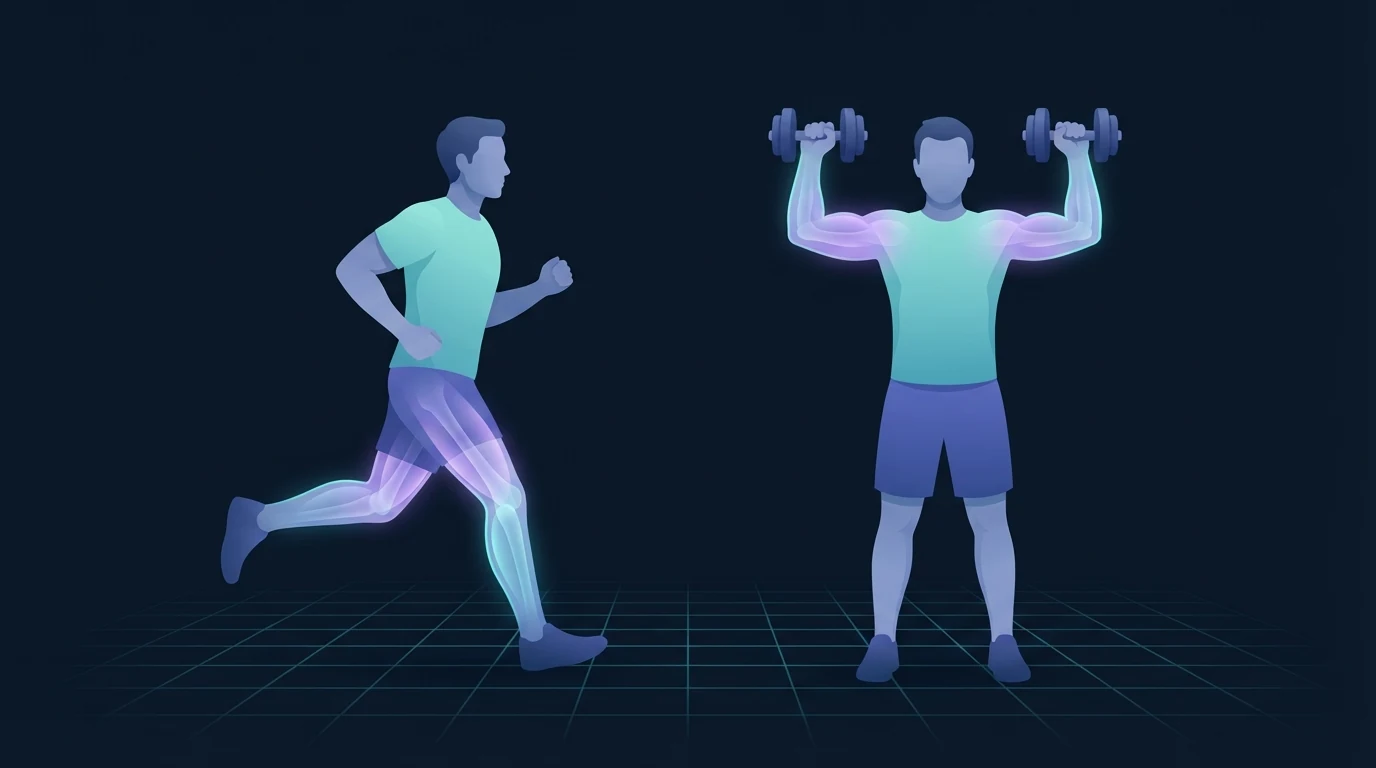
"Cardio eats your gains" has been repeated in gyms for so long that it feels like physiology rather than folklore. The picture people carry around is vivid: you run, your body runs out of sugar, and it starts dismantling your biceps for fuel. It's a memorable story. It's also a bad description of how energy metabolism works.
This matters more than a forum argument, because the belief pushes people into a bad trade. Cardiovascular fitness is one of the strongest predictors of how long you stay healthy, and plenty of lifters avoid it entirely on the strength of a myth about muscle.
So here's the honest version: what "burning muscle" would actually mean biochemically, what the concurrent-training evidence says, the three specific conditions under which cardio genuinely does cost you muscle, what endurance athletes' bodies really look like under an MRI, and how to arrange your week so the question stops mattering.
What "Burning Muscle" Actually Means
Your body doesn't have a single fuel switch. During exercise it runs on a blend of stored carbohydrate, fat and, in a minor role, amino acids. That last part is the grain of truth the myth grew out of. Amino acid oxidation does rise during endurance exercise. The question is how much, and what happens afterward.
The classic experiment is Lemon and Mullin (1980) in the Journal of Applied Physiology. Six subjects cycled for an hour at 61 percent of VO2max, once after carbohydrate loading and once after carbohydrate depletion, while the researchers tracked urea nitrogen losses in sweat and urine. Nitrogen losses more than doubled in the depleted condition. Protein use during exercise is real, it's a minor contributor, and it climbs when carbohydrate is scarce.
Two things follow from that, and they point in opposite directions from the myth:
- The lever is fuel status, not the cardio. The same session with the same duration and intensity produced very different protein breakdown depending on what the subject had eaten. Cardio is the context; carbohydrate availability is the variable.
- Breakdown isn't loss. Muscle protein is constantly being broken down and rebuilt. What determines whether you lose tissue is the net balance across 24 hours, not the flux during one hour of it. Eat enough total protein and enough total energy and the rebuild covers the breakdown with room to spare.
That's why the relevant target is a daily one. Thomas, Erdman and Burke (2016), in the joint position statement from the Academy of Nutrition and Dietetics, Dietitians of Canada and the American College of Sports Medicine, put protein for muscle remodeling at 1.2 to 2.0 grams per kilogram of body weight per day across athlete types. Note that endurance athletes sit inside that range, not below it. Their protein needs go up, not down, precisely because of the turnover their training drives.
The Interference Effect, Briefly
There's a separate and more interesting question sitting next to this one: not whether cardio destroys existing muscle, but whether it blunts the adaptation to lifting. That's the interference effect, and it has its own literature. Wilson and colleagues (2012) pooled 21 studies and found a real signal, concentrated in high-frequency, long-duration running rather than cycling, while the much larger update by Schumann and colleagues (2022) pooled 43 studies and found a standardized mean difference for hypertrophy of essentially zero (-0.01, 95% CI -0.16 to 0.18) between concurrent training and lifting alone. That's a whole topic on its own, and we've covered it in depth in our review of whether cardio kills your gains. For this article, the takeaway is one sentence: the modern pooled evidence says adding cardio to a lifting program costs you close to nothing in muscle size.
When Cardio Actually Does Cost You Muscle
Cardio becomes a muscle problem when it travels with other things. Three conditions do almost all of the work.
1. A steep energy deficit
This is the big one, and it has the cleanest evidence. Garthe and colleagues (2011) in the International Journal of Sport Nutrition and Exercise Metabolism randomized 24 elite athletes to lose weight at either 0.7 percent of body weight per week (slow) or 1.4 percent per week (fast). Both groups kept lifting four times a week. Both groups lost the target amount of fat. Only the slow group increased lean body mass; the fast group did not. Same training, same athletes, different rate of loss.
This is the mechanism people mistake for cardio burning muscle. If you add four cardio sessions and don't add any food, you've just deepened your deficit. The muscle loss that follows is a deficit problem wearing a cardio costume.
2. Protein below about 1.6 g/kg
Mettler, Mitchell and Tipton (2010) in Medicine and Science in Sports and Exercise fed 20 resistance-trained athletes a hypoenergetic diet for two weeks with either about 1.0 g/kg of protein or about 2.3 g/kg. The high-protein group preserved substantially more lean body mass over the same deficit and the same training. Two weeks is a short window to produce a difference that clear.
3. Dropping the lifting to make room
This is the version nobody counts, because it doesn't feel like a choice. A person decides to "focus on cardio for a while", the strength sessions quietly fall from three a week to one, and three months later the muscle is gone. It wasn't the running. It was the resistance training that stopped being a stimulus. Muscle is maintained by being asked to produce force, and nothing in a steady-state aerobic session asks that.

Protein Is the Lever That Decides It
If you only change one thing after reading this, change your protein intake. It's the single variable with the most direct evidence for protecting muscle while you train hard and eat less.
The most striking demonstration is Longland and colleagues (2016) in the American Journal of Clinical Nutrition. Forty young men spent four weeks in a 40 percent energy deficit while doing six days a week of hard resistance and interval training, eating either 1.2 or 2.4 g/kg of protein. Both groups lost fat. The high-protein group also gained about 1.2 kilograms of lean mass, in a steep deficit, while training at a volume that would make most people expect the opposite. The low-protein group held roughly steady.
Practical targets that follow from this literature:
- Maintenance or a surplus: 1.6 g/kg of body weight per day is plenty.
- In a deficit, or doing lots of cardio: 1.8 to 2.4 g/kg. Higher end if the deficit is aggressive or you are already lean.
- Spread it out: three or four servings of 0.3 to 0.4 g/kg each is easier to hit than two large ones and gives the rebuild more chances to run.
- Keep some carbohydrate around your harder sessions. That's the direct implication of the Lemon and Mullin finding: fuelled sessions break down less protein than depleted ones.
Our guide on how to lose fat without losing muscle walks through building the deficit and the protein target together, which is where most of the real risk lives.
Knowing what to do is the easy part.
FitCraft, our mobile fitness app, pairs you with an AI coach who builds you a personalized plan around your goals, schedule, and fitness level. Every FitCraft program is designed by Domenic Angelino, MPH (Brown University) and NSCA-CSCS, with research published in the Journal of Strength and Conditioning Research and Medicine & Science in Sports & Exercise.
Take the Free Assessment Free • 2 minutes • No credit cardWhat Endurance Athletes' Bodies Actually Show
The strongest intuitive argument for "cardio burns muscle" is a visual one. Look at elite marathoners: they're tiny. Look at sprinters: they're huge. Case closed.
Except the comparison confuses selection with causation. Distance running selects hard for low body mass, because carrying weight over 26 miles is expensive. Elite distance runners also deliberately avoid building upper-body mass they'd have to carry. What you're seeing is who succeeds at the sport and what they choose to train, not what the training does to anyone who does it.
Look at the muscles endurance athletes actually use and the picture inverts. Wroblewski and colleagues (2011) in The Physician and Sportsmedicine ran MRI scans on 40 high-level recreational athletes aged 40 to 81 who trained four to five times a week, most of them in endurance sports. Mid-thigh muscle area did not decline with age. Quadriceps area did not decline with age. Quadriceps peak torque did not decline with age. Intramuscular fat stayed low. In a sedentary population, all four of those go the wrong way after 40. The authors concluded that the usual age-related decline reflects chronic disuse rather than aging itself.
The mechanistic literature agrees that aerobic work isn't inherently catabolic. Murach and Bagley (2016) in Sports Medicine reviewed the fiber-level evidence and argued that under some conditions aerobic exercise may actually augment resistance-training hypertrophy, likely through improved capillary density and nutrient delivery to the muscle. Cycling in particular shows up repeatedly as neutral or mildly helpful.
How to Schedule Cardio So It Doesn't Cost You
Programming solves most of what's left. The rules are short.
- Separate the sessions when you can. Robineau and colleagues (2016) in the Journal of Strength and Conditioning Research trained 58 amateur rugby players for seven weeks with 0, 6 or 24 hours of recovery between the strength and aerobic sequences. Back-to-back with no gap produced the worst neuromuscular and aerobic outcomes. Six hours was better. Twenty-four hours was better still.
- Lift first if they share a session. The heavy work is the one that needs a fresh nervous system and full glycogen. Aerobic work tolerates fatigue far better.
- Keep hard cardio away from leg day. Running especially. This is where the interference signal in the older literature concentrates, and it's also just a recovery problem.
- Don't do long cardio depleted if you're already in a deficit. That's the one place the Lemon and Mullin result becomes practically relevant. Our review of the fasted cardio research covers what that does and does not change for fat loss.
- Eat back some of what you burn. If you add three 40-minute sessions to your week and your intake doesn't move, you've built a deeper deficit by accident. That's the actual mechanism of most "cardio killed my muscle" stories.
- Prefer cycling, incline walking or the elliptical when muscle is the priority. Lower eccentric load means less muscle damage to recover from before the next lifting session.
If you're choosing between the two because your week only has so many slots, our breakdown of whether cardio or weights is better for fat loss compares them on the outcome most people are actually chasing. And if you want the whole week laid out around your schedule rather than assembled from articles, our personalized training program page walks through how that gets built.
What This Means for You
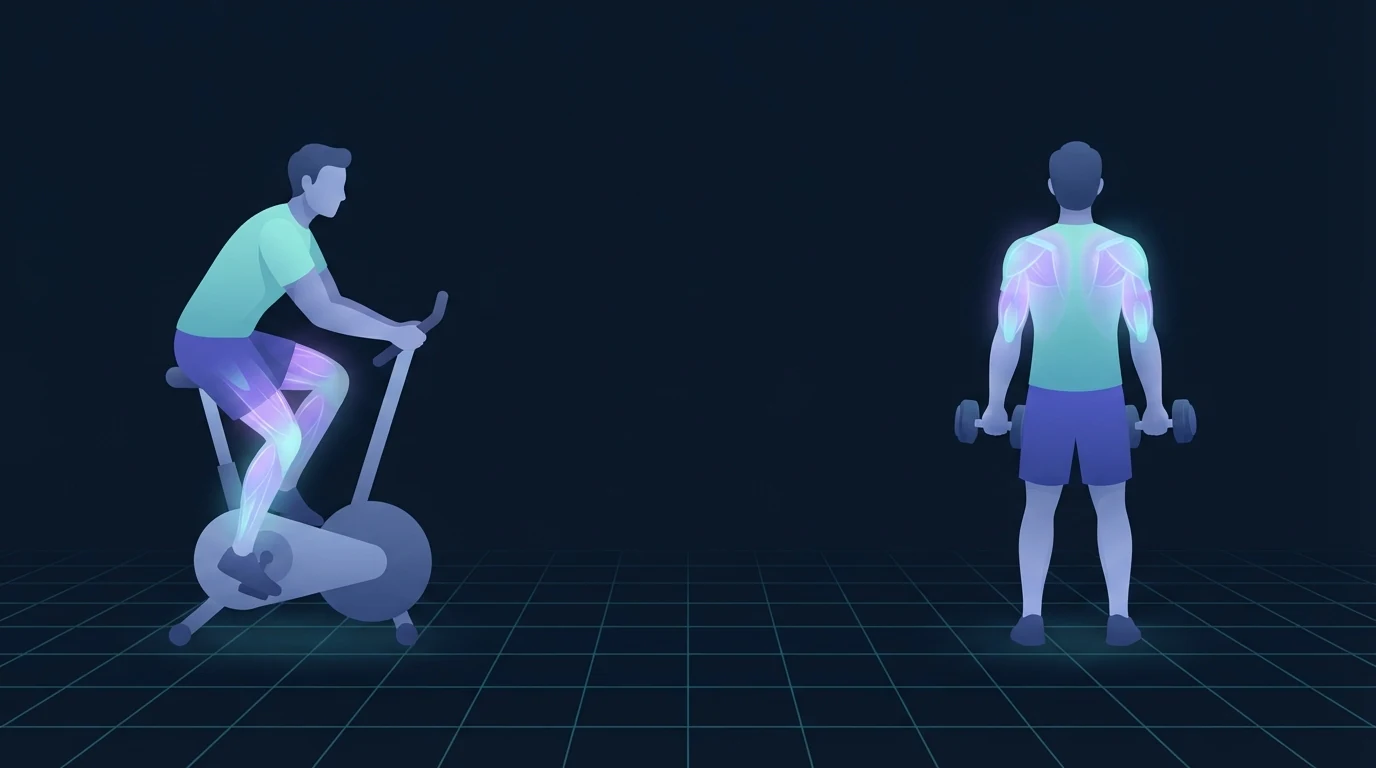
If you lift two or three times a week, eat enough protein and keep your deficit moderate, you can do a lot of cardio without paying for it in muscle. That's what the pooled evidence supports, and it's a much less anxious way to train.
If you have lost muscle during a period of heavy cardio, the diagnosis is almost never the cardio itself. Look at what your protein intake actually was, how fast you were losing weight, and how many hard resistance sessions survived the change. One of those three is the culprit, and all three are fixable without giving up aerobic fitness.
The trade people think they're making (cardio or muscle) mostly isn't a real trade. The real trade is between doing the boring supporting work, tracking protein, keeping the lifting in the schedule, holding the deficit at a sane rate, and not doing it. Do the supporting work and you get to have both.
Frequently Asked Questions
Does cardio burn muscle?
Not on its own. Protein supplies only a small fraction of the fuel for endurance exercise, and your body spends the rest of the day rebuilding what it broke down. What actually costs you muscle is the company cardio keeps: a steep energy deficit, protein under about 1.6 g/kg, and dropping resistance training to make room for more cardio. Garthe and colleagues (2011) found elite athletes losing 0.7 percent of body weight a week gained lean mass, while a matched group losing 1.4 percent a week did not. The rate of loss did the damage, not the aerobic work.
How much cardio is too much if you want to build muscle?
There is no hard ceiling, but the interference signal in the literature shows up mainly with high-frequency, long-duration running rather than with moderate cycling or incline walking. Schumann and colleagues (2022) pooled 43 studies and found essentially no hypertrophy penalty from adding aerobic training to a lifting program. A practical range for most people building muscle is two to four cardio sessions a week of 20 to 45 minutes, with the harder ones placed away from leg day.
Does fasted cardio burn muscle?
It raises protein breakdown modestly, and it does not meaningfully change body composition over weeks. Lemon and Mullin (1980) had subjects cycle for an hour at 61 percent of VO2max and found nitrogen losses more than doubled when they began glycogen-depleted rather than carbohydrate-loaded. That is a real effect and a small one in absolute terms. If you do long or hard fasted sessions, eat protein soon after. If you are worried, have a small carbohydrate and protein snack beforehand and the question goes away.
Why do marathon runners look so thin if cardio does not burn muscle?
Selection and specificity, not catabolism. Lighter athletes are faster over distance, so distance running selects for small frames, and elite runners rarely lift for size because extra upper-body mass is dead weight to carry. The muscles they actually train look different: Wroblewski and colleagues (2011) imaged 40 masters athletes aged 40 to 81 who trained four to five times a week and found no age-related decline in thigh muscle area, quadriceps area or peak torque. The legs of a lifelong endurance athlete are not wasted.
Should you do cardio before or after lifting?
After, if they are in the same session, and better still on a different day or with hours in between. Robineau and colleagues (2016) trained 58 amateur rugby players for seven weeks with 0, 6 or 24 hours between the strength and aerobic sequences and found that back-to-back sessions with no recovery produced the smallest neuromuscular and aerobic gains. Six hours was better and 24 hours was better again. If you only have one window, lift first so the heavy work gets your fresh nervous system.
How much protein do you need if you do a lot of cardio?
Aim for 1.6 to 2.4 grams per kilogram of body weight per day, toward the top of that range if you are in a deficit. Thomas, Erdman and Burke (2016) put the general athlete range at 1.2 to 2.0 g/kg for muscle remodeling. Mettler, Mitchell and Tipton (2010) showed why the upper end matters during weight loss: resistance-trained athletes eating about 2.3 g/kg held onto substantially more lean mass over two weeks of dieting than a matched group eating about 1.0 g/kg.