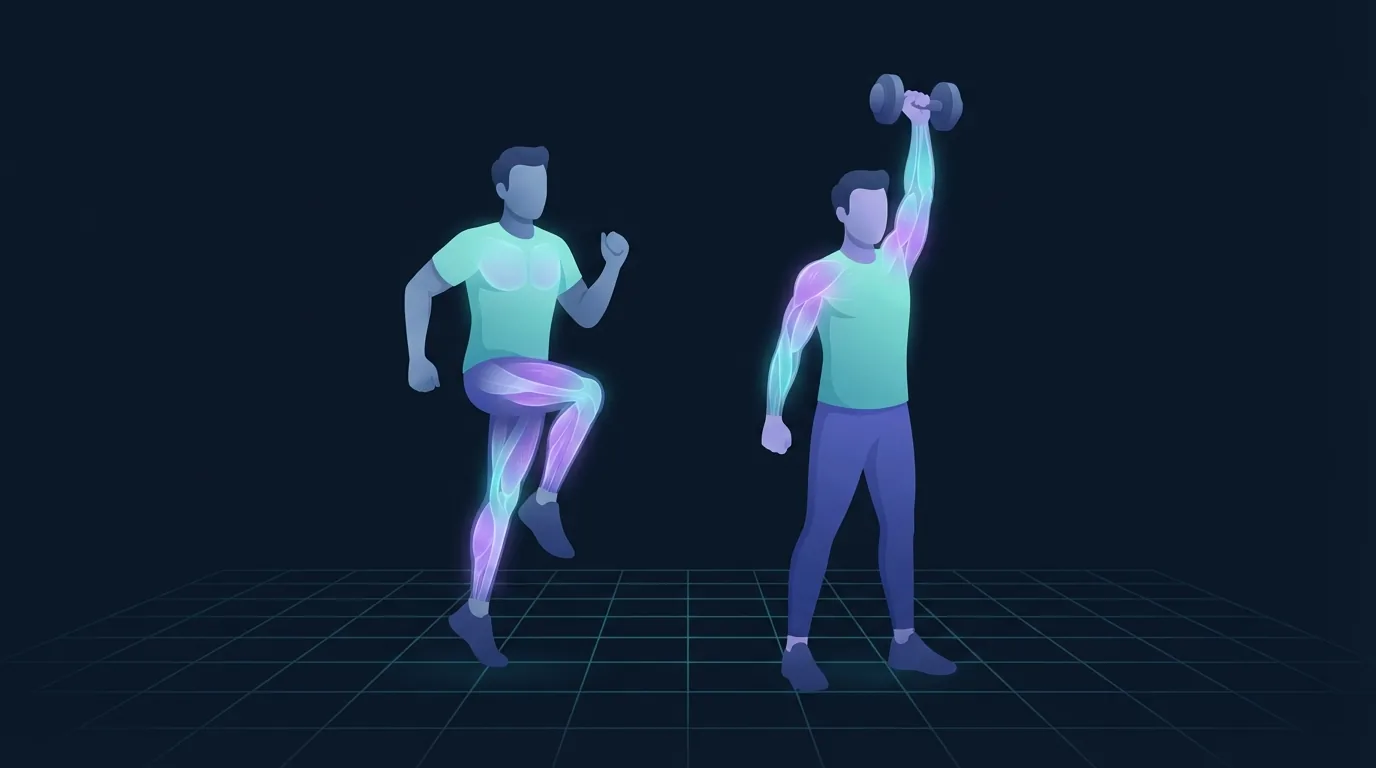
This argument has been running in gyms for forty years, and both sides are partly right, which is why it never resolves. The cardio camp points at calories burned per session. The lifting camp points at muscle, metabolic rate and what you look like at the end. The trials that actually randomised people to one or the other settle it more cleanly than either camp usually admits.
What makes the question hard is that "better for fat loss" hides two different goals. Losing fat mass and looking leaner are not the same outcome, and they respond to different training. A program that maximises one can quietly undercut the other.
Here's the evidence, mode by mode: what each one does to fat mass, what each one does to lean mass, how much time each one costs, what the deficit contributes, and a weekly split you can run at home with dumbbells.
What the Head-to-Head Trials Found
STRRIDE AT/RT: the cleanest comparison we have
Willis, Slentz, Bateman, and colleagues (2012) published this in the Journal of Applied Physiology, and it remains the best-designed comparison of the three options. They took 119 sedentary overweight or obese adults and randomised them to 8 months of aerobic training, resistance training, or both. Nobody was asked to change their diet, which is what makes the numbers so readable: everything measured came from the training.
| Group | Weekly training time | Fat mass | Lean mass | Body mass |
|---|---|---|---|---|
| Aerobic training | about 133 min | -1.66 kg | -0.10 kg | -1.76 kg |
| Resistance training | about 180 min | -0.26 kg | +1.09 kg | +0.83 kg |
| Combined | about 313 min | -2.44 kg | +0.81 kg | -1.63 kg |
Three things jump out. Aerobic training was the most time-efficient way to lose fat: it took the least weekly time and produced most of the fat loss. Resistance training was the only arm that meaningfully built lean mass, and it left people heavier on the scale as a result. Combined training produced the best body composition of the three, and it did so by spending roughly double the hours. The authors' own conclusion was that aerobic training is the optimal mode for reducing fat mass and body mass, with combined adding lean mass on top.
Note what the resistance group's scale said: up 0.83 kg. If you only weighed them you would call that program a failure, when what actually happened is they added more than a kilogram of muscle. The same trap catches people at home, which is why a scale that climbs early is usually telling you about water and lean mass rather than fat.
The meta-analyses agree, twice
Schwingshackl, Dias, Strasser, and Hoffmann (2013) ran a network meta-analysis in PLoS One across 15 trials and 741 overweight or obese participants. Combined training beat resistance training by 1.88 kg of fat mass and 2.03 kg of body weight. Aerobic training beat resistance training by 1.14 kg of fat mass. Combined versus aerobic came out at 0.56 kg in favour of combined, which did not reach significance. Their recommendation was combined training "whenever possible".
Twelve years later, Lafontant and colleagues (2025) pooled 36 randomised trials and 1,564 participants in the Journal of the International Society of Sports Nutrition and landed in the same place. In programs lasting 10 weeks or more, aerobic training beat resistance training for fat mass by 1.06 kg and combined training beat resistance by 1.09 kg, with no significant difference between aerobic and combined. Aerobic training also retained 0.88 kg less fat-free mass than resistance training did.
Then they added the finding that matters most. When the programs were matched for workload, fat mass, body mass, body fat percentage and fat-free mass changes were all statistically similar across the three modes. Mode matters less than most arguments assume once total work is equal. What differs is how much work each mode gets you per hour, and what happens to the muscle along the way.
Why Weights Still Belong in a Fat-Loss Plan
The STRRIDE resistance numbers make lifting look weak for fat loss. They are also measured in people who were not dieting. Add a deficit and the picture changes completely, because in a deficit your body is deciding what to break down, and resistance training is the signal that tells it to spare muscle.
Weinheimer, Sands, and Campbell (2010) reviewed 52 weight-loss studies in Nutrition Reviews and reported the cleanest version of this. Among groups that dieted without exercising, 81 percent lost at least 15 percent of their total weight as fat-free mass. Among groups that dieted and exercised, only 39 percent did. Same amount of weight gone, very different composition of what left.
That is the whole case for weights in a cut. Lose 10 kg with 8 kg of it from fat and you look and perform better. Lose the same 10 kg with 3 kg of it from muscle and you end up smaller, weaker, and with a lower daily energy requirement, which makes keeping the weight off harder. Our guide to losing fat without losing muscle covers the deficit sizes and protein targets that hold that line.
Longland and colleagues (2016) showed how far this can go. They put 40 young men in a 40 percent energy deficit for 4 weeks with resistance and interval training six days a week. The group eating 2.4 g of protein per kilogram gained 1.2 kg of lean mass while losing 4.8 kg of fat. Gaining muscle during a severe deficit should not be possible on paper. Enough protein and enough lifting made it happen.
Weights also do reduce fat on their own, just modestly. Wewege and colleagues (2022) pooled 58 trials in Sports Medicine and found resistance training alone cut body fat percentage by 1.46 percent versus no-exercise controls, along with 0.55 kg of fat mass and a meaningful drop in visceral fat. No dieting required.
Knowing what to do is the easy part.
FitCraft, our mobile fitness app, pairs you with an AI coach who builds you a personalized plan around your goals, schedule, and fitness level. Every FitCraft program is designed by Domenic Angelino, MPH (Brown University) and NSCA-CSCS, with research published in the Journal of Strength and Conditioning Research and Medicine & Science in Sports & Exercise.
Take the Free Assessment Free • 2 minutes • No credit cardThe Deficit Is Doing Most of the Work
Look again at the STRRIDE numbers. Eight months of supervised training, no diet change, and the best arm lost 2.44 kg of fat. That is real and it is worth having, but it is roughly what a modest food deficit achieves in six to eight weeks. Training is not a weak tool. It is a tool pointed at a different target.
Two practical consequences follow. First, if fat loss is the only goal and time is scarce, fixing intake beats adding a fifth cardio session almost every time. Second, if you want the result to survive, training is what makes the deficit worth running at all, because it decides the composition of what you lose and it keeps your strength while you get smaller.
It also pays to be honest about the afterburn story. Excess post-exercise oxygen consumption, or EPOC, is real, and it is small: usually low tens of calories after a normal session, not the hundreds the marketing implies. Choose training modes for what they do to your body, not for a calorie bonus that rounds to a slice of bread.
The other thing to settle before building a week is your phase. Trying to add muscle and strip fat aggressively at the same time works for beginners and returning lifters and gets much harder after that. Our guide to bulking versus cutting covers how to pick a phase and how long to hold it.
Does Lifting Weights Burn Fat?
Yes, but almost none of it happens the way the afterburn story claims. Start with that claim, because it is the one people build plans around. Borsheim and Bahr (2003) reviewed the post-exercise oxygen consumption literature in Sports Medicine and found the size of the effect tracks intensity and duration: low-intensity or short sessions produce no sustained elevation at all, and harder resistance work produces more than moderate resistance work. Greer and colleagues (2015) then matched the calories burned during three different sessions in 10 men and found resting metabolic rate was still measurably higher 12 and 21 hours after the lifting and interval sessions than after steady-state cardio. So the afterburn is real, it is longer-lived after lifting than after easy cardio, and in absolute terms it is small. It is a rounding adjustment on the week, not a mechanism you can plan a deficit around.
The second claim, that muscle sends your resting metabolism up, is also real and also smaller than advertised. MacKenzie-Shalders and colleagues (2020) meta-analysed 18 trials in the Journal of Sports Sciences and found resistance exercise raised resting metabolic rate by 96 kcal per day against controls (95% CI 45 to 147), while aerobic exercise produced no significant change. Ninety-six calories is not nothing over a year, and it is not the several-hundred-calorie engine that gets sold with the phrase "muscle burns fat while you sleep". The honest way to hold both facts: lifting nudges your daily energy requirement up a little and protects it from falling while you diet, which is the part that decides whether the weight stays off.
Now the direct question, which is whether resistance training removes fat. It does, and the size depends entirely on whether food is involved. Lopez and colleagues (2022) pooled 114 trials and 4,184 participants with overweight or obesity in Obesity Reviews. Resistance training on its own cut body fat by 1.6 percentage points and 1.0 kg of fat mass versus no-training controls, close to what Wewege and colleagues measured above. Resistance training combined with caloric restriction cut 3.8 percentage points and 5.3 kg. Resistance training alone was also the single best option for adding lean mass, at 0.8 kg, and when it was paired with the deficit, lean mass held flat instead of falling. That is the whole answer in one table of numbers: lifting burns a modest amount of fat by itself, burns a lot of fat when you eat for it, and is the only one of the two modes that defends the tissue underneath.
A Practical Weekly Split
The evidence supports the same shape at almost every time budget: lift two or three times a week, do aerobic work two or three times, keep a modest food deficit, and let the balance shift toward cardio if the goal is purely fat and toward lifting if you want to keep your shape.
Four days a week (the default)
- Monday: full-body resistance, 45 minutes. Dumbbell or bodyweight squat pattern, hinge, push, pull, carry. Two to three sets each, stopping a couple of reps short of failure.
- Tuesday: moderate aerobic work, 35 to 45 minutes. Brisk incline walking, cycling, rowing or easy running at a pace where you can speak in short sentences.
- Thursday: full-body resistance, 45 minutes. Same pattern, different exercise variations and a slightly heavier load than Monday.
- Saturday: longer easy aerobic session, 45 to 60 minutes. Walk, hike, ride, swim. Whatever you will still be doing in six months.
- Everything else: keep daily steps up. The unstructured movement adds more weekly energy expenditure than the sessions do for most people.
Three days a week (the minimum that works)
- Two full-body resistance sessions of 40 to 45 minutes, at least 48 hours apart.
- One longer aerobic session of 45 to 60 minutes, plus 20 to 30 minutes of brisk walking on as many other days as you can manage.
- Protein at 1.6 to 2.2 g per kilogram of body weight daily, which does more for lean mass retention than any extra session would.
Cardio before or after weights?
If both land in the same session and strength matters to you, lift first. Hard aerobic work beforehand degrades the lifting that follows, while the reverse costs much less. If fat loss is the only goal, the order is a minor variable next to how much total work you do.
The bigger lever is separation. Putting the two modes in different sessions, or at least a few hours apart, does more for both adaptations than getting the within-session order right. Our review of the research on cardio before or after weights works through the effect sizes from both recent reviews. And if you're worried that adding aerobic work will cost you muscle, the interference literature is more reassuring than gym folklore suggests: it takes a lot of high-frequency running before strength adaptations measurably suffer.
The Verdict
Cardio wins on fat lost per hour. Weights win on what you keep. Combined wins overall, at a real cost in time. Across STRRIDE and two independent meta-analyses the ranking is stable: combined and aerobic training both beat resistance training for fat mass, combined and resistance training both beat aerobic training for lean mass, and combined training takes about double the weekly hours of either one alone.
Practical rule: 3 hours a week or less, weight the schedule toward cardio and keep one full-body lifting session so you don't lose muscle. 4 hours or more, run 2 to 3 lifting sessions plus 2 aerobic sessions. In both cases the food deficit is doing more of the fat-loss work than either mode, and the lifting is what decides whether the weight you lose is fat or muscle.
The one ranking that never changes is doing something versus doing nothing. Every effect size quoted here was measured against people who turned up for months. Picking the theoretically optimal split and attending twice is worse than picking the wrong one and attending forty times.
What This Means for You
If you've been grinding cardio for months and hating it, you can cut it back and replace some of it with lifting without wrecking your fat loss, as long as the food side holds. If you've been lifting only and the scale hasn't moved, you're not failing: you're probably adding lean mass while removing fat, and the fastest fix is a waist measurement and a couple of aerobic sessions rather than a different program.
Pick the version of the week you'll actually run. Two lifting sessions and two walks that happen beat four perfect sessions that don't. If you want something that builds the split for you and keeps you turning up, our roundup of the best workout apps for weight loss compares the options on what they actually track and how well they hold people to a schedule.
Frequently Asked Questions
Is cardio or weights better for fat loss?
Cardio removes more fat per hour of training, weights protect the muscle underneath, and doing both beats either one alone. In the 8-month STRRIDE AT/RT trial, Willis and colleagues (2012) randomised 119 overweight adults and measured fat mass falling 1.66 kg with aerobic training, 0.26 kg with resistance training and 2.44 kg with combined training. Resistance training was the only arm that added lean mass, at 1.09 kg. If you can only train three hours a week and fat loss is the goal, weight the schedule toward cardio. If you can train four or more, do both.
Why does resistance training barely reduce fat mass in the trials?
Because resistance training adds lean mass at almost the same time as it removes fat, so the two changes cancel on the scale and partly cancel on fat mass too when the training is not paired with a calorie deficit. Wewege and colleagues (2022) pooled 58 studies and found resistance training alone reduced body fat percentage by 1.46 percent versus control with no dieting at all. The effect is real, it is just smaller and slower than aerobic work per hour spent, and it comes with the muscle that aerobic work does not add.
Should I do cardio before or after weights?
If the session includes both and strength is a priority, lift first, because hard aerobic work before lifting reduces the quality of the lifting that follows. If fat loss is the only goal the order matters much less than the total work you do. The bigger lever is separation: putting the two modes in different sessions, or at least a few hours apart, beats getting the within-session order right. Our review of the research on cardio before or after weights covers the effect sizes.
How much cardio should I do to lose fat?
Start at 120 to 180 minutes a week of moderate aerobic work plus 2 to 3 resistance sessions, and keep a food deficit in place. The aerobic dose in STRRIDE was calorically equivalent to about 12 miles of jogging a week at 65 to 80 percent of peak VO2, or roughly 133 minutes a week, and that produced 1.66 kg of fat loss in 8 months without any dietary change. More cardio does more, but the returns flatten and recovery costs rise, so adding food accuracy usually beats adding a fifth cardio session.
Can you lose fat with weights alone?
Yes, especially if you are in a calorie deficit. Longland and colleagues (2016) ran young men through 4 weeks of resistance and interval training in a 40 percent energy deficit: the higher-protein group lost 4.8 kg of fat and gained 1.2 kg of lean mass. Lafontant and colleagues (2025) also found that when aerobic, resistance and combined programs were matched for workload, fat mass changes were statistically similar. Weights alone works. It just tends to need a bigger contribution from the kitchen.
Does lifting weights burn fat?
Yes, and mostly not through the afterburn. Borsheim and Bahr (2003) found the post-exercise oxygen consumption bump scales with intensity and duration and is small in absolute terms, and MacKenzie-Shalders and colleagues (2020) found resistance training raised resting metabolic rate by 96 kcal per day against controls, with no significant change from aerobic training. The real number is in the fat-loss trials. Lopez and colleagues (2022) pooled 114 trials and 4,184 participants: resistance training alone cut body fat by 1.6 percentage points and 1.0 kg of fat mass, resistance training plus caloric restriction cut 3.8 percentage points and 5.3 kg, and resistance training was the only option that added lean mass. Lifting burns fat modestly on its own and substantially once the kitchen is involved.
Does lifting weights burn more calories after the workout?
A little, and far less than the marketing suggests. The post-exercise oxygen consumption bump after a typical resistance session is usually worth somewhere in the low tens of calories, not hundreds. The real metabolic case for lifting is the lean mass you keep while dieting, not the afterburn. Build the plan around the muscle you protect, not around a calorie bonus that rounds to a slice of bread.