
You've probably heard both versions. One says lifting weights is the best fat burner there is, because muscle keeps burning calories while you sleep. The other says lifting builds muscle and cardio burns fat, so if you want to lose weight you should get on the treadmill. If you're lifting weights to lose weight and the scale hasn't moved in a month, the second version starts to sound right.
So does lifting weights burn fat? The trials say yes, in four ways: the fuel you burn during and after each session, the calories the session costs, what it does to your body composition over months, and what it changes about the weight you lose when you eat less. Each one has numbers attached, and none of them is the "furnace" the ads describe.
This page sticks to what lifting itself does to fat. Whether added muscle raises your resting burn is its own question, and we answer it in does muscle burn fat. Whether you should pick cardio or weights for fat loss is another, covered with the head-to-head trials in is cardio or weights better for fat loss.
What the Trials Show When People Only Lift
The cleanest recent test is the CardioRACE trial. Lee and colleagues (2024) randomized 406 adults aged 35 to 70 with overweight or obesity to a year of supervised resistance training, aerobic training, both, or no exercise. The lifting group trained for an hour three times a week. Everyone, including the control group, got the same healthy-eating advice, but nobody was put on a weight-loss diet. Here's what a year of lifting alone did:
- Body fat percentage fell by 1.0 point, against 0.1 in the control group.
- Lean body mass rose by 1.2 kg. No other group gained a meaningful amount.
- Body weight went up by 0.6 kg on average, a change too small to be meaningful.
- Waist size shrank by 0.8 cm, which also wasn't a significant change.
Read that list as a lifter, and it explains a lot of frustration. A year of real training lowered body fat, but because the body added muscle at the same time, the scale and the tape measure barely moved. The aerobic group, training for the same hour, lowered body fat percentage by about the same amount and lost 1.4 kg on the scale, because they didn't add muscle.
Pooled trials say the same. A 58-study meta-analysis by Wewege and colleagues (2022) found resistance training alone cut body fat percentage by about 1.5 points and fat mass by about half a kilogram, with no diet change, and the effect was the same size in men and women. Our cardio versus weights breakdown puts those numbers next to the aerobic trials.
Long-term data points the same way. In a cohort of 11,938 adults followed for about six years, Brellenthin and colleagues (2021) found that people who lifted 60 to 119 minutes a week were 31 percent less likely to cross into obesity as measured by body fat percentage than people who didn't lift, even after accounting for their aerobic exercise. That's an observational study, so it can't prove cause, but it fits the trials: lifting keeps fat from creeping up, and over years that matters as much as any single diet.
Where the Fat Goes During and After a Lifting Session
A set of eight to fifteen reps is short and hard, and short, hard work runs mostly on carbohydrate. Koopman and colleagues (2006) took muscle biopsies before and after a 45-minute lifting session in untrained men. Glycogen, the carbohydrate stored in muscle, fell by 23 to 44 percent depending on the fibre type. But the fat stored inside the muscle fibres dropped too, by 27 percent in the slow-twitch fibres. So even during the sets, your muscles are burning some fat.
The bigger shift comes after you put the weights down. Ormsbee and colleagues (2007) measured belly fat directly in eight trained men, using tiny probes placed under the skin of the abdomen. During a full-body lifting session, fat breakdown in that belly tissue ran 78 percent higher than on a rest day. In the 45 minutes after the session:
- Fat burning doubled, from 5.0 to 10.2 grams an hour.
- The body's fuel mix moved almost entirely to fat. The respiratory exchange ratio fell to 0.71, close to the 0.70 that means pure fat.
- Energy use stayed about 10 percent above resting.
The session spends your muscle glycogen, and recovery leans on fat while that glycogen is restocked. Ten grams of fat an hour is about 90 calories, roughly half of it extra compared with a rest day, so this is a real effect and a modest one. It also explains why "lifting doesn't burn fat, it burns carbs" is only half true: the fat burning happens on the far side of the session.
What about the calories muscle burns at rest, once you've built more of it? That number is smaller than most people think, about 13 calories a day per kilogram of muscle, and we work through it in our post on whether muscle burns fat.
How Many Calories Does Weight Lifting Burn?
Less than a run, more than most people expect, and the range is wide. The 2024 Adult Compendium of Physical Activities by Herrmann and colleagues rates lifting by how it's done. Ordinary resistance training, several exercises at 8 to 15 reps, is 3.5 METs. Resistance circuits built from supersets are 5.8 METs. High-intensity bodyweight work such as squats, lunges and push-ups is 6.5 METs. One MET is roughly one calorie per kilogram of body weight per hour, so here's what a 45-minute session costs:
| 45-minute session | 60 kg (132 lb) | 80 kg (176 lb) | 100 kg (220 lb) |
|---|---|---|---|
| General bodyweight exercises (3.0 METs) | 135 | 180 | 225 |
| Traditional sets with rest (3.5 METs) | 158 | 210 | 263 |
| Supersets or resistance circuit (5.8 METs) | 261 | 348 | 435 |
| High-intensity bodyweight circuit (6.5 METs) | 293 | 390 | 488 |
Calories are MET value × body weight in kg × 0.75 hours, rounded. About one MET of each figure is what you'd burn sitting on the couch anyway, so the extra cost of a 45-minute session for an 80 kg person is roughly 60 calories less than the table shows.
Measured sessions land in the same range. Kelleher and colleagues (2010) had ten young men do six exercises for four sets of ten, once as traditional sets and once as reciprocal supersets, pairing opposing muscle groups with little rest. The total work was identical. The traditional session took about 36 minutes and burned about 228 calories. The superset session took about 29 minutes and burned about 241. That's 8.3 calories a minute against 6.3, the same lifting done in less time.
Those figures probably undercount a little. Standard measurements read the oxygen you use while you lift, but a hard set runs partly on energy systems that don't use oxygen and pays the bill later. When Scott and colleagues (2011) measured all three parts of single bench press sets taken to fatigue, the oxygen-free share and the recovery share were each larger than the oxygen used during the set itself. Lighter loads lifted for many reps, at roughly 35 to 55 percent of a one-rep max, cost more total energy than heavy loads lifted a few times. That's useful news if you train with dumbbells at home: moderate weights taken close to fatigue cost more energy per set, not less.
So a lifting session is a real calorie cost. It isn't a large one. Three sessions a week of supersets for an 80 kg person comes to roughly 800 to 900 extra calories a week, or about 120 a day. That's worth having, and it's why the food side still decides how fast the scale moves.
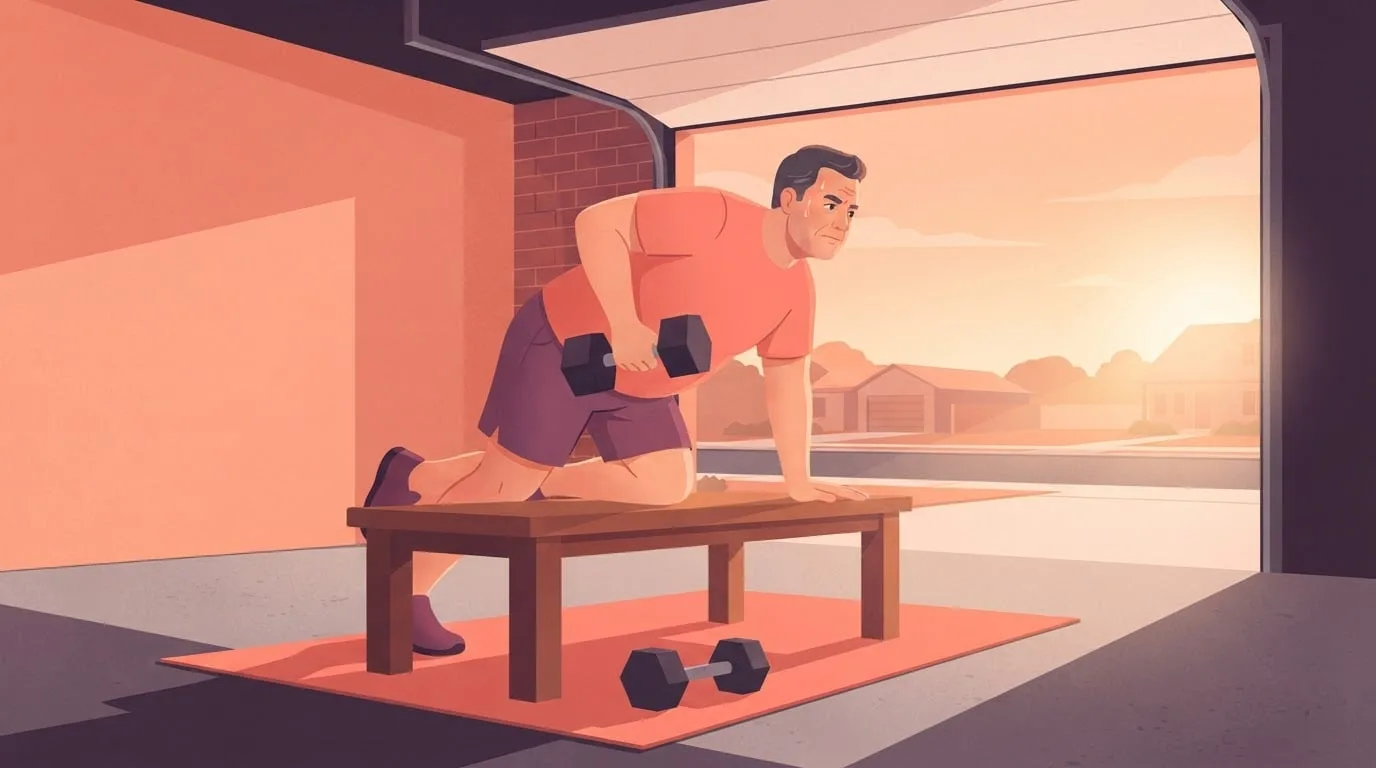
The Afterburn: How Long Lifting Keeps Your Metabolism Up
Excess post-exercise oxygen consumption, the afterburn, is the extra energy your body spends restoring itself after a workout. After lifting it lasts a surprisingly long time, at a low level. For the general research on how intensity and duration shape it, see our review of the EPOC afterburn effect. The lifting studies look like this:
- The first hour. In the Kelleher trial, the afterburn in the 60 minutes after the session was worth about 14 calories after traditional sets and 19 after supersets.
- The next morning. Melby and colleagues (1993) had trained men lift for 90 minutes in the afternoon. Their metabolic rate was still 11 to 12 percent above baseline two hours later, and resting metabolism the next morning was 4.7 to 9.4 percent higher than the morning before. Their fuel mix that morning had also shifted toward fat.
- Up to a day and a half. Schuenke and colleagues (2002) put seven men through a brutal 31-minute circuit of bench presses, power cleans and squats, every set taken to failure. Their oxygen use was still raised 38 hours later.
Add those up honestly and the afterburn from a normal session is worth somewhere in the tens of calories, spread over many hours. The longest effects came from long or brutal sessions that most people won't repeat three times a week. Count the afterburn as a small bonus on top of the session itself.
Knowing what to do is the easy part.
FitCraft, our mobile fitness app, pairs you with an AI coach who builds you a personalized plan around your goals, schedule, and fitness level. Every FitCraft program is designed by Domenic Angelino, MPH (Brown University) and NSCA-CSCS, with research published in the Journal of Strength and Conditioning Research and Medicine & Science in Sports & Exercise.
Take the Free Assessment Free • 2 minutes • No credit cardDoes Lifting Make You Lose Belly Fat?
Yes, modestly, and the deep fat responds as well as the fat you can pinch. Belly fat comes in two layers: subcutaneous fat under the skin, and visceral fat packed around the organs, the kind most strongly linked to diabetes and heart disease. Lifting reaches both.
- Visceral fat. Khalafi and colleagues (2021) pooled 34 studies with 2,285 people and found resistance training lowered visceral fat compared with no exercise. The effect was small, and it held for people with and without obesity, in middle age and in older age.
- Fat under the skin of the belly. Yarizadeh and colleagues (2021) pooled 43 trials and found resistance training shrank this layer by about 5 square centimetres on scans. Aerobic training shrank it by about 13.
- One clear example. Ibanez and colleagues (2005) had older men with type 2 diabetes lift twice a week for 16 weeks without dieting. Visceral fat fell 10.3 percent and the fat under the skin of the abdomen 11.2 percent, while body weight didn't change at all.
Not every trial agrees, and it's fair to say so. In the eight-month STRRIDE comparison, Slentz and colleagues (2011) found three days a week of lifting reduced the fat under the skin of the belly but didn't significantly reduce visceral fat, which the aerobic group did. And Khalafi's review found that adding lifting to a diet didn't strip extra visceral fat beyond what the diet did alone. Lifting helps belly fat. Brisk aerobic work helps it a little more per hour.
What lifting can't do is aim. Crunches won't pull fat off your stomach any more than curls pull it off your arms. When Kostek and colleagues (2007) had 104 people train one arm for 12 weeks, MRI found the fat change was no different between the trained and untrained arms. Our guide to the best exercises to lose belly fat builds a week around that fact.
Lifting Weights to Lose Weight: What Changes With a Calorie Deficit
Lifting on its own changes your shape more than your weight. Add a modest calorie deficit and the scale starts moving, and the lifting decides what the lost weight is made of. That's the job lifting does best.
One of the longest trials on this question comes from Wake Forest University. Beavers and colleagues (2017) randomized 249 adults with obesity, most of them in their 60s, to 18 months of a weight-loss diet alone, the diet plus walking, or the diet plus lifting weights:
| After 18 months | Weight lost | Fat lost | Lean mass lost |
|---|---|---|---|
| Diet alone | 5.7 kg | 4.8 kg | 1.0 kg |
| Diet plus walking | 8.5 kg | 6.8 kg | 1.6 kg |
| Diet plus lifting | 8.7 kg | 7.8 kg | 0.8 kg |
The lifters lost 3 kg more fat than the dieters who didn't exercise, and they lost the least lean mass of any group. About 90 percent of their weight loss was fat. In the study, losing lean mass tracked with losing leg strength, which is why that last column matters as you get older.
This is also why "how much weight did you lose?" is the wrong question for a lifter. Two people can lose the same 8 kg. The one who lifted ends up with more muscle, a smaller waist and more strength. If you want the full case for keeping muscle in a diet, including deficit size and protein, it's in our breakdown of cardio versus weights for fat loss.
A Dumbbell and Bodyweight Routine for Fat Loss
You don't need a barbell or a gym to get the effects above. Use dumbbells and your body weight, and set the session up to cost as much energy per minute as you can recover from:
- Three full-body sessions a week, about 40 to 45 minutes each, with a rest day between them.
- Supersets of opposing movements. Pair a lower-body exercise with an upper-body pull or push, do one set of each back to back, then rest 60 to 90 seconds.
- 8 to 15 reps per set, stopping one to three reps before you couldn't do another.
- Progressive overload. When the top of the rep range feels manageable for every set, add reps, a little weight or a slower lowering phase next session.
- Walk on the other days, and keep protein in every meal if you're eating less.
A session built that way looks like this. Do each pair for three rounds:
- Pair 1: goblet squat, 10 to 12 reps, then one-arm dumbbell row, 10 to 12 reps per side.
- Pair 2: dumbbell Romanian deadlift, 10 to 12 reps, then push-ups, 8 to 15 reps, with your hands on a bench or couch if floor push-ups are too hard.
- Pair 3: reverse lunge, 8 to 10 reps per leg, then standing dumbbell overhead press, 10 to 12 reps.
- Finisher: farmer's carry, walking with a heavy dumbbell in each hand for 40 seconds, three times.
The plan is simple. Doing it 100 times is the hard part, and that's where a lot of people stall, often around week three. If planning each session is the part you drop, a dumbbell workout app that progresses your program can carry it. In FitCraft, a 3D AI coach demonstrates every dumbbell and bodyweight exercise so you can learn the form, your program adapts as you progress, and streaks and leaderboards give you a reason to show up for session 30 as well as session 3.
What This Means for You
Lifting burns fat. It does it through the energy each session costs, a fat-heavy recovery afterward, a slow drop in body fat over months and, above all, by making sure the weight you lose when you eat less is mostly fat. None of that shows up fast on a bathroom scale, so judge your lifting by your waist, your strength and how your clothes fit.
If you've quit lifting before because the scale didn't move, that wasn't a willpower problem. You were reading the wrong number. Jim, 26, lost 24 pounds in three months, and his line is the one to borrow: "I kept telling myself I'd start Monday. FitCraft made me start on a Wednesday and I haven't stopped." Three sessions a week, a modest deficit and a few months of showing up is the whole method.
Frequently Asked Questions
Can you lose weight by lifting weights?
Yes, and it works best with a calorie deficit. In an 18-month trial of 249 older adults with obesity, dieters who lifted weights lost 8.7 kg, 7.8 kg of it fat, against 5.7 kg for diet alone (Beavers and colleagues, 2017). Without a deficit, lifting mostly changes what your weight is made of: in a one-year trial, the lifting group's body fat percentage fell while the scale stayed about the same.
Can you lose weight just by lifting weights, with no cardio?
Yes. Weight loss comes from the calorie deficit, and lifting decides how much of the loss is fat. In the Beavers trial, dieters who lifted lost about the same weight as dieters who walked, 8.7 kg against 8.5 kg, with more fat and half the lean mass loss. Cardio still adds calorie burn and heart and lung fitness, so walking on your non-lifting days is a good addition.
How many calories does lifting weights burn in 30 minutes?
About 105 to 175 calories for traditional sets with rest and about 180 to 300 calories for hard supersets or circuits, for people weighing 60 to 100 kg. Those figures use the 2024 Compendium of Physical Activities values of 3.5 and 6.0 METs. Heavier people, shorter rests and bigger exercises such as squats and rows land at the top of the range.
Is weight lifting good for weight loss for women?
Yes. In a 58-study meta-analysis, resistance training lowered body fat percentage by about 1.5 points, and sex didn't change the size of the effect (Wewege and colleagues, 2022). Moderate dumbbell and bodyweight training adds a modest amount of muscle, which is part of why the waist often shrinks faster than the scale moves.
What are the signs that your body is burning fat?
A smaller waist measurement, looser clothes and rising strength are the most reliable signs when you lift, because the scale can stall while fat drops and muscle is added. In the CardioRACE trial, the lifting group's body fat percentage fell by a point over a year while their average weight rose by 0.6 kg. Measure your waist every two to four weeks rather than judging by daily weigh-ins.
Which body part burns fat first?
There's no fixed order, and training a body part doesn't make it go first. When 104 people trained one arm for 12 weeks, MRI found fat loss was similar in the trained and untrained arms (Kostek and colleagues, 2007). Deep belly fat often responds early: older men who lifted twice a week for 16 weeks lost 10 percent of their visceral fat with no change in body weight (Ibanez and colleagues, 2005).
Does lifting weights burn fat after the workout?
Yes, for a while. In trained men, fat oxidation in the 45 minutes after a lifting session was double the rate on a rest day, 10.2 against 5.0 grams an hour (Ormsbee and colleagues, 2007), and resting metabolism was still 4.7 to 9.4 percent higher the next morning after a long session (Melby and colleagues, 1993). In calories, this afterburn is worth tens, not hundreds.