You've decided to swim for fitness. Maybe your knees have had enough of running, or a doctor said low-impact cardio, or you just like the water. Then you get in, push off, and halfway down the first length you're gasping and grabbing the lane rope.
That's normal, and it isn't a fitness problem. Swimming is a skill as much as a workout, and most adults who learned as kids never learned to breathe in rhythm. Without a plan, the usual pattern is a few exhausting visits of swimming until you're tired, then a quiet return to the gym or the couch.
A beginner swim workout fixes that by giving every minute in the pool a job. This guide gives you three swimming routines for beginners, from single lengths with rests to 30 minutes of mixed sets, an 8-week beginner swim workout plan, and the swimming exercises for beginners you can do on land at home.
How to Start Swimming for Exercise
Start by checking one thing: can you swim one length of the pool without stopping or standing up? If yes, you're ready for the starter workout below. If not, book a few adult swimming lessons first, then spend your first sessions in the shallow end with a kickboard, practicing the breathing drill further down. Either way, swim where a lifeguard is on duty while you're learning.
A few basics make the first visits easier:
- Count lengths, not laps. A length is one trip from wall to wall. Some pools call that a lap and some call a there-and-back a lap. Most pools are 25 yards or 25 meters long, and every workout here is written in lengths so it works in either.
- Pick the slowest lane. Lanes are usually signed slow, medium and fast. Swim on the right side of the lane, or whichever side the pool posts, and let faster swimmers pass at the wall.
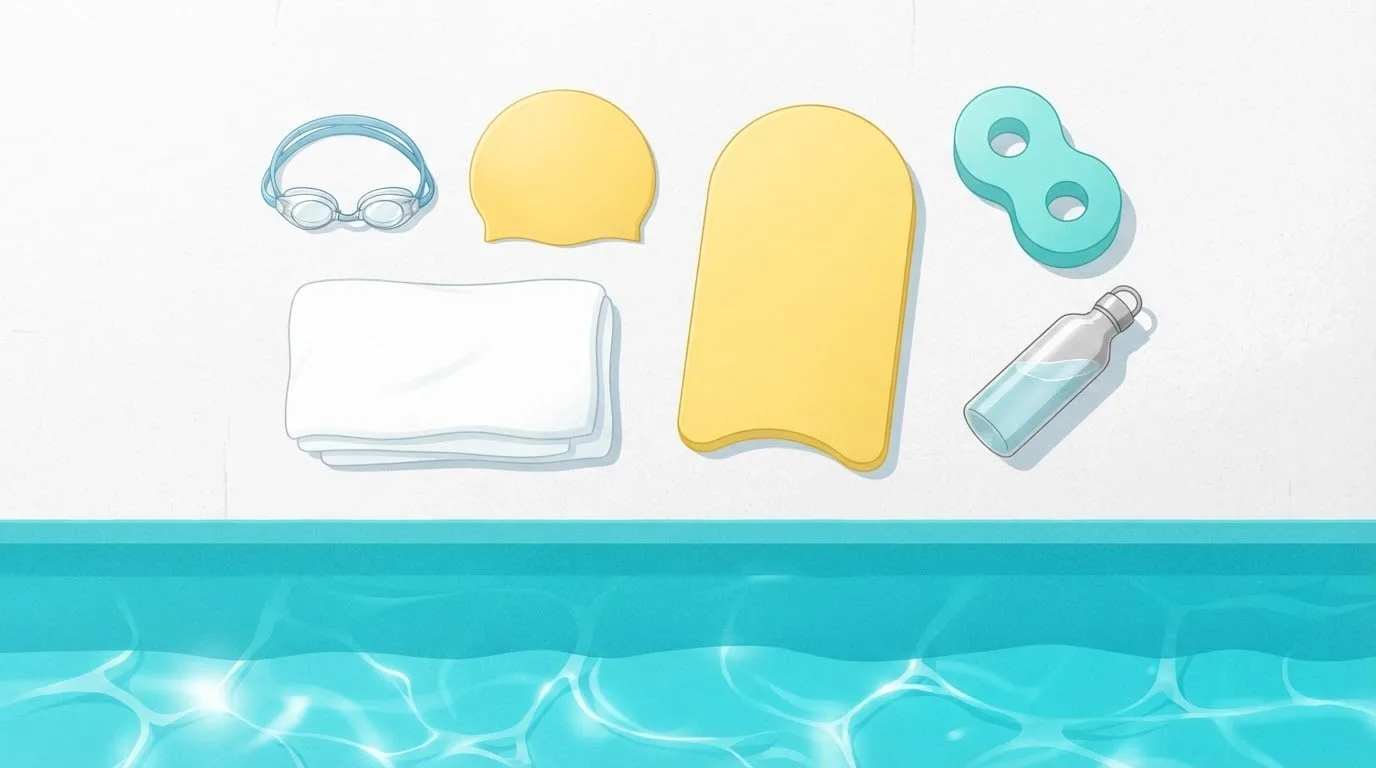
- Bring goggles and a cap. Goggles are the one item worth buying, because seeing clearly underwater makes breathing calmer. A cap keeps hair out of your face. Most pools lend kickboards and pull buoys.
- Use an effort scale. On a scale of 1 to 10, easy is 3 or 4, where you could chat at the wall. Moderate is 5 or 6. Hard is 7 or 8. Heart rate runs lower in water than on land, so effort is a better guide than a running heart rate zone.
How a Beginner Swim Workout Is Built
Every good swim session has the same four parts, whatever your level. The warm-up raises your heart rate and loosens your shoulders. A short drill or kick set works on one piece of technique. The main set is the workout itself, usually repeats of one or more lengths with a set rest. The cool-down brings your breathing back to normal.
Swimmers write sets as repeats times distance. "6 x 1 length, rest 30 seconds" means swim one length, rest 30 seconds at the wall, and do that six times. Rest is part of the plan, not a sign you're failing. As you get fitter, you'll cut the rest first and link lengths together second.
Three Beginner Swim Workouts
These three swimming routines for beginners build on each other. Start with the one that matches what you can do today, and move up when the current one feels comfortable twice in a row.
Workout 1: The starter session (about 20 minutes)
For you if you can swim one length but not four in a row. It totals about 14 lengths, roughly 350 yards or meters.
| Part | What to swim | Rest |
|---|---|---|
| Warm-up | In the shallow end, 10 slow breaths out underwater, then 2 lengths of any stroke at an easy effort | 30 to 45 seconds after each length |
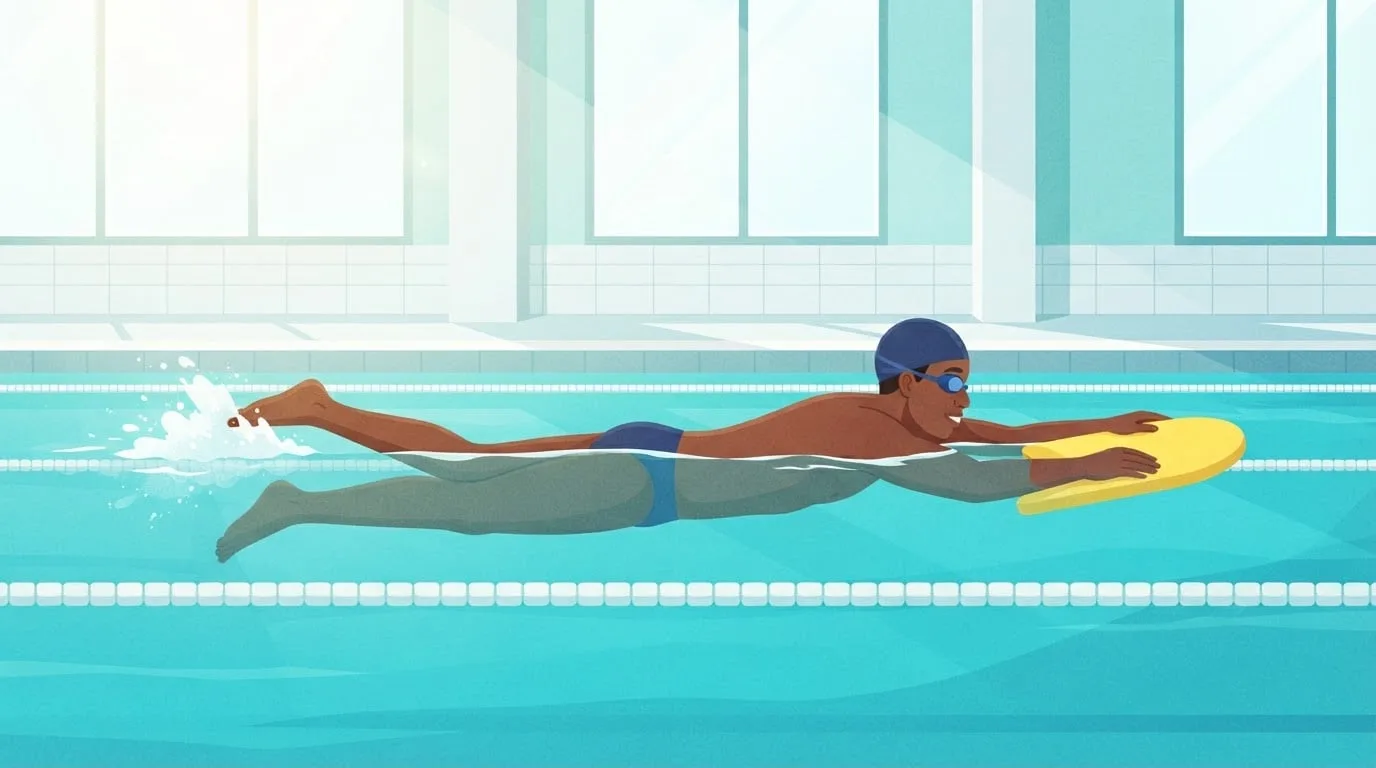
| Kick | 4 lengths of kicking with a kickboard, small and relaxed | 30 seconds after each |
| Main set | 6 x 1 length of freestyle or breaststroke at a moderate effort | 30 to 45 seconds after each |
| Cool-down | 2 lengths of slow backstroke or breaststroke | As needed |
Workout 2: Technique and breathing (about 25 minutes)
For you once you can swim two lengths in a row. It totals about 26 lengths, roughly 650 yards or meters.
| Part | What to swim | Rest |
|---|---|---|
| Warm-up | 4 lengths, mixing freestyle, backstroke and breaststroke | 20 to 30 seconds after each |
| Drills | 4 lengths of side kick (one arm forward, roll to breathe), then 4 lengths of catch-up freestyle (each hand waits for the other in front) | 30 seconds after each |
| Main set | 4 x 2 lengths of freestyle, breathing every 3 strokes if you can, or every 2 if you can't | 30 seconds after each pair |
| Pull | 4 lengths of freestyle with a pull buoy between your thighs | 20 seconds after each |
| Cool-down | 2 lengths of easy backstroke | As needed |
Workout 3: Endurance plus short hard lengths (about 30 minutes)
For you once you can swim four lengths in a row. It totals about 28 lengths, roughly 700 yards or meters, and includes a short set of hard lengths modeled on the interval trial described below.
| Part | What to swim | Rest |
|---|---|---|
| Warm-up | 2 lengths swim, 2 lengths kick, 2 lengths swim, all easy | 20 seconds after each |
| Steady set | 3 x 4 lengths of freestyle at a moderate effort, or mixed strokes | 40 seconds after each block of 4 |
| Hard set | 6 x 1 length at a hard effort, 7 or 8 out of 10 | Up to 2 minutes, until your breathing settles |
| Cool-down | 4 lengths easy, finishing with backstroke | As needed |
On a busy day, the warm-up, the hard set and the cool-down make a 15-minute session. Doing that short version still counts, and it keeps the habit alive.
Find out what's really holding you back
FitCraft, our mobile fitness app, pairs you with an AI coach who builds you a personalized plan around your goals, schedule, and fitness level. Every FitCraft program is designed by Domenic Angelino, MPH (Brown University) and NSCA-CSCS, with research published in the Journal of Strength and Conditioning Research and Medicine & Science in Sports & Exercise.
Take the Free Assessment Free • 2 minutes • No credit cardShould Beginners Swim Intervals or Steady Laps?
Beginners do well with both, and the best plan mixes them. One trial tested the two styles head to head in people who weren't exercising.
Mohr and colleagues (2014), in BioMed Research International, randomized 62 inactive women with mildly high blood pressure into three groups for 15 weeks. One group swam 6 to 10 all-out 30-second efforts with 2 minutes of rest. A second group swam continuously for an hour at a moderate pace. A third group didn't change anything. Each training group completed about 44 sessions, close to three a week.
Both swim groups lowered their systolic blood pressure, by 6 mmHg after the intervals and 4 mmHg after the steady swims. Resting heart rate fell by 5 beats a minute in both. The steady group lost more fat mass, about 2.2 kg against 1.1 kg. Each group got better at the kind of swimming it practiced: the steady swimmers improved their 10-minute swim by 22%, and the interval group improved its interval performance by 23%.
A follow-up analysis of the same trial by Connolly and colleagues (2016), in the European Journal of Applied Physiology, looked at blood sugar control. Insulin sensitivity improved by 22% after the interval training and didn't change after the steady swims. The interval group got there with only a few minutes of hard swimming per session.
For a beginner, that suggests a simple split. Make most sessions steady, because steady swimming builds the comfort in the water that lets you swim farther. Add one short set of hard lengths a week once you can swim four lengths in a row, as in Workout 3. Hard means hard for you, not a race, and the disclaimer at the end of this page applies.
Your 8-Week Beginner Swim Workout Plan
This plan takes you from single lengths to about 30 minutes of swimming, three times a week. Leave a day between swims, and add two short strength sessions on land on other days.
| Weeks | Pool sessions | Workouts | Goal by the end |
|---|---|---|---|
| 1 to 2 | 2 a week | Workout 1 both times | Rest at the wall feels easy at 45 seconds |
| 3 to 4 | 2 to 3 a week | Workout 1, then Workout 2 | Rests down to 30 seconds and 2 lengths in a row |
| 5 to 6 | 3 a week | Workout 2 twice, Workout 3 once | 4 lengths in a row without stopping |
| 7 to 8 | 3 a week | Workout 3 twice, Workout 2 once | 8 lengths in a row, about 200 yards or meters |
Add no more than two to four lengths per session from one week to the next, and repeat a week if it felt hard. The plan is built to be slow. Somewhere around weeks five and six, many beginners notice they've stopped dreading the first length, which is the moment swimming becomes something you keep doing.
Breathing and Technique Fixes for Beginner Swimmers
Most beginners tire because of breathing and body position, not fitness. Four fixes make the biggest difference.
Breathe out underwater
Holding your breath while your face is in the water leaves you trying to empty and refill your lungs in the split second your mouth is clear. Practice in the shallow end: take a breath, sink your face, and hum or blow bubbles out through your nose and mouth for three or four seconds. Lift your head, breathe in, and repeat ten times. Do this drill at the start of every session for the first month.
Keep your head low and your hips up
Look at the bottom of the pool, not the far wall. Lifting your head to look forward drops your hips and legs, and the water drags on your whole body. When you breathe in freestyle, roll your head to the side so one goggle stays in the water, rather than lifting it up and forward.
Kick small from the hips
Beginners often kick hard from the knees and run out of air. The kick matters less than it feels. Deschodt and colleagues (1999), in the European Journal of Applied Physiology, had swimmers sprint front crawl with and without their legs. Adding the legs raised top speed by only about 10%, and the authors concluded that the kick helped mostly by improving the arm stroke. So keep it small, quick and relaxed, with nearly straight legs and loose ankles.
Use the pull buoy to learn the arms
A figure-eight pull buoy squeezed between your thighs floats your legs, so you can focus on reaching long, pulling back past your hip and breathing to the side. If your legs sink when you swim freely, a few lengths with the buoy show you what a flat body position feels like.
Protect Your Shoulders as You Add Distance
Swimming is gentle on knees and hips, but it asks a lot of your shoulders, and the risk grows with volume. Sein and colleagues (2010), in the British Journal of Sports Medicine, examined 80 elite swimmers aged 13 to 25. Of these, 91% reported shoulder pain, and 69% of those who had an MRI showed tendon damage in the supraspinatus, one of the rotator cuff muscles. The more hours and distance they swam each week, the more likely they were to have it. Loose shoulder joints weren't linked to the tendon damage.
You won't be swimming elite distances, but the lesson scales down. Shoulders get sore when weekly distance jumps faster than the tendons can adapt. Four habits help:
- Build slowly. Follow the plan above rather than doubling your distance because a session felt good.
- Mix your strokes. Backstroke and breaststroke load the shoulder differently from freestyle.
- Go easy on hand paddles. They add force to every stroke, so leave them out for your first few months.
- Stop with sharp pain. A pinching pain at the front or top of the shoulder that lingers after swimming is a reason to rest and get it checked.
Swimming Workout for Beginners at Home: Dry-Land Strength
There's no swimming workout you can do at home, but there's a land workout that makes your pool time easier. Strength work for the back, shoulders and trunk helps you hold a long, flat body line and pull with control. The World Health Organization's 2020 guidelines, summarized by Bull and colleagues, also ask adults for muscle-strengthening activity on two or more days a week, which swimming alone doesn't fully cover.
Most of the research on land training comes from competitive swimmers. A systematic review by Crowley and colleagues (2017), in Sports Medicine, found that strength work carried over to swimming best when it was specific, low in volume and done with fast, forceful reps. For a beginner, the main goals are simpler: stronger shoulders and a steadier trunk. Do this circuit twice a week, two or three rounds, with bodyweight and a pair of light to moderate dumbbells:
- Push-ups, 8 to 12 reps. Use a bench or counter for incline push-ups if floor push-ups are too hard.
- Bent-over dumbbell rows, 10 to 12 reps a side. They train the same pulling muscles as the freestyle arm stroke.
- Y-raises, 10 to 12 reps. Light weights or none. They strengthen the muscles that hold the shoulder blades steady.
- Superman holds, 3 holds of 10 to 20 seconds. They train the back muscles that keep your hips high in the water.
- Hollow holds, 3 holds of 15 to 30 seconds. This is the land version of a streamlined push-off.
- Side planks, 20 to 30 seconds a side. They help you control the body roll in freestyle.
- Goblet squats, 10 to 12 reps. Strong legs make every push-off from the wall stronger.
FitCraft isn't a swimming app and doesn't plan pool sessions. Where it fits is the land half of your week and the habit of showing up. Its strength workouts use dumbbells and bodyweight. An AI coach, a 3D character who says your name, demonstrates each exercise on an interactive 3D model you can zoom in on, and your workouts adjust as you progress. Streaks and calendar rewards make the in-between days feel like part of the plan. If weight loss is part of why you're swimming, our review of the best workout apps for weight loss explains why strength training belongs in that plan.
Is Swimming a Good Workout?
Yes. Swimming is a good workout for beginners because it trains your heart and lungs while the water carries your weight, so your joints take far less pounding than on a run. We cover the details in three separate answers. Our article on whether swimming is cardio explains why your heart rate runs lower in the pool and how much swimming meets the activity guidelines. Our look at whether swimming builds muscle explains why it tones more than it grows. And our breakdown of how many calories swimming burns gives the numbers by stroke and body weight.
The Bottom Line
A swimming workout for beginners is short, structured and full of rest: a warm-up, a main set of single lengths, and a cool-down, two or three times a week. Cut your rests before you add distance, breathe out underwater, keep your kick small, and add two strength sessions on land. Over eight weeks, the plan takes you from one length at a time toward eight lengths without stopping.
The first few sessions are the hardest part, because nothing feels natural yet. That's when most people quit, and it's exactly when a plan helps most. As one FitCraft user, Matt, said: "The real win is I actually want to work out now. That's never happened before."
Frequently Asked Questions
How long should a beginner swim workout be?
A beginner swim workout should last about 20 to 30 minutes, including rests at the wall, two or three times a week. That's long enough for a warm-up, a main set and a cool-down without wearing out your shoulders. Add time only once your sessions feel comfortable for two weeks in a row.
How many laps should a beginner swim?
Most beginners should start with about 12 to 16 lengths of a 25-yard or 25-meter pool per session, with rests after each one. Over eight weeks, build toward about 26 to 28 lengths and toward swimming 8 lengths without stopping. Some pools call one length a lap and others call a there-and-back a lap, so count lengths to be sure.
Is swimming a good workout for beginners?
Yes, swimming is a good workout for beginners because it trains the heart and lungs while the water supports your weight, so it's easy on the joints. In a 15-week trial of inactive women, three swim sessions a week lowered resting heart rate and systolic blood pressure and improved swim fitness. Pair it with two short strength sessions on land for a complete week.
How do I start swimming for exercise if I'm not a strong swimmer?
If you can't swim one length comfortably, start with a few adult lessons, then practice breathing out underwater and kicking with a kickboard in the shallow end. Once you can swim one length, use the starter workout: single lengths with rests at the wall. Swim where a lifeguard is on duty while you're learning.
Should beginners use a kickboard or pull buoy?
Yes, a kickboard and a pull buoy help beginners practice one part of the stroke at a time. The kickboard trains a small, steady kick from the hips, and the pull buoy floats your legs so you can focus on your arms and breathing. Most pools lend both, so you don't need to buy them to start.
Can you lose weight swimming as a beginner?
Swimming can help with weight loss, but the changes are modest without changes to what you eat. In a 15-week trial of inactive women, an hour of moderate swimming three times a week cut fat mass by about 2.2 kg, and short hard intervals cut it by about 1.1 kg. Consistent sessions plus strength training and a sensible diet give the best results.
Is it OK to swim every day as a beginner?
It's better to swim three days a week as a beginner and add a fourth only after a couple of months. In elite swimmers, more hours and more distance each week went with more shoulder tendon damage, so build your weekly distance slowly. On days off, a short land strength session or a walk keeps the habit going.