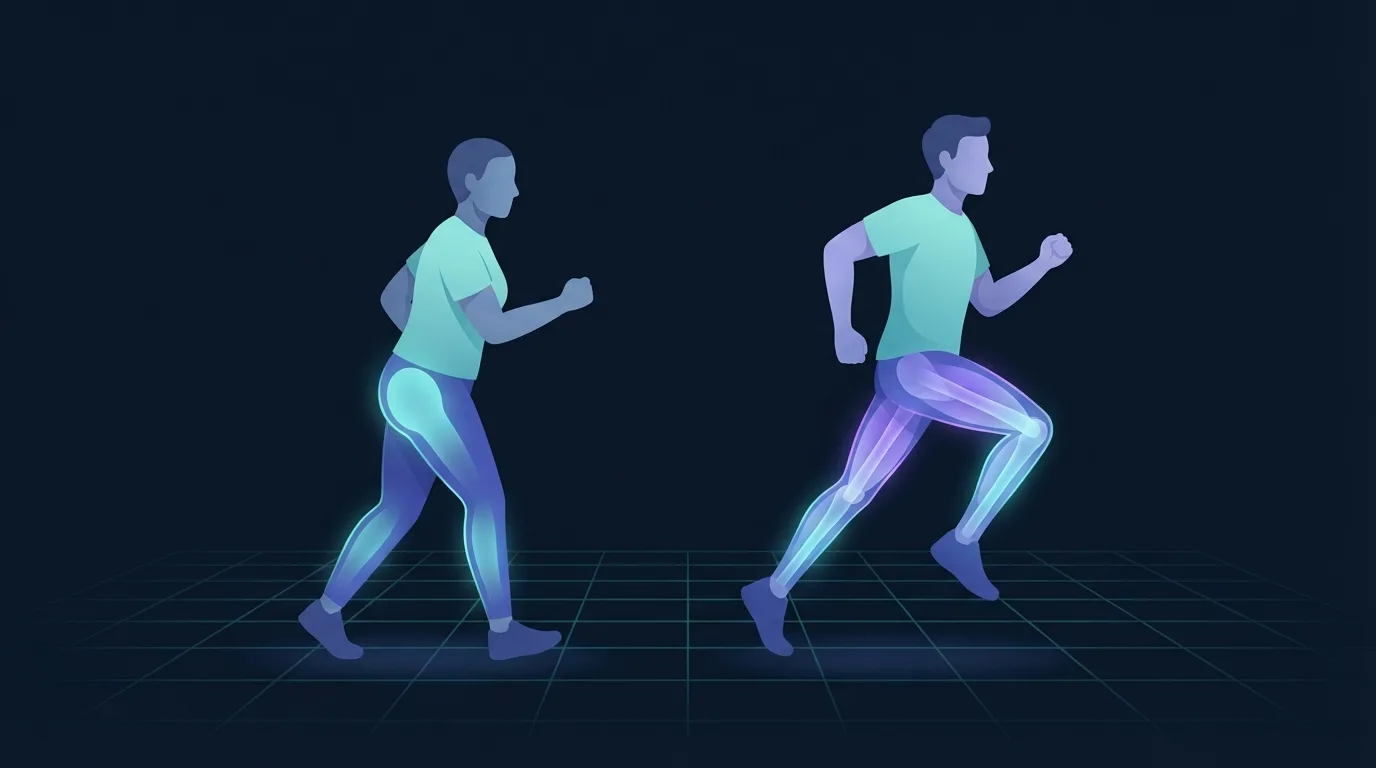
Walking vs running for weight loss has a clean answer on paper and a messy one in practice. Running burns roughly 40 percent more energy per mile and more than 50 percent more per minute, so if you did identical amounts of both, running would win every time. Nobody does identical amounts. Running is harder to start, harder to sustain and far more likely to hurt you, which is why walking quietly outperforms it for a lot of people who are not yet runners.
The useful question is not which burns more. It is which one you can accumulate 250 honest minutes of, every week, for the next six months without your knees filing a complaint. That question has a different answer depending on your weight, your history and how much time you have.
The Energy Cost Per Mile
The cleanest measurement of this comes from Hall et al. (2004) in Medicine and Science in Sports and Exercise. They put 24 adults through indirect calorimetry while covering 1600 m, once walking at 1.41 m/s (about 3.2 mph) and once running at 2.82 m/s (about 6.3 mph), on both a treadmill and an outdoor track. Running cost 481 kJ on the treadmill against 340 kJ for walking, and 480 kJ against 334 kJ on the track. In calories that is roughly 115 against 81 per mile.
So the mile you run costs about 40 percent more than the mile you walk. Notice what that number is not. It isn't double, and it isn't the four-times figure that gets thrown around online. Covering a given distance on foot has a fairly fixed price, and running raises it rather than transforming it.
The catch is the clock. Running that mile took about 9 and a half minutes. Walking it took about 19. Compare the two per minute instead of per mile and running pulls much further ahead, because it packs the same distance into half the time and charges more for it.
Per Hour, the Gap Gets Bigger
Most people have a time budget rather than a distance budget, so this is the table that matters. The MET values come from the 2024 Adult Compendium of Physical Activities compiled by Herrmann et al., which pooled 2,356 measured energy-expenditure values from 701 studies. One MET is about one calorie per kilogram of bodyweight per hour.
| Activity | METs | Approx. calories per hour at 70 kg | At 100 kg |
|---|---|---|---|
| Walking, 2.5 mph, strolling | 3.0 | 210 | 300 |
| Walking, 3.5 to 3.9 mph, brisk | 4.8 | 335 | 480 |
| Walking, 4.0 to 4.4 mph, very brisk | 5.5 | 385 | 550 |
| Running, 12-minute mile | 8.5 | 595 | 850 |
| Running, 10-minute mile | 9.3 | 650 | 930 |
Two things jump out of that table. The first is that pace matters more than mode at the walking end: strolling and brisk walking are almost two different activities, and only one of them changes your week. The second is that bodyweight is a multiplier. A 100 kg walker doing 45 brisk minutes is doing roughly what a 70 kg runner does in 30, which is exactly why walking works better for heavier beginners than the internet gives it credit for.
If you want the dose translated into a daily target rather than a MET number, we worked through it in how many miles you should walk a day by goal.
What Happens Over Years, Not Weeks
The largest long-term comparison is Williams (2013), who tracked 32,216 runners and 15,237 walkers in the National Runners' and Walkers' Health Study and compared change in BMI with change in exercise dose over a 6.2-year follow-up. Both activities were inversely related to BMI change, meaning more of either was associated with less weight gain. Running was more strongly related than walking in men and in heavier women.
That is a real finding, and it is also a cohort study, so it cannot separate the exercise from the people who choose it. The runners in that dataset were self-selected, and self-selection into running usually means a body that tolerates running. Read it as confirmation that the energy arithmetic survives into the real world, not as proof that switching to running would reproduce it for you.
Find out what's really holding you back
FitCraft, our mobile fitness app, pairs you with an AI coach who builds you a personalized plan around your goals, schedule, and fitness level. Every FitCraft program is designed by Domenic Angelino, MPH (Brown University) and NSCA-CSCS, with research published in the Journal of Strength and Conditioning Research and Medicine & Science in Sports & Exercise.
Take the Free Assessment Free • 2 minutes • No credit card
Appetite, Compensation and Why the Scale Lags
The most common objection to running for weight loss is that it makes you ravenous. In the short term, that's not what the data shows. Schubert et al. (2013) meta-analyzed 29 studies and 51 trials in Appetite, looking at how much people ate in the two hours after 30 to 120 minutes of moderate-to-high intensity exercise. Absolute energy intake barely changed. Relative energy intake, meaning intake minus the energy the session cost, dropped a lot. Their conclusion was that people tend not to compensate for the energy they expend, at least not right away.
The compensation that ruins weight-loss plans operates on a longer timescale and it's much less conscious. Flack et al. (2018) put overweight sedentary adults through 12 weeks of aerobic training at either 1,500 or 3,000 calories a week of exercise energy expenditure, and measured what came back. The lower-dose group compensated 943 calories a week, about 63 percent of what they burned. The higher-dose group compensated a similar absolute amount, 1,007 calories, which was only 34 percent of their much larger expenditure. Only the higher-dose group lost body fat.
That result is the single most useful thing on this page, and it cuts both ways. Compensation is not proportional, so small exercise doses get almost entirely erased while larger ones survive. It also does not care whether you walked or ran. What determines whether your effort shows up on the scale is total weekly energy expenditure, and you can build that out of brisk walking minutes just as well as running minutes. You simply need more of them.
Compensation is also not only appetite. It includes moving less for the rest of the day, which is the trap runners fall into and walkers mostly avoid. A hard 40-minute run has a way of producing an afternoon on the sofa. A 40-minute walk rarely does. We went through the mechanics of this in can you lose weight by walking, including the dose where it starts to work.
Adherence and Injury: Where Walking Wins
The energy arithmetic assumes you do the sessions. The adherence literature says that assumption is the weak link. Perri et al. (2002) randomized 379 sedentary adults in Health Psychology to different exercise prescriptions and found significantly greater adherence in the moderate-intensity condition, 45 to 55 percent of heart rate reserve, than in the higher-intensity condition at 65 to 75 percent. Prescribing harder exercise did not produce more exercise. It produced less.
Injury tells the same story. Colbert et al. (2000) compared walkers and runners in the Aerobics Center Longitudinal Study and found walkers carried lower odds of activity-related injury: an odds ratio of 0.75 in men under 45 and 0.64 in men aged 45 and over, with similar but non-significant patterns in women. Running duration mattered too. Men running 15 to 30 minutes a day had an odds ratio of 1.36 for injury, and those running more than 30 minutes a day 1.52. The authors concluded that walking can be safely recommended as a way to improve health and fitness.
The per-hour picture is starker. Videbaek et al. (2015) pooled 13 prospective studies in Sports Medicine and found 17.8 running-related injuries per 1,000 hours of running in novice runners, against 7.7 per 1,000 hours in recreational runners. Being new to running is the risk factor, not running itself, which is exactly why the first eight weeks should be slower and shorter than your fitness says you can handle. If your problem is that runs feel unsustainably hard from the first minute, our guide to running without getting tired covers pacing, breathing and the walk-run structure that fixes it.
The Part Both Options Miss
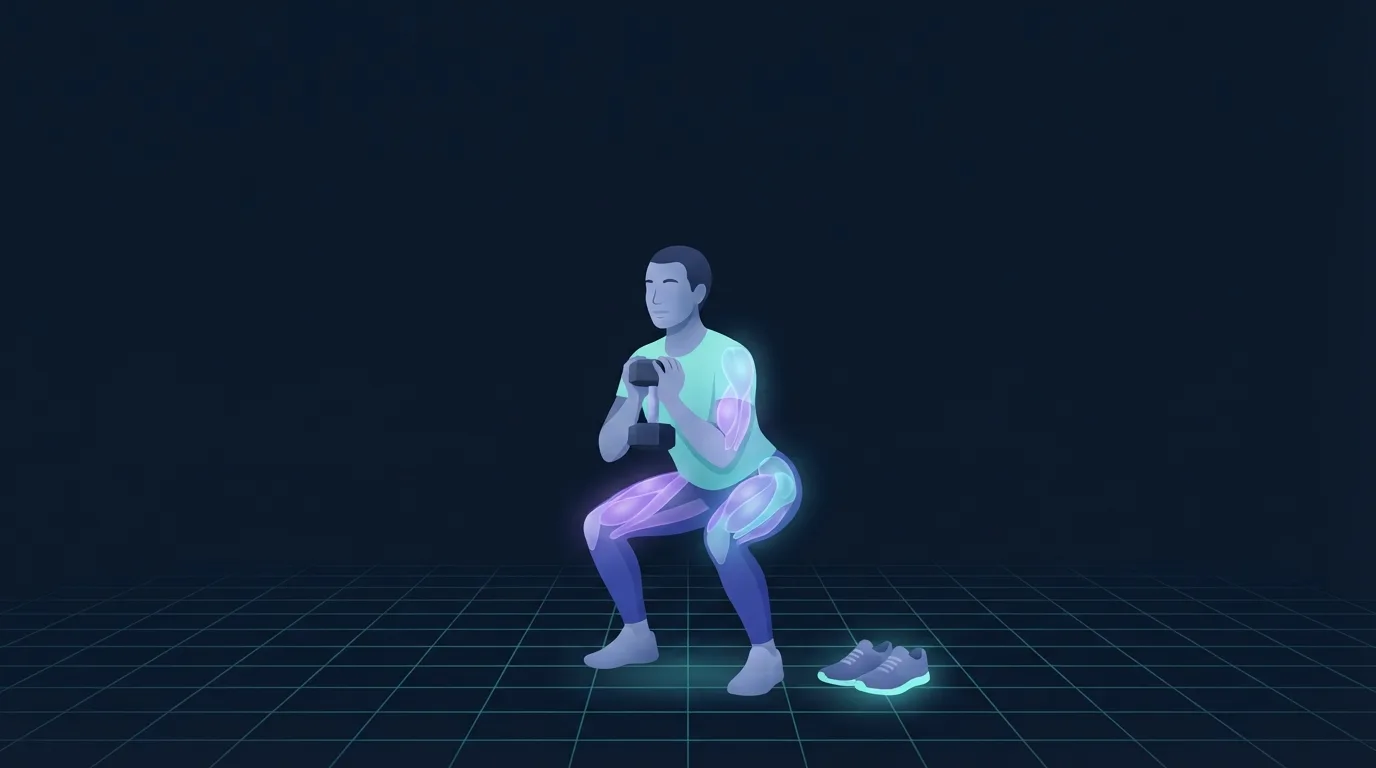
Whichever one you pick, a share of the weight you lose in a deficit comes from lean tissue. Cava et al. (2017), reviewing the evidence in Advances in Nutrition, concluded that both endurance and resistance exercise help preserve muscle mass during weight loss, and that resistance training additionally improves muscle strength, which endurance work and high protein intake on their own do not. Their recommendation for anyone losing weight is to increase physical activity with a particular emphasis on resistance-type exercise.
So the honest version of this comparison has three columns, not two. Two full-body strength sessions a week, 30 to 40 minutes each, sit underneath either choice. You don't need a gym for it. Dumbbells or bodyweight progressions are enough to send the signal that keeps muscle in place while the deficit does its work.
Which One Should You Choose?
| Where you are starting | Pick | Why |
|---|---|---|
| Sedentary, carrying a lot of extra weight | Walking | Bodyweight already raises your cost per minute, and impact risk is high |
| Sedentary, no joint issues, keen to run | Walk-run intervals | Novice injury rate is 17.8 per 1,000 hours. Ease into it |
| Already walking 8,000 to 10,000 steps, scale stalled | Add pace or incline | You are compensating. More of the same dose will not fix it |
| Under 30 minutes a day available | Running | The only one of the two that fits a real dose into that window |
| Running 3 times a week, stalled at week 6 | Add walking, not more running | More expenditure at a much lower injury and fatigue cost |
| History of shin splints or a stress fracture | Walking plus strength | Build tissue tolerance for two to three months first |
| Knee or hip osteoarthritis | Walking | Keeps the joint moving without repeated landing forces |
| You dread the thought of running | Walking | Adherence beats efficiency over any horizon longer than a month |
The stalled-walker row is the one people argue with, so here is the reasoning. If your minutes are already high and nothing is happening, adding a sixth walk changes very little. Raising the intensity of the walks you already do changes a lot, and incline is the cheapest way to do it. The evidence for that's summarized in our incline walking research review.
Two Sample Weeks
Both of these target roughly the same weekly energy expenditure. One uses time, the other uses intensity. Pick the one that matches your calendar and your joints.
| Day | Walking-led week | Running-led week |
|---|---|---|
| Monday | Brisk walk, 50 min | Easy run, 30 min |
| Tuesday | Strength, 35 min, full body | Strength, 35 min, full body |
| Wednesday | Brisk walk, 50 min, some incline | Brisk walk, 40 min |
| Thursday | Brisk walk, 45 min | Easy run, 30 min |
| Friday | Strength, 35 min, full body | Strength, 35 min, full body |
| Saturday | Long walk, 70 to 90 min | Longer run, 40 to 50 min |
| Sunday | Easy walk, 30 min, or rest | Brisk walk, 45 min |
| Weekly cardio total | 245 to 265 min | 185 to 195 min |
Notice that the running week still contains walking. That is deliberate. Walking is the cheapest energy expenditure available to a runner, it doesn't add to the tissue load that causes running injuries, and it is the easiest thing to protect when a week goes sideways. The apps most likely to help here are the ones that keep the streak alive on the bad weeks, which is what we looked at in our comparison of the best workout apps for weight loss.
The Bottom Line
Running wins per mile and per minute. Walking wins per year. Running a mile costs about 40 percent more than walking one, and the per-hour gap is larger still. But moderate intensity produces better adherence than higher intensity, walkers get hurt substantially less often than runners, and compensation erases small doses of either regardless of which one you chose.
Practical rule: if running feels sustainable and your time is short, run three days a week and walk on the others. If running hurts, or you're heavy enough that impact is a real problem, build to 250 brisk walking minutes a week instead. Add two strength sessions either way, and judge the plan at week 12, not week 3.
The failure mode on this topic is almost never picking the wrong one. It is picking the harder one, doing it enthusiastically for three weeks, getting hurt or bored, and stopping. The plan you will still be running or walking in six months beats the optimal one you abandon in March, every time and by a lot.
Frequently Asked Questions
Is walking or running better for weight loss?
Running is better per mile and per minute. Walking is better per week for most beginners, because it's easier to repeat and much less likely to injure you. Measured by indirect calorimetry, running a mile cost 481 kJ against 340 kJ for walking the same mile, about 40 percent more. That advantage only counts if you keep running, which is where most people fail.
How much walking do you need to do to lose weight?
Aim for 250 to 300 minutes a week at a brisk pace, which is roughly 45 minutes on most days. Brisk means 3.5 mph or faster, around 4.8 METs, fast enough that talking takes a little effort. Below about 150 minutes a week the scale rarely moves unless food changes at the same time.
Does running make you hungrier than walking?
Not in the hours right after a session. A meta-analysis of 29 studies and 51 trials found acute exercise had almost no effect on how much people ate afterwards, so the session created a real energy deficit. Compensation is a slower process that shows up over weeks, and it happens after both walking and running.
Can you lose weight by walking alone?
Yes, if the dose is high enough and food doesn't rise to meet it. The failure mode isn't walking, it's walking 20 gentle minutes three times a week and expecting a change. Push the pace, push the minutes toward 250 a week, and add two strength sessions so the weight you lose is fat rather than muscle.
Is it better to walk longer or run shorter?
If you have the time, walk longer. A 60-minute brisk walk and a 30-minute easy run land in a similar place for energy cost, and the walk carries almost no injury risk. If your window is 25 minutes, running is the only one of the two that fits a meaningful stimulus into it.
Should you lift weights while trying to lose weight?
Yes. Some of the weight lost in any deficit comes from muscle, and resistance training is the most reliable way to limit that while also improving strength. Two full-body sessions a week is enough. Neither walking nor running protects lean mass the way loaded training does.