
Jog or walk? It's one of the most common questions in fitness, and it usually gets one of two unhelpful answers. Running is better because it's harder, or walking is just as good because it's gentler. Neither answer asks what you want the exercise to do for you.
If you're choosing between the two, you're probably weighing real trade-offs: limited time, knees that complain, a body that hasn't run in years, or a goal like losing weight or getting fitter for a race. You may have started running before, hurt something in week three and gone back to nothing. Running and walking win on different goals, and the research is clear enough to sort them.
This page compares running vs walking goal by goal: calories per mile and per minute, heart health, fitness, longevity, joints, injury risk and weight loss. It also covers whether running is better than walking for older adults, whether walking helps running, and how to choose.
Running vs Walking by Goal: The Quick Answer
| Goal | Better choice | Why |
|---|---|---|
| Calories per minute | Running | About twice as many: 9.3 METs for a 10-minute mile against 4.8 for a brisk walk |
| Calories per mile | Running, by less than you'd think | About 25 to 40 percent more in lab measurements |
| Heart disease risk factors | Tie, at equal energy | Similar drops in blood pressure, cholesterol and diabetes risk |
| Aerobic fitness | Running | Higher intensity raises VO2 max more for the same energy |
| Living longer | Both | Running is linked with 27 percent lower mortality, and brisk walkers do better than slow walkers |
| Joints | Walking, though running isn't harmful for most | Lower force per step, and recreational runners have less arthritis than non-runners |
| Injury risk | Walking | Lower odds of injury, especially compared with new runners |
| Weight loss | Running per minute | Faster calorie burn, but the plan you keep matters more |
| Saving time | Running | Guidelines count one vigorous minute as two moderate ones |
The pattern is simple. Running packs more work into each minute, so it wins on anything measured per minute or per session. Walking wins on anything where impact and injury matter. On heart health, the two tie once you match the energy, which means a walker has to walk roughly twice as long as a runner runs.
Calories per Mile and per Minute
Per mile, running wins by 25 to 40 percent
Covering a mile on foot costs a fairly fixed amount of energy, and running raises that cost rather than multiplying it. Hall and colleagues (2004) measured 24 adults covering 1,600 meters, about a mile. Running at about 6.3 mph cost 481 kJ, about 115 calories, against 340 kJ, about 81 calories, walking at 3.2 mph. That's roughly 40 percent more. Wilkin and colleagues (2012) found a smaller gap in 30 adults of average fitness: about 113 calories for the run against 89 for the walk, roughly 27 percent more. The afterburn was small in both cases, with oxygen use back to resting levels 10 minutes after the walk and 15 minutes after the run.
Per minute, running burns about twice as much
The bigger difference is time. The 2024 Adult Compendium of Physical Activities rates brisk walking at 3.5 to 3.9 mph at 4.8 METs and running a 10-minute mile at 9.3 METs. One MET is roughly one calorie per kilogram of body weight per hour, so a 70 kg (154 lb) person burns about 335 calories in an hour of brisk walking and about 650 in an hour of running at that pace. Running covers more ground each minute and costs more per mile, so per minute it burns about twice as much.
Net calories, the part most calculators skip
Some of what you burn on a walk or run would have burned anyway while sitting still. Subtract that resting share and running's lead per mile grows, because a walking mile takes almost twice as long. Wilkin's volunteers averaged about 71 kg, which works out to roughly 1.2 calories a minute at rest. Take that out and the walk's 89 calories shrink to about 67 above rest, while the run's 113 shrink to about 101, a gap of roughly 50 percent. That's our arithmetic from the study's averages, not a figure the authors reported.
Is it better to run 5k or walk 10k?
For total calories, the 10K walk wins. Using Hall's per-mile figures, 6.2 miles of walking comes to about 500 calories against about 355 for 3.1 miles of running. For fitness, the 5K run wins, because it's done at a higher intensity. For your calendar, the 5K run takes about 30 minutes while the 10K walk takes close to two hours. If you have the time and your joints prefer walking, the 10K walk is a great session. If you have half an hour, run.
Which Is Better for Heart Health?
Per unit of energy, neither. The largest head-to-head comparison is Williams and Thompson (2013), who followed 33,060 runners and 15,945 walkers for 6.2 years. For every extra MET-hour of exercise a day, running cut the risk of developing high blood pressure by 4.2 percent, high cholesterol by 4.3 percent, diabetes by 12.1 percent and coronary heart disease by 4.5 percent. Walking cut them by 7.2, 7.0, 12.3 and 9.3 percent. None of the differences was statistically significant except cholesterol, where walking did marginally better. The authors concluded that equal energy spent walking or running produced similar risk reductions.
The catch is the word equal. To match a runner's energy, a walker has to cover more miles and spend about twice the time on their feet. Walkers who do that get the heart benefits. A 20-minute stroll doesn't match a 20-minute run.
Walking on its own still moves the numbers. A meta-analysis of 32 randomized trials by Murtagh and colleagues (2015) found that walking programs in inactive adults lowered systolic blood pressure by about 3.6 mmHg, trimmed about 1.5 cm from the waist and raised aerobic capacity by about 3 mL/kg/min, though they didn't change blood lipids.
Which Builds More Fitness?
Running, mostly because it's harder. Aerobic fitness, measured as VO2 max, responds to intensity as well as volume. In a trial that held energy expenditure constant, Gormley and colleagues (2008) found that six weeks of training raised VO2 max by 3.4 mL/kg/min at moderate intensity, 4.8 at vigorous intensity and 7.2 at near-maximal intensity. It was a cycling study, but the principle carries over: the same calories burned at a higher intensity build more fitness. A review by Swain and Franklin (2006) reached the same conclusion across trials. With total energy matched, vigorous exercise beat moderate exercise for aerobic capacity, diastolic blood pressure and blood sugar control, though not for systolic blood pressure, cholesterol or body fat.
Fitness matters because it's one of the strongest predictors of how long you live. A meta-analysis of 33 studies by Kodama and colleagues (2009) found that each 1-MET increase in fitness, about what it takes to run 1 km/h faster, was linked with a 13 percent lower risk of death from any cause and a 15 percent lower risk of heart disease events.
Walking can still count as vigorous if you're starting from a low fitness level or walking uphill. For an unfit adult, a brisk walk up a hill can feel as hard as an easy jog does for someone fitter, and the fitness response follows the effort you put in.
Which Helps You Live Longer?
The case for running
Lee and colleagues (2014) followed 55,137 adults for an average of 15 years. Runners had a 30 percent lower risk of death from any cause and a 45 percent lower risk of death from cardiovascular disease than non-runners, which worked out to about three extra years of life. The benefit showed up even in people who ran 5 to 10 minutes a day at slow speeds, under 6 mph. A meta-analysis by Pedisic and colleagues (2020) pooled 14 studies and 232,149 people and found that running was linked with a 27 percent lower risk of death from any cause, with no clear extra benefit from running more often, longer or faster. Even once a week beat none.
The case for walking
Walking's evidence is about pace and volume. In a pooled analysis of 50,225 walkers from 11 British cohorts, Stamatakis and colleagues (2018) found that people who reported an average walking pace had a 20 percent lower risk of death from any cause than slow walkers, and brisk walkers had a 24 percent lower risk. Steps count too. A meta-analysis of 15 cohorts by Paluch and colleagues (2022) found that the risk of death kept falling with more daily steps until about 6,000 to 8,000 a day in adults 60 and older, and 8,000 to 10,000 in younger adults.
Are runners the healthiest people?
Runners do well in these studies, but they're also a self-selected group. People who run tend to be leaner and already healthy enough to run, and no study can fully adjust for that. The fairer reading is that both activities add years, running gets there in fewer minutes, and a walker who walks briskly and often closes most of the gap.
Knowing what to do is the easy part.
FitCraft, our mobile fitness app, pairs you with an AI coach who builds you a personalized plan around your goals, schedule, and fitness level. Every FitCraft program is designed by Domenic Angelino, MPH (Brown University) and NSCA-CSCS, with research published in the Journal of Strength and Conditioning Research and Medicine & Science in Sports & Exercise.
Take the Free Assessment Free • 2 minutes • No credit cardWhich Is Easier on Your Joints?
Walking puts less force through your joints with every step. Nilsson and Thorstensson (1989) measured ground reaction forces on a force plate and found that the peak vertical force rose from about 1.0 to 1.5 times body weight in walking, and from about 2.0 to 2.9 times body weight in running, as speed went up.
More force per step doesn't mean running wears out your knees. In a meta-analysis of 17 studies with nearly 115,000 people, Alentorn-Geli and colleagues (2017) found hip or knee arthritis in 3.5 percent of recreational runners, against 10.2 percent of sedentary non-runners and 13.3 percent of competitive runners. Recreational running wasn't linked with higher odds of arthritis, and its raw rate was the lowest of the three groups. It was years of high-volume competitive running that went with higher rates. Joints adapt to loads they can handle, and our article on whether running is bad for your knees covers who should be careful.

Which Has the Lower Injury Risk?
Walking, clearly. In the Aerobics Center Longitudinal Study, Colbert and colleagues (2000) compared 5,327 regular walkers and runners. Male walkers had 25 percent lower odds of an activity-related injury than male runners if they were under 45, and 36 percent lower odds if they were 45 or older. Women showed a similar trend that wasn't statistically significant. More walking didn't raise injury risk, while men who ran 30 or more minutes a day had about 50 percent higher odds of injury than men who ran under 15 minutes.
Running injuries cluster in the first months. A meta-analysis by Videbæk and colleagues (2015) found 17.8 injuries per 1,000 hours of running in novice runners, more than double the 7.7 in recreational runners. That's the main reason to start with walking, or with a run-walk mix, and build running time slowly.
Which Is Better for Weight Loss?
Running has the edge per minute, and the long-term data agree. Williams (2013) followed 32,216 runners and 15,237 walkers for 6.2 years and found that body mass index fell more per unit of energy spent running than walking in men and in heavier women. The same study found that walkers kept up their exercise better over time than runners did, and the plan you stick with burns more than the one you drop. Neither one burns belly fat specifically, because your body loses fat from all over when you spend more energy than you eat. Our guide to walking vs running for weight loss covers the calorie math, appetite and two sample weeks.
Is Running Better Than Walking for Seniors?
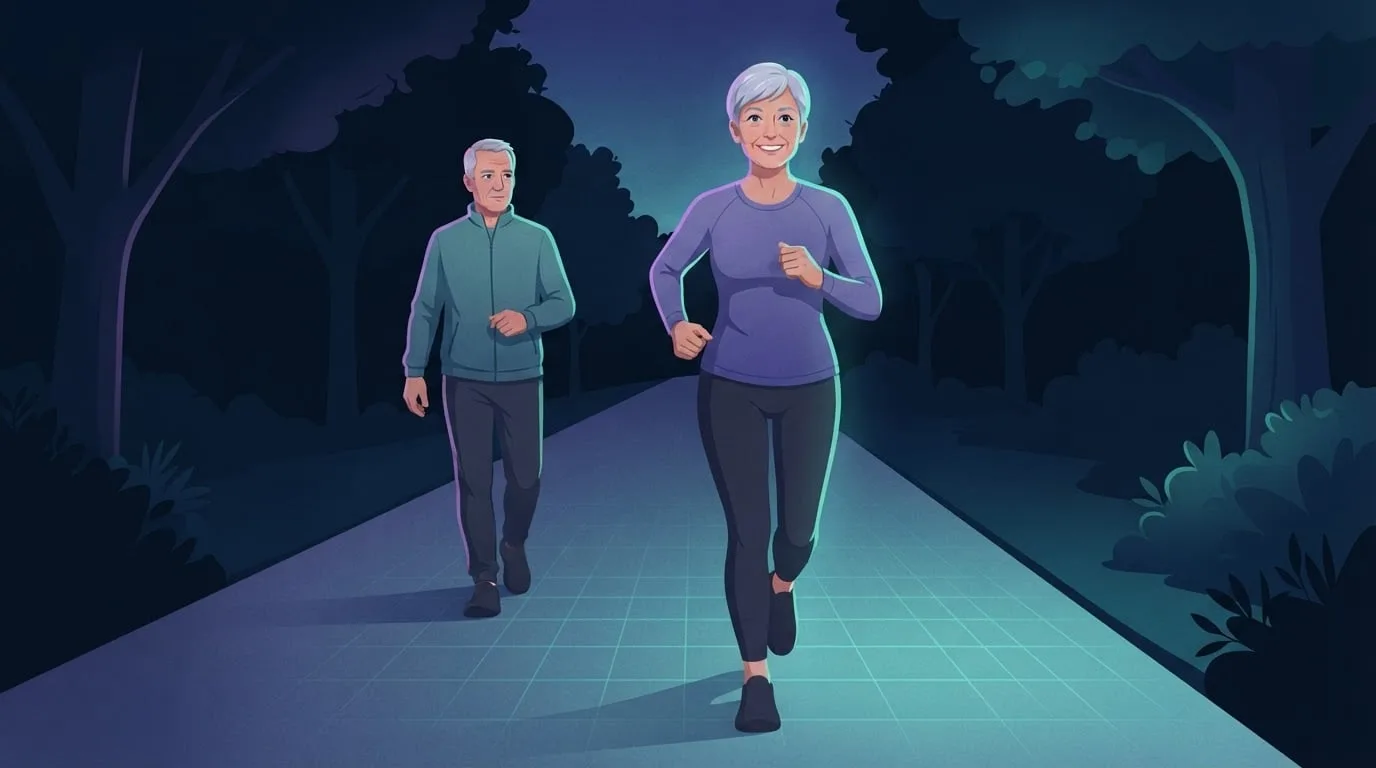
Not automatically, but older runners keep something walkers lose. Ortega and colleagues (2014) compared 15 adults around 69 years old who ran at least 30 minutes three times a week with 15 who walked that much. The runners walked 7 to 10 percent more economically than the walkers, at about the same energy cost as sedentary young adults. The walkers were no more economical than sedentary people their own age. That matters as you age, because the more effort walking takes, the harder everyday life feels.
Walking is still the safer default for most older adults. In Colbert's data, men 45 and older who walked had 36 percent lower odds of injury than men who ran, and Paluch's step data suggest the benefit of daily steps levels off around 6,000 to 8,000 a day after 60. The US guidelines summarized by Piercy and colleagues (2018) ask older adults for aerobic activity plus muscle-strengthening and balance work. If you already run and it feels good, keep running. If you're starting at 60 or 70, begin with brisk walking, add two strength sessions a week, and try short jogging intervals only after a few months of regular walking.
Does Walking Help Running?
Yes. Walking builds the aerobic base and the tolerance in your tendons, bones and calves that running depends on, with a fraction of the impact. That's why most beginner running plans start with walk breaks, and why experienced runners walk on recovery days. The run-walk method alternates short running and walking intervals, so you can spend more total time on your feet without the injury risk of running continuously too soon. Structured walking plans like the 6-6-6 walking challenge are another way to build that base before you add running.
Jog or Walk: How to Choose
Choose running if:
- You're short on time. The guidelines count a minute of vigorous activity like running as two minutes of moderate activity like brisk walking.
- You want to raise your fitness or train for an event.
- Your joints tolerate impact and you're willing to build up gradually.
Choose walking if:
- You're new to exercise, carrying a lot of extra weight, or coming back from an injury.
- Running hurts, or you dread it enough that you'll skip it.
- You want daily movement you can repeat without needing recovery days.
Mix both if you want the benefits of each. Run-walk intervals, or walking on the days between runs, give you running's fitness gains with walking's lower injury risk.
Whichever you choose, add two strength sessions a week. Neither running nor walking builds much muscle, and the guidelines ask for muscle-strengthening work on two or more days. In FitCraft, a 3D AI coach demonstrates each bodyweight and dumbbell exercise and the program adapts as you progress. If you're just starting out, a fitness app built for beginners can give you those two strength sessions while you keep walking or running on your own.
What This Means for You
The best choice is the one you'll still be doing six months from now. Running is the faster route to fitness. Walking is the gentler route, with the same heart benefits per calorie. Most people who stop exercising stop because nothing makes the next session easy to start, whichever activity they picked.
Picture a normal week a few months from now: four sessions on your calendar, a route you like, legs that feel springier on hills, and no debate each morning about whether today counts. That's what consistency buys you, whether you jog or walk. As Katie put it after years of false starts: "I've tried everything. This is the first time I've stuck with something past two weeks."
Frequently Asked Questions
What are the benefits of walking vs jogging?
Walking's main benefits are a lower injury risk, a pace you can repeat every day without recovery days, and the same heart benefits per calorie as jogging. Jogging burns about twice as many calories per minute, raises aerobic fitness more, and meets the activity guidelines in about half the time. Many people get the best of both by jogging two or three days a week and walking on the others.
Is it better to run 5k or walk 10k?
Walking 10K burns more total calories, about 500 against about 355 for a 5K run based on lab measurements in average adults, but it takes close to two hours instead of about 30 minutes. Running 5K builds more aerobic fitness because it's done at a higher intensity. Pick the walk for low-impact volume and the run for fitness and time.
What is the 6 6 6 rule in walking?
The 6-6-6 walking rule is a six-week challenge: a 6-minute warm-up, 60 minutes of brisk walking at 6 a.m. or 6 p.m., and a 6-minute cool-down, six days a week. That adds up to 360 minutes of walking a week, more than double the 150-minute guideline minimum. The 6 o'clock timing has no proven advantage, so walk at whatever time you can repeat.
What is the 80% rule in running?
The 80% rule, often called 80/20 training, means doing about 80 percent of your running at an easy, conversational pace and about 20 percent at harder efforts. It comes from how elite endurance athletes train, and polarized plans built on this split have beaten threshold-heavy plans in trials with trained athletes. For most beginners, it simply means slowing most runs down.
Does running build muscle?
Running builds a little leg muscle in people who haven't trained before, but far less than strength training, and almost none in people who already lift. Downhill running loads the thigh muscles more than flat running does. If you want stronger legs, pair your runs with squats, lunges and other strength work twice a week.
Are runners the healthiest people?
Runners live longer on average: in a study of 55,137 adults, runners had a 30 percent lower risk of death from any cause and lived about three years longer than non-runners. But walkers who burn the same energy get similar protection against high blood pressure, high cholesterol and diabetes. Runners also tend to be healthier to begin with, which studies can't fully separate from the running itself.
Is swimming better than running?
Neither is better overall: swimming is gentler on your joints, and running is easier to fit into a day and loads your bones. In a study of 80,306 British adults, swimmers had a 28 percent lower risk of death from any cause and a 41 percent lower risk of death from cardiovascular disease than non-swimmers, while running showed no significant link in that group. Larger pooled analyses do find lower death rates in runners, so pick the one you'll do most often.
Is walking or running better to burn belly fat?
Neither one burns belly fat specifically, because your body loses fat from all over when you spend more energy than you eat. Running burns about twice as many calories per minute, so it gets you there faster if you can do it consistently. Walking works too if you walk more minutes, and adding strength training helps you keep muscle while the fat comes off.