Almost everyone has heard some version of "running will wreck your knees" from a relative, a coworker or a doctor who said it offhand. It sounds obviously true. You're landing on one leg thousands of times an hour at multiples of your body weight, and cartilage doesn't grow back. The intuition is clean. It's also wrong at the population level, and the gap between that intuition and the data is one of the better-documented mismatches in sports medicine.
The stakes aren't small. Knee worry is one of the most common reasons people quit running or never start, and the substitution they make (sitting more) is worse for knees than the thing they were avoiding.
Here's what this article covers: what the arthritis numbers actually show, why cartilage holds up better than the intuition predicts, the specific conditions under which running does raise your risk, why most knee pain in runners isn't arthritis at all, and the two changes with the best evidence behind them.
What the Arthritis Data Actually Shows
The single most useful study here is a meta-analysis. Alentorn-Geli and colleagues (2017) in the Journal of Orthopaedic and Sports Physical Therapy searched PubMed, Embase and the Cochrane Library, pulled 25 studies covering 125,810 people, and compared hip and knee osteoarthritis prevalence across three groups:
- Recreational runners: 3.5 percent (95% CI 3.4 to 3.6)
- Sedentary, non-running controls: 10.2 percent (95% CI 9.9 to 10.6)
- Competitive and elite runners: 13.3 percent (95% CI 11.6 to 15.2)
Read that carefully, because it's a U-shape and not a straight line. The group with the least arthritis isn't the group doing nothing. It's the group running recreationally. The group with the most is the professional and elite tier: national-level competitors, career-long high-mileage athletes, people whose training volume is their job.
The marathon data agrees. Ponzio and colleagues (2018) in the Journal of Bone and Joint Surgery surveyed 675 active marathoners who had completed at least five marathons and were still running at least 10 miles a week. Hip or knee arthritis showed up in 8.8 percent of them, compared with 17.9 percent in a matched slice of the US population. More striking: within the marathoners, arthritis risk had no relationship to years of running, weekly mileage, pace or number of marathons finished. What did predict it were age, family history and prior surgery. Running history didn't.
Two more results round it out. Lo and colleagues (2017) used the Osteoarthritis Initiative cohort, a large multi-center study built specifically to track knee arthritis, and found that people with any history of running had lower odds of both radiographic and symptomatic knee osteoarthritis than people who had never run. And Burfield, Sayers and Buhmann (2023) in Physical Therapy in Sport pooled nine case-control studies covering 12,273 participants to test whether more mileage meant more arthritis. It didn't. The odds ratio was 0.97 with a confidence interval running from 0.56 to 1.68, and the subgroup covering more than 48 kilometres a week trended toward less knee arthritis, not more.
None of that is a randomized trial, and it can't be. Nobody is going to assign 10,000 people to run or not run for thirty years. Self-selection is real: people whose knees hurt stop running, which biases runner groups toward healthy knees. But the effect is large, consistent across designs and countries, and it runs in the opposite direction from the folk belief. If running were quietly destroying knees, 125,810 people would not hide it.
Why Cartilage Holds Up Better Than It Sounds Like It Should
The "wear and tear" mental model treats cartilage like a brake pad: a finite amount of material that grinds down with use. That model is wrong. Cartilage is living tissue with no blood supply of its own, and it gets its nutrition from being squeezed. Compression pushes fluid and waste out, release draws fluid and nutrients back in. Rhythmic loading is how cartilage eats.
That's why immobilisation thins cartilage and why bed rest is bad for joints. And there's direct measurement from inside the knee. Hyldahl and colleagues (2016) in the European Journal of Applied Physiology drew synovial fluid straight out of the knees of recreational runners before and after a 30-minute run and compared it with a seated control session. Running lowered the concentration of pro-inflammatory cytokines inside the joint, and it moved cartilage oligomeric matrix protein out of the joint space and into the bloodstream. It's a pilot study with six participants, so treat the size of the effect with caution. The direction is what matters here, and it's the opposite of what the grinding model predicts.
The honest version of the mechanism: cartilage, like bone and tendon, adapts to load applied gradually and fails under load applied suddenly. That one sentence explains most of what follows.
Where Running Actually Does Raise Your Risk
The evidence isn't "running is always fine". Four conditions move the needle.
Elite and competitive volume sustained for years
The 13.3 percent figure in the Alentorn-Geli meta-analysis is real. At the professional end, training volume, racing frequency, running through injury and the accumulated trauma of a competitive career stack up. Very few recreational runners are anywhere near that exposure, and the threshold appears to sit well above a typical 20 to 40 mile week.
A knee that was already injured
This is the biggest one, and it gets lost in the headline. A prior ACL tear, meniscus surgery or any significant injury inside the joint raises later arthritis risk sharply, regardless of what you do afterward. In the Ponzio marathon data, surgical history predicted arthritis independently while running history did not. If you've had knee surgery, your risk conversation is about that surgery, not about running.
Load that arrives faster than tissue adapts
Nielsen and colleagues (2014) in JOSPT followed 874 healthy novice runners for a year with GPS-verified distance. Runners who progressed their weekly distance by more than 30 percent over a two-week window picked up more distance-related injuries (patellofemoral pain, iliotibial band syndrome, tibial stress injuries, patellar tendinopathy) than runners who progressed by less than 10 percent. Same people, same shoes, same surfaces. The variable was the rate of change.
Carrying substantially more body mass while starting from zero
Higher body mass raises both the per-stride joint load and the baseline arthritis risk, and starting a running program from a sedentary baseline compounds it. That's not a reason never to run. It's a reason to build in with walk-run intervals, strength work and a longer ramp. Our roundup of the best low-impact exercises for bad knees covers the on-ramp options that load the knee less while you build the surrounding strength.
Most Running Knee Pain Is Not Arthritis
When a runner's knee hurts, arthritis is rarely the diagnosis. Taunton and colleagues (2002) in the British Journal of Sports Medicine reviewed 2,002 running injuries presenting to a primary care sports medicine clinic. The knee was the most common site, and patellofemoral pain syndrome was the single most common diagnosis overall. Runner's knee, in other words.
Patellofemoral pain is a load-tolerance problem, not a structural one. The tissue around and under the kneecap is being asked for more than it currently tolerates, usually because of a recent spike in volume, hills or speed work, and usually in a leg where the hip and quadriceps aren't contributing enough. It shows up as a dull ache around or behind the kneecap that's worse going downstairs, worse after sitting for a long stretch, and worse late in a run.
The good news is that the treatment is well studied and it isn't rest. Lack and colleagues (2015) in the British Journal of Sports Medicine pooled the rehabilitation trials and found that hip-focused strengthening reduced patellofemoral pain and improved function more than knee-focused exercise alone. Strengthen the hip, flatten the load spike, keep moving.
Load Management Is the Real Protective Factor
If you take one practical rule from this article, take this one: change your training load slowly enough that tissue can keep up. Everything else is detail.
- Cap weekly increases at roughly 10 to 15 percent, and keep any two-week jump under 30 percent. That's the Nielsen threshold with a margin.
- Hold a week flat after every third week. Three weeks up, one week level. It costs almost nothing in fitness and it's where adaptation consolidates.
- Change one variable at a time. Add distance, or add hills, or add speed work. Not two in the same week, and never all three.
- Use walk-run intervals while you build. They cut continuous impact exposure per session without cutting total training time, which is exactly the trade a new runner wants.
- Treat a 48-hour ache as data. Soreness that fades within a day is normal. A knee that's worse the morning after than it was during the run is a load signal.
Pacing feeds into this too. Running every session faster than you should is one of the most common ways beginners generate load spikes without noticing, and our guide on how to run without getting tired covers the easy-pace discipline that keeps the ramp sustainable.
Knowing what to do is the easy part.
FitCraft, our mobile fitness app, pairs you with an AI coach who builds you a personalized plan around your goals, schedule, and fitness level. Every FitCraft program is designed by Domenic Angelino, MPH (Brown University) and NSCA-CSCS, with research published in the Journal of Strength and Conditioning Research and Medicine & Science in Sports & Exercise.
Take the Free Assessment Free • 2 minutes • No credit cardCadence: The Cheapest Change With Real Evidence
Step rate is the one gait variable with solid mechanical data behind it, and you can change it today without new shoes or a coach. Heiderscheit and colleagues (2011) in Medicine and Science in Sports and Exercise put 45 healthy recreational runners on an instrumented treadmill at constant speed and manipulated step rate at their preferred cadence plus or minus 5 and 10 percent. Raising step rate cut the energy absorbed at the hip and knee substantially, with the 10 percent condition producing the largest drop. Speed was held constant, so the only thing that changed was how the load was distributed.
The mechanism is simple. A quicker step rate means a shorter step, which means your foot lands closer to underneath your hips instead of well out in front of them. Less overstriding, less braking force, a less extended knee at contact.
In practice: count your steps for 30 seconds at your normal easy pace and double it. Most recreational runners land somewhere between 155 and 170. Add roughly 5 percent (about 8 steps a minute) and hold it for a few minutes at a time on easy runs until it stops feeling strange, which usually takes two to three weeks. Don't chase 180. That number came from observations of elites at race pace and isn't a target for everyone. Our review of the running cadence research covers what the step-rate trials do and don't support.
Strength Is the Other Lever
The second protective factor is muscle, and the evidence is direct. Oiestad and colleagues (2015) in Osteoarthritis and Cartilage pooled five cohort studies covering 5,707 people with follow-up between 2.5 and 14 years. People with knee extensor weakness had about 65 percent higher odds of developing symptomatic knee osteoarthritis (OR 1.65, 95% CI 1.23 to 2.21). Weak quadriceps is a risk factor for knee arthritis. Running is not.
Muscle is what absorbs force before it reaches the joint. A strong quadriceps, glute and calf complex decelerates your body over a longer distance and a longer time, which lowers peak joint stress at exactly the moment it matters.
You don't need a barbell or a gym for this. Two sessions a week of the following, done with body weight or a pair of dumbbells, covers almost all of it:
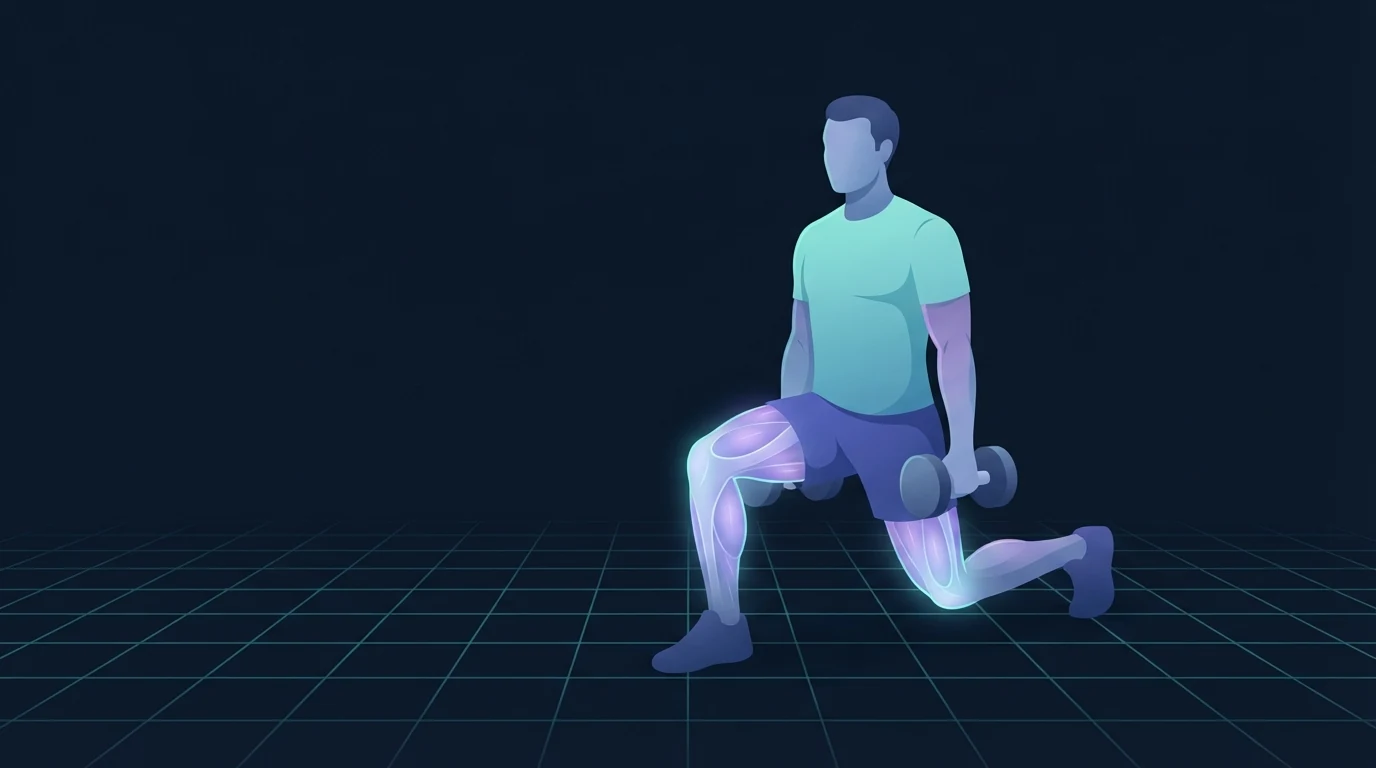
- Split squats or rear-foot-elevated split squats, 3 sets of 8 to 12 per leg. The best quadriceps builder that also trains balance under load.
- Step-ups to a knee-height box, 3 sets of 8 per leg, controlled on the way down. The lowering half is the part that matters most for runners.
- Single-leg Romanian deadlifts, 2 to 3 sets of 8 per leg. Hamstrings and glutes, which share the braking job with the quadriceps.
- Side-lying or banded hip abduction, 2 to 3 sets of 12 to 15 per side. This is the hip work the patellofemoral pain trials kept finding useful.
- Slow calf raises, 3 sets of 12 to 15, straight leg and bent knee. The calf absorbs a large share of landing force before the knee ever sees it.
Our guide on how to strengthen your knees walks through the progressions in more detail, including what to do if a movement currently hurts. And if you've never run a structured strength program and want something that keeps you showing up rather than something maximally clever, our roundup of the best fitness apps for beginners compares the options on exactly that criterion.
Who Should Actually Be Careful
The general answer is reassuring. The individual answer sometimes isn't. Talk to a clinician before you start or continue running if any of these describe you:
- You've had knee surgery, especially ACL reconstruction or a meniscectomy. Post-traumatic arthritis follows its own timeline, and your program should be built around that history.
- Your knee swells after activity, locks, gives way, or catches. Those are mechanical symptoms that deserve an assessment before more loading.
- Pain climbs during a run rather than warming up and fading, or is consistently worse the next morning.
- You already have diagnosed knee osteoarthritis. This one is genuinely nuanced. Lo and colleagues (2018) in Clinical Rheumatology followed Osteoarthritis Initiative participants aged 50 and older who already had knee osteoarthritis and found that self-selected running was associated with less knee pain over time and no increase in radiographic structural progression. That's encouraging, and it's also observational: the people who kept running were the people whose knees tolerated it. Our review of exercise for knee osteoarthritis covers what the randomized therapy trials support, which is where the stronger evidence lives for this group.
- You're returning after a long layoff or from a sedentary baseline. Not a contraindication. Just a reason to spend six to eight weeks on walk-run and strength before continuous running.
What This Means for You
If you have healthy knees and you want to run, run. The population data is about as clear as observational data gets, and the alternative you're weighing it against (not running) carries its own arthritis risk through weight gain and quadriceps weakness. The fear of wrecking your knees has probably cost more knees than running ever did.
If your knees already hurt, the useful move is almost never "stop everything". It's to find the load you tolerate today, build strength around it, and expand slowly. Most runner's knee resolves with hip and quadriceps work plus a corrected training ramp, without a single week of complete rest.
And if you're starting from scratch, give yourself the boring version: two strength sessions a week, walk-run intervals for the first month, a 10 percent ceiling on weekly increases, and a cadence a touch quicker than feels natural. It isn't exciting. It's what keeps you running in ten years.
Frequently Asked Questions
Is running bad for your knees?
No, not for most people. Alentorn-Geli and colleagues (2017) pooled 25 studies covering 125,810 people and found hip and knee osteoarthritis in 3.5 percent of recreational runners, 10.2 percent of sedentary controls and 13.3 percent of competitive and elite runners. Recreational running at 15 to 40 miles a week sits at the bottom of that curve, not the top. What damages knees is a sudden jump in training load, a knee that was already injured, or elite-level volume sustained for years, not the act of running itself.
Does running cause knee arthritis?
The evidence points the other way for recreational volumes. Ponzio and colleagues (2018) surveyed 675 active marathoners who had run at least five marathons and found hip or knee arthritis in 8.8 percent of them, against 17.9 percent in a matched slice of the US population, with no link to mileage, pace or number of marathons. Burfield, Sayers and Buhmann (2023) pooled nine studies and found no difference in knee osteoarthritis prevalence between runners and low-mileage controls at any weekly volume they could analyze.
Why do my knees hurt after running?
Usually patellofemoral pain, commonly called runner's knee, which is an irritated load-tolerance problem around the kneecap rather than cartilage wear. Taunton and colleagues (2002) reviewed 2,002 running injuries at a sports medicine clinic and found the knee was the most common injury site with patellofemoral pain the single most common diagnosis. The two things that usually caused it are a recent jump in mileage or intensity and weak hip and quadriceps muscles. Both are fixable without stopping running.
How much should you increase your running to protect your knees?
Keep two-week jumps under about 30 percent of your current weekly distance. Nielsen and colleagues (2014) followed 874 healthy novice runners for a year and found that progressing weekly distance by more than 30 percent over a two-week window was associated with more distance-related injuries, including patellofemoral pain and iliotibial band syndrome, than progressing by less than 10 percent. Ten to fifteen percent per week is a safe working default, and holding a week flat after every third week costs you nothing.
Can you run if you already have knee osteoarthritis?
Often yes, with medical clearance and a slow build. Lo and colleagues (2018) tracked Osteoarthritis Initiative participants aged 50 and older who already had knee osteoarthritis and found that self-selected running was associated with less knee pain over time, not more, and no increase in radiographic structural progression. That is observational data from people who chose to keep running, so it is not a green light for everyone. Talk to a clinician first, and stop and reassess if pain climbs during a run or is worse the next morning.
What exercises protect your knees from running injuries?
Hip and quadriceps strength work, two sessions a week. Oiestad and colleagues (2015) pooled five cohort studies covering 5,707 people and found knee extensor weakness raised the odds of developing symptomatic knee osteoarthritis by about 65 percent. Lack and colleagues (2015) found hip-focused rehabilitation reduced patellofemoral pain and improved function better than knee-only work. Split squats, step-ups, single-leg hip hinges, hip abduction work and slow calf raises with a pair of dumbbells cover almost all of it.