- Weighted vest walking is the viral 2026 walking trend. The science behind it is real, but more modest than your TikTok feed suggests.
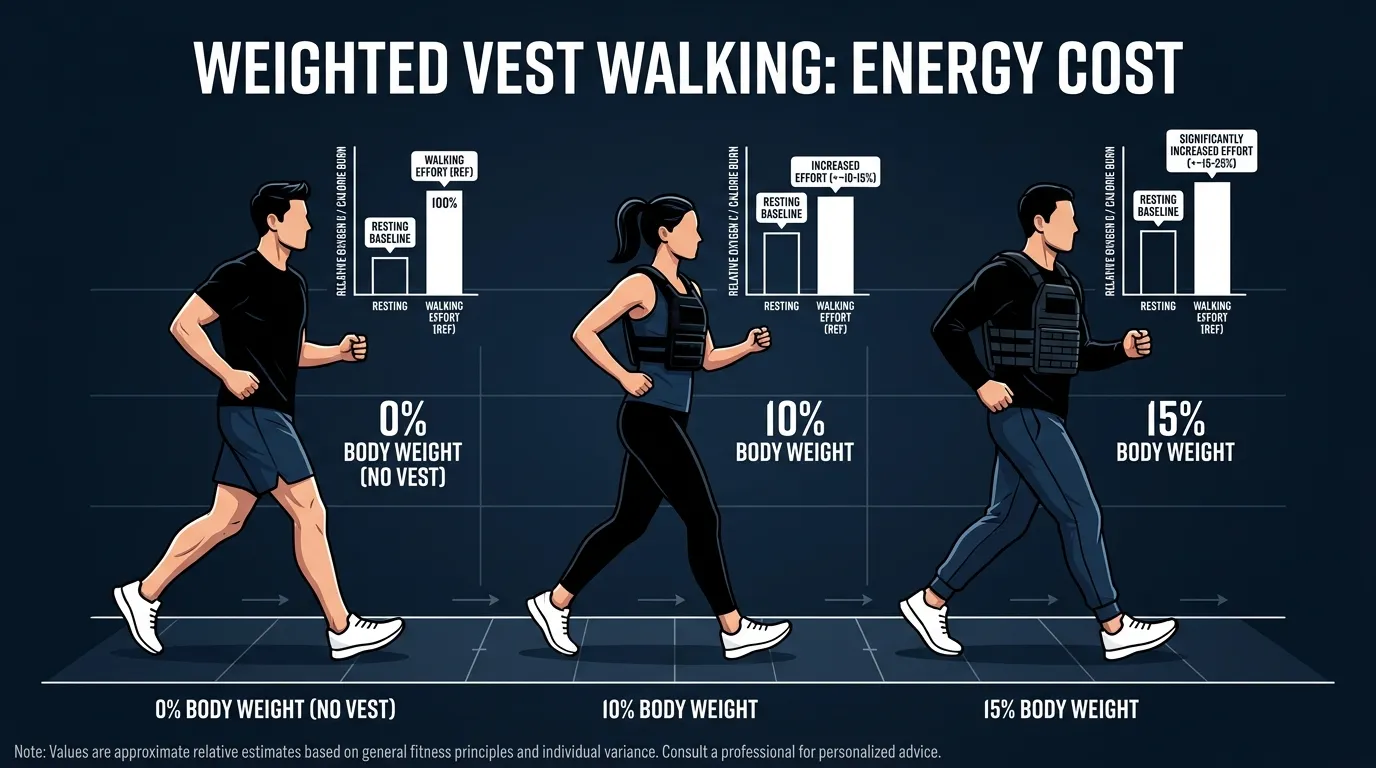
- A 15% body-weight vest raises calorie burn at the same walking pace by about 12% (Puthoff et al., 2006). Heavier vests burn more, but comfort and injury risk rise fast.
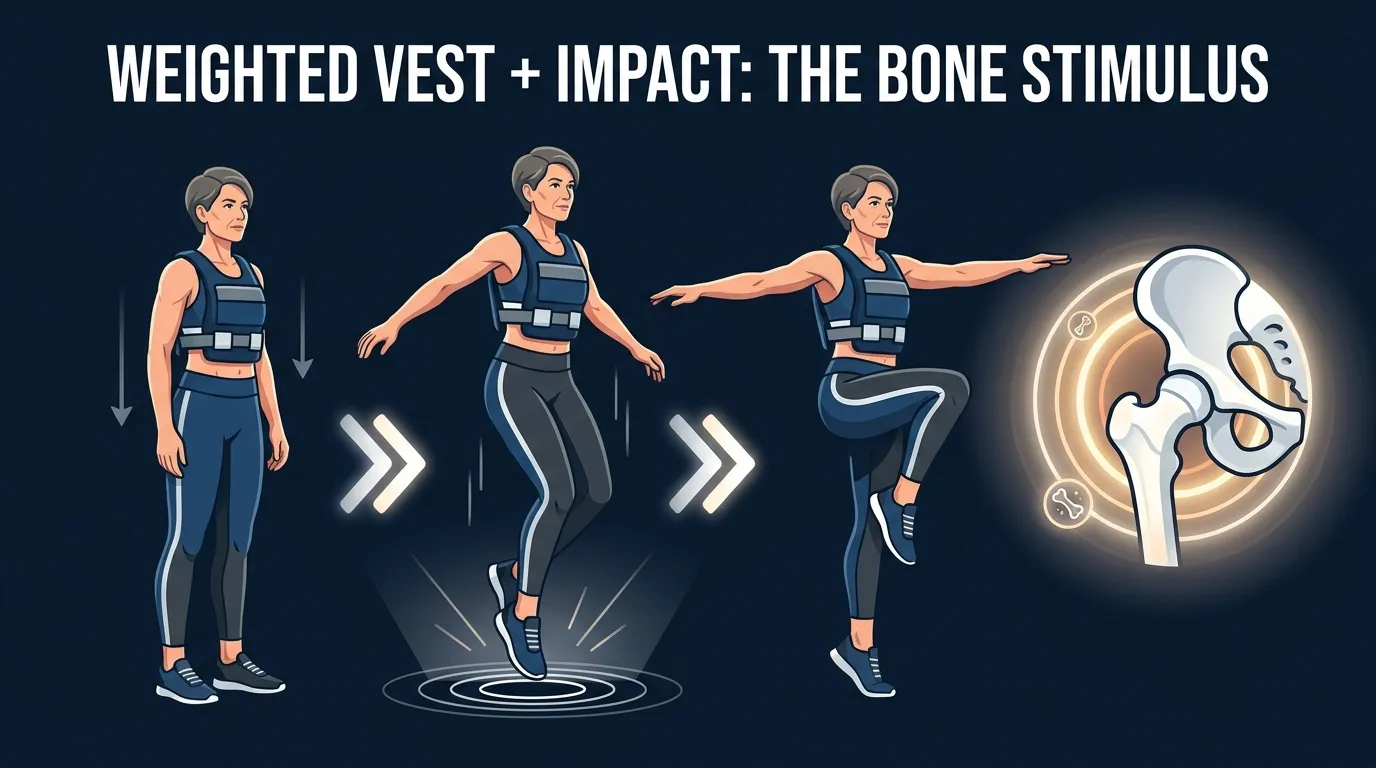
- The strongest bone-density evidence comes from a 5-year trial that paired weighted vests with jumping in postmenopausal women. Casual vest walking alone is a weaker stimulus.
- A vest will not replace strength training. Walk in it for cardio and a bone-preservation nudge. Lift for muscle.
Open TikTok in May 2026 and you'll see the same clip on loop. A woman in athleisure straps on a 12-pound vest, narrates over a Costco aisle walk, and announces her bones are getting denser by the minute. The comments? Wild. People claim they've replaced strength training with walks. Others swear their VO₂ max jumped 20%. Nutritionists and orthopedic surgeons have spent the past year quietly pulling their hair out.
So here's the honest version. Walking with a weighted vest does something. It's not nothing. But it's also not the magic bullet your feed makes it sound like, and the gap between what the research says and what the influencers claim is wide enough to drive a Costco cart through. This article walks through the actual peer-reviewed evidence, the limits nobody mentions, and a sane starter plan for adults who want to try it without wrecking their back.
You'll see what 5%, 10%, and 15% vest weights actually do to calorie burn. You'll see why the most-quoted bone-density study is being misread. And you'll get a 4-week ramp-up that won't trash your knees by Friday.
What Weighted Vest Walking Actually Is
A weighted vest is a snug, garment-style load. Most modern vests use small steel or sand-filled inserts in pockets across the chest and back, distributing the weight evenly across your torso. You wear it like a heavy backpack that grew arms and learned manners. Walking with one is exactly what it sounds like. Slightly heavier you, same speed, same shoes.
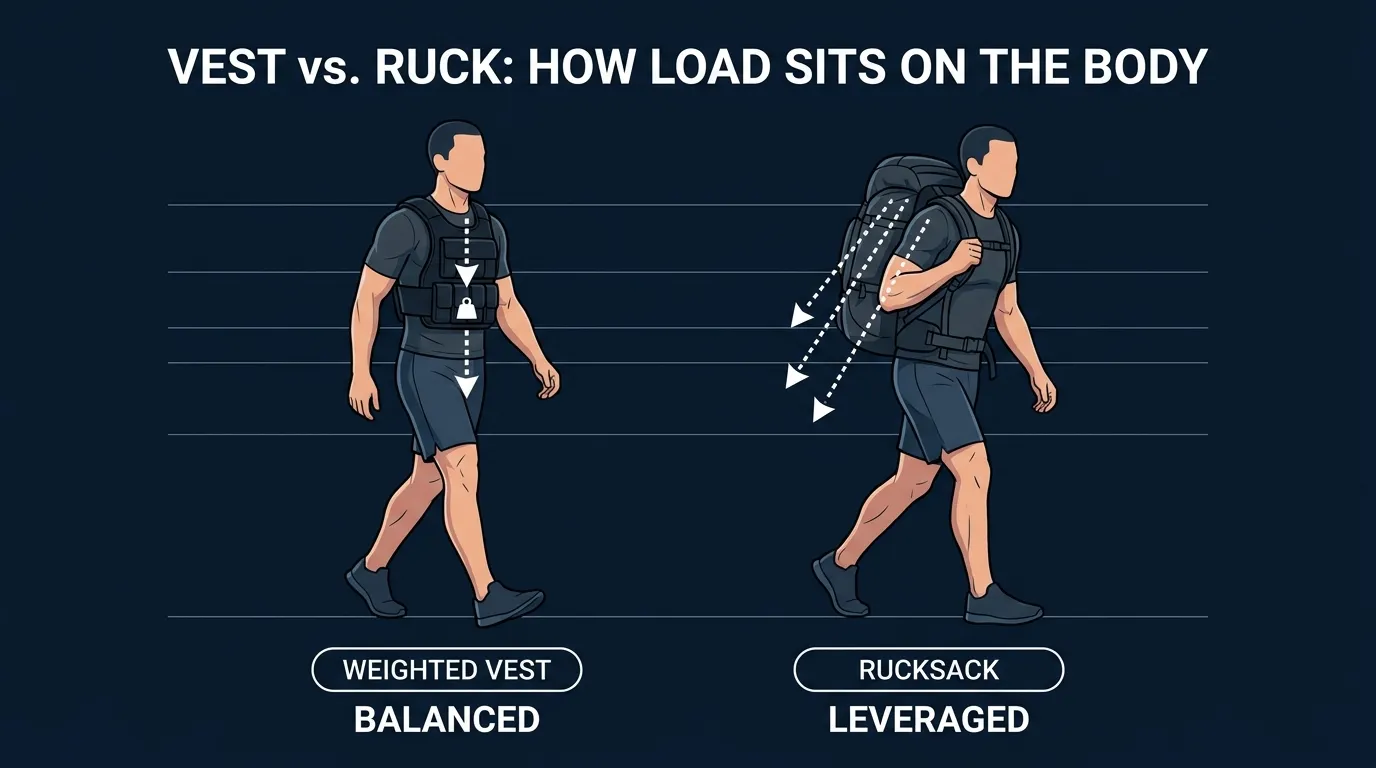
People often confuse vests with rucking, which is walking with a weighted backpack. The two share a research lineage but the experience is different. A vest sits flush against your trunk, so the load travels straight down through your spine. A ruck sack hangs off your upper back and pulls you backward, forcing your hip flexors and core to fire harder to keep you upright. We've covered the rucking case in detail in our guide on rucking for beginners; the short version is that vests feel friendlier for short urban walks and rucks earn their keep on longer carries.
Why It Suddenly Exploded
Two things happened. First, the longevity-and-fitness conversation kept hammering on bone density and muscle preservation as you age. Second, a single 5-year-old study about postmenopausal women keeping their hip bones intact while wearing weighted vests went viral on a longevity podcast. The clip got chopped into 30-second Reels. The nuance got lost. The vests got bought.
Per the trade tracker Glimpse, weighted-vest searches climbed several hundred percent year over year through 2025. Mainstream coverage from Harvard Health, Mass General Brigham, and a careful NPR fact-check from August 2025 all caught up to the trend. Here's the thing. Most of those reports landed in the same place. Useful tool, oversold benefits.
What the Research Actually Shows
Two things show up clearly in the literature. Energy cost goes up. Cardiovascular demand goes up. Beyond that, the picture gets blurrier.
Calorie Burn
The cleanest number we have comes from Puthoff and colleagues, published in Medicine & Science in Sports & Exercise in 2006. They had healthy adults walk at 2.5 mph on a flat treadmill while wearing vests loaded to 0%, 10%, 15%, and 20% of body weight. The 15% vest boosted oxygen consumption (a stand-in for calorie burn) by roughly 12% over the unloaded baseline. The 20% vest pushed it higher still, but compliance and comfort dropped sharply at that load.
Twelve percent is a meaningful but not life-changing bump. On a 30-minute walk that normally burns about 120 calories, you're looking at an extra 14 or 15. Over a week of daily 30-minute walks, that's roughly 100 extra calories. Real, but small. If somebody promises you 40% more burn, ask them which study.
Cardiovascular Demand and VO₂ Max
The same vest that raises oxygen consumption also raises heart rate. ACE-funded research from a similar protocol found that vests bumped heart rate enough to push casual walkers from a low-zone effort into the start of zone 3 territory. Over time, that's the kind of stimulus that nudges VO₂ max at home in the right direction, especially for sedentary adults whose walking pace has been too easy to drive any cardiovascular adaptation.
This matters more than the calorie story. Cardiorespiratory fitness predicts longevity better than almost any other modifiable variable. If a vest converts a leisurely stroll into a session that actually challenges your aerobic system, the long-term payoff is bigger than the calorie math suggests.
Bone Density: The Most Misread Finding
Now we get to the famous study. Snow and colleagues, published in 2000 in Journals of Gerontology, followed 18 postmenopausal women for 5 years. They wore weighted vests during a structured exercise program that included jumping, balance work, and lower-body resistance moves. At the end of the trial, the exercise group preserved hip bone mineral density while the control group lost roughly 4% over the same window.
That outcome is real. It's also being misquoted constantly. The intervention wasn't "wear a vest while you walk to the store." It was a structured 3-day-per-week program with jumping that loads the hip in the way bones actually respond to: short, sharp, multi-directional impact. Pull the jumping out and you're left with weighted walking, which is a much weaker bone stimulus.
The contrast case makes the point. Greendale and colleagues randomized 62 older adults to no vest, a 3% body-weight vest, or a 5% body-weight vest, worn 2 hours a day, 4 days a week for 27 weeks, with no particular activity prescribed. Strength, physical performance, bone turnover markers and quality of life all came out the same across groups. Load without impact did nothing. The active ingredient looks like impact plus load, not load alone.
And honestly? If the trend ends with people swapping a vest walk for the calcium-rich strength-and-jumping protocols that actually move the DEXA needle, we'll have made bone health worse, not better. Pair vest walking with the home protocol in bone density exercises at home if bone is the goal.
Muscle Building
This one's quick. Walking in a vest will not give you noticeably bigger muscles. Hypertrophy needs progressive mechanical tension at moderate-to-heavy loads, repeated over weeks. A 15-pound vest spread across your torso during a flat walk doesn't load your quads, glutes, or hamstrings hard enough to drive much growth. You'll feel a little more soreness in the calves at first. That fades. The mirror won't change.
If you want muscle, lift. Two to three resistance sessions a week, working the major movement patterns, is a more efficient bet than walking under load. The resistance training and mortality research backs this up at the all-cause level too: it's strength training, not loaded walking, that drives the biggest protective effect on aging bodies.
How to Start Without Hurting Yourself
The injuries we see with weighted vests almost always come from one of two mistakes. Going too heavy too soon. Or wearing the vest on a body that already has a low-grade neck, shoulder, or lumbar issue that the load promptly amplifies. Both are easy to avoid.
How Heavy?
Start under 5% of body weight. For a 160 lb adult, that's 8 lb or less. For a 200 lb adult, 10 lb or less. This will feel almost too easy. That's the point. The first week is about teaching your spine, hips, and knees what loaded walking feels like, not about maximizing calorie burn.
Then progress like this:
- Weeks 1-2: 5% body weight. Walk 20-30 minutes, 3-4 days a week.
- Weeks 3-4: Add 1-2 lb if last week's walks felt easy and pain-free. Walk 30 minutes, 4 days a week.
- Month 2: Continue adding 1-2 lb every 2-3 weeks. Cap progression at 10-15% of body weight. Most people never need more.
The cap is non-negotiable for general use. Above 15% of body weight, the published research shows compressive force on the lumbar spine climbing into territory that's appropriate for trained military rucking, not casual fitness walks. Heavier doesn't mean better. It means a bigger argument with your lower back.
Form Cues That Save Your Back
The vest changes how your body distributes load. A few cues:
- Stand tall, ribs over hips. Don't lean forward to "counter" the weight.
- Engage your core gently the whole walk. Think low-grade brace, not crunch.
- Choose flat or gently rolling routes for the first month. Skip stairs and steep hills until the vest feels routine.
- Keep the vest snug. A loose vest swings with each step and doubles the load on your shoulders.
- Take it off for the last 5 minutes of long walks. Letting your spine decompress before you sit down at home matters.
Who Should Skip It Entirely
Vests aren't for everybody. Sit this one out if you have:
- Active neck or upper-back pain, or any cervical disc issue
- Diagnosed osteoporosis without medical clearance for loaded exercise
- Recent spinal, hip, or knee surgery
- Balance issues or a recent fall history
- Pregnancy (the load shifts your center of mass, which is already migrating)
- Uncontrolled high blood pressure or unstable cardiovascular disease
Want a walking plan that actually fits your week?
Take the free FitCraft assessment and get a personalized walking and strength plan built on behavioral science, not willpower.
Take the Free Assessment Free · 2 minutes · No credit cardVest Walking vs. Other Walking Trends
Weighted vest walking is one of three viral walking protocols of the last 18 months. Each is doing something a little different, and the trade-offs matter.
| Approach | Best For | Honest Limit |
|---|---|---|
| Weighted vest walking | Calorie boost, easy cardio progression, gentle bone preservation when paired with impact work | Won't build muscle. Easy to hurt your back if you go too heavy |
| Japanese Walking (IWT) | VO₂ max gains, leg strength, blood pressure | Requires effort cycling. The fast intervals aren't optional |
| Rucking | Long-duration loaded carries, posterior chain work | Heavier and more demanding. Not ideal for short city walks |
| Plain daily walks | Habit-building, recovery, low-impact cardio | Stops driving fitness gains once your pace plateaus |
Mix and match. A vest walk on Monday, an interval walk on Wednesday, a longer easy walk on Saturday is a more interesting and productive week than three identical sessions of any one approach.
The Real Reason Most People Quit a Vest in Three Weeks
It's not the weight. It's the boredom. Walking with a vest is, mechanically, just walking. The first few days you feel virtuous. Around day 10, you're a person carrying laundry around the neighborhood. By week 3, the vest is in a closet and you're back on the couch.
This pattern shows up everywhere in the engagement-decay literature. Novel fitness behaviors get adopted fast and abandoned faster, especially when the activity itself isn't intrinsically rewarding. Research on gamification in fitness shows that adding external motivation structures (streaks, progress tracking, achievement markers) produces a small-to-medium improvement in physical activity compared with self-directed exercise alone.
Buying the vest is the easy part. Wearing it on day 47, when nothing visibly impressive has happened in the mirror yet, is the part that matters. That's the problem FitCraft was built to solve. Ty, our 3D AI trainer, motivates you by name, demonstrates each exercise with interactive 3D models you can rotate, and builds your weekly walks and strength sessions into a single program. Free version available, with a subscription to unlock the full coaching engine.
What This Means for You
Use the vest. Don't oversell it to yourself.
If you're already walking 3-4 times a week and want a small bump in cardiovascular load and calorie burn, strap on a 5-10% body-weight vest and keep walking. You'll notice slightly harder breathing within a week and probably modestly stronger legs within a month. That's a real result for a tool that costs less than two months of a gym membership.
If you're trying to preserve bone density, especially if you're postmenopausal or over 60, the vest is one piece of the puzzle. Pair it with the kind of impact and resistance work that actually moves bone density numbers. The Snow protocol included jumping for a reason.
If you want muscle, you want strength training. The vest is not the move. And if your low back, neck, or shoulders are already complaining, leave the vest on the shelf until you've sorted those out with a physical therapist.
Pick one approach. Stick with it for 8 weeks. Then reassess. That's the actual recipe.
Frequently Asked Questions
Does walking with a weighted vest actually work?
Yes, but with limits. A 15% body-weight vest raises calorie burn at the same pace by roughly 12% (Puthoff et al., 2006, Medicine & Science in Sports & Exercise). It also nudges VO₂ max higher when used consistently. The bone-density and muscle-building claims popular on social media are weaker. The strongest bone evidence comes from a 5-year trial that combined vests with jumping in postmenopausal women, not from casual vest walking alone.
How heavy should a weighted vest be for walking?
Start at 5% of body weight or less. For a 160 lb adult, that's 8 lb or under. Most published studies on metabolic and cardio effects use 5-15% of body weight. Above 15%, comfort drops fast and injury risk climbs. A reasonable progression is to add 1-2 lb every 2-3 weeks if walking at the new load feels easy and your back, hips, and knees feel fine. Most people never need more than 10-20 lb total.
Is weighted vest walking better than rucking?
They're close cousins, not the same thing. A vest spreads load evenly across the torso. A rucksack concentrates it on the upper back and shoulders. Vests are typically lighter (10-25 lb) and feel more like an extra layer of clothing. Rucks run heavier (20-45 lb) and shift posture more aggressively. For low-stakes daily walks, a vest is more comfortable. For longer endurance loaded carries, a rucksack is the right tool.
Who should not wear a weighted vest?
Skip the vest if you have neck or back pain, cervical disc issues, advanced osteoporosis without medical clearance, balance disorders, or any acute joint injury. Pregnant individuals, anyone post-spinal surgery, and people with uncontrolled cardiovascular disease should also avoid loaded walking until cleared by a clinician. The added compressive load can aggravate spinal and pelvic conditions even at modest weights.
Will a weighted vest replace strength training?
No. Walking with a vest is cardio with extra metabolic demand. It does not produce the targeted mechanical overload needed for meaningful muscle hypertrophy. Resistance training is far more effective for muscle and most measures of bone strength. Use weighted vest walking as a calorie and cardio booster on top of, not instead of, 2-3 strength sessions per week.
How long until I see results from weighted vest walking?
Cardio adaptations show up first. Most people notice a slightly easier baseline walking pace within 2-4 weeks of consistent loaded walks. Visible body composition changes are slow and small. The calorie bump from a 12% increase is real but modest, so expect months not weeks. If your goal is bone density, expect to log 6-12 months of consistent vest plus impact work before a DEXA scan would register a change.