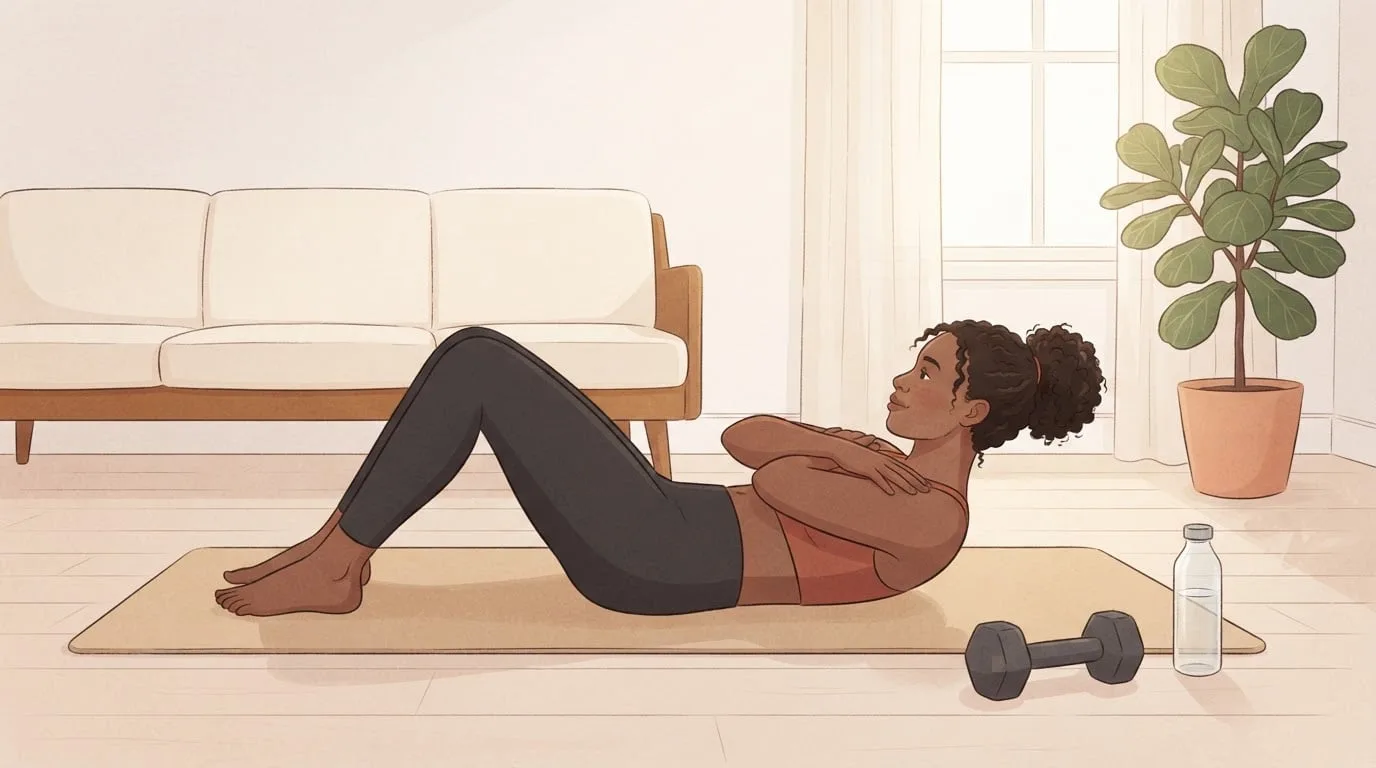
You probably learned sit-ups in gym class: knees bent, a friend holding your feet, as many as you could do in a minute. Years later you still do them, or crunches, or both, and the six-pack still hasn't shown up. Meanwhile the advice keeps changing. One coach says sit-ups wreck your back, another says crunches are a waste of time, and a third says to plank instead.
That kind of advice makes it easy to feel like hundreds of reps were wasted, or that your body just doesn't respond. Neither is true. Most ab routines stall because they use a tool that doesn't match the goal, and because nobody gave you a plan for making the work harder over time.
A crunch is the first part of a sit-up, and that one fact explains most of the differences between them. This guide covers what each one works, what sit-ups do and what they help with, what the spine research found, whether either one gives you abs, how planks compare, and a crunch and sit-up workout you can do at home.
Crunches vs Sit Ups at a Glance
| Crunch | Sit-up | |
|---|---|---|
| How far you rise | Head, shoulders and upper back lift; your lower back stays on the floor | All the way up until your chest is close to your thighs |
| Main muscles | Rectus abdominis and obliques | Rectus abdominis and obliques, plus the hip flexors (psoas, iliacus and rectus femoris) |
| Hip flexor work | Low: rectus femoris 6 to 10% of maximum in a crunch; psoas under 10% in a curl-up | High: psoas 15 to 35% of maximum in every sit-up style tested |
| How long the abs work | Most of the rep (90% of the cycle in a shoulder-lift curl) | About a third of the rep (34%) in a sit-up from a long-lying position, legs straight |
| Lower-back load | Partial curl-ups had the best ratio of ab work to spine compression among 12 ab exercises | Over 3,000 newtons of lumbar compression, with bent or straight legs |
| Difficulty | Beginner friendly | Harder; many beginners need their feet held |
| How to make it harder | Slow the lowering, move your arms overhead, hold a dumbbell on your chest | Arms across your chest instead of reaching forward, feet free instead of held |
| Belly fat | Doesn't burn it | Doesn't burn it |
| Best for | Building your abs with the least hip flexor and spine cost | Fitness tests that count sit-ups, and hip flexor strength |
Two rows decide it for most people. Your abs do their work in the curl, which a crunch already covers. A sit-up adds a second movement, the hip flexors pulling your trunk up, and that second half is where the extra spine load comes from. The sources for each row are in the sections below.
What Is the Difference Between a Crunch and a Sit-Up?
A crunch curls your rib cage toward your pelvis. Your head, shoulders and upper back lift off the floor, and your lower back stays down. A sit-up starts with the same curl and keeps going. Once your trunk has curled as far as it can, your hips bend and your hip flexors pull your whole torso up to sitting. So every sit-up contains a crunch, and the extra half is mostly hip work.
That split shows up in the muscle recordings. In an electromyography (EMG) study, Halpern and Bleck (1979) compared five sit-up styles. With the legs out straight, the rectus abdominis was active for only 34% of the sit-up cycle on average. A shoulder-lift version with the knees bent, which rises only until the shoulder blades leave the mat and is essentially a crunch, kept the muscle working for 90% of the cycle with about 3 degrees of lumbar flexion. The authors rated it the most effective and the safest of the five.
A curl-up is a crunch with an even smaller range: the head and shoulders lift just clear of the floor. Spine researcher Stuart McGill's modified curl-up, with one knee bent and your hands under your lower back, is explained step by step in our core stability exercises guide.
What Muscles Do Sit-Ups Work?
Sit-ups work two muscle groups in sequence. Your abdominal muscles, mainly the rectus abdominis and the obliques, curl your trunk first. Then your hip flexors lift it the rest of the way. The main hip flexors are the psoas and the iliacus, which together form the iliopsoas, plus the rectus femoris, the one quadriceps muscle that crosses the front of the hip. Three studies show how big the hip flexor share is:
- Psoas. Juker and colleagues (1998) placed fine-wire electrodes in the psoas of 8 adults. Every form of sit-up they tested activated it at 15 to 35% of its maximum, while the curl-up stayed under 10%.
- Rectus femoris. In 18 adults, Escamilla and colleagues (2010) recorded 10 abdominal exercises. The crunch was in the group with the lowest rectus femoris activity, 6 to 10% of maximum. The bent-knee sit-up, tested in the same study, wasn't in that low group.
- Foot position. Andersson and colleagues (1997) recorded 38 exercises in 6 men. Bending the knees and supporting the feet during sit-ups raised hip flexor activity but generally didn't change how hard the abs worked.
That last finding undoes a piece of gym-class wisdom. Bending your knees doesn't switch off your hip flexors, and hooking your feet under a couch makes them work harder, because held feet give them something to pull against. That's also why most people can do more sit-ups with someone holding their ankles.
What muscles do crunches work? Mainly the rectus abdominis, with the obliques helping. The hip flexors barely join in, and the lower-back muscles stay quiet too: lumbar paraspinal activity stayed under 10% of maximum in every exercise in the Escamilla study. Our crunch exercise guide covers form, variations and common mistakes.
What Do Sit-Ups Do? What They Help With
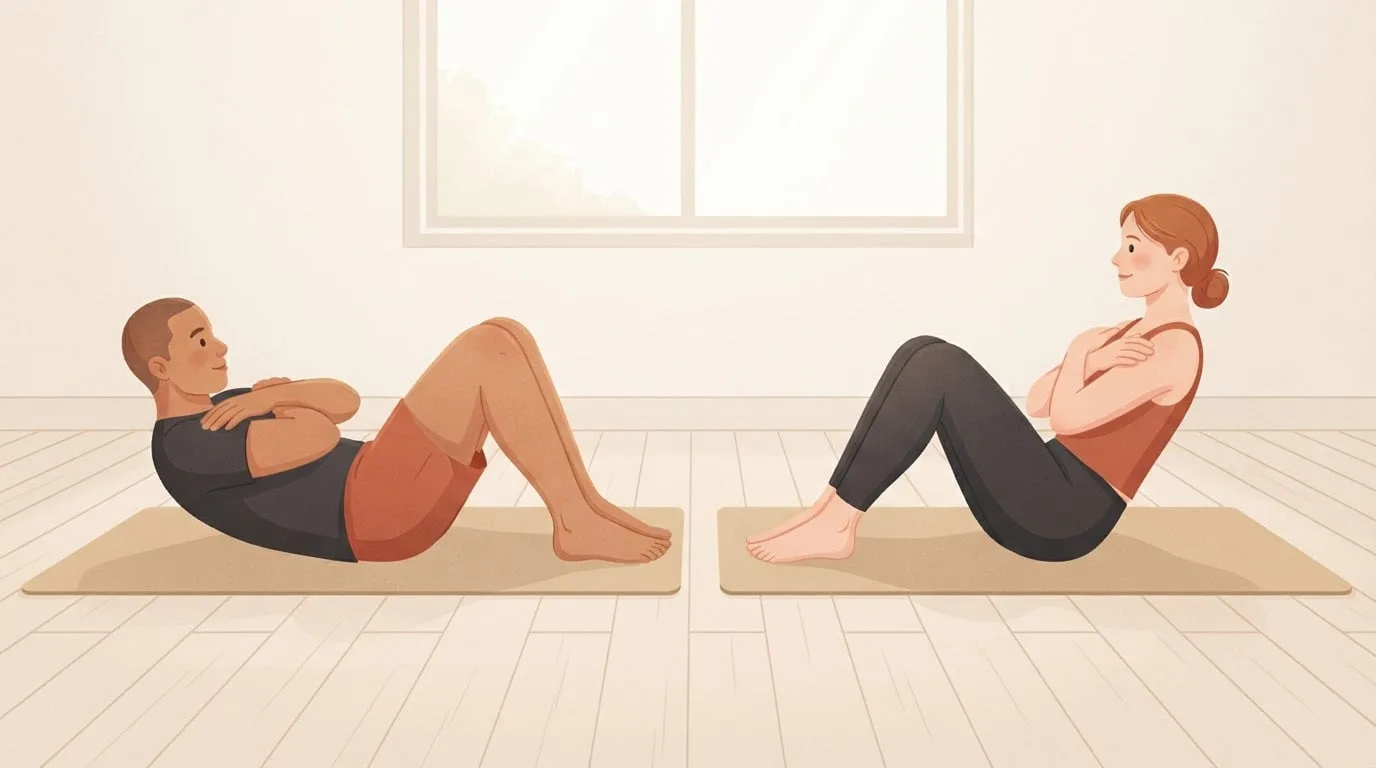
Sit-ups train your abs and your hip flexors together, and they're the direct way to practice for any test that counts them. Here's what they help with:
- Abdominal endurance. Sets of many reps teach your abs to keep curling as they tire, which is exactly what a timed sit-up test measures.
- Hip flexor strength. The psoas, iliacus and rectus femoris lift your trunk in the second half of every rep. Crunches barely train them.
- Fitness tests. If a school, team or job test counts sit-ups, practicing the scored movement is the most specific preparation you can do.
What sit-ups don't do is build your abs better than other exercises. A large Army trial shows it. Childs and colleagues (2009) randomized 2,616 soldiers aged 18 to 35 to 12 weeks of either a traditional exercise program that included sit-ups or a core stabilization program without them, four times a week. Sit-up performance and overall fitness improved in both groups, with no difference between them, and the pass rate on the sit-up test rose slightly more in the core stabilization group, 5.6% against 3.9%.
So even if your goal is a better sit-up score, you don't need to grind out hundreds of sit-ups every day. Strong abs from crunches and stabilization work carry over, and a little test-specific practice covers the rest.
Are Sit-Ups Bad for Your Back? What the Spine Research Found
Sit-ups put more load on your lower back than crunches, and that's the main reason many coaches and physical therapists dropped them. Whether that load actually injures healthy people is a separate question, and the evidence on it is weaker than gym lore suggests.
The lab case: spine load
Modelling the spines of 12 young men, McGill (1995) predicted lumbar compression above 3,000 newtons for both straight-leg and bent-knee sit-ups. He concluded that the knee angle mattered less than whether sit-ups should be prescribed at all. Two years later, Axler and McGill (1997) tested 12 abdominal exercises in nine volunteers and divided the abdominal muscle challenge by the spine compression each one caused. Partial curl-ups generally gave the best ratio. No single exercise trained every abdominal muscle at a low spine cost, so they recommended a variety.
The hip flexors explain part of the gap. The psoas runs from the sides of your lumbar vertebrae down to your thigh bone. When it pulls hard to lift your trunk, it also squeezes those vertebrae together, and that's a pull a crunch mostly avoids. Our plank research review shows how planks train the same abdominal wall with the spine held still.
The disc studies: pig spines bent thousands of times
The fear that crunches cause disc herniations comes mostly from animal tissue studies. Callaghan and McGill (2001) bent pig spine segments forward and back up to 86,400 times, once per second, under compression. Herniation was tied more closely to the repeated bending than to the compression load, at least in young, healthy discs, and higher compression made the injuries more frequent and more severe. In a follow-up, Tampier and colleagues (2007) loaded 16 pig segments at 1,472 newtons for 4,400 to 14,400 bending cycles and produced 8 complete and 4 partial herniations.
These studies show how a disc can fail. They don't show how often crunches injure people. A set of crunches is a few dozen bends, not thousands in a row, and living people rest between sessions.
The human case: injuries and back pain
Studies in people point to a smaller risk than the lab work implies. In a cluster randomized trial, Childs and colleagues (2010) assigned 20 Army companies, 1,141 soldiers in all, to 16 weeks of a traditional program with sit-ups or a core stabilization program. The share of soldiers with a musculoskeletal injury didn't differ between the groups. Low back injuries in the sit-up group cost 8.3 days of restricted duty on average, against 4.2 days in the core stabilization group, which the authors called marginal evidence in favor of core stabilization.
Bending itself isn't the clear villain either. A systematic review by Saraceni and colleagues (2020) looked at lifting, where the same flexion debate runs. Nine of 11 studies found no significant difference in lumbar flexion between people with and without back pain, and the low-quality evidence didn't show more flexion as a risk factor for back pain starting or lasting.
What it means for you
With a healthy back, a few sets of crunches a few times a week has no evidence of harm, and crunches give you most of the ab work for the least spine cost. Sit-ups add compression and hip flexor pull on top of the same ab curl, so they're the one to drop first. If bending already hurts, or you've had a disc injury, skip both for now, use bracing exercises like dead bugs and planks, and get assessed before you add loaded bending back.
Find out what's really holding you back
FitCraft, our mobile fitness app, pairs you with an AI coach who builds you a personalized plan around your goals, schedule, and fitness level. Every FitCraft program is designed by Domenic Angelino, MPH (Brown University) and NSCA-CSCS, with research published in the Journal of Strength and Conditioning Research and Medicine & Science in Sports & Exercise.
Take the Free Assessment Free • 2 minutes • No credit cardHow to Do Crunches Without Hurting Your Back
These six cues keep the work in your abs and off your neck and lower back:
- Keep your feet free. Don't hook them under a couch or have someone hold them. Held feet raise the hip flexors' share of the work.
- Curl, don't lift. Think of bringing your bottom ribs toward your hip bones, and stop when your shoulder blades clear the floor.
- Leave your lower back on the floor. If it peels up, you've turned the crunch into the start of a sit-up.
- Keep your hands off your head. Cross your arms on your chest, or rest your fingertips at your temples without pulling, and leave a fist of space between your chin and chest.
- Breathe out on the way up and lower slowly. Take two to three seconds to come down instead of dropping.
- Stop when form slips. End the set when you start jerking up, and stop for the day if you feel pain in your back or down a leg.
If crunches still bother your back with clean form, swap in a dead bug, a forearm plank and a side plank for a few weeks, then try a few partial crunches again.
Do Sit-Ups Give You Abs?
Sit-ups and crunches build your abdominal muscles, but neither one makes them visible, because neither one removes the fat on top. Visible abs come from a lower body fat level, and that depends on what you eat and how much you move across the whole day.
Kordi and colleagues (2015) tested this with ultrasound. They randomly assigned 40 overweight or obese women to a diet alone or the same diet plus 12 weeks of abdominal resistance exercise. Both groups lost weight, waist size and belly fat, and the ab training added no extra loss of the fat layer over the abs.
So will crunches give you a six-pack? They build the muscle that forms it. Whether you see it depends on your body fat, and our guide on how to get abs covers that side: the calorie deficit, protein and timeline.
Planks vs Crunches: What Each One Trains
Planks and crunches train two different jobs, so the useful answer is to do both. A crunch trains trunk flexion: your abs shorten to curl your spine. A plank trains anti-extension: your abs work to stop your lower back from sagging toward the floor, in an isometric hold where nothing moves.
For whole-core activation, plank variations come out ahead. Gottschall and colleagues (2013) recorded 16 core exercises, including crunches and hover (plank) variations, in 10 men and 10 women. The abdominal and lower-back muscles worked hardest in the exercises that also recruited the shoulders and glutes, which describes a plank variation far better than a crunch.
Is a plank more effective than crunches, then? For working the whole trunk, and for a back that dislikes bending, yes. For training your abs through their full curl, and adding load with a dumbbell when the reps get easy, the crunch is the simpler tool. Our abs workout at home answers "Are planks better than crunches?" in its FAQ and puts both into one six-week routine.
A Crunch and Sit-Up Workout at Home
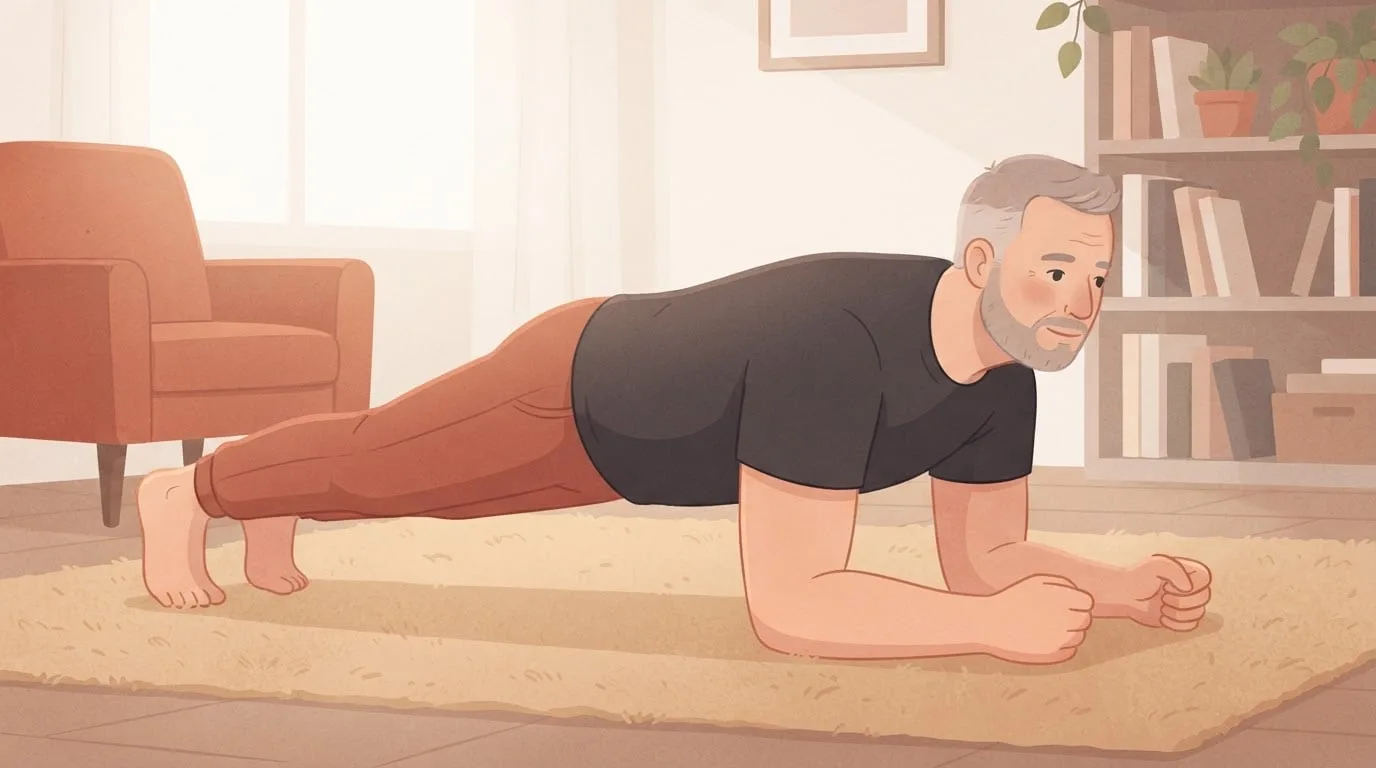
This sit-up workout is built around crunches, with sit-ups added only if you have a test to prepare for. The main session takes about 12 to 15 minutes with bodyweight and one optional dumbbell. Do it two or three times a week on non-consecutive days, at the end of a workout or on its own, and rest 30 to 45 seconds between exercises.
| Exercise | Sets x reps | How to do it |
|---|---|---|
| 1. Crunch | 3 x 12 to 20 | Arms crossed on your chest, two seconds down; end each set one or two reps short of failure |
| 2. Reverse crunch | 3 x 8 to 15 | Curl your hips off the floor toward your ribs instead of swinging your legs |
| 3. Dumbbell crunch | 2 x 8 to 12 | Hold one light dumbbell on your chest; add it once 20 slow crunches feel easy |
| 4. Forearm plank | 3 x 20 to 45 seconds | Squeeze your glutes and end the hold when your hips sag |
| 5. Side plank | 2 x 15 to 30 seconds per side | Hips stacked and lifted; end the hold when the bottom hip drops |
How to progress it
Add a rep or two to each set, or a few seconds to each hold, every week. When the crunch reaches the top of its range, make it harder: move your fingertips to your temples, then reach your arms overhead, then use the dumbbell crunch for all three sets. That's progressive overload, and it's the part most ab routines skip.
If you have a sit-up test coming up
- Keep the crunch session above on two days a week for strength.
- Once or twice a week, practice the test exactly as it's scored: the same foot position, the same arm position and the same time limit, for one or two all-out sets.
- Do your last all-out practice two or three days before the test so you arrive fresh.
The Army trial above is the reason this works: stabilization work improved sit-up scores as much as sit-up training did.
Crunches or Sit-Ups: Which Should You Do?
For most people, crunches, with planks alongside. Here's the choice by goal:
- You want stronger abs that eventually show: crunches, reverse crunches and planks, plus a modest calorie deficit for the visible part.
- You have a sit-up test: crunches for strength, and test-specific sit-up practice once or twice a week.
- You want stronger hip flexors: sit-ups train them and crunches barely do.
- You're a beginner: start with partial crunches or curl-ups and a 20-second plank. Sit-ups can wait.
- Your back hurts when you bend, or you've had a disc injury: neither one for now. Use dead bugs, planks and side planks, and get a clinician's go-ahead before you add bending back.
- You're pregnant or postpartum: check with your midwife, doctor or a pelvic health physical therapist first. Our diastasis recti exercises guide explains which curl-ups are usually fine.
Knowing which exercise to do is the easy part. Doing it three times a week for months is where most people drop off, and that's a problem a better system can solve. In FitCraft, a 3D AI coach demonstrates each exercise in your workout with interactive 3D demos and says your name while you train, your program adapts as you progress, and streaks and calendar tracking keep the sessions visible. If you'd rather not plan your ab work yourself, a home workout app with no equipment can carry it for you.
The Bottom Line
Crunches vs sit ups: crunches are the better ab exercise for most people. A crunch works the rectus abdominis and obliques through the part of the movement where they do the work. A sit-up adds a hip flexor lift and more lower-back compression on top of the same ab curl, and neither one burns belly fat.
Practical rule: do crunches, reverse crunches and planks two or three times a week, practice sit-ups only when a test counts them, and drop both while bending hurts.
The reps you've already done weren't wasted. Your abs got stronger; they just need a plan that keeps asking a little more of them. As Katie put it: "I've tried everything. This is the first time I've stuck with something past two weeks."
Frequently Asked Questions
Will 20 crunches a day do anything?
Twenty slow crunches a day will build a little abdominal endurance, especially in your first few weeks, but they won't flatten your stomach. Once twenty feels easy, repeating them keeps what you have rather than building more. For real progress, do two or three sets of 12 to 20 slow crunches two or three times a week, end each set one or two reps short of failure, and add reps or a light dumbbell as they get easier.
Will crunches give you a 6 pack?
Crunches build the rectus abdominis, the muscle that forms a six-pack, but they won't make it visible on their own. Whether you see a six-pack depends on how much fat covers that muscle, and that comes down to your eating and overall activity rather than your ab exercises. Crunches help most as part of a plan that also brings your body fat down slowly.
Is plank more effective than crunches?
For working your whole trunk, yes. In a 2013 EMG study of 16 core exercises by Gottschall and colleagues, the abs and lower back worked hardest in exercises that also recruited the shoulders and glutes, which plank variations do and crunches don't. Crunches are still the easier way to train the abs through their full curl and to add weight over time, so most people do best with both.
What is the difference between core and abs?
Your abs are the muscles on the front and sides of your trunk: the rectus abdominis, the external and internal obliques and the deep transversus abdominis. Your core is the whole cylinder around your spine, which adds the diaphragm above, the pelvic floor below, the back muscles and the hip muscles that anchor your pelvis. Crunches and sit-ups mostly train the abs, while planks, side planks and bird dogs train more of the core.
What is the no. 1 exercise for abs?
No single exercise is best for every ab muscle. In an EMG study of 18 adults, Escamilla and colleagues (2010) found that a stability ball roll-out and pike activated the abdominals more than most of the other exercises tested, which included the crunch and the bent-knee sit-up: up to 63% of maximum in the upper rectus abdominis for the roll-out and 84% in the external oblique for the pike. At home without a ball, slow crunches and reverse crunches taken close to failure, plus planks, cover the main jobs.
Do curl-ups give you abs?
Curl-ups build your abs the same way crunches do, because a curl-up is a crunch with a smaller range: your head and shoulders lift just clear of the floor. They train the rectus abdominis while keeping the hip flexors quiet, with psoas activity under 10% of maximum in a study by Juker and colleagues (1998). Whether the muscle shows depends on your body fat, not on how many curl-ups you do.
Can you get a six-pack just from planking?
No. Planks train your abs to hold your spine still, but a six-pack shows only when your body fat is low enough, and no ab exercise removes fat from your belly. In a 12-week trial, adding abdominal exercise to a diet didn't shrink belly fat more than the diet alone (Kordi 2015). Plank for core strength, add crunches to build the six-pack muscle, and let your eating and overall activity bring the body fat down.
Are bent-knee sit-ups safer than straight-leg sit-ups?
Not by much. McGill's 1995 model put lumbar compression above 3,000 newtons for both, and in a 1997 study by Andersson and colleagues, bending the knees with the feet held down raised hip flexor activity without changing how hard the abs worked. If you want less load on your spine, stop at the top of the crunch instead of sitting all the way up.