- Progress in four phases. Breathing and low-load holds, then bird dogs and bridges, then head lifts and curl-ups, then carries and loaded lifting. Roughly 2 to 3 weeks per phase.
- Doming is the stop sign, not the exercise name. If your midline pushes up into a ridge, you hold your breath, or you leak, that repetition is too hard today. Regress it.
- Crunches are not banned. Ultrasound work shows head lifts and curl-ups narrow the gap in the moment, and a 2023 trial found 12 weeks of them did not worsen it.
- The gap is not the whole story. A systematic review of 12 studies and 2,242 participants found no significant link between having a diastasis and lumbopelvic pain or incontinence.
- Time does a lot of the work. Prevalence falls from about 60 percent at 6 weeks postpartum to about 33 percent at 12 months on its own.
- See a pelvic floor physio if you leak, feel heaviness or bulging, have pain, or if the doming has not changed after several weeks of careful work.
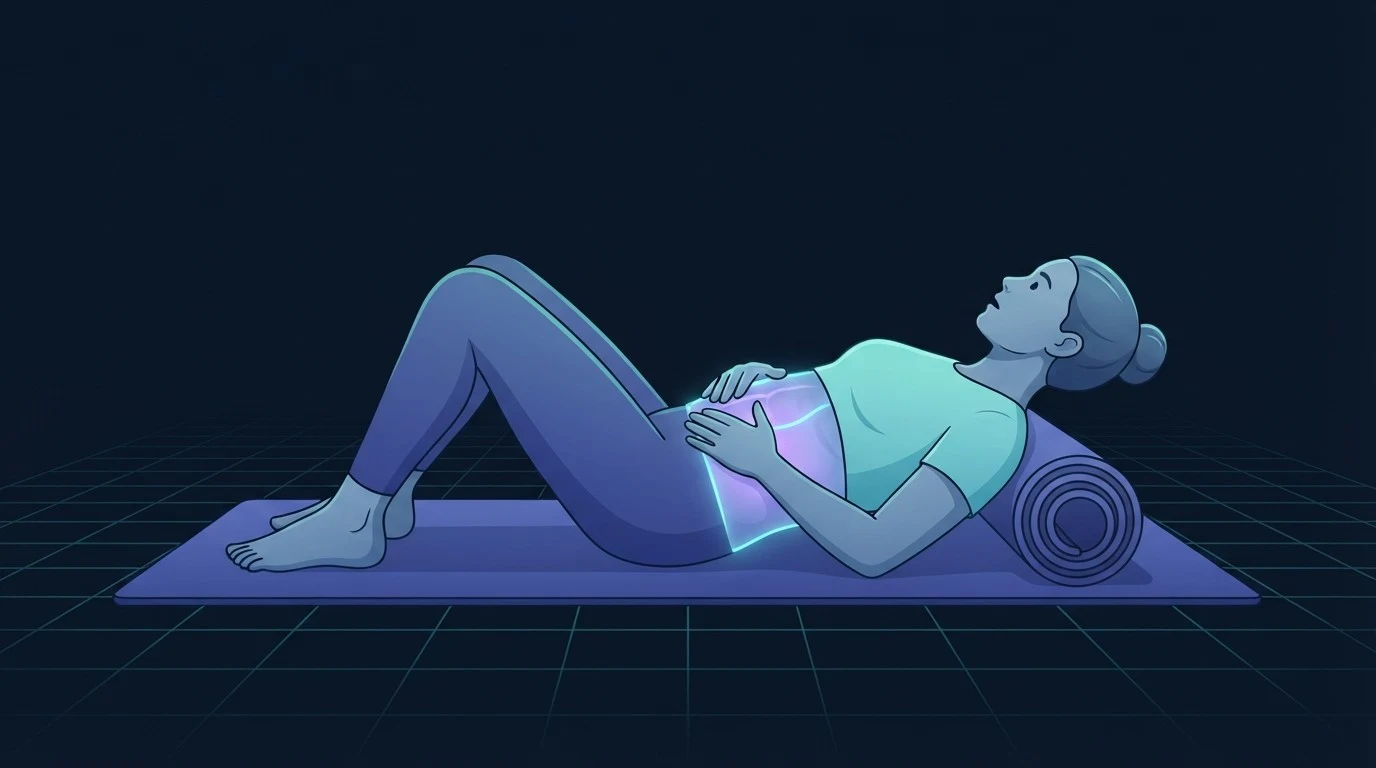
The best diastasis recti exercises are graded core exercises you can do without the midline of your belly bulging, without holding your breath, and without leaking. Start with connected breathing and low-load holds. Add bird dogs, glute bridges and side planks. Then progress to head lifts and curl-ups, which ultrasound studies show narrow the gap rather than widen it. See a pelvic floor physiotherapist if you leak, bulge or hurt.
That last sentence is the one most articles bury. Almost everything written about diastasis recti online is far more confident than the research it claims to be based on, and most of it opens with a list of forbidden exercises. This guide does the opposite. Here is what is actually known, what is genuinely uncertain, and a progression you can start this week.
What is diastasis recti, and how common is it?
Diastasis recti abdominis is a widening of the linea alba, the strip of connective tissue running down the middle of your abdomen between the two halves of your rectus abdominis. During pregnancy that tissue stretches and thins to make room. After delivery it recoils, slowly, and sometimes incompletely.
It is not an injury and it is not rare. A prospective cohort of 300 first-time mothers by Sperstad et al. (2016) in the British Journal of Sports Medicine followed women from pregnancy to a year after birth and found prevalence of 33.1 percent at gestation week 21, 60.0 percent at 6 weeks postpartum, 45.4 percent at 6 months, and 32.6 percent at 12 months. Roughly one in three women still had a measurable separation a full year later.
Here is the part that changes how you should think about it. The same study found no difference in reported lumbopelvic pain between women with and without a diastasis at 12 months. A later systematic review by Benjamin et al. (2019) pooled 12 studies covering 2,242 participants and reached a similar conclusion: no significant association between having a diastasis and lumbopelvic pain or incontinence, a small association with pelvic organ prolapse, and a possible link between the width of the separation and abdominal strength, back pain severity and quality of life.
So the gap itself is a poor scapegoat. What tends to bother people is the function that comes with it: a core that will not brace, a midsection that domes when it works, and a body that no longer trusts itself under load. Those are trainable.
Do diastasis recti exercises actually close the gap?
Honest answer: sometimes, and less reliably than the internet promises.
The strongest summary we have is a systematic review with meta-analysis by Gluppe, Engh and Bo (2021) in the Brazilian Journal of Physical Therapy. Seven randomised trials, 381 women, and a conclusion that reads like a cold shower: there is currently very low quality scientific evidence to recommend specific exercise programs for treating diastasis recti postpartum. Transversus abdominis training reduced the gap by about 0.63 cm across two poolable studies, but the certainty rating on that number was very low.
Two randomised trials from the same Norwegian group show why the picture is murky. In Gluppe et al. (2018), 175 first-time mothers were randomised to a four-month supervised weekly exercise class starting at 6 weeks postpartum, plus daily home pelvic floor training, or to no intervention. The program did not reduce the prevalence of diastasis at 6 or 12 months. In Gluppe et al. (2023) in the Journal of Physiotherapy, 70 women 6 to 12 months postpartum did a 12-week home program of head lifts and curl-ups five days a week. It did not narrow the gap. It also did not worsen it, and it did increase rectus abdominis thickness and abdominal strength.
On the prevention side there is a little more optimism. A systematic review by Benjamin, van de Water and Peiris (2014) pooled eight studies of 336 women and found exercise during pregnancy reduced the presence of diastasis by 35 percent (RR 0.65, 95% CI 0.46 to 0.92), though the authors flagged the underlying literature as poor quality. And a smaller randomised trial by Thabet and Alshehri (2019) found that adding a deep core stability program to traditional abdominal work for 8 weeks reduced separation and improved physical functioning more than the traditional work alone.
Put it together and you get a realistic promise. Training reliably buys you a stronger, better-controlled midsection. It may narrow the gap. Time narrows the gap for a lot of women regardless. That is a good enough reason to train, and a bad reason to measure yourself with a ruler every week.
What is the best diastasis recti exercise progression?
Four phases. Move up when the current phase feels easy and you can do it without doming, breath holding or leaking, which for most people is 2 to 3 weeks. Move back down for a session or two whenever a bad night or an illness knocks your control out. This is ordinary progressive overload applied to pressure management instead of load.
| Phase | What you do | Dose | Ready to move on when |
|---|---|---|---|
| 1. Connect Weeks 1 to 3 |
360 degree breathing on your back, exhale-timed pelvic floor lifts, supine heel taps, single dead bug arm or leg only | 5 to 10 minutes, most days | You can exhale, feel the abdominal wall tension, and move one limb without the belly rising |
| 2. Control Weeks 3 to 6 |
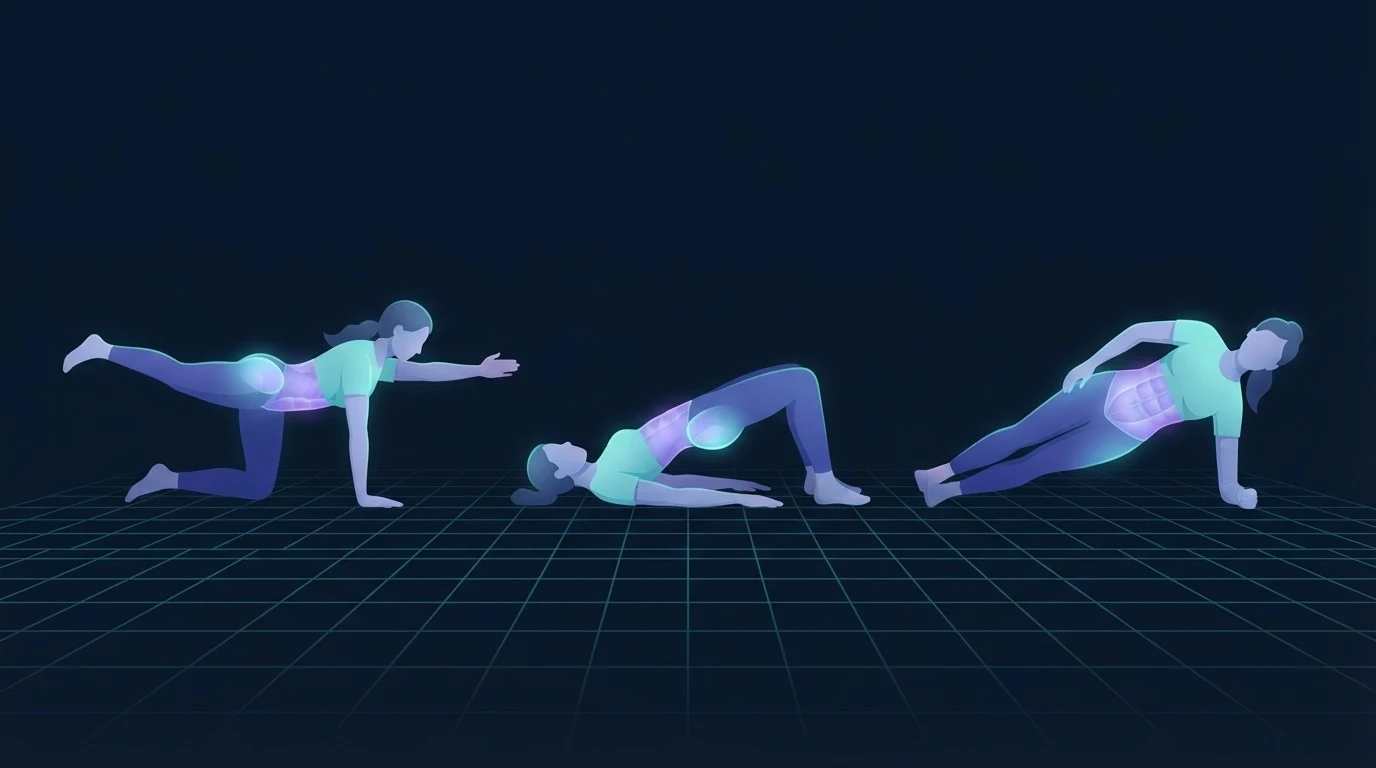
Glute bridges, bird dogs, full dead bugs, side-lying leg lifts, wall or incline push-ups | 2 or 3 sessions a week, 2 sets of 8 to 12 | You hold each position for 30 seconds with a flat midline and normal breathing |
| 3. Load the front Weeks 6 to 10 |
Head lifts, small partial curl-ups, twisted curl-ups, side planks from the knees, then forearm planks | 3 sessions a week, 2 or 3 sets of 8 to 12 | No ridge or coning at the midline on the last rep, not just the first |
| 4. Return to load Week 10 onward |
Suitcase and farmer carries, goblet squats, hinges, rows, overhead pressing, then running or jumping | 2 or 3 full-body sessions a week | You can cough, lift your child and load your core with no doming, pain or leaking |
Phase 1: connect before you strengthen
The goal here is not fatigue. It is getting your diaphragm, deep abdominal wall and pelvic floor working on the same rhythm again, so that pressure inside your abdomen goes somewhere useful instead of straight into the linea alba. Lie on your back, knees bent, one hand on your lower ribs and one below your navel. Breathe wide into the ribs. Exhale slowly and feel a gentle tension arrive under the lower hand. That tension is what you carry into every later exercise.
One caveat worth knowing, because it contradicts a lot of postpartum advice. Aggressive drawing-in, the classic suck-your-navel-to-your-spine cue, does not narrow the gap. Mota et al. (2015) measured 84 women with ultrasound and found drawing-in slightly widened the inter-recti distance postpartum, by 3.0 mm at 6 to 8 weeks and 2.5 mm at 24 to 26 weeks below the navel. Gluppe et al. (2020) found the same thing in 38 women who had a diagnosed diastasis. Use a gentle exhale-driven tension, not a maximal suck-in.
Phase 2: control under a longer lever
Now you add movements that ask the core to resist something. Bird dogs resist rotation. Glute bridges wake up hips that spent a pregnancy shutting down. Dead bugs resist extension while a limb moves. Side-lying work prepares you for side planks without asking for a full one on day one.
Watch the midline, not the clock. Every rep should look the same at the end of the set as at the start. If the belly starts to peak, you have found today's limit, and stopping two reps earlier next time is the fix.
Find out what's really holding you back
FitCraft, our mobile fitness app, pairs you with an AI coach who builds you a personalized plan around your goals, schedule, and fitness level. Every FitCraft program is designed by Domenic Angelino, MPH (Brown University) and NSCA-CSCS, with research published in the Journal of Strength and Conditioning Research and Medicine & Science in Sports & Exercise.
Take the Free Assessment Free • 2 minutes • No credit cardPhase 3: yes, curl-ups
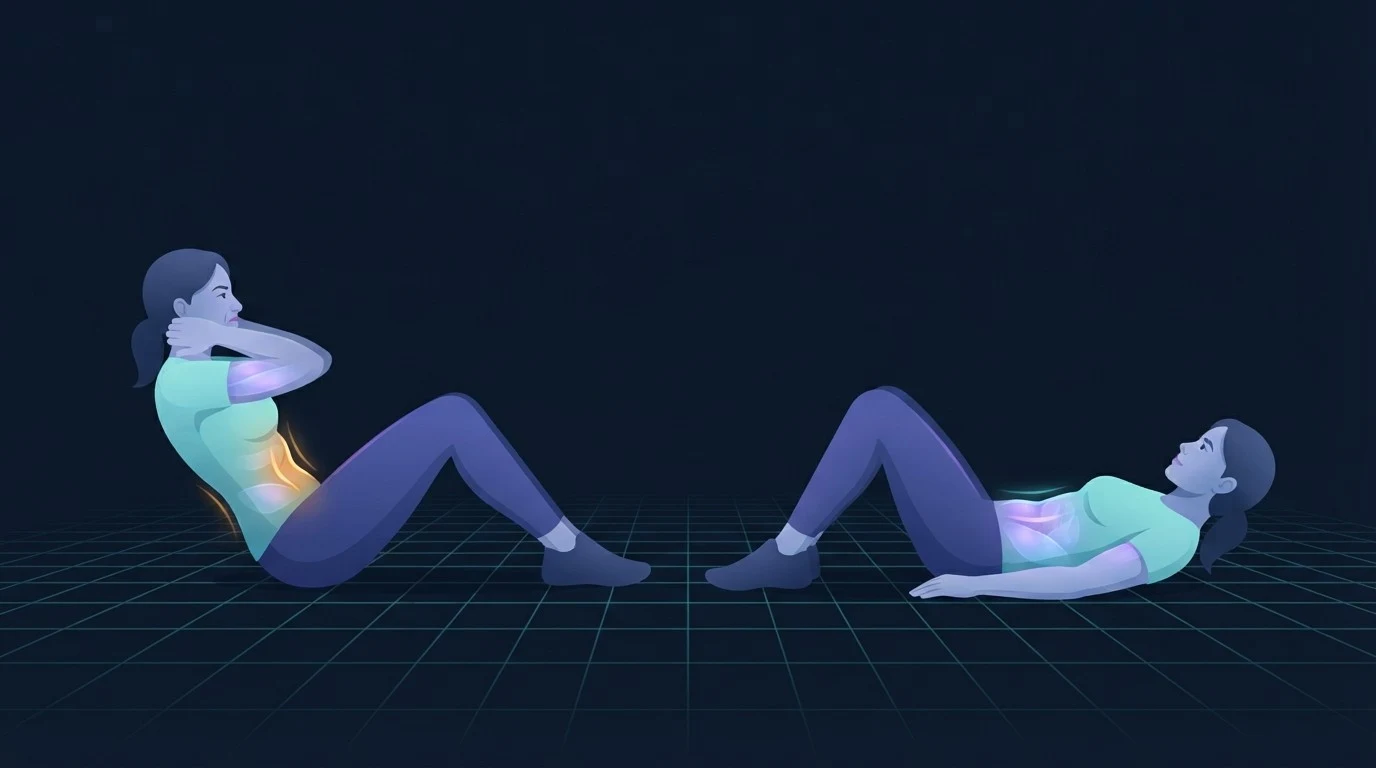
This is the phase most guides skip, and skipping it is why so many women stay stuck in gentle breathing drills for a year. Mota's ultrasound work found the abdominal crunch consistently narrowed the inter-recti distance at almost every site and time point tested, with narrowing ranging from 1.6 to 20.9 mm. Gluppe's 2020 study found head lifts narrowed the gap by a mean of 10 mm above the navel and 6.1 mm below it in women who had a diastasis. The 2023 randomised trial then ran 12 weeks of exactly those movements and found no worsening of the gap, pelvic floor symptoms or pain.
Start with a head lift: chin gently tucked, exhale, lift the head and the very tops of the shoulders, pause, lower. Progress to a small partial curl-up and then a twisted curl-up. Keep the ribs down and the range small. Range is the dial you turn, and doming is the signal that tells you which way to turn it.
Phase 4: put load back on
Carries are the most underrated postpartum exercise there is, because they train exactly the thing daily life demands: staying stacked and braced while something heavy hangs off you. Add goblet squats, hinges and rows, then overhead work, then impact. Change one variable at a time so you can tell what caused a flare.
Which exercises should you avoid with diastasis recti?
Fewer than you have been told, and the honest rule is a behaviour rather than a list. Avoid anything that makes your midline cone into a ridge, forces you to hold your breath to complete it, causes leaking or a feeling of heaviness in the pelvis, or hurts. That rule survives every phase of this plan.
That said, some movements ask a lot of pressure control very early, so they are worth postponing rather than banning.
| Postpone for now | Why | Do this instead |
|---|---|---|
| Full sit-ups with straight legs | Long lever plus a hip flexor pull is the most common trigger for visible doming | Head lift, then a small partial curl-up with knees bent |
| Double leg lowers and V-ups | The longest lever your core will ever face, with almost no way to regress mid-rep | Single-leg heel taps, then dead bugs |
| Full front planks in week one | Gravity pulls the abdominal contents forward against the linea alba for the whole hold | Incline plank against a counter, then knee plank, then full plank |
| Loaded twisting and heavy Russian twists | Rotation under load concentrates shear across the midline | Bird dogs and Pallof-style anti-rotation holds with a band |
| Maximal drawing-in as a cue | Ultrasound shows it slightly widens the gap postpartum | Gentle exhale-timed tension, no navel-to-spine suck |
| Jumping into heavy lifting volume | Reported heavy lifting 20 or more times weekly carried an odds ratio of 2.18 for diastasis | Carries and controlled hinges, adding load gradually |
Notice what is missing from that list: crunches, as a category. The blanket ban does not match the ultrasound or trial evidence. What matters is the size of the range and the quality of the rep.
How do you check your own separation at home?
Lie on your back, knees bent, feet flat. Place two or three fingers flat across your midline just above the navel, pointing toward your feet. Exhale, lift your head and the tops of your shoulders slightly, and feel how many finger widths sink in. Repeat about 4.5 cm above the navel, at the navel, and 4.5 cm below it, which is the protocol the Norwegian prevalence studies used. Two or more finger widths is the threshold they used to call it a diastasis.
Depth matters more than width. A gap you can sink three knuckles into with no springy resistance is a different training problem than a wide but firm one. And a home finger-width check is a rough screen, not a diagnosis. If the number is what you are anxious about, that is a good reason to get assessed rather than to keep measuring.
When should you see a pelvic floor physiotherapist?
Almost every study cited on this page was run by physiotherapists in a clinic, and there is a reason for that. A person watching you move catches things a mirror does not.
Book an assessment if any of these apply:
- You leak urine or stool when you cough, sneeze, laugh, jump or lift
- You feel heaviness, dragging or bulging in the vagina, which can indicate prolapse
- You have pain with sex, or pain at the pubic bone, tailbone or low back that is not settling
- You feel a firm bulge at or near the navel, which needs a doctor to rule out a hernia
- Your midline still domes after several weeks of careful graded work
- You are planning a return to running, barbell lifting or competitive sport
- You had a caesarean, a complicated delivery, or a multiple pregnancy
The American College of Obstetricians and Gynecologists advises resuming activity gradually after birth and individualising the timeline, with medical clearance guiding when to progress. If you are not sure whether your delivery changes the plan, that clearance conversation is the right first step, not a strangers' forum.
How long does postpartum core rehab take?
Months, and the honest version of that answer is freeing rather than discouraging. The Sperstad cohort shows most of the natural narrowing happens across the first year with no intervention at all. The trials that produced measurable strength gains ran 8 to 12 weeks. Two or three weeks per phase across four phases lands in exactly that window.
Progress is easier to see if you track something other than a gap. Can you do a phase 3 head lift with no ridge? Can you carry the car seat and a toddler up a flight of stairs without bracing your breath? Those checkpoints move long before a tape measure does. Our broader postpartum fitness guide covers how to fit the rest of your training around a newborn's schedule, and if you are choosing an app to hold the plan together, our roundup of the best fitness apps for women compares how each one handles beginner progressions and form teaching.
The bottom line
Diastasis recti is common, it is usually not the cause of your back pain, and the evidence for any one magic exercise is weak. What holds up is the shape of the plan: graded exposure, doming as your stop sign, patience measured in months, and a professional in the loop if anything hurts or leaks. You are not fragile and your core is not broken. It just needs the load put back on in an order it can accept.
Frequently Asked Questions
What are the best exercises for diastasis recti?
The best exercises for diastasis recti are graded core exercises you can perform without the midline of your abdomen bulging or coning, without holding your breath, and without leaking. In practice that means starting with connected breathing and low-load holds, then adding bird dogs, glute bridges, dead bugs, heel slides and side planks, then progressing to head lifts and curl-ups, then to loaded carries, squats, hinges and full plank work. Ultrasound research from Gluppe and colleagues in 2020 found head lifts and twisted curl-ups narrowed the gap between the muscle bellies by roughly 10 mm above the navel, while drawing-in and pelvic floor contractions widened it slightly. No single exercise is magic. The dose you can hold for months is what matters.
Do exercises actually close a diastasis recti?
Sometimes, and less reliably than the internet suggests. A 2021 systematic review with meta-analysis of seven randomised trials and 381 women concluded there is currently very low quality evidence to recommend any specific exercise program for treating diastasis recti abdominis postpartum. A 2023 randomised trial of a 12-week home curl-up program found it did not narrow the gap, but it did increase abdominal muscle thickness and strength. So training reliably buys you a stronger, more functional midsection, and it may or may not change the measured width. Most of the natural narrowing happens in the first year anyway, with prevalence falling from about 60 percent at 6 weeks postpartum to about 33 percent at 12 months.
Are crunches and sit-ups bad for diastasis recti?
The blanket ban on crunches is not supported by the current evidence. Ultrasound work by Mota and colleagues in 2015 found an abdominal crunch consistently narrowed the inter-recti distance at almost every site and time point tested, and a 2023 randomised trial found a 12-week program of head lifts and curl-ups did not worsen the gap, pelvic floor symptoms or pain. What matters is how the movement looks and feels. If your midline domes into a visible ridge, if you have to brace your breath to get up, or if you feel pressure or leaking, that repetition is too hard right now. Regress to a head lift, keep the ribs down, exhale on the way up, and build from there.
How do I check for diastasis recti at home?
Lie on your back with your knees bent and feet flat. Place two or three fingers flat across your midline just above the navel, pointing toward your feet. Exhale, lift your head and the tops of your shoulders slightly off the floor, and feel how many finger widths sink into the gap and how much tension you feel under your fingertips. Repeat about 4.5 cm above and 4.5 cm below the navel. A separation of two or more finger widths is the threshold used in the Norwegian prevalence research. Depth and springiness matter more than width: a narrow gap with no tension is often harder to train around than a wider gap that feels firm.
How long does it take to recover from diastasis recti?
Expect months, not weeks. In a prospective cohort of 300 first-time mothers, prevalence was 60 percent at 6 weeks postpartum, 45.4 percent at 6 months and 32.6 percent at 12 months, so a large share of the natural change happens across the first year without any intervention. On the training side, the randomised trials that reported strength gains ran 8 to 12 weeks. A reasonable plan is 2 to 3 weeks per phase, four phases, then normal progressive training. Function is the finish line, not a number. If you can lift your child, cough, run and load your core without doming, pain or leaking, you are done rehabbing.
When should I see a pelvic floor physiotherapist for diastasis recti?
Book an assessment if you leak urine or stool, feel heaviness, bulging or dragging in the vagina, have pain with sex, have low back or pelvic girdle pain that is not settling, feel a hernia-like bulge at or near the navel, or if your midline still domes after several weeks of careful graded work. A hands-on assessment is also worth it if you had a caesarean, a difficult delivery or a twin pregnancy, or if you simply want someone to watch you move before you go back to running or lifting. Physiotherapist-guided programs are the setting in which most of the published diastasis trials were run.
Can I run or lift weights with diastasis recti?
Yes, once you can manage pressure under load. The practical test is whether you can perform the movement without doming along your midline, without breath holding, without leaking and without pain, on your last repetition as well as your first. Build up with carries, split squats, hinges and rows before you add running or overhead pressing, and add one variable at a time. One risk factor did stand out in the Norwegian cohort research: women who reported heavy lifting 20 or more times a week were about twice as likely to have a diastasis, so ramp your load up gradually rather than all at once.
References
- Sperstad JB, Tennfjord MK, Hilde G, Ellstrom-Engh M, Bo K. "Diastasis recti abdominis during pregnancy and 12 months after childbirth: prevalence, risk factors and report of lumbopelvic pain." British Journal of Sports Medicine. 2016;50(17):1092-1096. DOI: 10.1136/bjsports-2016-096065
- Mota P, Pascoal AG, Carita AI, Bo K. "The Immediate Effects on Inter-rectus Distance of Abdominal Crunch and Drawing-in Exercises During Pregnancy and the Postpartum Period." Journal of Orthopaedic & Sports Physical Therapy. 2015;45(10):781-788. DOI: 10.2519/jospt.2015.5459
- Gluppe SB, Engh ME, Bo K. "Immediate Effect of Abdominal and Pelvic Floor Muscle Exercises on Interrecti Distance in Women With Diastasis Recti Abdominis Who Were Parous." Physical Therapy. 2020;100(8):1372-1383. DOI: 10.1093/ptj/pzaa070
- Gluppe SB, Ellstrom Engh M, Bo K. "Curl-up exercises improve abdominal muscle strength without worsening inter-recti distance in women with diastasis recti abdominis postpartum: a randomised controlled trial." Journal of Physiotherapy. 2023;69(3):160-167. DOI: 10.1016/j.jphys.2023.05.017
- Gluppe SL, Hilde G, Tennfjord MK, Engh ME, Bo K. "Effect of a Postpartum Training Program on the Prevalence of Diastasis Recti Abdominis in Postpartum Primiparous Women: A Randomized Controlled Trial." Physical Therapy. 2018;98(4):260-268. DOI: 10.1093/ptj/pzy008
- Gluppe S, Engh ME, Bo K. "What is the evidence for abdominal and pelvic floor muscle training to treat diastasis recti abdominis postpartum? A systematic review with meta-analysis." Brazilian Journal of Physical Therapy. 2021;25(6):664-675. DOI: 10.1016/j.bjpt.2021.06.006
- Benjamin DR, van de Water AT, Peiris CL. "Effects of exercise on diastasis of the rectus abdominis muscle in the antenatal and postnatal periods: a systematic review." Physiotherapy. 2014;100(1):1-8. DOI: 10.1016/j.physio.2013.08.005
- Benjamin DR, Frawley HC, Shields N, van de Water ATM, Taylor NF. "Relationship between diastasis of the rectus abdominis muscle (DRAM) and musculoskeletal dysfunctions, pain and quality of life: a systematic review." Physiotherapy. 2019;105(1):24-34. DOI: 10.1016/j.physio.2018.07.002
- Thabet AA, Alshehri MA. "Efficacy of deep core stability exercise program in postpartum women with diastasis recti abdominis: a randomised controlled trial." Journal of Musculoskeletal & Neuronal Interactions. 2019;19(1):62-68. PMID: 30839304
- American College of Obstetricians and Gynecologists. "Physical Activity and Exercise During Pregnancy and the Postpartum Period." Committee Opinion No. 804. Obstetrics & Gynecology. 2020;135(4):e178-e188. acog.org