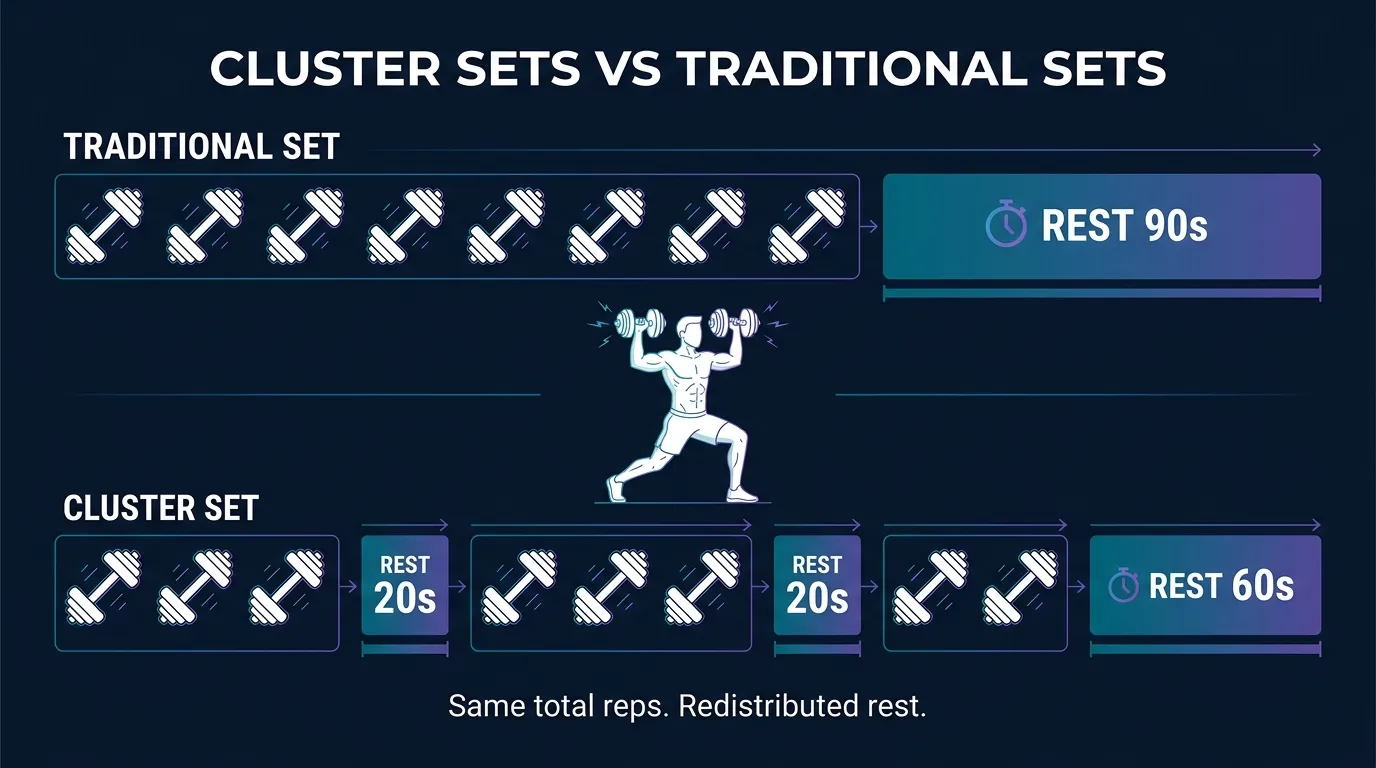
Straight sets are the default. You pick a weight, do 8 reps, rest, do 8 more. And in most training research, straight sets are what "traditional" means. But there's a growing body of work asking whether the last few reps of that straight set are actually pulling their weight.
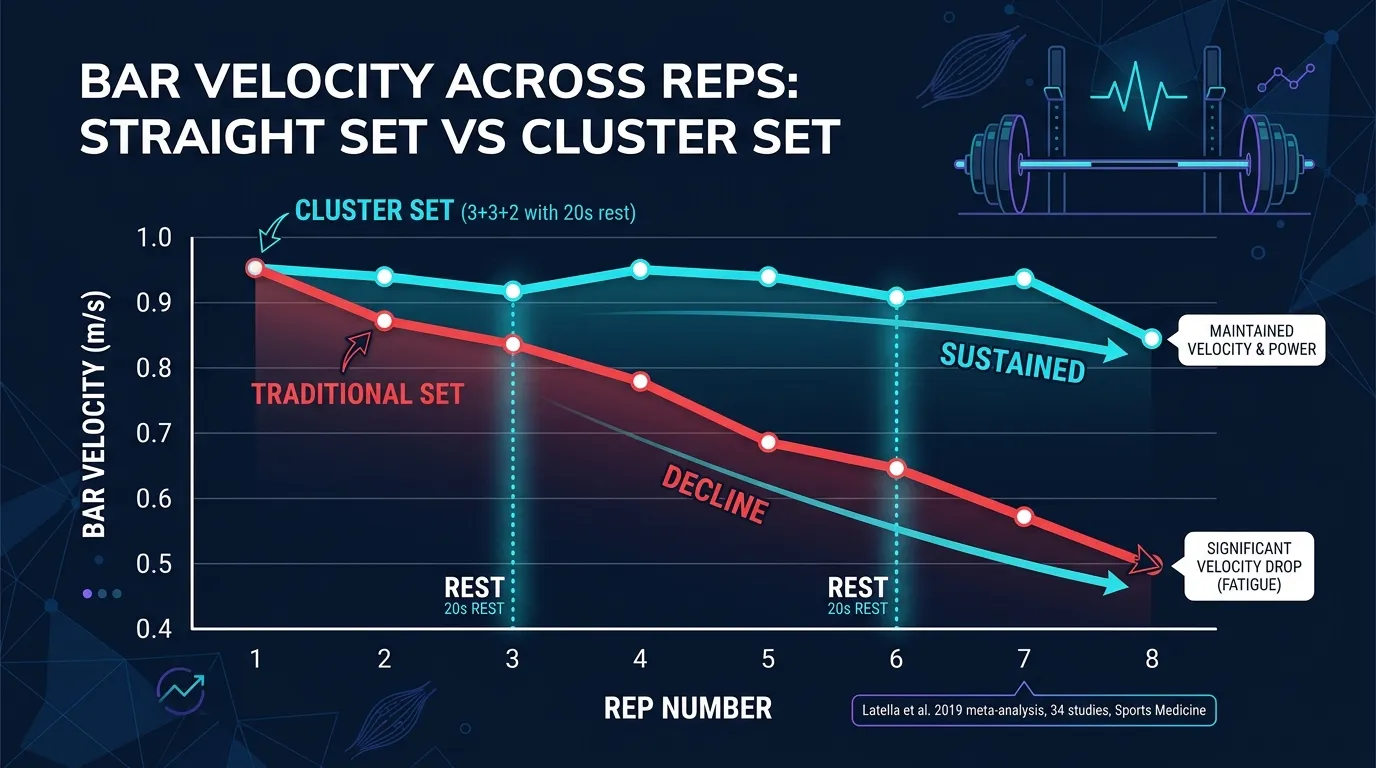
The physiology is clean. Once phosphocreatine drops, bar speed drops. Once bar speed drops, mechanical output per rep drops. So the last two reps of a hard set of 8 are doing much less work per rep than the first two, even though they feel much harder. That's the gap cluster sets are built to close.
This piece walks through what a cluster set actually is, the four biggest research syntheses on the topic, the specific outcomes where clustering wins versus draws, and how to actually use them when your equipment is a pair of dumbbells and your kitchen floor.
What a Cluster Set Actually Is
A cluster set inserts short rest breaks inside a single working set. Instead of eight straight reps, you might do 4 reps, rest 20 seconds, do 4 more, and count that as one cluster set of 8. The rest is short. It's not enough to fully recover, but it's enough to let phosphocreatine partially resynthesize, which restores some of the bar speed and mechanical output that fatigue was taking away.
Tufano, Brown, and Haff (2017) in the Journal of Strength and Conditioning Research cataloged the main configurations. The three most useful ones:
- Basic cluster sets: rest between groupings of reps (for example, 3+3+3 with 20 seconds between clusters).
- Rest-redistribution: keep total set-plus-rest time the same as a straight set, but break the rest into shorter, more frequent intervals across the set.
- Rest-pause: push a set to failure or near failure, rest briefly (10 to 20 seconds), then squeeze out extra reps at the same load.
The three do slightly different jobs. Basic clusters are about preserving bar speed across a heavier working set. Rest-redistribution is about doing more total quality volume in the same wall-clock window. Rest-pause is about wringing extra reps and effort out of a fatigued muscle. All three are cluster set variants, but they map to different training goals.
The Research: What Studies Show
Latella et al. (2019): The Acute Effect Meta-Analysis
The clearest evidence for cluster sets comes from the acute studies. Latella, Teo, Drinkwater, Kendall, and Haff (2019) in Sports Medicine pooled 25 studies comparing cluster set configurations to traditional (straight) sets on within-session neuromuscular output. The outcomes were velocity, power, and force measured across a working set.
Clusters won on all of them. The pooled effect sizes were moderate to large:
- Peak velocity: SMD 0.82 (95% CI 0.11 to 1.52) favoring clusters
- Mean velocity: SMD 0.86 (95% CI 0.32 to 1.41) favoring clusters
- Mean power: SMD 0.69 (95% CI 0.40 to 0.99) favoring clusters
- Peak power: SMD 0.36 (95% CI 0.06 to 0.66) favoring clusters
- Peak force: SMD 0.31 (95% CI -0.03 to 0.58) favoring clusters
Translation: the same load moved faster and with more mechanical output on the later reps of a cluster set than on the later reps of a straight set. The overall effect for clusters across all subgroups (loads, exercises, experience levels, and cluster structures) was SMD 0.70 (95% CI 0.55 to 0.86, p<0.001). It held across trained and untrained populations, across light and heavy loads, and across different cluster configurations.
This is the strongest and most consistent finding in the cluster-set literature. Bar speed on late reps is the mechanism. Whether that mechanism translates into bigger chronic adaptations is a separate question, which the long-term studies had to answer.
Davies et al. (2021): The Chronic Adaptations Meta-Analysis
Acute effects are one thing. Whether cluster sets produce bigger adaptations over weeks and months is what matters. Davies, Tran, Hogan, Haff, and Latella (2021) in Sports Medicine pooled 29 studies comparing chronic cluster training to traditional set configurations, with training durations of three weeks or longer.
The pooled finding is uncomfortable for anyone hoping clusters are a shortcut. No significant differences between cluster and traditional configurations on any adaptation:
- Strength: ES −0.05 (95% CI −0.21 to 0.11, p=0.56). No difference.
- Power output: ES 0.02 (95% CI −0.17 to 0.20, p=0.86). No difference.
- Velocity: ES 0.15 (95% CI −0.10 to 0.41, p=0.24). No difference.
- Hypertrophy: ES −0.05 (95% CI −0.32 to 0.23, p=0.73). No difference.
- Muscular endurance: ES −0.07 (95% CI −0.43 to 0.29, p=0.70). No difference.
The authors also ran subgroup analyses by training volume, cluster set model, training status, body part trained, and exercise type. No differences within any subgroup either. Their conclusion: cluster and traditional configurations are equally effective at inducing muscular and neuromuscular adaptations, but clusters may achieve those adaptations with less fatigue development, which can matter in periodized programming.
So the acute mechanism (better bar speed within a session) doesn't translate to bigger chronic adaptations. Cluster sets aren't a growth hack, and they aren't a power hack either. What they are is a way to accumulate quality reps with less within-set fatigue. That's a real tool. It's just narrower than the marketing suggests.
Cui et al. (2025): The Time-Course Nuance
A more recent synthesis added an interesting wrinkle to the strength question. Cui, Yu, Xu, and Wu (2025) in Frontiers in Physiology pooled 21 articles and 49 reports on cluster and traditional resistance training for maximum strength in young adults.
The overall pooled effect was a tie (SMD 0.10, 95% CI −0.14 to 0.33). But the subgroup analysis found a time-course pattern:
- 4 to 8 weeks: cluster training was more effective (SMD 0.24, 95% CI 0.06 to 0.42 favoring clusters).
- 9 to 12 weeks: traditional training was more effective (SMD −1.54, 95% CI −3.03 to −0.05 favoring traditional).
- Age 23 and above: clusters showed a small advantage (SMD 0.38, 95% CI 0.11 to 0.65).
The 9-12 week traditional advantage has wide confidence intervals and pools fewer studies, so read it as a preliminary signal rather than a settled finding. But the authors' practical framing is worth carrying forward. Cluster training may buy a small early-block strength edge by mitigating fatigue, then traditional sets take over as the more effective long-term stimulus. In periodized programming, that suggests a possible role for clusters in shorter prep blocks (a microcycle or a specific stage), then a switch to traditional configurations for extended strength blocks. This adds a small nuance on top of Davies (2021), where the overall pooled finding is still a tie.
Vargas-Molina et al. (2025): Volume-and-Effort-Matched Hypertrophy
The freshest data on cluster sets and muscle growth is a within-participant unilateral trial in resistance-trained lifters, published by Vargas-Molina et al. (2025) in the European Journal of Applied Physiology. Ten resistance-trained volunteers (7 men, 3 women, age 21) trained for 8 weeks, twice a week, with 5 sets of 12 reps of leg press and leg extension. One leg did traditional straight sets. The contralateral leg did 3 clusters of 4 reps with 20 seconds of intra-set rest. Loads were matched to reps in reserve so effort was equated across legs, not just volume load.
The result was similar hypertrophy in both legs. Muscle thickness increased in both conditions (traditional ES 0.56, cluster ES 0.42, both p<0.05). Thigh lean tissue mass by DXA also increased in both (traditional ES 0.11, cluster ES 0.13). The authors concluded that when sets, reps, and effort are equalized, cluster sets and traditional sets produce equivalent hypertrophy. The sample was small (n=10), which limits precision, but the unilateral design controls for between-person variability tightly.
If your goal is growth, the set structure is not the lever. Volume, load, and proximity to failure are. Cluster structure is a way to accumulate the same volume with less within-set fatigue, which can matter for movement quality, but the tissue outcome is the same.
Why This Matters for Your Training
Two clean use cases fall out of the data. The first is any training block where speed of movement matters. Jumps. Throws. Explosive push-ups. Kettlebell swings. Any exercise where the intent is fast concentric acceleration and where a slow, grinding last rep isn't just useless but actively unhelpful. Cluster sets keep the bar moving fast on rep six the way it moved on rep one. That's a within-session movement quality benefit that the Latella (2019) meta-analysis pinned down clearly. It won't automatically produce bigger power adaptations over weeks (Davies 2021 pooled it and found no chronic power advantage), but it will let each rep in each session be a better version of itself.
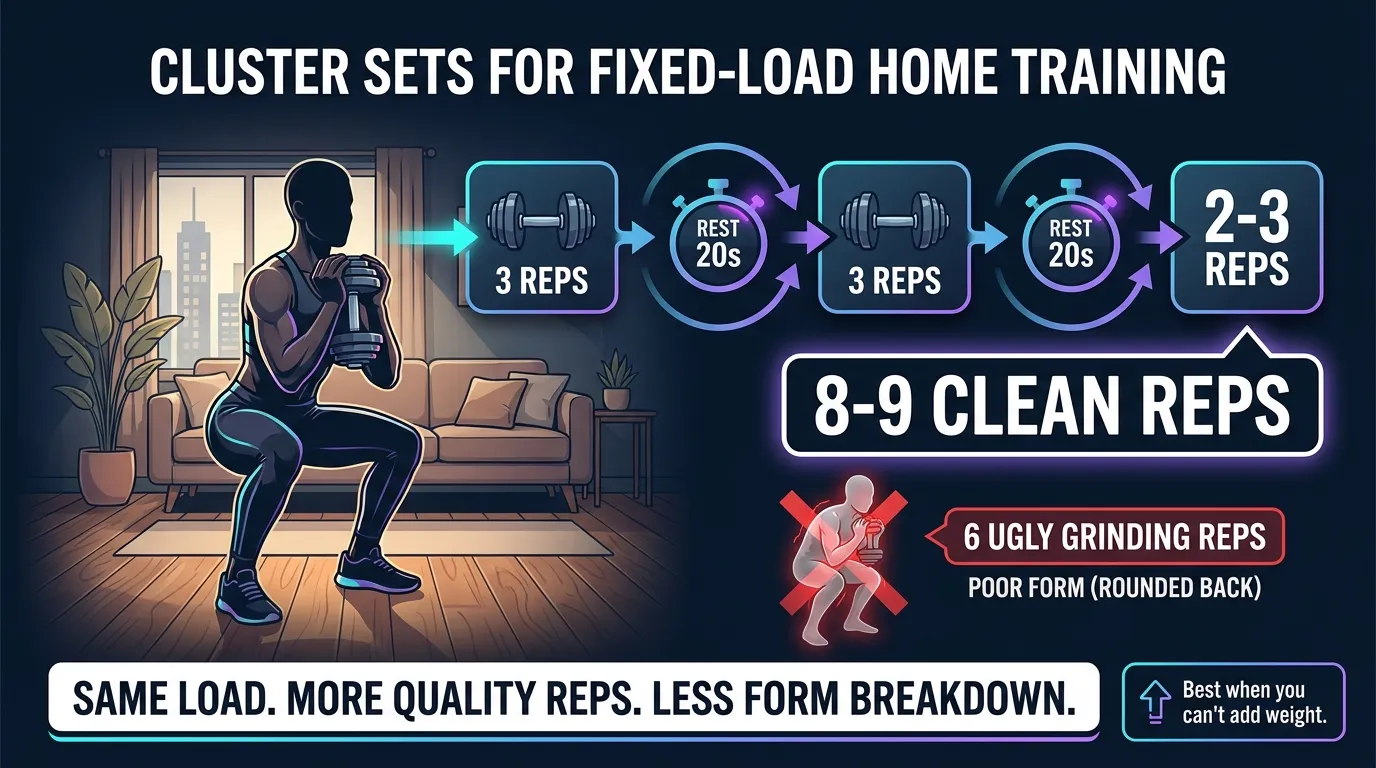
The second use case is a common home-training constraint. You own one pair of dumbbells. The load is fixed. You want to progressively overload, but you can't add weight. A cluster set gets you more total quality reps at the same load without the form breakdown of grinding through fatigue. Nine clean reps done as 3+3+3 with 20-second rests is a cleaner training stimulus than six ugly straight-set reps at the same load. Same total effort, better movement quality. The chronic outcome will be similar, but the reps you did to get there were closer to what you intended them to be.
For hypertrophy work, the honest answer is that clusters aren't buying you extra growth. Straight sets to close proximity to failure produce the same result. If you like clustering because it feels cleaner and the bar moves better, that's a legitimate preference. But the Vargas-Molina (2025) volume-and-effort-matched trial closed the door on the "clusters grow more muscle" claim. They don't. And the same goes for chronic strength and power. Cui (2025) noted a small edge for clusters in 4-8 week blocks, but the effect flipped or vanished past 9 weeks.
How to Actually Use Cluster Sets
The three configurations map to three different problems. Pick the one that matches the goal.
- Power-focused work (jumps, throws, explosive push-ups): basic clusters, 2 to 3 reps per rep group, 15 to 20 seconds of intra-set rest. Total reps per set 6 to 9. Focus on maximum concentric acceleration on every rep. Stop the set the moment bar speed noticeably drops.
- Strength-focused work at heavy loads: basic clusters, 1 to 3 reps per rep group, 20 to 45 seconds of intra-set rest. Total reps per set 3 to 6 at 80 to 90% of 1RM. This is where cluster configuration lets you accumulate quality reps at a load that would grind you into a slow, ugly last rep on a straight set.
- Volume accumulation on a fixed load (home training constraint): rest-redistribution or rest-pause. Take your usual straight-set rest time (say 90 seconds between sets) and break some of it into shorter intra-set intervals. A traditional 3 x 8 with 90 seconds between sets becomes 3 sets of (5+5) with 20 seconds inside and 70 seconds between. You bank more total reps at the same load, at close to the same effort.
Two structural rules. First, cluster sets aren't magic on top of a bad program. If total volume, load, and effort are already dialed in, adding cluster structure won't produce more growth. What it will do is preserve the movement quality of your reps, which matters most on explosive and near-max work.
Second, don't cluster everything. The main reason clusters "feel easier" is that the reps are cleaner and faster. On accessory hypertrophy work where a bit of grinding is fine and even useful, straight sets are simpler and equally effective. Save cluster structure for the movements where speed or quality is the actual target.
For adjacent research on training methods that work well at home with limited equipment, our pieces on training frequency, training to failure vs reps in reserve, and greasing the groove all address the same underlying question. How do you get a strong training stimulus without adding load?
Get an evidence-based plan built for you
FitCraft, our mobile fitness app, pairs you with an AI coach who builds you a personalized plan around your goals, schedule, and fitness level. Every FitCraft program is designed by Domenic Angelino, MPH (Brown University) and NSCA-CSCS, with research published in the Journal of Strength and Conditioning Research and Medicine & Science in Sports & Exercise.
Take the Free Assessment Free • 2 minutes • No credit cardCommon Misconceptions
"Cluster Sets Grow More Muscle Than Straight Sets"
They don't, when volume and effort are matched. The Vargas-Molina et al. (2025) volume-and-effort-matched trial in trained lifters found essentially identical hypertrophy in cluster and traditional configurations. Davies (2021) reached the same conclusion in the pooled meta-analysis of 29 chronic trials. The confusion comes from earlier trials that either didn't match volume (clusters accumulated more total reps at the same load, which is a volume effect, not a structure effect) or didn't match effort (traditional sets stopped short of failure while clusters didn't). Once you close both gaps, the growth outcome is the same.
"Cluster Sets Are for Elite Athletes Only"
Not really. The mechanism that makes clusters useful (better bar speed on later reps) applies to any lifter. What varies is when it matters. For a beginner learning form on push-ups or split squats, cluster structure lets more quality reps happen before form degrades, which is a real training advantage. For an intermediate lifter with fixed dumbbells at home, it's how you progressively overload without adding weight. The elite-athlete association is because the earliest research was in Olympic-lift populations. The physiology generalizes.
"Rest-Pause Is the Same as a Cluster Set"
Sort of. Rest-pause is a specific cluster variant where the first "block" is taken to or near failure, then you rest briefly and squeeze out extra reps. Basic clusters typically stop each rep group short of failure to preserve bar speed. The two produce different fatigue profiles. Rest-pause is closer to a traditional hard set with a bonus. Basic clusters are structurally different, with speed preservation as the goal. Both are useful. They just aren't identical, and confusing them muddies the research read.
"Longer Intra-Set Rest Is Always Better"
Up to a point, then diminishing returns. Tufano (2017) reviewed the rest-duration literature and noted 15 to 30 seconds is enough to substantially restore bar speed on the next rep group, and 30 to 45 seconds is the practical ceiling before intra-set rest starts to look and feel like just a shorter inter-set rest. Going longer than 60 seconds inside a set defeats the purpose. If the goal is fully fresh reps, use separate sets with normal rest between them.
What the Research Suggests Going Forward
The cluster-set literature is unusually specific about what it can and can't claim. That's a strength. Latella (2019) established the acute mechanism cleanly. Preserved velocity, power, and force within a working set. Davies (2021) mapped the chronic outcome. No difference from traditional sets across strength, power, velocity, hypertrophy, or endurance. Cui (2025) added a time-course wrinkle in favor of clusters over 4-8 weeks that reversed past 9 weeks. Vargas-Molina (2025) closed the door on volume-and-effort-matched hypertrophy differences.
Use cluster sets when the goal is preserving movement speed and quality within a session. Use them as a home-training tool when your loading options are fixed and you'd rather accumulate cleaner reps at the same weight than grind through fatigue. Use them in short (4-8 week) prep blocks where the small early-block strength edge Cui found may be useful. Don't use them expecting extra hypertrophy, extra chronic power, or extra 1RM strength on top of a well-designed straight-set program over longer training blocks.
The honest limits worth naming. Most trials are three to sixteen weeks long. The chronic adherence question (do lifters keep training this way at year 2?) is thin. Most participants are young. The response in older adults, women, and highly trained populations is less well characterized. Vargas-Molina's hypertrophy trial had only 10 participants. Cui's 9-12 week traditional advantage has wide confidence intervals and needs more data. The research is trending toward clusters being a within-session movement-quality tool in the coach's kit, not a universal upgrade to every workout.
Practical takeaway. If you already train straight sets and it's working, keep going. If you're training for movement quality on explosive lifts, or you need to preserve bar speed on late reps of a heavy set, adding cluster structure to those specific lifts is well-supported. And if your home setup keeps you at a fixed load with no easy way to progress, cluster structure is one of the most efficient ways to squeeze more quality volume out of what you already have. The chronic result will look similar to a straight-set program, but the reps you did to get there will be closer to what you intended them to be.
References
- Tufano JJ, Brown LE, Haff GG. "Theoretical and Practical Aspects of Different Cluster Set Structures: A Systematic Review." Journal of Strength and Conditioning Research. 2017;31(3):848-867. doi:10.1519/JSC.0000000000001581 · PubMed: 27465625
- Latella C, Teo WP, Drinkwater EJ, Kendall K, Haff GG. "The Acute Neuromuscular Responses to Cluster Set Resistance Training: A Systematic Review and Meta-Analysis." Sports Medicine. 2019;49(12):1861-1877. doi:10.1007/s40279-019-01172-z · PubMed: 31506904
- Davies TB, Tran DL, Hogan CM, Haff GG, Latella C. "Chronic Effects of Altering Resistance Training Set Configurations Using Cluster Sets: A Systematic Review and Meta-Analysis." Sports Medicine. 2021;51(4):707-736. doi:10.1007/s40279-020-01408-3 · PubMed: 33475986
- Cui J, Yu Y, Xu Y. "Effectiveness of long-term cluster training and traditional resistance training in enhancing maximum strength in young adults: a systematic review and meta-analysis." Frontiers in Physiology. 2025;16:1568247. doi:10.3389/fphys.2025.1568247 · PubMed: 40236825
- Vargas-Molina S, Petro JL, Romance R, Schoenfeld BJ, Bonilla DA, Kreider RB, Benítez-Porres J. "Cluster sets and traditional sets elicit similar muscular hypertrophy: a volume and effort-matched study in resistance-trained individuals." European Journal of Applied Physiology. 2025;125:1725-1734. doi:10.1007/s00421-025-05712-6 · PubMed: 39932536
Frequently Asked Questions
What is a cluster set?
A cluster set is a resistance training set that inserts short rest breaks (typically 15 to 45 seconds) between single reps or small groups of reps within a single set. Instead of doing 8 reps straight through, you might do 4 reps, rest 20 seconds, then do 4 more, and count that as one set. The intra-set rest lets muscle phosphocreatine partially replenish, which preserves bar speed and mechanical output on later reps. Tufano, Brown, and Haff's 2017 systematic review in the Journal of Strength and Conditioning Research catalogs the main structures. Basic cluster sets rest between rep groupings, rest-redistribution keeps total rest constant but breaks it into shorter intervals across the set, and rest-pause pushes to failure then rests briefly to squeeze out extra reps.
Do cluster sets build more muscle than traditional sets?
No, when volume and effort are matched, they build about the same. Vargas-Molina et al.'s 2025 volume-and-effort-matched trial in resistance-trained lifters (European Journal of Applied Physiology, n=10, within-participant unilateral 8-week design) found similar muscle thickness and lean tissue mass gains in cluster and traditional legs. Davies et al.'s 2021 meta-analysis in Sports Medicine reached the same conclusion across 29 chronic trials (hypertrophy ES −0.05, 95% CI −0.32 to 0.23, p=0.73). Cluster sets don't unlock extra hypertrophy on top of traditional sets. What they do is get you to the same growth outcome with less within-set fatigue and cleaner reps.
Are cluster sets better for strength and power?
Within a single session, yes for velocity, power, and force output. Over weeks, essentially a tie. Latella et al.'s 2019 meta-analysis in Sports Medicine pooled 25 acute studies and found cluster sets significantly preserved peak velocity (SMD 0.82), mean velocity (SMD 0.86), and mean power (SMD 0.69) within a working set. But Davies et al.'s 2021 meta-analysis of 29 chronic trials found no differences between cluster and traditional configurations on strength (ES −0.05), power (ES 0.02), velocity (ES 0.15), or hypertrophy (ES −0.05). Cui et al.'s 2025 meta-analysis noted a small cluster edge in 4-8 week blocks (SMD 0.24) that reversed past 9 weeks. Bottom line: clusters preserve movement quality within a session, but they don't produce bigger chronic adaptations.
How long should the intra-set rest be for cluster sets?
15 to 45 seconds is the range that shows up across the research. Tufano's 2017 review notes that rest durations of 15 to 30 seconds between rep pairs are the most commonly studied for power preservation, while 30 to 45 seconds is more typical when the goal is to maintain velocity across a heavier working set. The practical shortcut: if the goal is bar speed on power-focused work (jumps, throws, explosive presses), keep intra-set rest short (15 to 20 seconds). If the goal is completing a challenging strength set at higher relative load, longer rest (30 to 45 seconds) works better. Total training-block rest time is usually kept similar to a traditional set. You just redistribute it.
Can you do cluster sets at home with dumbbells or bodyweight?
Yes. Cluster sets are a set configuration, not an equipment requirement. Any exercise where you can pause, briefly rest, and continue at the same movement can be clustered. A useful home application is push-up progressions where you'd otherwise hit failure at 6 reps. Do 3, rest 20 seconds, do 3 more, rest 20, do 2 to 3 more. You've now done 8 to 9 clean reps at the same effort level, versus 6 grinding reps with breakdown in form. The same idea works for pull-ups, dumbbell squats, split squats, and single-leg deadlifts. It's especially useful when your loading options are fixed (one pair of dumbbells) and adding weight isn't easy.