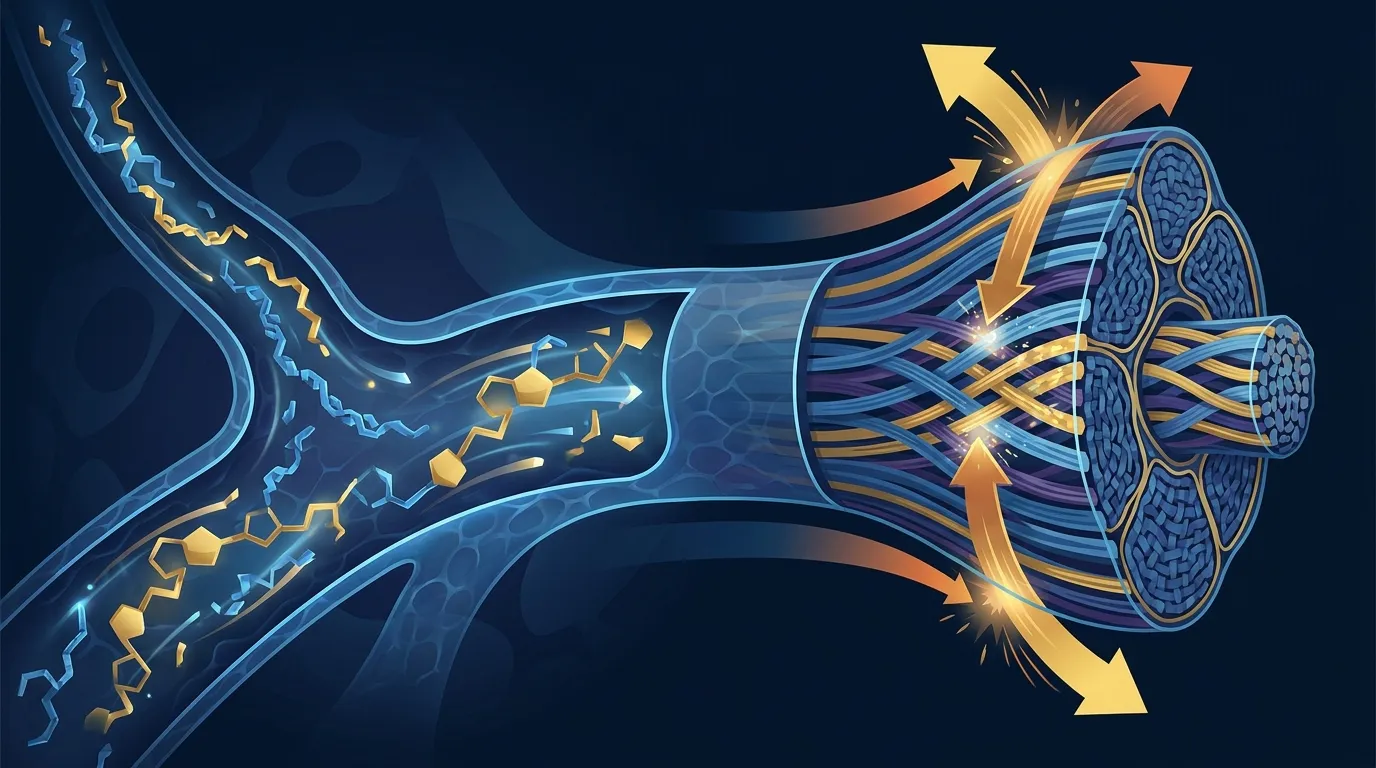
Tendons are slow tissue. A tendon has about one-tenth the blood supply of the muscle it connects to bone, and its structural turnover is measured in months. That's why a torn Achilles takes half a year to come back and why chronic patellar tendinopathy can drag on for a year. It's also why anyone chasing a fitness goal that involves jumping, sprinting, heavy lifting, or repeated impact eventually runs into tendon pain and starts googling collagen.
The collagen supplement market has ballooned into a multi-billion-dollar category. The marketing usually sells three claims: better joints, better skin, better tendon and connective-tissue health. The middle claim (skin) has decent evidence. The first (joints) has some. The third (tendon) has the most rigorous recent data, and that's what this article is about. Specifically: does taking hydrolyzed collagen make your tendons work better, and if so, how much, when, and for whom?
The short answer: yes, at the right dose and with mechanical loading, but on a slower timeline than the marketing suggests. And no, collagen is not a strength or muscle-building supplement. It's a connective-tissue tool. This piece walks through the primary studies, the mechanism, and what the honest use case actually looks like.
The Research: What Studies Show
Miyamoto 2025: 16 Weeks, 10 g/day, Real Tendon Stiffness Gains
The most rigorous recent trial comes from Miyamoto and colleagues (2025), published in Medicine & Science in Sports & Exercise. Fifty healthy young sedentary males were randomized to either 10 g of collagen peptide per day or matched placebo for 16 weeks, alongside a resistance-training protocol. The measurement was mechanical: shear-wave elastography of the medial gastrocnemius and Achilles tendon, plus rate of torque development at the ankle.
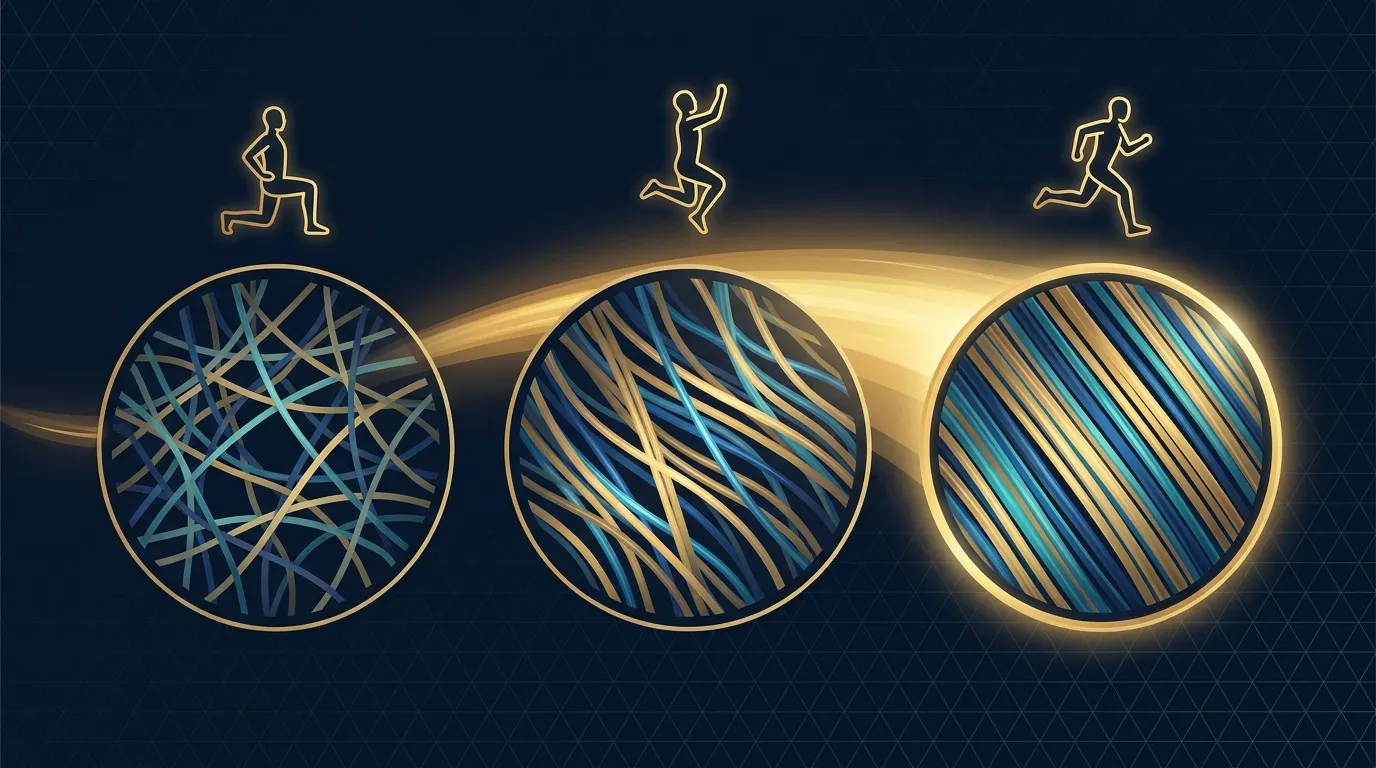
The collagen group showed significantly increased medial gastrocnemius stiffness (Cohen's d = 0.594, p < 0.001), significantly increased Achilles tendon stiffness (d = 0.378, p < 0.001), and a significantly improved normalized rate of torque development (d = 0.525, p < 0.001). Placebo did not. Muscle and tendon cross-sectional area did not change, and neither did maximal voluntary isometric contraction. So the collagen didn't add tendon size or peak strength. It added stiffness, and stiffness translated to faster force production.
Why that matters: a stiffer tendon transmits force from muscle to bone with less delay and less energy loss in stretch. Sprinting, jumping, and any explosive movement depend on how quickly the tendon can convert muscle force into joint torque. This is the mechanical basis for why collagen tends to show up in rate-of-force-development studies but not in max-strength studies.
Shaw & Baar 2017: The Mechanistic Cornerstone
The mechanistic reference point for the whole field is Shaw, Lee-Barthel, Ross, Wang, and Baar (2017), published in the American Journal of Clinical Nutrition. It's a small study (n=8 healthy male subjects, crossover design) but it established the timing and mechanism the field now works with.
Subjects consumed either 5 g gelatin, 15 g gelatin, or a placebo, each enriched with about 48 mg of vitamin C, one hour before a 6-minute jumping protocol. Blood samples showed that gelatin ingestion elevated circulating amino acids that make up collagen (glycine, proline, hydroxyproline, hydroxylysine), with peak levels one hour post-consumption. And when the researchers cultured engineered ligaments in serum from the 15 g gelatin group, those ligaments produced more collagen and were mechanically stronger. Blood markers of collagen I synthesis roughly doubled at the 15 g dose.
Two things came out of this study that shaped everything downstream. First, timing matters: the amino acids need to be circulating when mechanical loading of the tendon happens. Loading is the signal that tells the tissue to build. Second, 15 g does more than 5 g. That dose-response pattern is the reason the current guideline is 10 to 15 g rather than the 2.5 g some cheap products advertise.
Lis 2022: Faster Recovery of Rate of Force Development
Lis, Jordan, Lipuma, Smith, Schaal, and Baar (2022), publishing in the International Journal of Sport Nutrition and Exercise Metabolism, ran a 3-week trial in 50 healthy male athletes (ages 18 to 25). Subjects took either 20 g of hydrolyzed collagen with 50 mg of vitamin C daily or a matched placebo, alongside a training block. The outcome was countermovement jump performance and lower-limb rate of force development.
Both groups saw performance dip after a hard training week, as expected. But only the collagen group returned rate of force development to baseline by the end of the study (p = 0.036). Placebo did not. The interpretation is that collagen helped the connective-tissue machinery bounce back faster after training-induced fatigue. Peak strength didn't change (no leucine effect on muscle). What changed was how quickly the tendon-and-muscle unit could produce force, which is a connective-tissue property.
Praet 2019: Collagen for Actual Tendinopathy
Praet and colleagues (2019) in Nutrients ran a randomized crossover trial in patients with chronic mid-portion Achilles tendinopathy. Twenty patients received either specific bioactive collagen peptides (TENDOFORTE) or placebo, alongside a structured bi-daily calf-strengthening program, for 6 months. Function was measured with the Victorian Institute of Sports Assessment Achilles questionnaire (VISA-A).
At 3 months, the group that started on collagen improved VISA-A by 12.6 points (95% CI: 9.7, 15.5). The group that started on placebo improved by only 5.3 points (95% CI: 2.3, 8.3). The collagen group saw more than double the functional improvement of the placebo group over the same eccentric-loading rehab protocol. Both groups improved (eccentric loading is a well-established tendinopathy treatment) but collagen added meaningfully on top.
This is one of the most clinically relevant studies in the field because it looks at people who already have tendon pain, not just uninjured subjects trying to add a marginal supplement. The takeaway: for chronic tendinopathy already in a loaded rehab program, adding collagen appears to accelerate return of function.
Dressler & Zdzieblik 2018: Ankle Instability and Injury Reduction
Dressler, Gehring, Zdzieblik, Oesser, Gollhofer, and König (2018) in the Journal of Sports Science and Medicine ran a 6-month RCT in 50 athletes with chronic ankle instability. Half took 5 g of collagen peptide daily, half took placebo. Subjective ankle stability (measured by the CAIT and FAAM-G questionnaires) improved significantly on collagen versus placebo (p < 0.001 for both). Mechanical stability measures did not change during the intervention. But in the 3-month follow-up phase, the collagen group had a significantly lower rate of ankle joint injuries (p < 0.05).
That injury-reduction signal is small (50 subjects) but interesting. It suggests the connective-tissue changes take time to translate into injury protection, and once they do, the effect persists beyond the supplementation window. And it fits the mechanism: connective tissue remodels slowly.
The 2024 Meta-Analysis: What Collagen Doesn't Do
A systematic review and meta-analysis by Kirmse, Hein, Schäfer, and Platen (2024) in the German Journal of Sports Medicine pooled 13 studies (9 in the meta-analysis). Their headline finding: collagen peptide supplementation has no significant effect on strength-related performance (SMD = 0.079, 95% CI: -0.120 to 0.273, p = 0.445). Of 55 performance parameters examined across the trials, 48 showed no response to collagen.
That's the ceiling on what collagen does. It is not a strength supplement. It is not a muscle builder. Two of the included studies did report increased Achilles and patellar tendon hypertrophy after prolonged resistance training with collagen, matching the Miyamoto stiffness finding, but neither of those studies showed strength gains. So the effect is real and structural (tendon remodels) but it does not translate into bigger peak strength numbers in short-to-medium studies. Kirmse's honest conclusion: current research does not support collagen for enhancing short- or long-term athletic performance in the strength or hypertrophy sense.
This is worth stating clearly because collagen marketing routinely blurs "supports connective tissue" into "helps you get stronger." The pooled data does not support the second claim.
| Study | Population | Dose & duration | Key finding |
|---|---|---|---|
| Miyamoto 2025 | 50 sedentary young men | 10 g/day, 16 weeks | Increased Achilles and gastrocnemius stiffness and rate of torque development |
| Shaw & Baar 2017 | 8 healthy men | 15 g, one hour pre-jump | Roughly doubled markers of collagen synthesis |
| Lis 2022 | 50 male athletes | 20 g/day, 3 weeks | Faster recovery of rate of force development after hard training |
| Praet 2019 | 20 Achilles tendinopathy patients | 5 g/day, 6 months | More than double the VISA-A improvement vs placebo |
| Dressler 2018 | 50 athletes, ankle instability | 5 g/day, 6 months | Better subjective stability, fewer ankle injuries at follow-up |
| Kirmse 2024 (meta-analysis) | 13 studies pooled | Various | No significant effect on strength (SMD 0.079) |
Why This Matters for Your Fitness
For someone doing bodyweight training, home workouts, running, or mixed-modality fitness, collagen is a targeted tool with narrow but real utility. Here's the honest translation of the research.
If you're an active adult with no tendon pain, collagen probably doesn't move the needle much. The most compelling structural findings (Miyamoto 2025, Kirmse 2024) show tendon stiffness increases and tendon hypertrophy over months, but they don't translate into strength or performance gains you'll feel. You'll spend money each month for a small structural change no scale or workout log will detect. That's a real effect, and it may lower injury risk over a longer timeline, but it's not the "supplement that makes your workouts better" the marketing sells.
If you have a specific tendon problem (Achilles pain, patellar tendinopathy, chronic ankle instability), collagen has some of the strongest evidence in the supplement world. Praet 2019 and Dressler 2018 both show meaningful improvements when collagen is paired with a proper loading rehab program. This is the strongest use case. If you're already doing eccentric calf raises for your Achilles or a structured knee-loading program for your patellar tendon, adding collagen at 5 to 15 g per day is a low-risk, evidence-backed adjunct.
If you're chasing muscle growth or peak strength, collagen is not your protein. It has essentially no leucine, which is the amino acid signal your body uses to switch on muscle protein synthesis. A whey shake, a serving of Greek yogurt, or a scoop of dairy protein does more for muscle. Collagen sits alongside those, not in place of them. Our piece on the leucine threshold covers why not all protein sources are interchangeable for building muscle.
If you're older (50+), the calculation shifts modestly in collagen's favor. Age-related connective-tissue changes are a bigger contributor to joint pain and injury risk than they are at 25, and the tendon-remodeling effect has a longer runway to matter. Older adults training seriously through a well-structured program with progressive load might see collagen's slow structural benefit convert to meaningful injury protection over a year.
Get an evidence-based plan built for you
FitCraft, our mobile fitness app, pairs you with an AI coach who builds you a personalized plan around your goals, schedule, and fitness level. Every FitCraft program is designed by Domenic Angelino, MPH (Brown University) and NSCA-CSCS, with research published in the Journal of Strength and Conditioning Research and Medicine & Science in Sports & Exercise.
Take the Free Assessment Free • 2 minutes • No credit cardHow do you use collagen for tendon health?
Take 10 to 15 grams of hydrolyzed collagen with about 50 mg of vitamin C, 30 to 60 minutes before a workout that loads the tendon, and stay consistent for 3 to 6 months. That is the pattern the successful trials share. Here is each piece translated into a workable strategy.
- Dose: 10 to 15 g of hydrolyzed collagen or collagen peptide per day. This is where the strongest studies cluster. Shaw 2017 showed 15 g roughly doubled the collagen synthesis response versus 5 g. Miyamoto 2025 saw tendon stiffness gains at 10 g daily. Below about 5 g, the amino-acid load is too small to matter. Above 20 g, no added benefit is documented and you're just spending more.
- Add about 50 mg of vitamin C alongside. Vitamin C is a required cofactor for the enzymes that stabilize the collagen triple helix. Shaw 2017 used 48 mg of vitamin C in the gelatin dose. Lis 2022 used 50 mg. If your collagen product already includes vitamin C, that's fine. If not, an orange or a small vitamin C tablet covers it.
- Timing: 30 to 60 minutes before a training session that loads the tendon. Amino acid peak in blood happens about one hour after ingestion (Shaw 2017). Loading during that window is what signals the tendon to build. On rest days, the timing is irrelevant, and skipping the dose is fine.
- Give it 3 to 6 months. Tendon remodeling is slow. Praet 2019 saw meaningful VISA-A improvement over 3 to 6 months. Miyamoto 2025 needed 16 weeks. Dressler 2018 needed 6 months plus follow-up before injury reduction showed up. A 2-week trial is not going to change anything you can feel.
- Type: hydrolyzed collagen (collagen peptides) or gelatin. Both work because both deliver the same amino acids. Peptides dissolve faster in cold liquid, which is why they dominate the supplement market. Gelatin (regular unflavored powder) is cheaper and works if you don't mind it being warm. Marine, bovine, or chicken source doesn't meaningfully affect the outcome. Type I / Type III / Type II labels matter mostly for marketing.
- Do not skip the loading. Every positive trial pairs collagen with mechanical loading of the target tissue. Kirmse 2024 flagged this too. Collagen without training does not remodel the tendon in any of the good studies. If you're taking the supplement but not loading the tendon, you're wasting money.
Who responds most to collagen?
People with existing tendon problems respond most, followed by newly-training and older adults who still have room for the tissue to adapt. Highly trained athletes see the smallest effect because their tendons are already heavily conditioned. Here is how the response breaks down by group.
People With Existing Tendinopathy
The biggest observed effect sizes come from patients with chronic tendinopathy (Praet 2019) or chronic connective-tissue instability (Dressler 2018). This makes mechanistic sense. Damaged tendon tissue is actively remodeling. Adding the amino acid substrate to that repair process has more room to matter than adding it to healthy tissue that isn't being pushed to build much.
Sedentary or Newly-Training Individuals
Miyamoto 2025 studied healthy sedentary men, and the collagen effect showed up cleanly in that population once resistance training started. The training stimulus alone would have produced some tendon adaptation. Adding collagen amplified it. If you're new to serious training or coming back from a long lay-off, the tendon has room to adapt and collagen has room to help.
Highly Trained Athletes
Effect sizes tend to shrink in elite athletes for two reasons. Their tendons are already highly adapted from years of loading, so there's less headroom. And their nutrition intake is usually high enough that adding collagen amino acids on top of an already-generous protein intake has diminishing returns. The Lis 2022 finding (faster recovery of rate of force development in trained athletes) is one of the few clear signals in this population, and it's about recovery rate, not peak performance.
Older Adults
Age-related decline in connective-tissue quality is a real and progressive problem. Collagen supplementation in older adults has shown effects on tendon and joint outcomes with a favorable safety profile. If you're 50+ and training hard through injuries or joint discomfort, this is where collagen's slow structural benefit is likely to matter most. Pair it with the strength work discussed in strength training after 60.
Common Misconceptions
Misconception 1: "Collagen builds muscle."
No. Kirmse and colleagues (2024) pooled 13 studies and found essentially zero effect on strength (SMD = 0.079). Collagen is a low-leucine protein, and leucine is the switch that activates muscle protein synthesis. If you swap your whey for collagen, expect slower muscle growth. If you add collagen on top of adequate leucine-rich protein, you may help the connective tissue around the muscle. That's structurally different from building muscle.
Misconception 2: "You need marine collagen, not bovine collagen."
The source of collagen (marine, bovine, chicken) does not meaningfully change the amino acid delivery that drives the effect. Marine collagen has slightly different peptide profiles and is sometimes better tolerated by people with beef allergies, but head-to-head trials do not show one source outperforming the others on tendon or joint outcomes. Pick the one you'll actually take consistently. Cheaper bovine works.
Misconception 3: "Take it whenever, it just needs to be in your system."
Timing matters more than most collagen products admit. Shaw 2017 showed that the amino acids peak in blood about one hour after ingestion. If you take collagen at breakfast and load the tendon at 6 PM, the blood peak has already passed. Taking collagen 30 to 60 minutes before the session that stresses the tendon is what the successful trials did. Post-workout timing is fine if that's what fits your day, but pre-workout is a cleaner match to the mechanism.
Misconception 4: "More is better."
The dose-response tops out somewhere around 15 g. Shaw 2017 tested 5 g vs. 15 g and saw a clear step up. But no trial has shown adding 30 g or 40 g outperforms 15 g on tendon outcomes. And the higher you go, the more collagen displaces higher-quality protein from your daily intake, which can quietly hurt muscle. 10 to 15 g is the honest sweet spot.
What the Research Suggests Going Forward
The collagen-for-tendons literature is maturing, but a few open questions remain worth naming:
- Whether long-term year-round use produces cumulative injury reduction the short trials cannot capture. Dressler 2018 hinted at this with a 3-month follow-up injury signal, but a well-powered multi-year trial has not been done.
- Whether specific bioactive collagen peptides (proprietary formulations like TENDOFORTE) genuinely outperform generic hydrolyzed collagen at equivalent doses, or whether the marketing premium is unearned.
- Whether the effect on tendon stiffness eventually converts to injury protection in athletes without pre-existing tendinopathy. The mechanistic case is there. The population-scale data is not yet.
- Whether collagen adds value on top of a high-quality protein intake, or whether the amino acids simply substitute for what a normal diet already provides at borderline-adequate levels.
The honest bottom line: collagen is a slow-acting, narrow-effect connective-tissue tool with real evidence at the right dose and timing. Use it if you have tendon pain and are doing rehab, if you're an older adult training seriously, or if you're comfortable spending on a small structural benefit that a bathroom scale will never show you. Skip it if you're expecting strength gains, muscle growth, or a felt improvement in workouts. Don't take it without mechanical loading, because the pill without training does not remodel the tissue. And don't let it displace whey, dairy, or another leucine-rich protein from your intake. Consistency with the training is what actually gets your tendons ready for the demands you're putting on them. See our injury-prevention research for the training side of that equation.
References
- Miyamoto N, Ishihara K, Oshima T, Kawai M, Oritani Y, Iemoto N. "Collagen Peptide Supplementation Enhances Muscle-Tendon Stiffness and Explosive Strength: A 16-wk Randomized Controlled Trial." Med Sci Sports Exerc. 2025. PMID: 40623147 · doi:10.1249/MSS.0000000000003814
- Shaw G, Lee-Barthel A, Ross ML, Wang B, Baar K. "Vitamin C-enriched gelatin supplementation before intermittent activity augments collagen synthesis." Am J Clin Nutr. 2017;105(1):136-143. doi:10.3945/ajcn.116.138594
- Praet SFE, Purdam CR, Welvaert M, et al. "Oral Supplementation of Specific Collagen Peptides Combined with Calf-Strengthening Exercises Enhances Function and Reduces Pain in Achilles Tendinopathy Patients." Nutrients. 2019;11(1):76. doi:10.3390/nu11010076
- Dressler P, Gehring D, Zdzieblik D, Oesser S, Gollhofer A, König D. "Improvement of Functional Ankle Properties Following Supplementation with Specific Collagen Peptides in Athletes with Chronic Ankle Instability." J Sports Sci Med. 2018;17(2):298-304. PMID: 29769831
- Lis DM, Jordan M, Lipuma T, Smith T, Schaal K, Baar K. "Collagen and Vitamin C Supplementation Increases Lower Limb Rate of Force Development." Int J Sport Nutr Exerc Metab. 2022. PMID: 34808597 · doi:10.1123/ijsnem.2020-0313
- Khatri M, Naughton RJ, Clifford T, Harper LD, Corr L. "The effects of collagen peptide supplementation on body composition, collagen synthesis, and recovery from joint injury and exercise: a systematic review." Amino Acids. 2021. doi:10.1007/s00726-021-03072-x
- Kirmse M, Hein V, Schäfer R, Platen P. "Collagen Peptide Supplementation and Musculoskeletal Performance: A Systematic Review and Meta-Analysis." Dtsch Z Sportmed. 2024. doi:10.5960/dzsm.2024.605
Frequently Asked Questions
How much collagen should I take for tendon health?
The strongest evidence uses 10 to 15 grams of hydrolyzed collagen or collagen peptide daily. Miyamoto and colleagues (2025) used 10 g per day for 16 weeks and saw significantly increased Achilles tendon stiffness. Shaw and Baar (2017) used 15 g one hour before jumping activity and saw doubled markers of collagen synthesis. For chronic tendinopathy, Praet (2019) used a specific bioactive peptide at 5 g per day for 6 months alongside eccentric calf training. Doses above 20 g show no added benefit and add cost.
Does collagen work without vitamin C?
Probably less well. Vitamin C is a required cofactor for prolyl and lysyl hydroxylase, the enzymes that stabilize the collagen triple helix. Shaw and colleagues (2017) enriched their gelatin dose with 48 mg of vitamin C and saw the doubled propeptide response. Lis and Baar (2022) added 50 mg of vitamin C to their collagen dose in the rate-of-force-development study. About 50 to 100 mg of vitamin C alongside the collagen dose is the pattern the successful trials used. Taking collagen without any vitamin C is not clearly wrong, it just skips the cofactor that lets the synthesis machinery run at full speed.
When is the best time to take collagen?
About 30 to 60 minutes before loading the tendon. Shaw and colleagues (2017) timed the gelatin dose one hour before a jumping protocol so that circulating amino acids like glycine, proline, and hydroxyproline peaked when the tendon was being mechanically loaded. Loading is what triggers collagen synthesis in the tissue, and the amino acids need to be available in the blood when that signal fires. Taking collagen without a training stimulus does not do much for the tendon, so on rest days you can skip the pre-workout timing or skip the dose entirely.
How long does it take for collagen supplementation to help tendons?
Weeks to months, not days. Structural adaptation of a tendon is slow. Praet and colleagues (2019) saw meaningful VISA-A improvement in Achilles tendinopathy patients over 3 to 6 months. Miyamoto (2025) needed 16 weeks to see significant tendon-stiffness changes. Dressler and Zdzieblik (2018) followed athletes with chronic ankle instability for 6 months and saw a significant drop in ankle injuries only at follow-up. A 2-week trial is not going to move a tendon.
Will collagen supplementation make me stronger or build muscle?
Not really, and this is where collagen is oversold. A 2024 systematic review and meta-analysis by Kirmse and colleagues in the German Journal of Sports Medicine pooled 13 studies and found no significant effect on strength performance (SMD=0.079). Collagen is a low-quality protein for muscle protein synthesis because it lacks leucine. It appears to help the connective tissue framework around muscle and joints, not the contractile machinery inside muscle fibers. If your goal is muscle growth, prioritize a leucine-rich protein like whey or dairy, and treat collagen as a tendon-and-joint tool on top.