Exercising by playing video games sounds like a fantasy cooked up by someone who'd rather hold a controller than a dumbbell. The pitch is almost too convenient: play a game, get fit, skip the suffering.
But the clinical data tells a different story. Across randomized controlled trials, cohort studies, and systematic reviews, researchers have documented real physiological adaptations from exergaming — fat loss, cardiorespiratory improvements, balance gains, and sustained increases in daily physical activity. Some of these outcomes rival or exceed what conventional exercise produces.
The catch is that exergaming evidence is often excluded from gamification meta-analyses. Multiple systematic reviews of gamification in fitness explicitly filter out full exergames and serious games, treating them as a separate category. That means this body of evidence is sometimes underrepresented in the broader conversation about game mechanics and exercise. It shouldn't be.
Here's what the research actually shows — the strong results, the limitations, and what it means for anyone trying to build a sustainable fitness habit.
VR Resistance Training: The Strongest Evidence
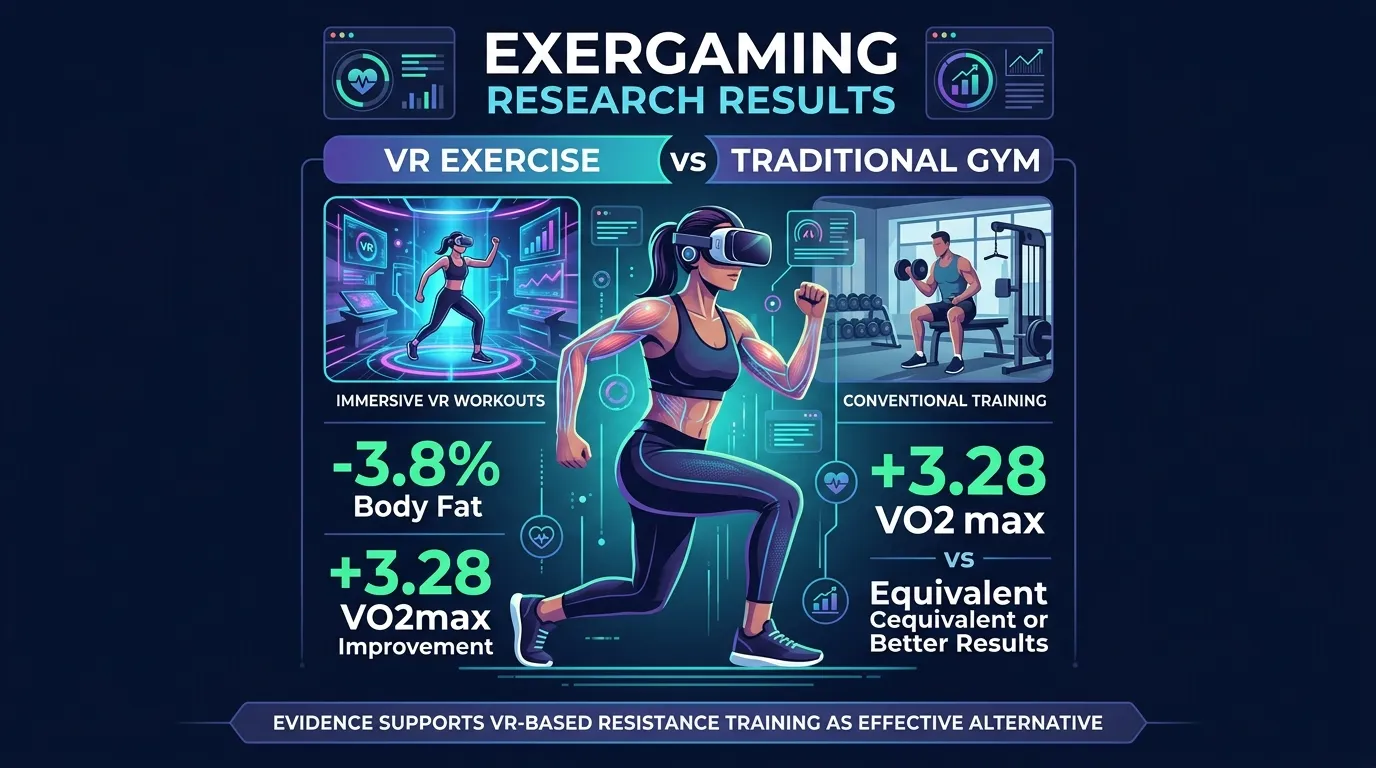
The most compelling exergaming trial to date is a 2022 randomized controlled trial published in PMC (PMC9819410) that compared immersive virtual reality resistance training against conventional self-directed resistance training over 12 weeks.
The study enrolled 32 college-aged adults with minimal training history — precisely the population most fitness interventions struggle to retain. Participants were randomized to either a VR resistance-training exergame or a conventional resistance-training program where they directed their own workouts.
The VR group's results were significantly superior across every major outcome:
- Body fat reduction: -3.8% in the VR group vs -1.9% in the conventional group (P<.001) — nearly double the fat loss
- Cardiorespiratory fitness: VO₂max increased by +3.28 ml/kg/min vs +0.89 ml/kg/min (P<.001) — more than triple the improvement
- Fat-free mass: Greater increases in the VR group, indicating the training stimulus was sufficient to build lean tissue
- Strength and endurance: Superior outcomes across multiple measures in the VR arm
Both groups showed high adherence rates, which rules out the simplest explanation (that VR participants just showed up more). The VR group wasn't exercising more — they were exercising differently, in a way that produced greater physiological adaptations despite equivalent commitment.
Why would a video game produce better results than self-directed training? Two factors stand out. First, the VR exergame structured the resistance training through programmed challenges, effectively removing the decision fatigue that undermines self-directed workouts. Second, the immersive environment likely reduced perceived exertion — participants worked harder without feeling like they were working harder, because their attention was split between the game objectives and the physical effort.
The limitation is obvious: this was a small study (N=32) with a young, healthy population in a controlled research setting. It's strong evidence that VR exergaming can work, not proof that it works for everyone in every context. But the effect sizes are large enough to take seriously.
Wii Fit and Balance: Exergaming for Older Adults
If VR resistance training represents the cutting edge, Wii Fit represents exergaming's most practical application to date — particularly for a population where the stakes are highest.
Falls are the leading cause of injury-related death in adults over 65. Balance training is one of the most effective interventions for fall prevention, but adherence to traditional balance programs is notoriously poor. The exercises feel tedious, the feedback is minimal, and there's no inherent motivation to continue once the novelty wears off.
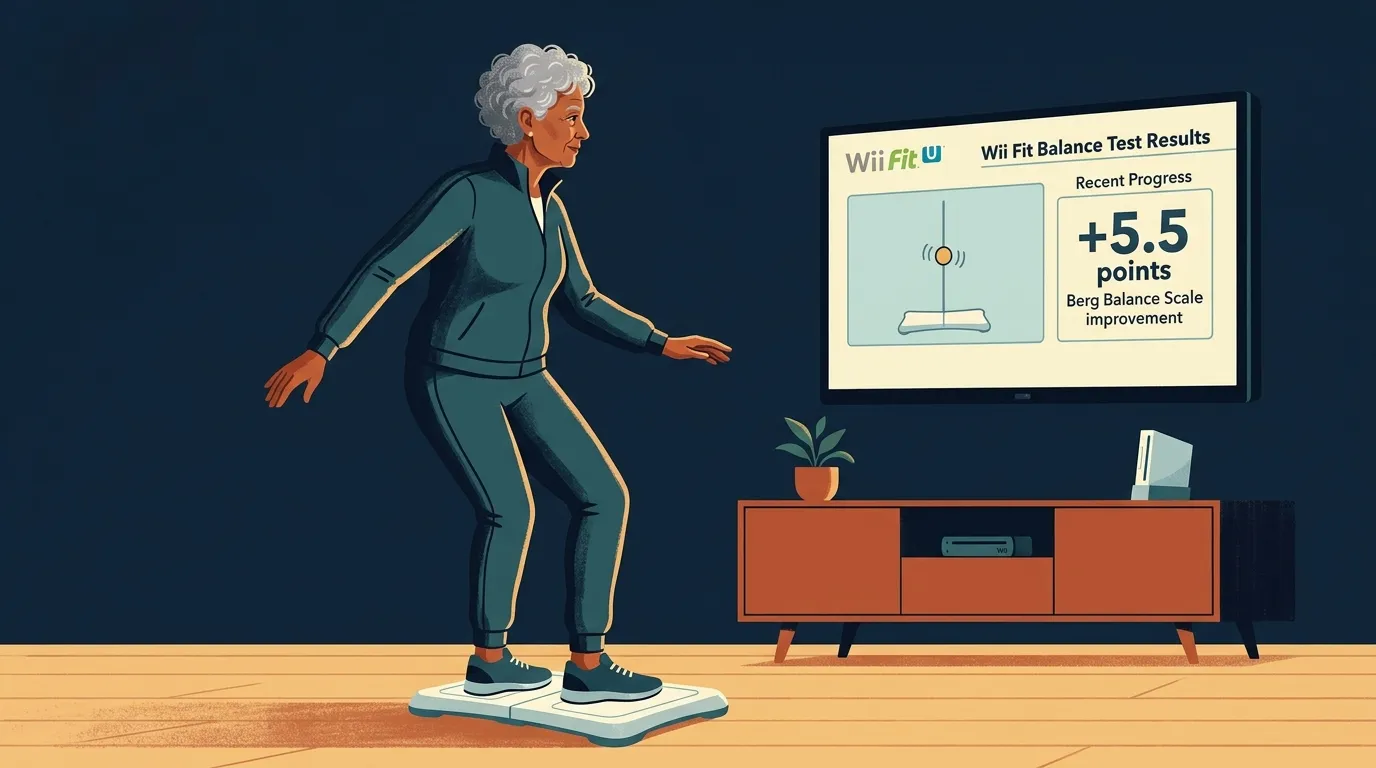
A 2017 RCT (PMC5316445) tested whether Nintendo's Wii Fit could solve the adherence problem. Thirty older veterans participated in an 8-week program of supervised Wii Fit sessions designed as a structured balance and exercise intervention.
The results were clinically meaningful. Participants improved their Berg Balance Scale scores by 5.5 points compared to the control group (P<.001). The Berg Balance Scale is the gold-standard clinical measure of balance function, and a 5.5-point improvement represents a meaningful reduction in fall risk — the kind of change that can be the difference between independent living and a hip fracture.
What made Wii Fit effective wasn't the technology itself — it was the combination of structured exercise with real-time visual feedback and game-like engagement. Participants could see their balance performance reflected on screen, received immediate scoring, and had clear objectives to pursue. The game reframed balance training from a chore into a challenge.
This study supports a broader pattern in the exergaming literature: the technology matters less than the psychological experience. Whether it's a Wii Balance Board or a VR headset, exergaming works when it makes the exercise engaging enough that people actually do it consistently.
Pokémon GO: The World's Largest Fitness Experiment
In July 2016, Niantic released Pokémon GO, and within weeks, tens of millions of people were walking more than they ever had before. It was, unintentionally, the largest exergaming study in history — and researchers scrambled to measure what was happening.
The Wearable Data
A cohort study using wearable device data (PMC5174727) tracked step counts before and after Pokémon GO's launch. The overall finding was modest: an average increase of 192 steps per day across all players. But that headline number obscures the more interesting result.
Highly engaged players — those who played intensively — increased their daily steps by 1,473, a 26% increase over baseline. This was measured over 30 days using objective wearable data, not self-reports. A 26% increase in daily walking is a clinically significant change in physical activity behavior, particularly for previously sedentary individuals.
The Longitudinal Picture
A 2019 longitudinal observational study (PMC6379816) examined Pokémon GO's effects on middle-aged and older adults over a longer timeframe. The findings added important nuance:
- Middle-aged and older players sustained higher step counts for longer periods — up to several months in some cases
- Seasonal patterns affected nonplayers more than active Pokémon GO players, suggesting the game buffered against the winter decline in physical activity that typically occurs
- The game's social and exploratory elements appeared to sustain engagement beyond the initial novelty period for this age group
The Attenuation Problem
A 2020 meta-analysis pooling Pokémon GO studies found a positive step increase overall but with high heterogeneity — meaning the effect varied dramatically across studies and populations. The consistent finding across all research was that effects attenuated over time. The initial step boost faded as players lost interest, encountered repetitive gameplay, or simply moved on.
This is the fundamental limitation of Pokémon GO as a fitness tool: it was designed as a game first and an exercise intervention never. There was no progressive overload, no structured programming, no adaptation to individual fitness levels. The physical activity was a side effect of gameplay, not a designed outcome. When the gameplay lost its pull, the walking stopped.
The lesson isn't that Pokémon GO failed. It's that engagement intensity strongly shapes outcomes — and sustaining engagement requires more than novelty. It requires the kind of deliberate design that keeps people coming back after the initial excitement fades.
Why Exergaming Works: Reduced Perceived Exertion + Enjoyment
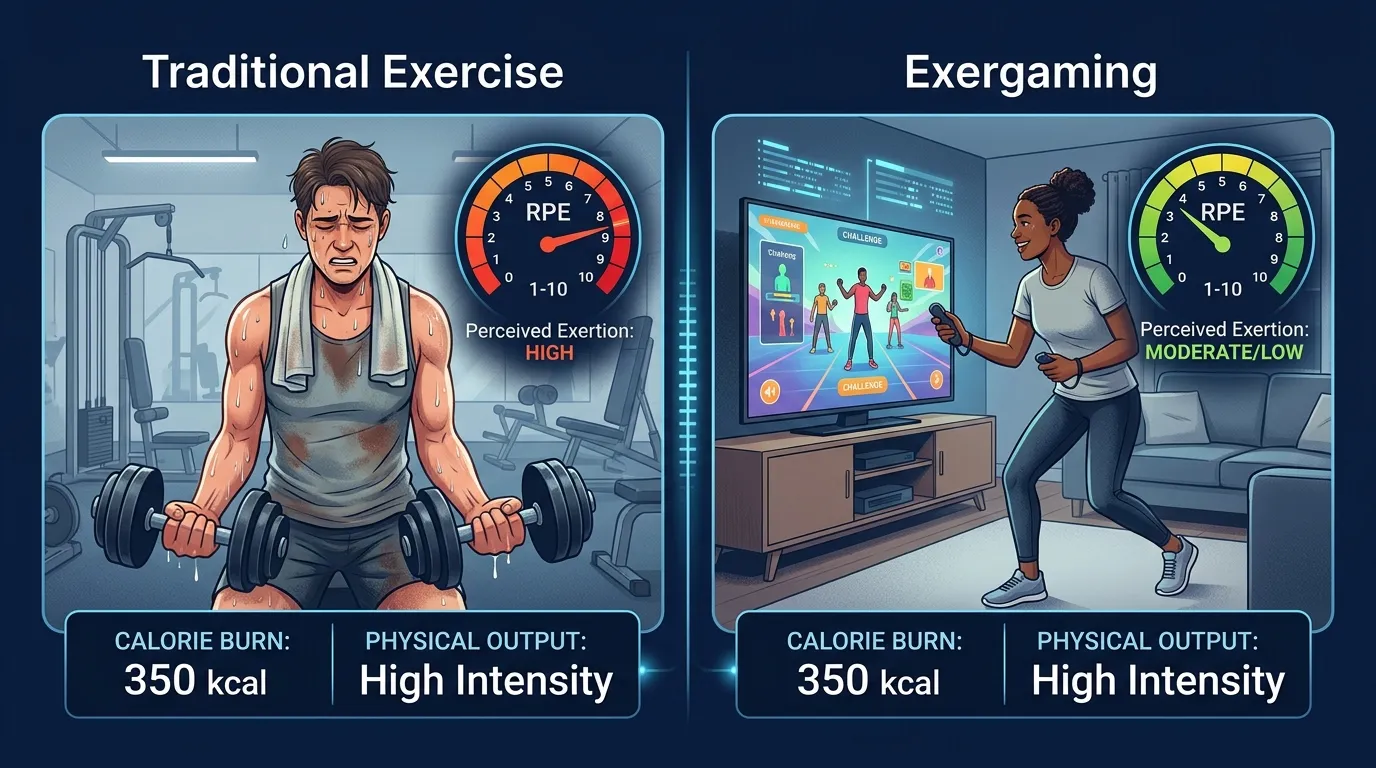
Across VR training, Wii Fit, and Pokémon GO, the same mechanism appears: exergaming shifts attention away from physical discomfort and toward game objectives, reducing how hard the exercise feels without reducing how hard it actually is.
This is not a placebo effect. It's an attentional phenomenon well-documented in exercise psychology. When your cognitive resources are occupied by a game task — tracking virtual objects, maintaining balance to hit a target, navigating to a PokéStop — fewer resources are available to process fatigue signals. The physiological work is identical, but the perceived exertion drops.
The practical consequence is profound. Reduced perceived exertion means people exercise longer, at higher intensities, and with greater willingness to return for the next session. It's the reason the VR group in the resistance training RCT achieved superior outcomes despite similar adherence rates — they were likely working harder within each session because the effort felt more tolerable.
Enjoyment compounds this effect. When exercise is genuinely fun — not "fun" in the forced, motivational-poster sense, but actually engaging — it stops being something you have to endure and becomes something you choose to do. That shift from obligation to choice is the difference between a 3-week habit and a 3-year lifestyle.
Exercise that feels like play — no VR headset required
FitCraft applies the same psychological principles behind exergaming to real workouts you can do anywhere. Take the free assessment to see how.
Take the Free Assessment Free · 2 minutes · No credit cardThe Scalability Problem
If exergaming is so effective, why isn't everyone doing it? Because the strongest evidence comes from settings that are difficult to replicate at scale.
The VR resistance training RCT (PMC9819410) used immersive VR equipment in a supervised research environment. Consumer VR headsets cost $300-$500, require dedicated space, and most VR fitness games lack the structured progressive programming that made the trial effective. The gap between a research-grade VR exergame and a consumer product is significant.
The Wii Fit study (PMC5316445) used supervised sessions — a trained facilitator guided each participant through the exercises. That supervision was likely a key ingredient in the results, but it doesn't scale to millions of users training at home.
Pokémon GO scaled beautifully — hundreds of millions of downloads — but the fitness outcomes were modest for average users and faded over time. Scalability came at the cost of exercise specificity and sustained engagement.
This is the core tension in exergaming research: the more controlled and structured the intervention, the better it works, but the harder it is to scale. The more scalable the platform, the weaker and more transient the fitness effects.
A 2024 systematic review of serious games and exergaming in youth reinforced this pattern. The review found favorable effects on physical activity, but noted that sustaining those effects may require longer interventions with more deliberate design — not just entertaining software, but structured programming that adapts and progresses over time.
Where FitCraft Fits In
FitCraft is not an exergame. You won't put on a VR headset or wave a controller at a screen. But FitCraft was built on the same psychological principles that make exergaming work — and designed to solve the scalability problem that limits exergaming's reach.
Reduced perceived exertion through engagement. Exergaming works because game objectives distract from physical discomfort. FitCraft's quest and narrative framing does the same thing: when you're completing a mission, progressing through a storyline, or earning collectible cards, the workout is the vehicle, not the destination. Your attention shifts from "this is hard" to "I want to see what happens next."
Enjoyment that sustains adherence. The Pokémon GO data showed that engagement intensity determines outcomes — and that engagement without deliberate retention design fades. FitCraft layers variable rewards, streak mechanics, and progression systems specifically to maintain engagement past the novelty window. The game mechanics aren't decoration. They're the retention engine.
Structured programming that actually adapts. The VR resistance training trial succeeded partly because the exergame structured the workouts — participants didn't have to figure out what to do next. FitCraft's AI coach provides the same structured, progressive programming, adapting difficulty to your performance so you stay in the zone between boredom and frustration. Unlike a VR game with fixed levels, FitCraft's programming evolves with you.
No hardware barrier. VR requires a headset. Wii Fit requires a console and balance board. Pokémon GO requires walking outdoors. FitCraft requires a phone. The psychological principles that drive exergaming outcomes — enjoyment, reduced perceived effort, game-framed exercise — don't require specialized equipment. They require thoughtful design.
The exergaming research proves that exercise can feel like play and still produce real results. FitCraft takes that insight and makes it accessible to anyone with a smartphone and 20 minutes. For a look at how the phone-based options stack up against each other, see our ranking of the best gamified fitness apps.
You do not need a headset for most of it, which is the argument on our page about workouts that feel like a game.
Frequently Asked Questions
Does exergaming count as real exercise?
Yes. Clinical trials show exergaming can produce measurable fitness outcomes. A 12-week RCT of VR resistance training (PMC9819410) found participants lost 3.8% body fat and improved VO₂max by 3.28 ml/kg/min — both significantly greater than conventional training. Wii Fit balance training improved Berg Balance Scale scores by 5.5 points in older veterans (PMC5316445). The key factor is intensity: exergames that demand real physical effort produce real physiological adaptations.
Can Pokémon GO actually improve fitness?
Moderately. A wearable-based cohort study (PMC5174727) found highly engaged Pokémon GO players increased daily steps by 1,473 — a 26% increase over baseline. However, the overall average increase was only 192 steps/day, and effects attenuated over time. Longitudinal research (PMC6379816) showed middle-aged and older adults sustained higher step counts for longer. The fitness benefit depends heavily on engagement intensity.
Is VR fitness better than regular workouts?
The early evidence is promising but nuanced. A 12-week RCT (PMC9819410) found VR resistance training produced significantly greater fat loss (-3.8% vs -1.9%) and cardiorespiratory improvements (+3.28 vs +0.89 VO₂max) than conventional training. However, this was a small study (N=32) with college-aged participants in a controlled setting. More research is needed across diverse populations and real-world conditions before making broad claims.
Why does exergaming work when regular exercise feels hard?
Exergaming works largely through reduced perceived exertion. When you are engaged in a game — tracking a quest objective, competing for a score, navigating a virtual environment — your attentional resources shift away from physical discomfort. Research shows that enjoyment and cognitive engagement lower how hard exercise feels, which increases both duration and adherence. You work just as hard physiologically, but the experience feels easier.
How does FitCraft compare to exergaming?
FitCraft is not an exergame — it does not require VR headsets or gaming hardware. Instead, it applies the same psychological principles that make exergaming effective: enjoyment through narrative and quest framing, reduced perceived effort through engagement, and progression systems that make workouts feel like play. You get evidence-backed exercise programming with game mechanics layered on top, accessible from your phone with no special equipment.