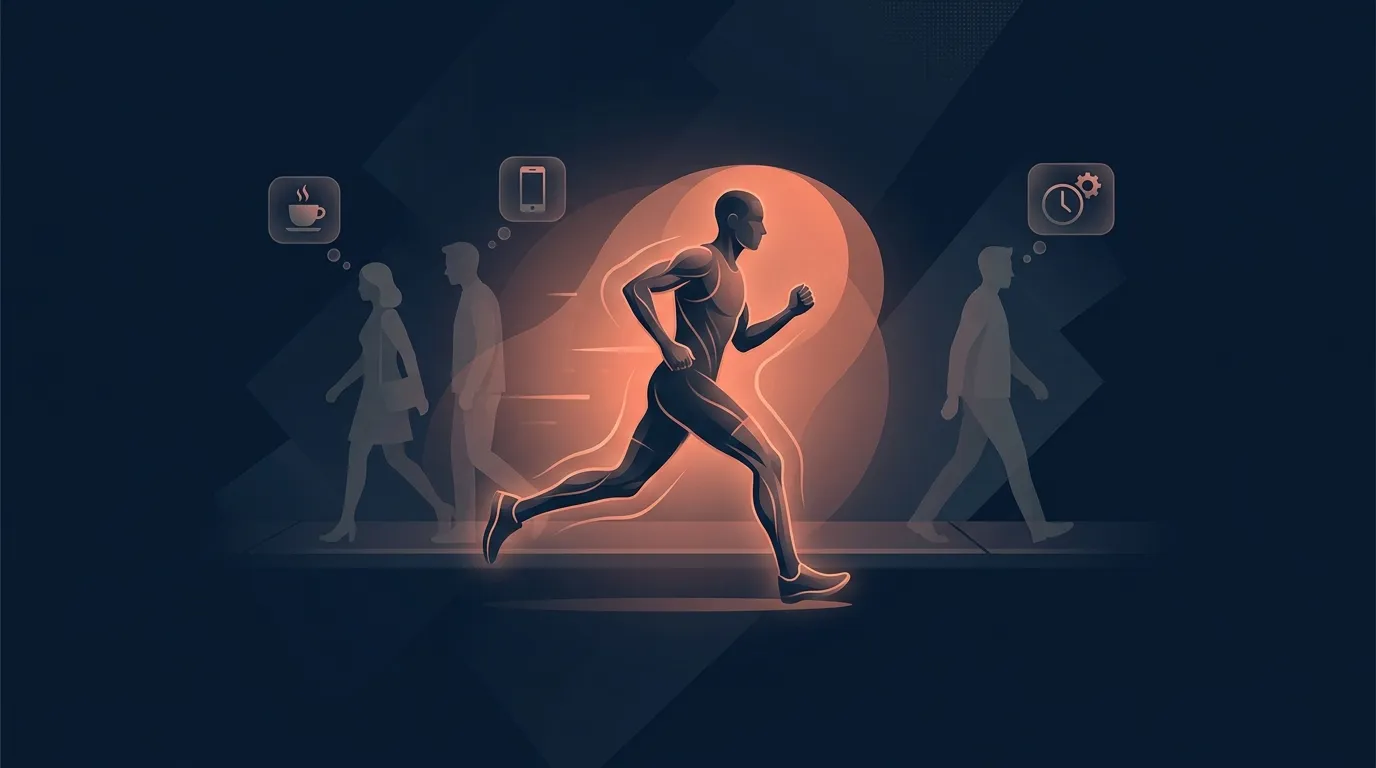
Type "embarrassed to run in public" into Google and the autocomplete fills in the rest of the thought before you can. Embarrassed to run in public, too embarrassed to run in public, how to not be embarrassed to run in public, how to get over embarrassment of running in public. Thousands of people, every month, asking the same question. The community Reddit threads (one from r/running has over 3,400 upvotes and 793 comments) read like group therapy. People in their thirties admitting they can't bring themselves to step outside for a jog because they're convinced someone will laugh.
It's worth saying upfront: this feeling is not stupid. It's based on a real brain mechanism, and it gets stronger the harder you push. But it's also based on a measurable error. People notice you about half as much as you think they do. The discrepancy between felt audience and real audience is the entire problem. Once you understand that gap, the whole thing gets smaller. Not gone. Smaller.
Here's what the social-psychology research actually says about why running outside feels mortifying, the small set of physiological tweaks that reduce it, and a step-by-step way to put yourself outside without white-knuckling through it.
Why Running Outside Feels Like Being Watched (Even When You're Not)
The brain has two related glitches that both fire at once when you go for a public run. Understand them separately and the shame loses some of its grip.
The Spotlight Effect: People Notice You About Half as Much as You Think
The foundational study here is Gilovich, Medvec, and Savitsky (2000), published in the Journal of Personality and Social Psychology. In a now-classic experiment the researchers had college students put on a T-shirt featuring Barry Manilow (pretested as the most uncool celebrity image they could find) and then enter a room of other students. The wearers were asked to estimate what percentage of the others would later remember whose face was on the shirt. The actual observers were also surveyed.
The wearers predicted, on average, that about 50% of the observers would remember the shirt. The actual percentage who remembered was 23%. Less than half of what the wearers expected. The study replicated this gap across multiple conditions: positive shirts, negative shirts, group discussion mistakes, you name it. People consistently believe they're more noticed than they are, by roughly a factor of two.
The researchers called this the spotlight effect, and they attributed it to egocentric bias. You're the protagonist of your own life. Of course your own actions feel salient and central. So when you go to imagine how others perceive a moment, you anchor on how it feels from inside your own head and adjust insufficiently outward. Your red face and labored breathing feel like the most prominent feature of the universe. To the person driving past, you're a generic runner-shape that registers for half a second.
The Illusion of Transparency: People Read Your Internal State Less Than You Think
A follow-up by Savitsky, Epley, and Gilovich (2001), also in JPSP, surfaced the second bias. The "illusion of transparency" describes how people overestimate the degree to which their internal states (nerves, embarrassment, discomfort) are visible from the outside. In their studies, participants who were anxious about a performance assumed observers could see their anxiety. The observers could not, or could only barely. The internal storm felt to the actor like a billboard. To the audience it was a faint background hum.
For running, this is what makes the experience feel so exposed. You think your wheezing is loud. You think your sweat looks weird. You think your form is obviously wrong and visible from blocks away. None of it is, really. The data shows that even when something genuinely noticeable happens, observers register and forget within seconds. And for the parts you're most worried about (internal effort, fear of looking foolish), the audience can't see them at all.
Why Effort Cranks Up the Self-Consciousness
There's a third piece, more physiological than cognitive. When you push your body to a sustained effort it hasn't done before, your sympathetic nervous system fires. Heart rate climbs. Adrenaline spikes. Cortisol rises. Your nervous system, evolutionarily speaking, treats this state as "high alert." It scans for threats. The presence of strangers (potential evaluators) gets categorized as a possible threat. The brain interprets your own elevated arousal as evidence that something is wrong, and the closest available explanation is the social context. So the harder you push, the more your nervous system tells you that the people watching are dangerous.
The implication is practical. If you run at an effort that doesn't trigger near-panic breathing, the social fear is dramatically lower. This is one of the strongest arguments for walk-run intervals as a beginner protocol, which we cover in detail in our piece on how to start running when you're out of shape.
Why This Particularly Affects New Runners (And Heavier Runners)
The Reddit threads and search queries cluster around two demographics: people who are out of shape and people who carry extra weight. Both groups have a logical reason to expect more scrutiny, and both groups are wrong about how much they're actually getting.
"I Look Like a Beginner"
You probably do. Beginners look like beginners. Slow pace, awkward stride, frequent walking breaks, red face. The question isn't whether you look like one. It's whether anyone besides you cares. And the survey evidence here is consistent. Most non-runners can't tell the difference between a casual beginner and a recreational runner. Most experienced runners are sympathetic, because they remember being beginners. The narrow population that does judge (a small subset of fast runners with a chip on their shoulder, mostly online) is much smaller than the imagined audience.
The flip side of looking like a beginner is the relief that comes with putting in time. Around weeks four to eight of consistent running, the awkwardness of stride softens. You stop sounding like you're dying. You start to look like a person running, not a person attempting to run. None of that means others' opinions changed. It means your own.
If you want those weeks to have a shape rather than just happening, our beginner 5K training plan gives you eight weeks of run-walk sessions and a race to point them at.
"I'm Overweight and Running"
The fear here is sharper, and the cultural baggage is real. Many heavier first-time runners describe the experience as feeling stared at, judged, or even mocked. The Reddit threads from r/running and r/loseit are full of stories about car horns, comments, and side-eye. We're not going to pretend those experiences never happen.
But two things are true at once. First, those experiences are rare relative to the volume of runs people take. Most run-streaks of three months or more involve dozens of outings and zero incidents. The few that do happen are memorable in the way that any threat is memorable, which makes the brain overweight them. Second, the people who do say something are saying more about themselves than about you. None of which makes a rude comment less painful in the moment, but it shifts the meaning afterward. The right takeaway from a single rude car horn isn't "I shouldn't run." It's "that person had a rough day and used me as the target."
If you're starting from a higher body weight, the practical playbook in the next section is even more relevant. Low-traffic times, headphones, a route you control. Stack the deck.
Knowing what to do is the easy part.
FitCraft, our mobile fitness app, pairs you with an AI coach who builds you a personalized plan around your goals, schedule, and fitness level. Every FitCraft program is designed by Domenic Angelino, MPH (Brown University) and NSCA-CSCS, with research published in the Journal of Strength and Conditioning Research and Medicine & Science in Sports & Exercise.
Take the Free Assessment Free • 2 minutes • No credit cardThe Practical Playbook for Running in Public Anyway
The research above is useful for understanding. It is not, on its own, a fix. The fear is built into your nervous system and won't argue with statistics. What works is structured exposure: small, repeated runs that let your brain accumulate evidence that the threat doesn't materialize. Here's how to engineer that.
1. Pick a Low-Traffic Time and Route
For the first few weeks, run when fewer people are out. Early morning before 7 a.m. The hour after sunset (still light enough to be safe). Mid-afternoon on weekdays. Avoid the weekend-morning park rush and the after-work commuter window. Lower foot traffic means fewer observers, which makes your nervous system's first guess about your audience size more accurate.
Pick a route you control and can return from. A neighborhood loop, a quieter side street, a park trail. Avoid main commercial drags and high-school proximity. You want your first runs to feel boring, not exposed.
2. Use Walk-Run Intervals to Stay Out of the Panic Zone
The biggest single change you can make is to lower the physiological intensity. Run for one or two minutes. Walk for two or three minutes. Repeat for twenty to thirty minutes. This is the structure of nearly every couch-to-5K plan, and it works specifically because it keeps you below the heart-rate threshold where your nervous system flips into threat mode.
Beginners often skip this protocol because it feels like cheating, but the research on aerobic adaptation says otherwise. The slow build is the build. As the weeks pass, the run intervals grow, the walk intervals shrink, and one day around month two you realize you ran the whole thing without stopping. The walk breaks aren't a sign of weakness. They're the mechanism.
3. Headphones and a Distraction
Music or a podcast at moderate volume serves three purposes. It occupies the worry channel of your brain so you spend fewer mental cycles imagining what onlookers think. It signals to passersby that you're in your own world. And it makes the run more pleasant, which means you're more likely to repeat it. Use bone-conduction or open-ear headphones if traffic is a concern, so you can still hear cars.
4. Wear Something Unremarkable
Dress to disappear, not to perform. Pure black or muted earth-tone leggings or shorts and a plain T-shirt is ideal. Avoid neon, avoid logos, avoid "running brand" tribal markers that signal you're trying to look the part. Your goal is to be the most boring possible figure on the street. Loose-fit tops work fine; you do not need tight running gear. None of the people you're afraid of will care or notice what you're wearing. You are dressing for your own peace of mind, not for an audience.
5. Repeat the Same Loop
Familiarity reduces threat. The first time you run a route, your brain is scanning for unknowns: who's around, where could I stop, is this awkward. The third time, most of those questions have answers. The tenth time, the route is just background. Pick one loop and do it for a few weeks before considering variation. Predictability is your friend at this stage.
6. Don't Hide. Accumulate Evidence.
The instinct when shame fires is to retreat. Stop running outside. Switch to a treadmill (which works as a stopgap but doesn't extinguish the public-running fear). Wait for some imagined future state where you'll feel "ready." That state never arrives, because the fear is maintained by avoidance. Each public run that ends without disaster is a brick laid in the wall of "this is fine, actually." It takes between six and twelve sessions for most people to feel the shift. Less than two months, in other words.
What This Means For Your First 90 Days
If you're staring down the prospect of running outside for the first time, here's what to expect. The first few runs will feel awful, in a way that is mostly mental. You'll be hyperaware of every passing car. You'll be sure people are staring. You'll want to quit halfway and go home. None of this means you're doing it wrong. It means you're doing the new thing.
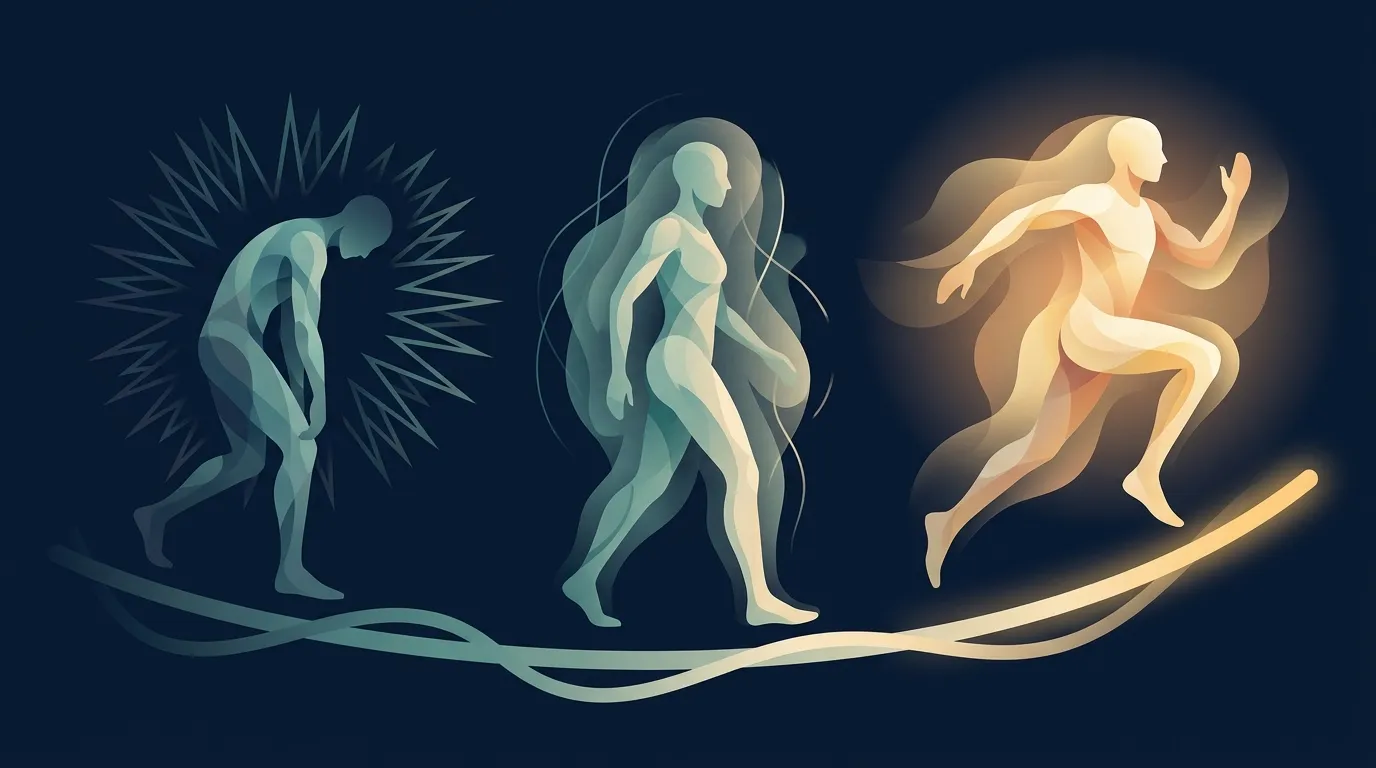
By the second or third week, the physical part of running will be slightly easier. You'll still feel watched, but the gap between expected and actual scrutiny will start to narrow because your brain has now seen 6+ runs end without incident. Around week four to six, most beginners describe a tipping point where the run becomes the part of the day they look forward to, not dread. The runner's high (mediated by endogenous opioids, per Boecker et al., 2008, in Cerebral Cortex) starts to show up. The shame doesn't fully go away, but it's no longer the dominant signal.
Past month two, most people stop thinking about being watched. They start thinking about pace, route, distance, breath, the weather, their playlist. That mental real estate the fear used to occupy gets used for something else. Running becomes a thing you do, not a thing you survive.
Exercise also pays you back. Schuch and colleagues (2019), in Depression and Anxiety, pooled prospective cohort studies and found that people meeting recommended physical activity thresholds had roughly 26% lower risk of developing an anxiety disorder over follow-up. Stonerock and colleagues (2015), in Annals of Behavioral Medicine, reviewed exercise as a treatment for diagnosed anxiety and found medium-to-large effect sizes comparable to standard therapies. The anxiety that keeps you from running is the same anxiety running is one of the most reliably evidence-backed treatments for. The bridge from "afraid to run" to "running treats my anxiety" is just the first month of consistent outings. We've covered this in more depth in our piece on exercise and depression research and our guide to gym anxiety, which covers a closely-related form of public fitness fear.
The Honest Counter-Argument
This whole article rests on a research-backed premise: people notice you less than you think. There's a fair counter, and it deserves addressing. Sometimes people are mean. Sometimes a car honks. Sometimes a kid yells something. The spotlight effect describes average attention, not the absence of bad actors.
Two responses. First, the frequency of these events is low relative to the number of times nothing happens. If you go on 30 runs over three months, the average number of rude incidents is somewhere between zero and one. The fear, before you start, makes it feel like one is guaranteed per outing. Once you've actually done the 30, you have your own data and the fear loses standing. Second, when an incident does happen, it's almost always a brief, anonymous, and untargeted event from someone whose life you'll never intersect with again. It feels personal. It rarely is.
None of which obligates you to like the experience when it happens. Just to keep going afterward. The runners who quit after one negative interaction are the ones who let it define their identity ("I tried, it confirmed I shouldn't run"). The runners who keep going treat it as one data point in a much larger picture ("that sucked, but the other 29 runs were fine").
What This Means For You
If you've been thinking about running and the public exposure has been the thing stopping you, here's the path forward. Pick a low-traffic time. Pick a quiet loop. Wear something boring. Use walk-run intervals so you're not gasping. Run that same loop two to three times a week. Expect the first three to four weeks to feel awkward and mostly mental. Expect a tipping point somewhere between week four and week eight where the fear stops showing up.
Do not wait for the fear to disappear before you start. The fear disappears in response to the running, not before it. The spotlight effect won't let you reason your way out of feeling watched. But it will let you walk out of it, slowly, by running often enough that your nervous system updates its model of the world.
You don't have to feel ready. You just have to step outside.
Frequently Asked Questions
Why am I embarrassed to run in public?
The shame of running in public is mostly a cognitive bias called the spotlight effect. Gilovich, Medvec, and Savitsky (Journal of Personality and Social Psychology, 2000) found that people consistently overestimate how much others notice their appearance, behavior, and mistakes by roughly a factor of two. When you're running and gasping for air, you feel like every passing car is watching. Onlookers are mostly thinking about their own lives. Combine that with self-consciousness about being a beginner and being out of breath, and your nervous system stamps the run as a public ordeal even though almost nobody noticed you.
How do I get over the embarrassment of running outside?
Three evidence-aligned tactics help. First, start at low-traffic times like early morning or just after sunset, which lowers the perceived audience and lets your brain accumulate proof that nothing bad happens. Second, use a run-walk protocol so you're not gasping the whole time. Lower physiological distress lowers self-focused attention, which is the actual driver of perceived judgment (Savitsky, Epley, and Gilovich, 2001). Third, do the same loop repeatedly. Familiarity with the route removes one variable, and over a few weeks your nervous system reclassifies the activity from threatening to ordinary.
Does running help social anxiety?
Yes, both for general anxiety and for the public-running form of social anxiety. Schuch and colleagues (2019, Depression and Anxiety) pooled prospective cohort studies covering tens of thousands of adults and found that people meeting the recommended physical activity threshold had roughly 26% lower risk of developing an anxiety disorder over follow-up. Stonerock and colleagues (2015, Annals of Behavioral Medicine) reviewed exercise as a treatment for diagnosed anxiety and found medium-to-large effects similar to first-line therapies. Running outside specifically also works through exposure: the fearful prediction (people will laugh) gets disconfirmed by experience over and over until the prediction loses its power.
Do people actually stare at runners?
Almost never. The spotlight effect research finds that even when something genuinely noticeable happens (you wear an embarrassing T-shirt, you make a mistake in conversation), about half the people you expect to notice will not. For a normal-paced runner on a normal street, observers register a generic person moving and then go back to their own thoughts within about a second. The exceptions are dog walkers (they look at everyone for safety reasons) and other runners (they nod). Neither group is judging.
What should I wear running in public if I'm self-conscious?
Wear something comfortable in neutral colors that doesn't draw your own attention. Pure black or muted earth tones reduce the part of self-consciousness that comes from feeling visually loud. Headphones serve double duty: they give you music or a podcast that occupies the worry channel of your mind, and they signal to passersby that you're in your own world and not seeking interaction. Avoid brand-new gear with tags visible. Your goal is to be unremarkable, not to look the part of a runner. The part comes later, automatically.