- Spot reduction: doing crunches doesn't burn belly fat. Vispute et al. (2011) showed 6 weeks of abdominal training did nothing to abdominal fat. Fat loss is systemic.
- Lifting heavy makes women bulky: the hormonal math doesn't allow it. Women have a fraction of the testosterone needed to add the kind of mass the myth describes.
- Cardio kills gains: mostly false. Schumann et al. (2022) found no meaningful interference for hypertrophy when training is programmed reasonably. Running blunts strength gains slightly more than cycling.
- No pain, no gain: hard effort yes, joint pain no. The two get conflated and that's where injuries come from.
- Soreness equals growth: false. Damas et al. (2018) found muscle damage is a weak driver of hypertrophy. Tension and progressive overload are the real signals.
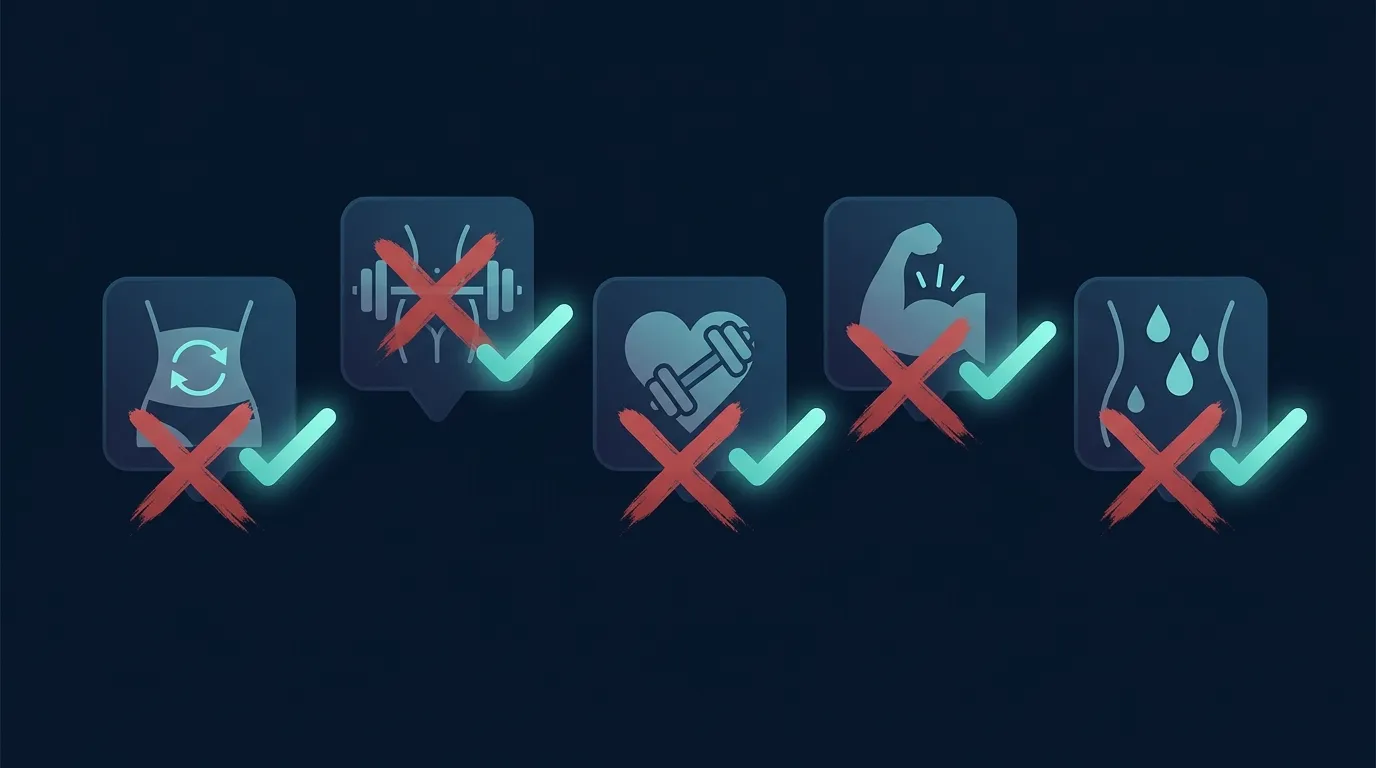
A few weeks ago someone posted a question to r/bodyweightfitness that pulled in nearly 3,000 upvotes and 1,445 comments. The question was simple. What's a fitness myth that still won't die no matter how often it's debunked? The thread became a master class in how slow folk wisdom is to update. The same five myths kept getting upvoted, again and again, by people who'd watched their friends, their parents, their gym buddies, and themselves repeat them for decades.
What follows is the research-backed walk through those five. Where the studies are clear, we'll say so. Where they're nuanced, we'll say that too. The goal isn't to make you the most annoying person in your friend group at the next dinner party. It's to free up training time you've been spending on things that don't work, so you can spend it on things that do.
One quick aside before the list. These myths survive because each has a kernel of truth. That's why correcting them feels uphill. The kernel makes them sound right at first pass, and the sticky part of the meme is the simple version, not the nuance. We'll flag the kernel in each case so you can keep what's useful and drop what isn't.
Myth 1: You Can Burn Belly Fat by Doing Ab Exercises
This is the granddaddy of fitness myths. Sit-ups for the belly, tricep kickbacks for arm flab, inner thigh exercises for the inner thighs. The intuition makes sense. If exercising a muscle gets it tired and pumped with blood, surely the fat next to it gets used as fuel?
The research says no, almost across the board. Vispute and colleagues (2011) ran one of the cleanest tests of this hypothesis: 24 healthy adults, 6 weeks, randomized to either an abdominal exercise program or a no-exercise control. The training group did 7 different abdominal exercises, 2 sets of 10 reps each, 5 days per week. After 6 weeks, abdominal fat (measured by skinfold callipers and DEXA) had not changed in either group. The exercise group also didn't lose any total body weight. The exercises did exactly nothing to the fat sitting next to the muscles being trained.
Kostek and colleagues (2007) ran an even more elegant test in 104 subjects. Each person trained ONE arm with resistance training for 12 weeks while the other arm did nothing. If spot reduction were real, the trained arm should have lost more subcutaneous fat than the untrained arm. The actual result: fat loss was distributed across the body, with no preferential reduction in the trained limb.
Why doesn't it work? Fat metabolism doesn't follow proximity. When your body burns stored fat for fuel, it pulls from adipose tissue based on hormonal signals (mostly catecholamines acting on adrenergic receptors), not based on which muscle is asking for energy. The fat near a working muscle isn't somehow easier to access than fat sitting on the other side of the body.
The kernel of truth. A few recent studies (Scotto di Palumbo 2017, a few others) have shown small, localized fat reductions in carefully designed protocols, especially with high-volume aerobic work targeted at specific regions. The effects are real but small, and they don't override total energy balance. If you're in a caloric surplus, you can do crunches all day and your belly won't shrink. The single biggest lever is total energy balance, full stop.
What to do instead. Train for total-body composition. Resistance training for the muscle, caloric balance for the fat. The fat will leave from wherever your body genetics send it from first, and you don't get a vote. We covered this in detail in our piece on body recomposition with home workouts.
Myth 2: Lifting Heavy Makes Women Bulky
The persistence of this one is partly cultural and partly hormonal misunderstanding. The cultural part: bodybuilding magazines from the 1980s and 90s used the same imagery for "muscular woman" and "elite competitive bodybuilder", flattening a continuum into a single scary image. The hormonal part: most people don't know how much testosterone matters for the rate of muscle gain.
Women have roughly 10 to 30 times less circulating testosterone than men. Testosterone is a primary driver of muscle protein synthesis. Less testosterone means a much slower hypertrophy ceiling, and the bulky physiques in the gym posters are usually decade-plus dedicated training programs with very high volume, very specific nutrition, and (in many high-profile cases) pharmaceutical assistance. None of that describes a woman doing 3 dumbbell sessions a week.
The research backs the hormonal logic. Vikmoen et al. (2016) trained female athletes with heavy strength training for 11 weeks and measured strength, lean mass, and performance. Strength gains were substantial. Lean mass increased modestly. Body mass barely budged. The athletes got stronger, more powerful, leaner-looking. They did not get visibly bulky. This pattern has been replicated in dozens of trials. Heavy resistance training produces strong, dense, athletic-looking bodies in women, not the silhouette in the myth.
The kernel of truth. Some women do gain visible muscle relatively quickly, especially in the legs and glutes where female hormones favor mass. If a woman is sensitive to that and prefers a smaller-leg look, lower-volume resistance training and more cardio is a reasonable preference. But the choice is between "athletic and toned-looking" and "more athletic and slightly more muscular-looking." It's not between "feminine" and "looks like a competitive bodybuilder." That second option requires resources almost no recreational lifter has.
What to do instead. If you want to look strong, train heavy. If you want to look athletic, also train heavy. The strength training and the cardio you'd do for general fitness will produce a leaner, more muscular silhouette than years of light reps with pink dumbbells. Our piece on light vs heavy loads for muscle goes deep on the load-effort principle.
Myth 3: Cardio Kills Your Gains
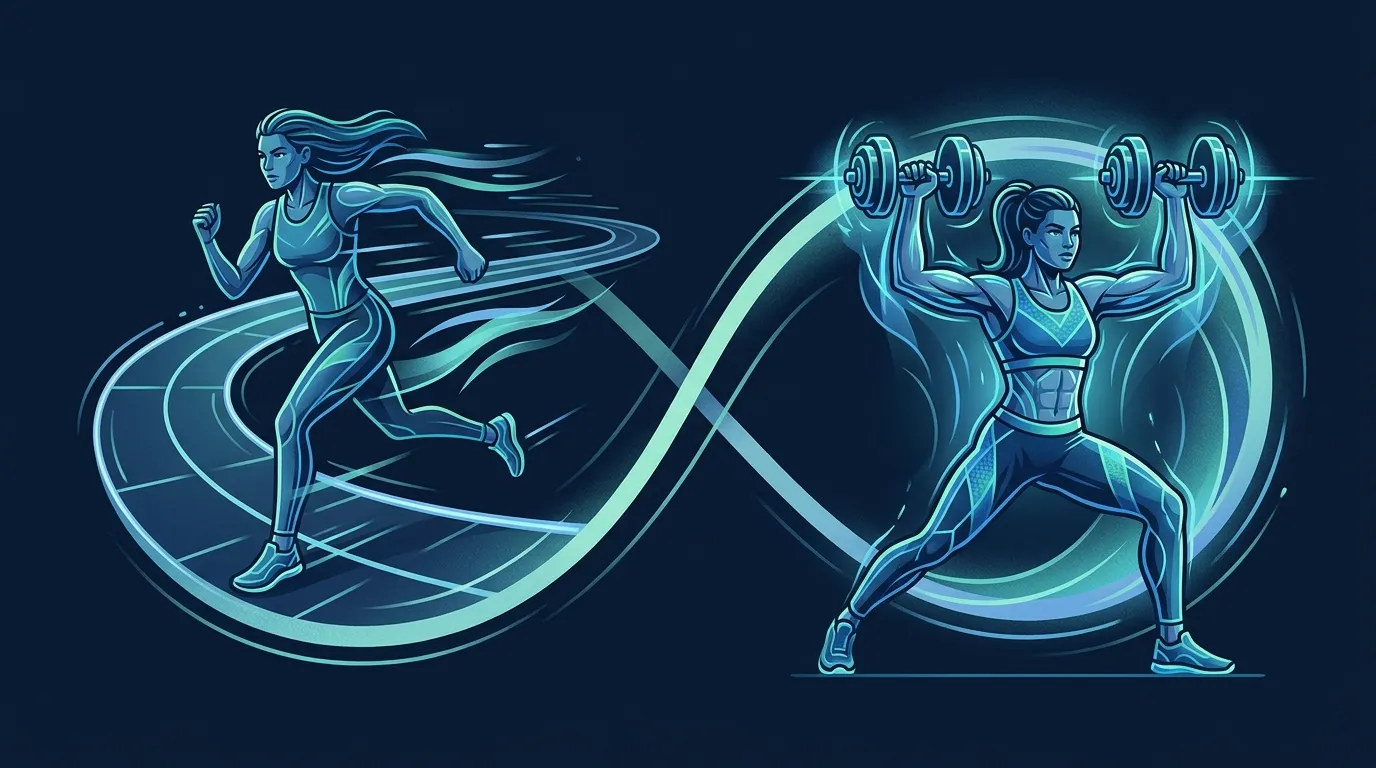
This one comes from the bodybuilding subculture and got viral around 2015. The thinking: cardio activates the AMPK pathway, which inhibits the mTOR pathway, which is the muscle-building pathway. Therefore cardio cancels out lifting. Therefore your treadmill habit is sabotaging your physique.
The actual research is more measured. Wilson and colleagues (2012) ran a meta-analysis of 21 studies on concurrent training (the technical term for doing both cardio and resistance) and reported that adding cardio to resistance training reduced hypertrophy effect sizes from 1.23 to 0.85 and strength from 1.76 to 1.44. Real reductions, but the concurrent groups still grew muscle and got stronger. The interference was much larger when running was the cardio (versus cycling) and when training frequency and duration were both very high.
Schumann et al. (2022) updated that picture with a newer meta-analysis published in Sports Medicine. Their conclusion was even friendlier to combined training: when programmed reasonably (with adequate rest between sessions and modest cardio volume), there was no meaningful interference for hypertrophy. Strength interference was small and mostly limited to running. Cycling and rowing barely interfered.
For most adults the practical translation is: 2 to 3 cardio sessions per week alongside 2 to 4 resistance sessions per week is fine. The cardiovascular benefits are large. The longevity data favors combined training over either modality alone. Skipping cardio because it might cost you a percent of muscle gain is trading a real benefit for a tiny one.
The kernel of truth. If you're a competitive bodybuilder peaking for a show or a powerlifter peaking for a meet, cutting cardio for the final weeks is a reasonable specialization choice. Outside of those narrow contexts, the interference effect doesn't justify avoiding cardio.
What to do instead. Train both. Separate cardio and resistance sessions by 6 hours when possible (or do them on different days). If you have to combine, lift first, then cardio. Keep cardio modes that don't share much with your lower-body lifts (cycling, rowing, swimming) if you're prioritizing leg strength. We covered the same theme from the other side in our piece on cardio and muscle gains research.
Myth 4: No Pain, No Gain
This one has the most cultural staying power because it sounds like discipline. Push through the pain. Hard work pays off. The 80s aerobics tape lineage. And there's a kernel of truth, which we'll get to.
The problem is that the myth treats two very different sensations as the same thing. The first is the muscular burn of a hard set. That's productive. It signals high motor unit recruitment, accumulating metabolite buildup, and the proximity to muscular failure that drives hypertrophy. Pushing through that kind of pain is part of why training works.
The second sensation is joint pain, sharp pain during a specific movement, or pain that lingers between sessions. That isn't a growth signal. It's an injury signal. A sharp pain in your knee during a squat isn't a sign of progress. It's your meniscus or tendon telling you something is wrong with the load, the form, or your readiness to do the movement.
The research on overuse injuries in beginners is consistent. The biggest predictor of training-related injury is rapid increases in volume or intensity, especially when paired with confusion between productive and unproductive pain. Beginners who push through joint pain because they think that's what dedication looks like end up sidelined for weeks at a time. The dedicated lifter who scales back when something hurts and comes back next session keeps training.
The kernel of truth. Productive resistance training is uncomfortable. The last 1 to 3 reps of a set, the burning sensation in working muscle, the cardiovascular load of intervals. Those are all forms of "pain" the saying captures correctly. So do push through that. The error is generalizing to all painful sensations.
What to do instead. Learn the difference. Muscular burn = good. Increased breathing rate and heart pounding = good. Joint pain = stop and check the form. Sharp pain during a movement = stop and check the form. Pain that gets worse with more reps = stop. Pain that lingers more than 2 to 3 days, that you can't trace to soreness, gets a deload week. The mature lifter has internalized this and doesn't confuse the two.
Myth 5: If You're Not Sore, You Didn't Work Hard Enough
The DOMS-as-progress myth is closely related to "no pain no gain" but worth its own section because the scoring rule is different. The claim isn't that pain helps; it's that delayed onset muscle soreness 24 to 48 hours after a workout is the proof that the workout was effective.
The research has been pulling against this for over a decade. Damas et al. (2018) wrote a comprehensive review in the European Journal of Applied Physiology on the role of muscle damage in hypertrophy. Their conclusion: muscle damage is a relatively weak contributor to hypertrophy compared to mechanical tension and metabolic stress. The studies they reviewed showed that hypertrophy proceeds at a similar rate whether the training program produces lots of soreness or none.
A particularly clear example. Beginners often experience massive soreness from any new program. Trained lifters running the exact same program might not be sore at all. Both groups grow. Both groups make strength progress. The soreness difference is about novelty, not effectiveness. After a few weeks of consistent training, the same sessions stop producing soreness even though they continue producing growth.
The other angle: long-duration aerobic work like marathon running or long bike rides can produce extensive muscle soreness via eccentric muscle damage. None of those activities are notably hypertrophic. Soreness is a damage signal, not a growth signal, and the relationship between damage and growth is weak.
The kernel of truth. A complete absence of any sensation after a workout might suggest the load was too low, especially in untrained individuals. But "some sensation" doesn't have to mean DOMS that lasts 3 days. It can be the immediate post-set burn, the acute fatigue, or just the awareness that you worked hard.
What to do instead. Track the variables that actually predict progress: weight on the bar, reps completed, time under tension, RPE, body composition over weeks. If those numbers are moving up, the training is working regardless of how sore you feel. We covered the related pattern of progress without effort wasted in our piece on why you might not be seeing workout results.
Knowing what to do is the easy part.
Take the free FitCraft assessment and get a personalized plan based on behavioral science, not willpower.
Take the Free Assessment Free • 2 minutes • No credit cardBonus Round: Three More That Almost Made the List
The Reddit thread surfaced more than five myths. Honorable mentions for the next time you're at a barbecue and someone says one of these out loud:
"You can tone specific muscles."
"Toning" isn't a real physiological process. What people mean by "toned" is two things happening together: visible muscle (built by resistance training) and low body fat over the muscle (built by caloric balance). You can't selectively "tone" a muscle without doing both. The word survives because magazine cover copy is more inviting than "lift weights and lose fat."
"Sweating means you're burning fat."
Sweating is your thermoregulatory response to elevated body temperature. It correlates with fat burning during exercise mostly because higher-effort exercise produces more heat AND burns more calories, but the sweat itself is just water and electrolytes leaving your body. You can lose 3 pounds of water in a sauna and gain it all back at the next meal. The fat doesn't move with the sweat.
"Eating fat makes you fat."
Eating fat in a caloric surplus contributes to weight gain because dietary fat is energy-dense (9 calories per gram). Eating fat in a caloric deficit contributes to weight loss. The macronutrient label on the food doesn't determine the outcome; the total energy intake does. Modern nutrition research has been moving away from this myth for over a decade, but the language ("fat-free," "low-fat") has cultural inertia.
Why These Myths Won't Die
The frustrating part of writing this article is knowing that for every reader who updates their mental model, two more will hear the myth from someone else next week and absorb it with no friction. The reasons these myths survive aren't really about evidence. They're about how human memory and social learning work.
Each myth is short and easy to repeat. The corrections are longer, full of nuance, and rely on words like "meta-analysis" and "concurrent training." In any contest between a sticky one-liner and a paragraph of qualified truth, the one-liner wins on speed and reach. So spot reduction stays alive because "you'll lose your gut by doing crunches" beats "fat metabolism is systemic and driven by total energy balance and adipocyte hormone receptor density."
The other factor: each myth reinforces something people want to believe. Spot reduction promises that a hard problem (overall fat loss) has an easy local solution. The bulky myth gives women permission to skip strength work that intimidates them. Cardio kills gains gives lifters an excuse to avoid the cardio they don't enjoy. Soreness equals growth gives anyone a quick proxy for "I worked hard," which feels good. Myths that flatter beat truths that ask for more.
So the practical advice for you, reader, is to be skeptical of any rule that's a) very short, b) very specific, and c) makes a hard thing sound easy. Real training principles are short, but they're conditional. Effort matters more than load, but only when programmed well. Cardio doesn't kill gains, but it can if the volume is too high. Eat less than you burn, but the amount and the macro mix and the food quality and the protein floor and the sleep all matter. The world is more conditional than the bumper sticker, and the conditions are where the actual progress lives.
Frequently Asked Questions
Is spot reduction real or a myth?
Mostly a myth, with some recent nuance. The classic studies found that training one body part doesn't preferentially burn fat from that area. Vispute et al. (2011) ran a 6-week abdominal training program in 24 healthy adults and found zero change in abdominal fat versus the no-exercise control. Kostek et al. (2007) trained one arm only for 12 weeks and found that fat loss occurred across the body, not selectively in the trained arm. A handful of newer trials suggest small, localized effects in specific protocols, but the overall pattern across decades of research is clear: fat loss is systemic, driven by total energy balance, not by which muscles you exercise.
Does lifting heavy make women bulky?
No. Women have roughly 10 to 30 times less circulating testosterone than men, which caps the rate of muscle hypertrophy at a fraction of what visibly bulky male physiques require. Vikmoen et al. (2016) and the broader resistance training literature consistently show that women gain meaningful strength with very modest changes in body mass. The athletes who appear bulky are usually doing decade-plus dedicated programs with very high training volume and very specific nutrition, sometimes with pharmaceutical assistance. A few sessions a week of moderate-load training produces leaner-looking, stronger bodies, not the silhouette in the myth.
Does cardio actually kill your muscle gains?
Mostly no. The interference effect is real but small for most people. Wilson et al. (2012) ran the largest meta-analysis on the question and found that concurrent training reduced strength gains slightly versus pure strength training, but the effect was smaller than gym wisdom suggests. Schumann et al. (2022) updated that picture in Sports Medicine and found no meaningful interference for hypertrophy when training was programmed sensibly. Running added to lifting was the worst combination; cycling or rowing barely interfered. For most adults running 2 to 3 cardio sessions per week alongside their resistance training, the interference is negligible compared to the cardiovascular and longevity benefits.
Does soreness mean you had a good workout?
No. Soreness (DOMS) is a poor proxy for hypertrophy or strength gains. Damas et al. (2018) reviewed the muscle damage and hypertrophy literature and found that muscle damage is a weak contributor to growth compared to mechanical tension and progressive overload. Trained lifters often grow consistently with little to no soreness; untrained beginners get sore from any new stimulus regardless of whether the session was actually productive. The gold-standard signal that a workout was effective is whether you can do more weight, more reps, or better form next session, not how sore you feel the next day.
Is the no pain no gain rule true?
Half-true at best. Productive resistance training does require effort that's uncomfortable, especially the last 1 to 3 reps of a set. That's where most of the growth signal comes from. But pain in joints, bones, or sharp pain anywhere is a warning sign, not a sign of progress. The useful version of the saying is: hard effort produces results, but pain that lasts beyond a session, sharp pain during a movement, or pain that gets worse with more training is your body asking you to scale back. Confusing those two is the leading cause of training-related injuries in beginners.