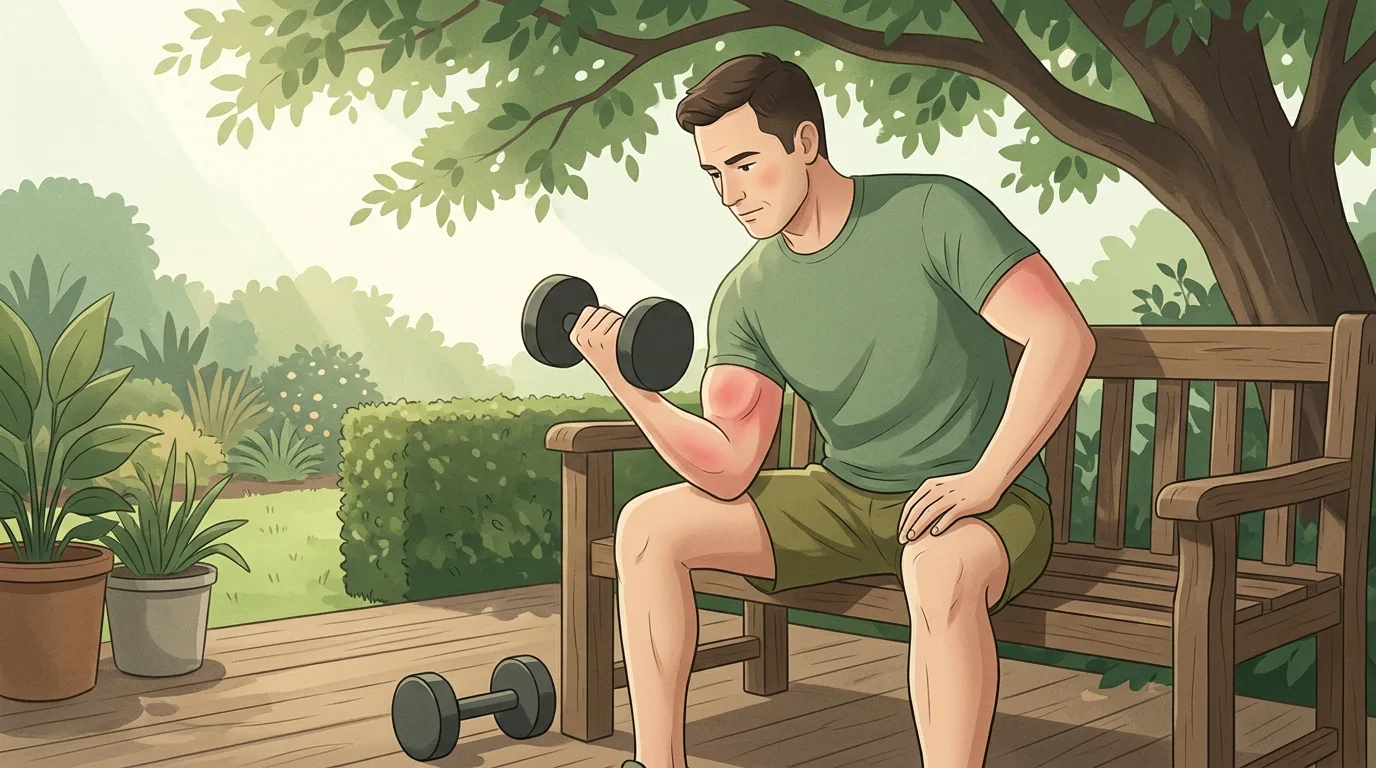
You finish your last set of curls and your arms look like they belong to someone else. Your sleeves are tight and your veins stand out. By the time you've showered and eaten, they look like your arms again. That's the pump, and the question most people ask next is how long it lasts and whether it means anything.
It does mean something, though less than gym folklore says. The pump is a real, measurable change in the size of the working muscle, and scientists have tracked it with ultrasound and MRI. But it's mostly fluid, it's temporary, and the case that it builds muscle on its own is thinner than the supplement ads suggest. Chasing it can also pull you away from the things that do build muscle.
This page covers how long a pump lasts after a workout, what causes it, what the research says about whether it builds muscle, what makes it bigger or shorter, and why a session with no pump at all can still be a good one. If you've also wondered why you're not sore, our post on why you're not sore after working out covers the other signal people misread.
How Long Does a Pump Last After a Workout?
A pump can last an hour or more after a hard session, and most people find the visible part has softened within one to two hours. Studies have measured the start of that window well. The end is less certain, because no study we found timed when the swelling is fully gone.
- Heavy sets. Freitas and colleagues (2017) had 10 men do leg exercise at 80% of their one-rep max. Thigh muscle thickness stayed above resting values for 60 minutes, and muscle cross-sectional area was still larger at 75 minutes.
- Light sets to exhaustion. In Yasuda and colleagues (2015), 10 men did four sets of dumbbell curls at 20% of their max until they couldn't lift any more. Biceps thickness jumped to about 1.2 times baseline, and the swelling was still there 60 minutes later.
- Squats. With MRI, Ploutz-Snyder and colleagues (1995) found the cross-sectional area of the main thigh muscles rose about 10% right after squats.
| Time after your last set | What's happening | Evidence |
|---|---|---|
| During the set | Blood rushes into the working muscle and waste products build up, so the muscle fills | Swelling shows up within a few sets (Hirono 2019) |
| Right after | Measured roughly 8 to 21% thicker | Hirono 2022, Yasuda 2015 |
| 30 minutes | Still clearly swollen after heavy sets, and after light sets with blood flow restriction | Freitas 2017 |
| 60 to 75 minutes | Still measurable after heavy sets, and after light sets taken to exhaustion | Freitas 2017, Yasuda 2015 |
| 1 to 2 hours | The visible pump has mostly faded for most people | Common experience, not timed in a study we found |
| The next few days | A different swelling from muscle damage can appear, mostly early in a new program | Damas 2016 |
That last row matters. If your arms look fuller the day after a tough new program, you're seeing a different kind of swelling. Damas and colleagues (2016) found that in 10 untrained young men, the early increase in muscle size by the third week of training came with signs of muscle damage and fluid. They proposed that this swelling, not new muscle, may explain a large part of that early increase.
What Causes a Muscle Pump?
Three things fill a muscle during and after a hard set. Blood is the main one.
Blood flows in faster than it drains out
When a muscle contracts hard, it squeezes the veins that drain it, while blood keeps arriving through the arteries. Fluid moves out of the blood and into the muscle. Ploutz-Snyder's team measured this directly: after squats, blood plasma volume fell 22% while the working thigh muscles grew. The more plasma a person lost, the more their muscles swelled, and muscles that did little work during the squat didn't swell at all.
Waste products pull water into the muscle
Hard sets, especially long ones with short rests, pile up lactate, phosphate and other byproducts inside the muscle. The leading explanation is that these draw water into the muscle cells, the way salt draws water. That would explain why high-rep sets and short rests pump you up faster. In a trial by Hirono and colleagues (2019), men doing light leg extensions with 20 or 60 seconds of rest had swollen thighs after just 3 sets. With 3 minutes of rest, the swelling wasn't clear until set 12.
Stored carbohydrate holds water
Your muscles store carbohydrate as glycogen, and glycogen holds water. In a study by Fernandez-Elias and colleagues (2015), each gram of glycogen that nine endurance-trained people restored after a long bike ride came back with at least 3 grams of water. Full glycogen stores make a muscle fuller before you lift a thing, which is part of why the pump feels flat on a low-carb day.
Does a Pump Build Muscle?
Maybe a little, and nobody has proved it. Here's what's known and what isn't.
The cell-swelling hypothesis
The idea that the pump helps you grow comes from cell biology. In a 2014 review, Schoenfeld and Contreras proposed that swelling inside muscle cells could act as a growth signal, because cells sense their own volume and change how they handle protein. The evidence behind that comes mostly from other tissues. In rat liver cells, Stoll and colleagues (1992) found that shrinking the cells cut protein synthesis by 60 to 74%, though swelling them didn't raise it. In 10 men, Berneis and colleagues (1999) found that making body fluids more dilute, which swells cells, lowered the rate of whole-body protein breakdown.
So well-hydrated, swollen cells seem to break down less protein. Whether the brief swelling of a gym pump does the same thing in muscle, and whether that adds up to more muscle over months, hasn't been tested directly.
What the training studies show
Two small studies point toward a link. In 22 untrained men, Hirono's team found that the muscle swelled about 8% after the first session of heavy leg extensions, and those who swelled more grew more over the next 6 weeks of training. The correlation was moderate (0.44), and the muscle grew 2.9% on average. In a 6-week trial by Fink and colleagues (2018), men who did a single drop set for their triceps swelled 18% right after the session and grew the triceps by 10.0%, against 5.1% for men doing 3 normal sets. But only 8 men were in each group, and the gap in growth between the groups was not statistically significant. The drop-set group also rated the session as much harder (7.7 against 5.3), so effort differed as well as the pump.
What argues against chasing the pump
Short rests give a faster pump, yet longer rests built more muscle in trained lifters. In an 8-week trial of 21 trained men, Schoenfeld and colleagues (2016) found that 3 minutes of rest between sets built more thigh muscle and more strength than 1 minute of rest. The likely reason is that longer rests let them lift more weight in each set. Load tells a similar story: in a 2017 meta-analysis of 21 studies, light and heavy weights built similar muscle when sets were taken to failure.
The honest summary: a pump shows the muscle worked hard, and pump-style sets can be a useful extra. But the things with strong evidence behind them are hard sets close to failure, enough of them each week, and progress over time. Our review of how many sets per muscle group per week covers the volume side, and about 10 hard sets a week per muscle is a good target for most people.
Knowing what to do is the easy part.
FitCraft, our mobile fitness app, pairs you with an AI coach who builds you a personalized plan around your goals, schedule, and fitness level. Every FitCraft program is designed by Domenic Angelino, MPH (Brown University) and NSCA-CSCS, with research published in the Journal of Strength and Conditioning Research and Medicine & Science in Sports & Exercise.
Take the Free Assessment Free • 2 minutes • No credit cardWhat Makes a Pump Bigger or Shorter
If you enjoy the pump, or you want one for a photo, these are the levers. Some have direct evidence and some follow from how the pump works.
Reps and sets
Longer sets taken close to failure produce the biggest pumps. Yasuda's light curls to exhaustion swelled the biceps about 20%, and Fink's drop set about 18%. Heavy sets still pump you up, and in Freitas's study the heavy session's swelling lasted longer than the light, blood-flow-restricted session's. For a pump at home, sets of about 12 to 20 reps with dumbbells or bodyweight work well, with a drop set or one long final set to finish.
Rest periods
Short rests of 20 to 60 seconds bring the pump on sooner, as Hirono's 2019 trial showed. If you're training for size and strength, keep normal rests for your main sets and save the short rests for one or two finishing exercises.
Carbohydrates
Eating enough carbohydrate keeps your glycogen stores, and the water they hold, topped up. In a small study by Nygren and colleagues (2001), five people went from a very low-carb diet to a very high-carb one for four days. Their thigh muscle cross-sectional area rose 3.5% as their glycogen stores more than doubled. You don't need to carb-load. A normal meal with some rice, potatoes, bread or fruit a couple of hours before training is plenty.
Water and salt
The pump is mostly fluid, so being dehydrated works against it. In the Fernandez-Elias study, riders who sweated off 4.6% of their body weight lost 13% of their muscle water. When they drank enough to replace their sweat losses, their muscles stored more water than when they drank only a little. We didn't find any study that tested salt or water intake on pump size directly. Drink normally through the day and skip the salt-loading tricks.
Blood flow restriction
Training with a cuff that partly limits blood flow out of the limb creates a large pump at very light loads, which is why researchers use it to study swelling. It's a real training method with its own rules, covered in our review of blood flow restriction training, and it's not something to improvise with a resistance band around your arm.
How to make a pump last longer
You can't stretch it much. Once you stop working the muscle, blood flow settles and the fluid drains out, most likely within a couple of hours. No food or drink has been shown to slow that. If you want the pump at its biggest for a photo or an event, do your high-rep finishing sets last and take the photo in the first half hour.
Does "No Pump" Mean a Bad Workout?
No. A small pump usually says more about the type of training you did than about how well it worked. You'll get less of a pump when you:
- lift heavy for low reps with long rests, which is great for strength
- do only a few short sets for a muscle, since the swelling builds over several sets
- are low on carbohydrate or water
Better signs of a productive session are simple. Most of your sets ended 1 to 3 reps short of failure. You beat last week's reps or weight on at least one exercise. And over the week, each muscle got about 10 hard sets. If all three are true, the session did its job, pump or no pump.
Pump vs swelling vs real muscle growth
| What you notice | How long it lasts | What it is | What it tells you |
|---|---|---|---|
| The pump | About an hour or two | Blood and fluid pulled into the working muscle | The muscle worked hard today |
| Next-day fullness and soreness | Days, mostly in the first weeks of a new program | Swelling from muscle damage, mostly after new or hard training | The session was new to you, not that it was better |
| Muscle growth | Months, as long as you keep training | More muscle protein, built over weeks | Your training and eating are working |
Growth happens when your muscles build more protein than they break down over weeks of training and eating, which is the balance our guide to anabolic vs catabolic states explains. The pump happens in an afternoon. It's a nice feeling, but it isn't the growth itself.
Is a 2 Week Gym Break OK?
Yes. Two weeks off won't cost you real strength or muscle. In a trial by Hwang and colleagues (2017), 20 trained men kept all of their leg press strength after a 2-week break, and their lean mass didn't change meaningfully. Some people feel a little flatter for the first session or two back. That usually passes quickly, and so does any missing pump.
What This Means for You
Enjoy the pump, and don't let it run your training. Build each session around a few exercises you can push close to failure with good form, and track whether your reps or weights go up from week to week. If you like the feeling, add one pump-style finisher with short rests at the end. Then judge the month by your strength and your measurements, not by how tight your sleeves felt on a given day.
The hard part is turning up three times a week for months while the visible changes come slowly. If you'd like that planned for you, our comparison of the best strength training apps lays out the options. FitCraft's strength workouts use dumbbells and bodyweight, an AI coach demonstrates each exercise on an interactive 3D model, the exercise tips name the muscles to focus on, and your workouts adjust as you progress. As Mike, 23, put it after four months: "The streak system got me hooked. I didn't want to break my chain."
Frequently Asked Questions
Does a pump mean muscle growth?
No. A pump is fluid and blood in the muscle, and it drains away within hours. It shows that the muscle worked hard, and people who swelled more after their first session grew a little more over 6 weeks in one small study (Hirono 2022), but no study has shown that the pump itself causes growth. Hard sets close to failure, added week after week, are what build muscle.
Why do I lose my pump so fast?
Your pump fades because blood flow to the muscle drops back to normal once you stop working it, and the extra fluid drains out. Studies still measured swelling 60 to 75 minutes after training, and most people see the visible pump soften within an hour or two. Being low on carbohydrate or water can make it smaller and shorter.
How do I get a better pump at home?
Use dumbbells or bodyweight for sets of about 12 to 20 reps taken close to failure, keep rests to 30 to 60 seconds, and finish with a drop set or one high-rep set for the muscle you want to fill. Eat a normal carbohydrate meal a couple of hours before and drink enough water during the day.
Does a pump make your muscles look bigger the next day?
Not the pump itself, which is gone within hours. If your muscles look fuller the next day, it's usually swelling from muscle damage after a new or hard session, which can linger for days early in a new program, or extra water stored with carbohydrate. Neither is new muscle yet.
Should I chase the pump every workout?
No. Build your sessions around hard sets with good form and progress in reps or load, then add pump-style sets at the end if you enjoy them. In trained men, 3-minute rests between sets built more muscle than 1-minute rests (Schoenfeld 2016), so a session can be productive with a modest pump.