
You want to build muscle, or you're trying to put back weight you've lost, and every piece of advice says the same thing: eat in a surplus. Then the questions start. How big a surplus? Does it matter what you eat? Won't it all turn into fat?
Those are fair questions, because "just eat more" is advice that skips every detail that matters. It's how people end up eating a lot more, gaining weight fast, deciding they look softer rather than stronger, and quitting the whole plan by spring. A surplus works on everyone, but it doesn't land the same way on every body, and the details decide whether the extra food becomes muscle or mostly fat.
This page explains what a calorie surplus is, how it compares with a deficit and with maintenance, what your body does with the extra energy, why two people respond differently to the same surplus, whether you can lose fat in one, how to tell if you're in one, what a caloric surplus diet looks like and when a surplus is bad for you.
What Does Calorie Surplus Mean?
A calorie surplus means the energy you take in from food and drink is higher than the energy your body uses over the same stretch of time. Scientists call it positive energy balance, and overfeeding studies call it an energy excess. Your body can't make the extra energy disappear, so it stores it.
The number you compare against is your maintenance calories, also called total daily energy expenditure or TDEE: what you burn at rest, digesting food, moving around and exercising. Anything above it is a surplus. For someone whose maintenance is 2,000 calories a day:
- 2,000 calories is maintenance, so weight holds steady over time.
- 2,100 to 2,300 calories is a small surplus of 5 to 15 percent, the range most muscle-building plans use.
- 2,500 calories or more is a large surplus of 25 percent or more, which tends to add mostly fat.
So a calorie surplus calculator is really a maintenance calculator plus a small addition. Our TDEE calculator estimates your maintenance from your age, height, weight and activity level. Treat its answer as a starting point, because your real maintenance shows up in your weight over the next few weeks.
Calorie Deficit vs Surplus
A calorie surplus is the opposite of a calorie deficit. In a deficit you eat less than you burn and your body covers the gap from its stores, mostly fat. In a surplus the gap runs the other way and the extra goes into storage. Maintenance sits between the two.
| Calorie deficit | Maintenance | Calorie surplus | |
|---|---|---|---|
| Intake vs burn | Below | About equal | Above |
| Scale over weeks | Trends down | Holds steady | Trends up |
| Common goal | Fat loss | Holding weight, slow recomposition | Muscle gain or weight gain |
| What strength training adds | Helps you keep muscle | Can build muscle slowly, mainly in beginners | Sends more of the extra energy to muscle |
Our research review of what a calorie deficit is covers the other side of this table, including how TDEE is built and why weight loss slows down over time.
What Happens to Your Body in a Calorie Surplus?
The extra energy has a few places to go, and it doesn't fill them all at once.
First, glycogen and water
Your muscles and liver store carbohydrate as glycogen, and each gram of glycogen is stored with at least 3 grams of water, according to muscle biopsy work by Fernández-Elías and colleagues (2015). When you start eating more, especially more carbohydrate, part of the first jump on the scale is glycogen and the water stored with it rather than fat or muscle. That's why your weight can rise quickly in the first week of a surplus and then settle into a slower trend.
Then mostly fat
Beyond that top-up, most of a surplus is stored as body fat. In a metabolic-ward trial by Bray and colleagues (2012) in JAMA, 25 healthy adults were overfed by about 954 calories a day for 8 weeks on diets with 5, 15 or 25 percent of calories from protein. Body fat rose by similar amounts in all three groups and made up 50 percent to more than 90 percent of the extra calories they stored. The authors concluded that calories alone accounted for the increase in fat.
What you overeat matters a little too. Horton and colleagues (1995) overfed 16 men by 50 percent for two weeks at a time, once with extra fat and once with extra carbohydrate, while measuring their energy use in a room calorimeter. Extra carbohydrate made the body burn more, so 75 to 85 percent of the excess was stored. Extra fat barely changed what the body burned, so 90 to 95 percent of it was stored.
Muscle, if you give it a reason
Muscle is the part of a surplus you have to earn. In the Bray trial, the normal- and high-protein groups gained about 2.9 and 3.2 kg of lean body mass on top of the fat, while the low-protein group gained none, even though everyone ate the same extra calories. Protein changed what was built, not how much fat was stored. Strength training is the other signal. It gives the extra energy and protein a job, which is the whole logic of eating in a surplus to build muscle.
Your body burns a little more, too
A surplus raises the number of calories you burn, but not by enough to cancel it out. Leibel, Rosenbaum and Hirsch (1995) overfed volunteers until they weighed 10 percent more than usual, then measured them while they held that weight. Their total daily energy expenditure rose by about 8 to 9 calories per kilogram of fat-free mass, roughly 500 calories a day for someone carrying 60 kg of fat-free mass.
Most of that rise is the cost of digesting more food and carrying a bigger body. In a review of 16 overfeeding studies by Joosen and Westerterp (2006), 11 found that weight gain matched the amount of overfeeding and that those costs explained the extra burn. Only 5 claimed evidence of extra heat production beyond those costs, a process called adaptive thermogenesis. In practice, the same daily intake becomes a smaller surplus as your weight climbs, so a plan that works in the first month may need a little more food later.
Knowing what to do is the easy part.
FitCraft, our mobile fitness app, pairs you with an AI coach who builds you a personalized plan around your goals, schedule, and fitness level. Every FitCraft program is designed by Domenic Angelino, MPH (Brown University) and NSCA-CSCS, with research published in the Journal of Strength and Conditioning Research and Medicine & Science in Sports & Exercise.
Take the Free Assessment Free • 2 minutes • No credit cardWhy the Same Surplus Affects People Differently
Two people can eat the same surplus and end up in very different places. Bouchard and colleagues (1990) overfed 12 pairs of young identical twin men by 1,000 calories a day, 6 days a week, for 84 days, an extra 84,000 calories each. The average gain was 8.1 kg, but it ranged from 4.3 to 13.3 kg. Twins in the same pair responded alike, including in how much fat landed around their organs, which points to genes shaping how a surplus is stored.
A few other things shift the split between fat and muscle:
- Everyday movement. In a study by Levine and colleagues (1999), the people whose fidgeting, standing and walking rose most when they were overfed gained the least fat.
- Protein. As the Bray trial showed, too little protein means a surplus builds no lean tissue at all.
- Training. Muscle you've challenged has a use for the extra energy, and untrained muscle mostly doesn't.
- Starting body fat. Leaner people tend to send more of a surplus to lean tissue than people who carry more fat, which is one reason many coaches suggest losing fat before a bulk.
Do You Need a Calorie Surplus to Build Muscle?
Not always, but most people who are already fairly lean and have trained for a while build muscle faster with one. Beginners, people coming back after a long break and people with more body fat can often build muscle while eating at maintenance, a process called body recomposition. Everyone else does best with a small surplus, because bigger ones mostly add fat.
How small is small? Our guide to how many calories to build muscle sets the surplus by training age, roughly 5 to 15 percent above maintenance, and aims for a gain of about 0.25 to 0.5 percent of body weight a week. Our bulking vs cutting guide explains how big a bulking surplus should be and walks through the trials that compared small and large surpluses.
What Is a Caloric Surplus Diet?
A caloric surplus diet is any way of eating that gives you more calories than you burn. There's no special food list. Most people get there by pulling one of three levers:
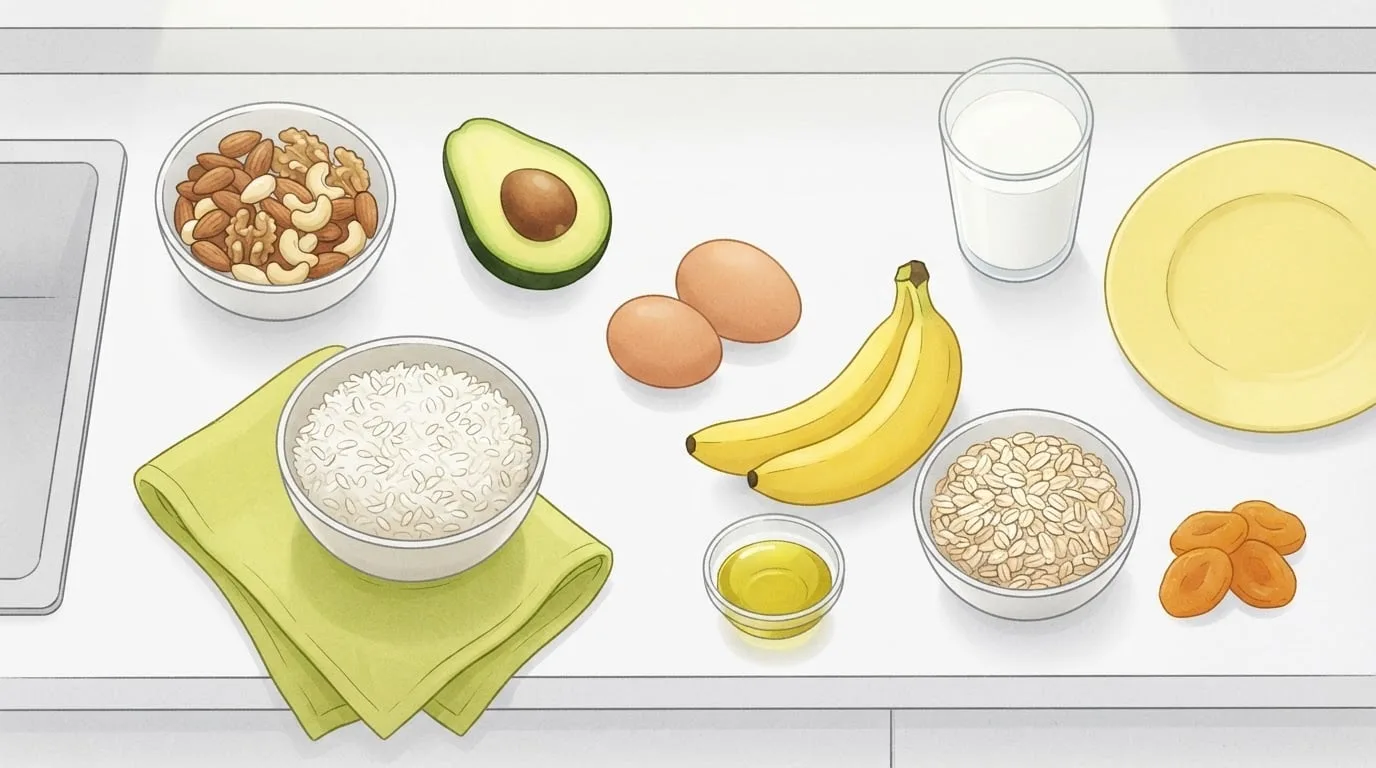
- Bigger portions of meals you already eat, such as an extra half cup of rice or oats, or a second piece of fruit.
- One more eating occasion a day, such as a mid-afternoon snack or a glass of milk before bed.
- More energy-dense foods, which pack more calories into each bite, such as nuts and nut butters, olive oil, cheese, whole milk, dried fruit and avocado.
If a full stomach is what stops you, calories you drink are the easiest to add. In a crossover study by DiMeglio and Mattes (2000), 15 adults added about 450 calories a day of carbohydrate for four weeks, once as a drink and once as a solid snack. With the solid snack, they ate less at other meals and their weight held steady. With the drink, they didn't eat less, so their total intake rose and so did their weight. A smoothie or a glass of milk works the same way in your favor when gaining is the goal, and against you when it isn't.
Build the extra around protein and minimally processed foods. The Bray trial suggests protein decides how much of a surplus can become lean tissue, and the Horton trial suggests a surplus that comes mostly from fat gets stored more completely. For a full day of lean bulk meals and macros, see our guide to what a lean bulk is.
Can You Lose Fat in a Calorie Surplus?
Losing fat overall in a true, sustained calorie surplus is very unlikely. When more energy comes in than goes out, your body's total energy stores go up, and fat holds most of that energy. In the Bray trial, body fat rose in every group, including the groups that also gained lean mass. What a small surplus can do is send most of the gain to muscle and keep the fat gain small, especially early in training.
When people seem to lose fat in a surplus, one of two things is usually going on. The first is recomposition near maintenance, where intake swings a little above and below your burn and the week roughly evens out. It works best for beginners and returning lifters. The second is a miscount. Food tracking and calorie calculators are both estimates, so a surplus on paper can be a deficit in real life. If your waist keeps shrinking while you think you're in a surplus, you're probably not in one.
How to Tell If You're in a Calorie Surplus
Your weight tells you, as long as you read the trend rather than single days. Weigh yourself first thing in the morning on most days and compare weekly averages, because food, salt and water move the number from one morning to the next. If your weekly average climbs over two to three weeks, you're in a surplus. If it holds steady, you're at maintenance, whatever a calculator said.
Strength and your waist tell you where the surplus is going. If your reps and weights climb along with your weight and your waist barely changes, most of the surplus is likely going to muscle. If your waist grows faster than your strength, the surplus is probably too big, and trimming 100 to 200 calories a day is the usual fix.
Is a Calorie Surplus Bad for You?
A small, planned surplus combined with training is a normal part of building muscle for healthy adults. The risk comes from a surplus that's large, long or unplanned.
Unplanned surpluses are how most adults gain weight. Yanovski and colleagues (2000) weighed 195 adults through autumn and winter for the New England Journal of Medicine. They gained an average of 0.37 kg over the holiday season, far less than the popular claim of 2.3 kg, but they didn't lose it again by the next autumn. The authors suggested that this small gain, repeated each winter, probably adds to the weight many people gain through adulthood.
Where the extra fat goes matters too. A 2017 review of overfeeding experiments by Cuthbertson and colleagues describes a personal fat threshold. The fat under your skin can only expand so far, and once your own limit is passed, more fat is stored in the liver and around the organs, where it's linked to insulin resistance, unhealthy blood fats and high blood pressure. That limit varies a lot between people, which is one reason some bodies handle a surplus better than others. Keep a surplus small, give it a purpose and give it an end date.
What This Means for You
A calorie surplus is a tool: a measured amount of extra food, aimed at a goal and checked against your weight every couple of weeks. Used that way, it's how people who are underweight regain healthy weight and how lifters build muscle. Used without a plan, it's how weight creeps up one holiday season at a time.
If your goal is muscle, the food is only half the plan. The extra calories need a reason to become muscle, and that reason is training that gets a little harder over time. A dumbbell workout app can give you that structure at home. FitCraft's programs use dumbbells and bodyweight, a 3D AI coach demonstrates each exercise, and your workouts adjust as you progress.
Picture three months from now: you're eating a little more than you used to, your weekly average weight is rising slowly and on schedule, and the dumbbells you're pressing have gone up with it.

Frequently Asked Questions
How many calories do I need for a surplus?
Any amount above your maintenance calories is a surplus, but to build muscle most people need only about 5 to 15 percent above maintenance, roughly 100 to 500 extra calories a day depending on their size and training experience. Estimate your maintenance with a TDEE calculator, add a small amount, and adjust after two to three weeks based on your weekly average weight.
Is a 300 calorie surplus a lean bulk?
It depends on your maintenance. At a maintenance of 2,500 calories, 300 extra is 12 percent, a little above the 5 to 10 percent usually called a lean bulk, while at 3,500 calories it's under 9 percent and fits inside it. Work out the percentage for your own maintenance, then judge it by the scale: a lean bulk usually adds about 0.25 to 0.5 percent of body weight a week.
Can you eat 1500 calories and still gain muscle?
Only if 1,500 calories is at or above your maintenance, which is true for some smaller, less active adults but not for most people. For most adults 1,500 calories is a deficit, and a deficit makes muscle gain harder, though beginners who train hard and eat plenty of protein can still add some. Check your maintenance before deciding what 1,500 means for you.
What is the opposite of a calorie deficit?
The opposite of a calorie deficit is a calorie surplus, where you eat more calories than you burn and your body stores the extra. Eating about as much as you burn is called maintenance. Over weeks, a deficit leads to weight loss, maintenance keeps your weight steady and a surplus leads to weight gain.
How fast do you gain weight in a calorie surplus?
The scale usually rises within the first few days as your muscles store extra glycogen and the water bound to it, then settles into a slower trend set by the size of your surplus. For muscle gain, aim for about 0.25 to 0.5 percent of your body weight a week, which is 0.2 to 0.4 kg for an 80 kg person. Gaining much faster than that usually means more of the gain is fat.