
For most of gym history, you had to pick a side. Lifters were told cardio would eat their gains, and runners were told lifting would make them heavy and slow. Hybrid athletes refuse that choice. They lift, they run, and they judge themselves by what they can do across both, like running a 10K on Saturday and still feeling strong in Monday's strength session.
If you've bounced between a running phase and a lifting phase, losing one every time you chase the other, the appeal is easy to see. Being a hybrid athlete is how most people actually want to feel: strong enough to carry the groceries up the stairs in one trip, and fit enough to run for the bus without feeling it for the rest of the afternoon.
This page defines the term, sums up what the research says about training both at once, and explains how to order lifting and running so they don't get in each other's way. Then it gives you a beginner hybrid week that uses dumbbells, bodyweight and running, with no barbell or gym needed. It also answers the questions people search most: whether hybrid training is healthy, whether hybrid athletes run every day, and when you can call yourself one.
What Does "Hybrid Athlete" Mean?
Hybrid athletes train strength and endurance as equal priorities. In sports science the method has a drier name, concurrent training, which simply means doing resistance training and aerobic training in the same program. The hybrid label adds an identity to the method. Strength and endurance get equal billing, and you build both on purpose instead of treating one as a warm-up for the other.
Where the term comes from
The phrase spread through strength and endurance coaching in the 2010s. Strength coach Alex Viada's 2015 book The Hybrid Athlete laid out how to program serious lifting and long-distance endurance work side by side, and it's one of the earliest books built around the term. The idea then went mainstream through social media and through HYROX, a fitness race that held its first event in Hamburg in 2018.
What a hybrid race looks like
HYROX pairs eight 1-kilometer runs with eight functional workout stations, one station after each run, including a ski ergometer, a sled push, burpee broad jumps, a rowing machine and wall balls. It looks like a strength contest, but the running dominates the clock. In a 2026 study of 24 male HYROX PRO racers at the Madrid event, Gutiérrez-Hellín and colleagues found the athletes finished in about 70 minutes and ran their kilometers at an average of 76 percent of their maximal aerobic speed, slowing from about 16.1 km/h on the first run to 13.6 km/h on the last. Hybrid racing rewards an aerobic engine that keeps working while your legs are tired from the stations.
What hybrid athletes actually train
- Strength: the basic movement patterns, which are a squat, a hinge such as a Romanian deadlift, a push, a pull and a loaded carry. Many experienced hybrid athletes use barbells, but dumbbells and bodyweight cover every one of these patterns for a beginner.
- Endurance: mostly running, sometimes rowing, cycling or swimming. Most of it is easy, with a smaller dose of faster work.
- Recovery: rest days, sleep and enough food. Training two qualities means two sources of fatigue, so recovery gets planned instead of left to chance.
Can You Build Strength and Endurance at the Same Time?
Yes, with a small catch. The worry that cardio cancels out lifting goes back to Hickson's 1980 study, in which people who lifted five days a week and also did endurance training six days a week stopped gaining leg strength after about seven weeks, then lost some of it. That was an extreme workload. A 2022 meta-analysis of 43 studies by Schumann and colleagues found that adding aerobic training made no meaningful difference to muscle growth or maximal strength compared with lifting alone. Explosive strength, the kind you use to jump or sprint, took a modest hit, mostly when both were done in the same session. Our deep dive on concurrent training and the interference effect walks through the full research, including who is most affected. For a beginner hybrid athlete, the takeaway is short: you can train both and improve at both, as long as you organize the week sensibly.
How to Sequence Strength and Running
Order and spacing decide how well the two halves of a hybrid program get along. Four rules cover most of it. Our review of whether to do cardio before or after weights covers the full set of order studies, and here's how they translate into a hybrid week.
1. Put strength and running on different days when you can
In a 7-week trial with 58 amateur rugby players, Robineau and colleagues (2016) compared three gaps between strength and aerobic sessions: none, 6 hours and 24 hours. Strength gains were lowest with no gap, and aerobic fitness, measured as peak oxygen uptake, improved most when the sessions were a full day apart. The authors advised leaving at least six hours between the two.
2. If they share a session, lift first
When time forces both into one workout, do the one you care about more first. A meta-analysis by Eddens and colleagues (2018) found that lifting before endurance work produced about 7 percent more lower-body strength gain than the reverse order, with no difference in muscle growth, aerobic capacity or body fat. For most beginners chasing both, that means lift first, then run easy.
3. Keep hard runs away from leg days
Running may clash with leg strength more than other cardio does. In a meta-analysis of 21 studies, Wilson and colleagues (2012) found that strength and muscle gains dropped when people paired lifting with running but not with cycling, and the longer and more often people did endurance work, the smaller their strength gains. The newer Schumann analysis didn't find a running versus cycling difference, so treat this as a reason for sensible spacing, not a reason to avoid running. A simple rule works: no hard or long run the day before a leg-heavy strength session.
4. Keep most of your running easy
Hybrid athletes who run hard every time pile fatigue onto their strength days. Endurance coaches use an 80/20 approach, with roughly four of every five sessions at an easy pace you could hold a conversation at. In 48 well-trained endurance athletes, Stöggl and Sperlich (2014) found that this kind of polarized training raised peak oxygen uptake by 11.7 percent over nine weeks, more than threshold, high-intensity or high-volume plans did. Easy running also leaves more in the tank for lifting.
Knowing what to do is the easy part.
FitCraft, our mobile fitness app, pairs you with an AI coach who builds you a personalized plan around your goals, schedule, and fitness level. Every FitCraft program is designed by Domenic Angelino, MPH (Brown University) and NSCA-CSCS, with research published in the Journal of Strength and Conditioning Research and Medicine & Science in Sports & Exercise.
Take the Free Assessment Free • 2 minutes • No credit cardA Beginner Hybrid Athlete Week With Dumbbells, Bodyweight and Running
This week is built to meet the US Physical Activity Guidelines. Piercy and colleagues (2018) summarize them as 150 to 300 minutes of moderate aerobic activity or 75 to 150 minutes of vigorous activity a week, plus muscle-strengthening work on two or more days. Three runs totaling 75 to 100 minutes and two strength sessions cover both parts. Everything below uses a pair of dumbbells, your bodyweight and running shoes.
| Day | Session | What to do |
|---|---|---|
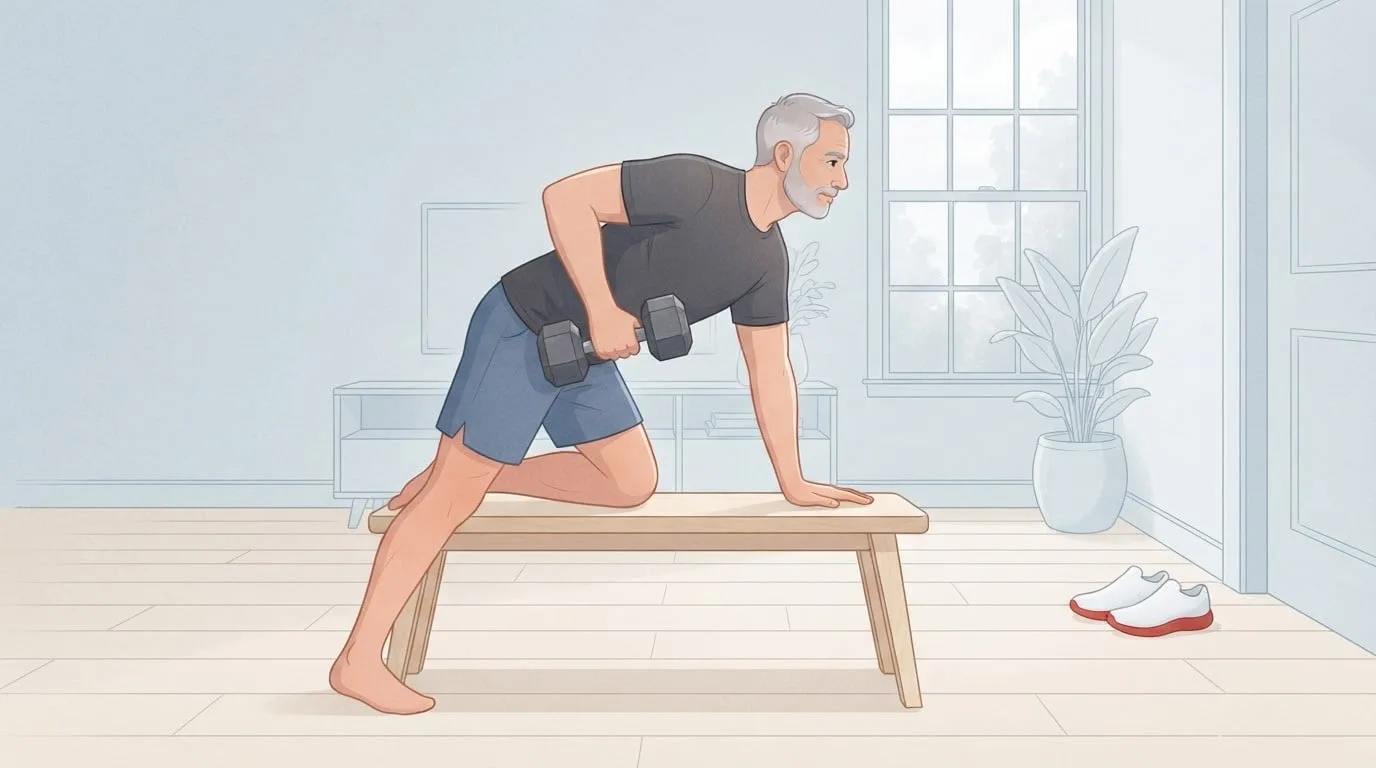
| Monday | Strength A | Goblet squat, dumbbell Romanian deadlift, push-up (hands on a bench if needed), one-arm dumbbell row, plank. 3 sets of 8 to 12 reps; plank 3 holds of 20 to 40 seconds. |
| Tuesday | Easy run | 20 to 25 minutes at a pace you could talk at. New runners alternate 1 minute of running with 1 to 2 minutes of walking. |
| Wednesday | Rest or walk | A 20 to 30 minute walk and a few minutes of mobility work. |
| Thursday | Strength B | Reverse lunge, glute bridge with a dumbbell on your hips, dumbbell overhead press, bent-over dumbbell row, side plank, farmer's carry. 3 sets of 8 to 12 reps; carries 3 walks of about 30 seconds. |
| Friday | Easy run | 20 to 30 minutes at a conversational pace. |
| Saturday | Longer easy run | 30 to 40 minutes easy, or run-walk intervals for the same time. |
| Sunday | Rest | Full rest. |
Notice the spacing. Both runs that follow a strength day are easy, the longest run sits two days after the leg-heavy Thursday session, and no hard running lands the day before a strength day. If you're new to running, the run-walk method is the gentlest way into those three runs.
How to progress
- Strength: when you can do 12 clean reps on every set, pick up a heavier dumbbell or move to a harder version of the exercise, then build back up from 8 reps.
- Running: add time slowly. In a study of 874 novice runners, Nielsen and colleagues (2014) found that people who increased their weekly distance by more than 30 percent over two weeks had more distance-related injuries, such as kneecap pain and shin splints, than people who increased it by less than 10 percent. Small weekly increases are the safer habit.
- Patience early: new runners get hurt the most. Videbæk and colleagues (2015) pooled 13 studies and found 17.8 injuries per 1,000 hours of running in novice runners, against 7.7 in recreational runners. The first two or three months are when holding back pays off most.
- Faster running, later: after six to eight weeks, add four to six relaxed 20-second strides at the end of one easy run. Save harder intervals for after you've run consistently for a few months.
Where FitCraft fits
The strength half is where most beginners stall, because it's the half with technique to learn. In FitCraft, a 3D AI coach demonstrates every dumbbell and bodyweight exercise on an interactive 3D model you can zoom in on, the program adapts as you progress, and your streak shows each session you've kept. If you want that half planned for you, a dumbbell workout app with a 3D AI coach can cover your strength days while you run on your own schedule.
When Can You Call Yourself a Hybrid Athlete?
You can call yourself a hybrid athlete once you're training both qualities on purpose and getting better at both. There's no governing body, qualifying test or official title, and the "hybrid athlete standards" shared online are informal benchmarks, usually built on barbell lifts and race times. If you want concrete targets, these are reasonable markers of a well-rounded beginner. They're a coach's rule of thumb, not an official standard:
- You've trained strength and endurance at least twice a week each for about three months.
- You can run 5 km, about 3.1 miles, without a walking break.
- You can do 20 full push-ups in a row with good form.
- You can do three rounds of 10 dumbbell goblet squats followed by a 1 km run without stopping between rounds.
The push-up target isn't arbitrary. In a 10-year study of 1,104 male firefighters, Yang and colleagues (2019) found that men who could do more than 40 push-ups had a 96 percent lower rate of cardiovascular events than men who managed fewer than 10. It's an observational study in one group of active men, so it shows a link rather than proof. Our review of the push-up test and heart health covers what that result does and doesn't mean.
Is Being a Hybrid Athlete Healthy?
For health, combining the two beats doing either alone. A 2022 meta-analysis of cohort studies by Momma and colleagues found that muscle-strengthening activities on their own were linked with a 10 to 17 percent lower risk of death from any cause, heart disease, cancer and diabetes. People who did both muscle-strengthening and aerobic activity had a 40 percent lower risk of death from any cause than people who did neither. These are observational studies, so they show association rather than cause, but they line up with why the guidelines ask for both.
The two halves also help each other. A systematic review by Blagrove and colleagues (2018) found that strength training usually improved running economy, the energy cost of running at a given pace, by 2 to 8 percent across the 20 studies that measured it, though not in every study. And in a meta-analysis of 25 trials with 26,610 participants, Lauersen and colleagues (2014) found that strength training cut sports injuries to less than a third, while stretching made no difference.
The risk is doing too much of both too soon. In a 12-week study of 89 HYROX athletes, Chittenden and colleagues (2026) found that in any given week about 30 percent reported a health problem, with 14.4 injuries per 1,000 hours of training. Nearly three quarters were overuse injuries, and the knee was the most commonly injured area. That's the pattern you'd expect when running volume outpaces what tendons and joints are ready for, and it's why the beginner week above starts small.
Do Hybrid Athletes Run Every Day?
Most hybrid athletes don't run every day, and beginners shouldn't. Daily running leaves no easy days for your legs to recover between strength sessions, and recovery is when both kinds of fitness actually build. Three runs a week is a sensible starting point, and experienced hybrid athletes often run four or five times.
The research gives two reasons to keep the number modest. Schumann's meta-analysis didn't find a significant difference between more than five and fewer than five concurrent sessions a week, but Wilson's earlier analysis found that the more often and the longer people did endurance work, the smaller their strength gains. And per hour of running, novice runners get hurt at more than twice the rate of recreational runners, so the first few months are the time to build frequency slowly. When you do add runs, make the new ones easy.
What This Means for You
You don't have to choose between being strong and being fit, and you don't need a gym or a race entry to train like a hybrid athlete. You need a plan that puts the two halves in the right order, and a way to keep showing up when week three gets busy. That second part is where most plans fall apart, usually because nothing in the week makes the next session easy to start.
Picture yourself three months from now: you run 5 km without stopping, your push-ups come in sets of 15 or 20, and a heavier dumbbell feels normal in your hands. You've become a runner and a lifter at the same time. As Mike, 23, who got visibly stronger in four months, put it: "The streak system got me hooked. I didn't want to break my chain."

Frequently Asked Questions
What is an example of a hybrid athlete?
A recreational runner who trains for a half marathon while lifting dumbbells two or three times a week is a hybrid athlete. So is a HYROX racer, a decathlete, or a firefighter who trains to carry heavy gear and still run. What they share is that strength and endurance both get trained on purpose, every week.
Who is the best hybrid athlete?
There's no official ranking, because hybrid training has no single governing body or test. The closest things to a scoreboard are HYROX, where Hunter McIntyre is a three-time world champion, and the Olympic decathlon, whose winner has traditionally been called the world's greatest athlete. Strength coach Alex Viada helped popularize the term with his 2015 book The Hybrid Athlete.
What are the three types of athletes?
A common way to group athletes is by what their sport demands: strength and power athletes such as weightlifters and sprinters, endurance athletes such as marathon runners and cyclists, and mixed or hybrid athletes who need both, such as rugby players, decathletes and HYROX racers. It's an informal grouping rather than a scientific classification, but it captures the main trade-off in training.
What does a hybrid athlete physique look like?
A hybrid athlete physique is usually lean and athletic, with more muscle than a typical distance runner and less than a bodybuilder. Research shows muscle growth holds up well when you add moderate cardio, but very high running volume makes it harder to carry a lot of muscle, and extra muscle makes long runs harder. Most hybrid athletes settle in the middle.
What is a good hybrid athlete split?
For beginners, two full-body strength sessions and three easy runs a week works well, with strength and running on different days, or lifting first when they share a day. Intermediate hybrid athletes often move to an upper and lower strength split with four runs, one of them faster. Keep the hardest run of the week away from the day before your leg session.
Can you train like a hybrid athlete at home without a gym?
Yes. Dumbbells and bodyweight cover every basic strength pattern, which means squat, hinge, push, pull and carry, and running needs only shoes and a route. FitCraft's 3D AI coaches can guide the strength half with dumbbell and bodyweight programs that adapt as you progress, while you run on your own schedule.