The r/running thread that inspired this article opened with a simple question. At what point does running become self-destructive behavior? A lot of the top comments went a familiar direction. Some said "when it hurts you." Some said "when it takes over your life." Some said "when you keep running through a stress fracture." Everyone was pointing at something real. Nobody was drawing a bright line.
That's because there is no bright line. Running becomes too much across three overlapping dimensions, and different runners hit their ceilings on different axes. One person's ceiling is bone stress. Another's is emotional dependence. A third's is the drift from healthy tool to compulsive habit that quietly reorders life around it.
This article covers all three: the physical load-recovery mismatch (overuse injury), the systemic overtraining continuum (fatigue, mood, sleep, performance), and the psychological end (exercise addiction). We'll cite the strongest studies for each, list the specific early flags to watch, and walk through what to actually do when you notice them. If you're wondering whether you're overdoing it, this piece is designed to give you an honest read.
Ceiling One: The Injury Ceiling (Load Outrunning Recovery)
The most tangible way running becomes too much is orthopedic. Your tissues can only adapt so fast. Bump the load faster than they adapt and you injure the site that adapts slowest.
Nielsen, Parner, Nohr, Sørensen, Lind, and Rasmussen (2014) in JOSPT followed 874 novice runners with GPS-tracked training over 12 months. They compared three progression tiers: less than 10 percent weekly distance increase, 10 to 30 percent, and greater than 30 percent. The result was clean. The greater-than-30-percent tier had roughly double the incidence of distance-related injuries (Achilles tendinopathy, patellofemoral pain, iliotibial band syndrome, plantar fasciitis, tibial stress syndrome) compared with the safer progression tiers. Interestingly, ankle sprains and non-distance-related injuries did not scale the same way. The finding is specific to injuries where tissue capacity gets outrun by training stress.
The classic 10 percent per week guideline you'll see in running magazines came out of a smaller earlier study and is more conservative than the JOSPT data strictly requires. The takeaway from Nielsen: keeping weekly progression under about 30 percent (and closer to 10 to 20 percent for return-from-break or newer runners) sharply reduces overuse injury risk. Above 30 percent, the risk climbs fast.
That same ceiling is what shapes the build in our half marathon training plan, which keeps every rise in single digits peak to peak and drops a cutback week in every fourth week.
The signal to watch: nagging low-grade pain that shows up on one site, resolves in 2 or 3 easy days, then reappears on a different site. That pattern is not random. It's a tissue-by-tissue announcement that recovery isn't keeping pace with load. Running is only one way to hit that ceiling, and our post on how much cardio is too much runs the same numbers for cycling, rowing and classes.
Ceiling Two: The Systemic Ceiling (Overtraining Continuum)
The 2013 ECSS-ACSM consensus statement (Meeusen and colleagues) is the reference document on overtraining syndrome. It reviewed the international literature and defined the continuum most sports medicine physicians and coaches use today:
- Functional overreaching: hard training block, temporary performance dip, full recovery in days to a week. This is normal and often planned.
- Non-functional overreaching: deeper fatigue and performance drop, resolution takes weeks to months. Mood and sleep start to shift. Motivation drops.
- Overtraining syndrome (OTS): persistent underperformance, mood disturbance, physiological changes (resting HR shifts, HRV drops, hormonal changes), and no resolution after 2 to 3 weeks of rest. Takes months to years to fully recover.
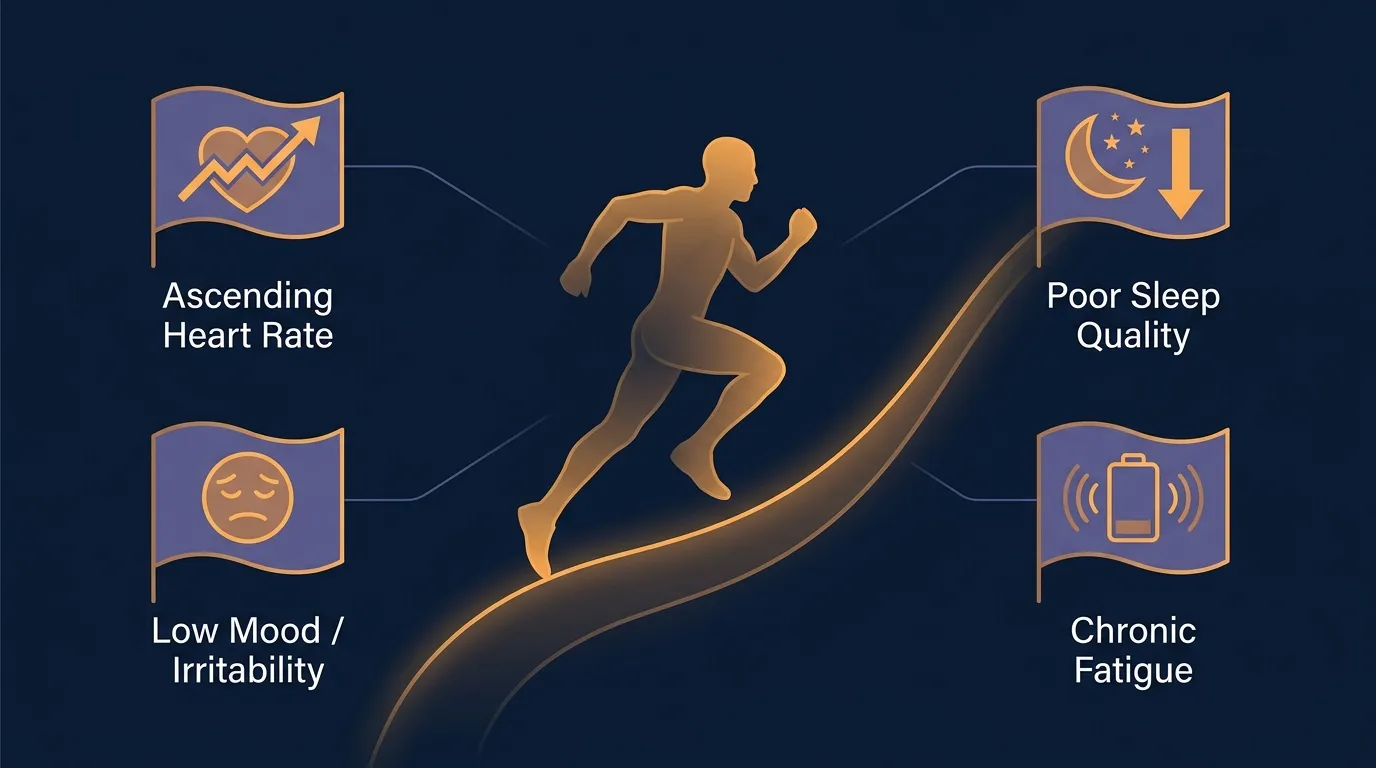
The consensus flags the specific early markers to watch. Persistent fatigue that does not resolve with an easy day. A daily rise in morning resting heart rate over consecutive days. Sleep quality dropping even when duration holds. Irritability or a flat affect during runs you normally enjoy. Menstrual cycle changes in women runners. Performance stalling or declining despite maintained or increased effort. Rising perceived exertion at the same pace and heart rate.
Any one of these can be one bad week. Two or three of them at once for two consecutive weeks is the signal to insert a deload, not push through. Meeusen's practical guideline: real overtraining syndrome is rare below about 80 weekly miles in recreational runners, but the earlier states (functional and non-functional overreaching) show up at any volume when the load-recovery ratio flips. Someone running 25 miles a week under high work stress, poor sleep, and undereating can reach non-functional overreaching much faster than someone running 60 miles a week with everything else dialed in.
This is the same load-versus-recovery framework we covered in our deeper science page on overtraining syndrome. And it's why the daily-running question has a "depends" answer instead of a hard number.

Ceiling Three: The Psychological Ceiling (Exercise Addiction)
This is the hardest one to see from the inside, and the r/running post specifically named it. When does a healthy habit become self-destructive?
Szabo and colleagues (2026) published a comprehensive review of exercise addiction that defines it around three consistent features:
- Loss of control over the behavior. The person cannot easily choose not to run, even when they intend to. Planned rest days get overridden. Volume drifts upward despite intent to hold steady.
- Continuation despite negative consequences. Running through recurring injuries, running when life logistics say don't, running when it strains a relationship or work. The person keeps prioritizing the run.
- Withdrawal symptoms on rest days. Anxiety, irritability, guilt, sadness, or a sense of losing control that reliably appears on planned off days. This is the differentiator from ordinary preference for exercise.
The prevalence data: Lukács, Sasvári, Varga, and Mayer (2019) in the Journal of Behavioral Addictions screened 257 amateur runners with the Exercise Dependence Scale and found 8.6 percent scored in the at-risk range. That's substantially higher than the population baseline (well under 1 percent). Endurance sports concentrate the risk. Longer-distance runners screen higher than short-distance runners.
The most useful distinguishing question is one Szabo's 2026 paper returns to repeatedly. Can you choose not to run today, without emotional cost? A dedicated runner can. A dedicated runner might not enjoy the rest day, but taking it doesn't trigger a spiral of anxiety, guilt, or a compensatory workout later. Someone in the addiction range cannot. The running has become a way to regulate mood or self-worth, and removing it removes the regulation tool.
The 2026 review notes a persistent research problem. Questionnaire-based "risk" scores don't always translate to clinical disorder. Many at-risk scorers are actually well-adapted, high-motivation athletes whose lives run smoothly around the training. The signal that shifts risk into problem is the presence of consequences: injury, relationship damage, work impact, financial cost, or persistent emotional distress on rest days. If those aren't showing up, you're probably dedicated, not addicted. If two or three are, it's worth a conversation with a professional.
How the Three Ceilings Interact
They usually don't move in isolation. Injury drives fear of rest ("if I stop I'll lose fitness"), which drives running through injury, which extends overuse, which increases systemic stress, which degrades sleep and mood, which triggers running as an emotional regulation tool, which reduces the chance of taking a real deload. The loop is well documented in the addiction literature. You can enter it from any door.
The most common on-ramp for otherwise healthy runners: a life stressor (job change, breakup, loss, financial pressure) coincides with a training push. Running becomes the reliable coping tool. Rest days feel worse than they used to. Mileage drifts up because more running is more coping. Injury or fatigue eventually surface, but stopping is now emotionally hard because the tool has become load-bearing for daily function.
You can't will yourself out of that pattern with better training programming alone. The programming fix (deload, drop mileage, cross-train) addresses the physical side and often works on its own if the psychological load isn't too high. If it is, the training fix stalls because rest days feel intolerable, and running back into the loop happens within days.
Knowing what to do is the easy part.
FitCraft, our mobile fitness app, pairs you with an AI coach who builds you a personalized plan around your goals, schedule, and fitness level. Every FitCraft program is designed by Domenic Angelino, MPH (Brown University) and NSCA-CSCS, with research published in the Journal of Strength and Conditioning Research and Medicine & Science in Sports & Exercise.
Take the Free Assessment Free • 2 minutes • No credit cardThe Practical Checklist
Read the following honestly. Give yourself 30 seconds per item. This isn't a validated clinical instrument. It's a quick self-scan built from the Meeusen and Szabo criteria to help you see whether you're near a ceiling.
Load ceiling (injury):
- My weekly mileage has increased by more than 30 percent in a single week within the last month.
- I have nagging low-grade pain that shows up on one site, resolves, then shows up on another.
- I have run through recurring pain in the same site for more than 3 weeks.
- My shoes have more than 500 miles or my form has visibly changed recently.
Systemic ceiling (overtraining continuum):
- My resting heart rate has been 5 to 10 beats above baseline for 3 or more consecutive mornings.
- My sleep quality has dropped noticeably in the last 2 weeks despite similar sleep duration.
- I feel flat or irritable on runs I used to enjoy.
- My paces at a given perceived effort have declined for 2 or more consecutive weeks.
- My menstrual cycle has shifted noticeably (irregular, missed, or lighter).
Psychological ceiling (exercise addiction risk):
- A planned rest day triggers anxiety, guilt, or a strong urge to compensate later.
- I have run despite specific medical advice not to.
- Running has caused a significant argument or missed obligation with someone important to me in the last month.
- I structure most social plans around running.
- I've hidden the true volume of my running from a partner, family member, or coach.
Two or more yesses in any one section is a signal to pause and reassess. Two or more yesses across sections is a stronger signal. It doesn't mean anything is wrong with you. It means the current pattern is above the ceiling and needs adjustment.
What to Actually Do
If the load ceiling is triggered
Cut weekly volume by 20 to 30 percent for a full week. Keep intensity easy. If nagging pain persists after that week, drop to zero running for 5 to 7 days and cross-train (cycling, elliptical, pool running, or the band-based strength work we cover in our home training guide). Return at 70 percent of pre-issue volume and progress no more than 10 to 15 percent per week for the following 4 weeks. If pain is site-localized, sharp, or shows up during activities of daily living (walking, stairs), see a sports medicine physician before returning.
If the systemic ceiling is triggered
Insert a planned deload week. Cut volume 40 to 50 percent, drop all intensity, sleep an extra hour if possible, eat to appetite (probably more than you think). Track morning resting HR. If it drops back to baseline within 5 to 7 days and mood and sleep normalize, you're in functional overreaching and safe to return. If it doesn't, you're likely non-functional overreaching and need 2 to 4 weeks of low-intensity cross-training or walking-only before a slow return.
Persistent underperformance after 2 to 3 weeks of rest is the marker for true overtraining syndrome. That's a medical situation and warrants a physician visit, ideally with someone who knows sports medicine. Recovery from OTS is typically months, not weeks.
If the psychological ceiling is triggered
This is the one where "just deload" won't work on its own. If rest days trigger genuine distress, running is functioning as your emotional regulation tool, and removing it without a replacement is unstable. The 2026 Szabo review recommends professional support: cognitive behavioral therapy adapted for behavioral addictions has the strongest evidence, and many sports psychologists have specific experience with exercise dependence. Peer support (groups, coaches with lived experience) helps. Substituting non-running fitness (strength work, yoga, cycling) preserves the identity and coping function without perpetuating the injury and volume load. Our piece on running self-consciousness touches on adjacent emotional patterns around identity and the sport.
The Honest Middle Ground
Most people asking "am I running too much" are not, in fact, running too much. They are running in a season where life stress has quietly compounded on training stress, and the same volume that felt easy a month ago feels heavy this week. That is not evidence of addiction. It's evidence of a temporary imbalance that a deload week and some sleep will fix.
The runners who need to worry are the ones who read the psychological checklist above and had a wave of recognition, or whose partners have raised the issue multiple times, or who have run through medical advice more than once. Those signals aren't proof of a problem, but they're worth taking seriously.
Running is one of the highest-return-per-hour fitness habits in existence. It builds cardiovascular capacity, bone density, mood stability, and life expectancy at a rate few interventions match. The question isn't whether running is good for you. It clearly is. The question is whether the current dose of running fits the current life you're living. When it does, running compounds. When it doesn't, running silently draws down. Knowing which one you're in is what this article is for.
Frequently Asked Questions
How much running is too much?
No single mileage number applies to everyone. Nielsen 2014 in JOSPT showed that weekly distance increases above 30 percent roughly doubled the rate of distance-related overuse injuries. The systemic answer per the Meeusen 2013 consensus: too much is when performance, mood, sleep, and morning heart rate all shift in the wrong direction for 2 or more consecutive weeks. The number that matters is progression relative to your recovery, not absolute weekly mileage.
What are the earliest signs of running too much?
Per Meeusen 2013, the earliest reliable flags are a small daily rise in resting heart rate over consecutive mornings, subtle sleep quality drop, and irritability or flat affect on runs you'd normally enjoy. Performance decline usually shows up after these. Any one flag is a bad week. Two or three together for two consecutive weeks is the signal to deload.
What is exercise addiction and how is it different from being dedicated?
Szabo 2026 defines exercise addiction as loss of control over the behavior, continuation despite negative consequences, and withdrawal symptoms on rest days. Dedication feels similar externally. The distinguishing question: can you take a scheduled rest day without significant emotional distress? A dedicated runner can. Someone in the addiction range cannot, and running has become an emotion regulation tool.
Can running every day be bad?
Not automatically. Streaks of many years without injury are documented. The risk is when daily running prevents adequate recovery. A healthy daily runner keeps most runs easy, alternates hard and easy days on the calendar, sleeps well, eats enough, and can drop a day without emotional distress. Absent those buffers, daily running becomes a load-recovery mismatch.
How do you recover from running too much?
Match the response to the severity. Early overreaching resolves with a 5-to-10-day deload. Non-functional overreaching needs 2 to 4 weeks of reduced load or cross-training. True overtraining syndrome per Meeusen 2013 needs months and often physician support. Suspected exercise addiction per Szabo 2026 often needs cognitive behavioral therapy adapted for behavioral addictions. The tool matches the ceiling that got hit.
Can FitCraft help me train without overdoing it?
FitCraft builds progressive programs around the goals, schedule, and fitness level you share in the free assessment. Programs progress based on the plan structure rather than pushing daily volume, which reduces the load-progression risk Nielsen 2014 documented. The AI coaches in the app help you stay consistent without escalating volume beyond what the plan calls for. Take the free FitCraft assessment for a plan built around your current life, not an idealized one.