- Your circadian clock peaks hunger around 8 p.m. Scheer et al. (2013) measured a 17% endogenous swing between morning trough and evening peak in 12 healthy adults under controlled conditions.
- Eating the same meals 4 hours later is metabolically worse. Vujović et al. (2022) in Cell Metabolism showed late eating dropped leptin, raised hunger, lowered energy expenditure, and shifted fat tissue toward storage.
- Short sleep makes it worse. Spaeth et al. (2013) in Sleep ran 5-night sleep restriction and watched participants gain weight via late-night calorie shifts.
- Skipping breakfast and underfeeding during the day predicts evening overeating. The pattern of "eat balanced all day, lose it at 9 p.m." is usually a calorie or protein deficit catching up.
- Night Eating Syndrome is real and diagnosable. Allison et al. (2010) set criteria. Most people don't meet them. The few who do should see a clinician.
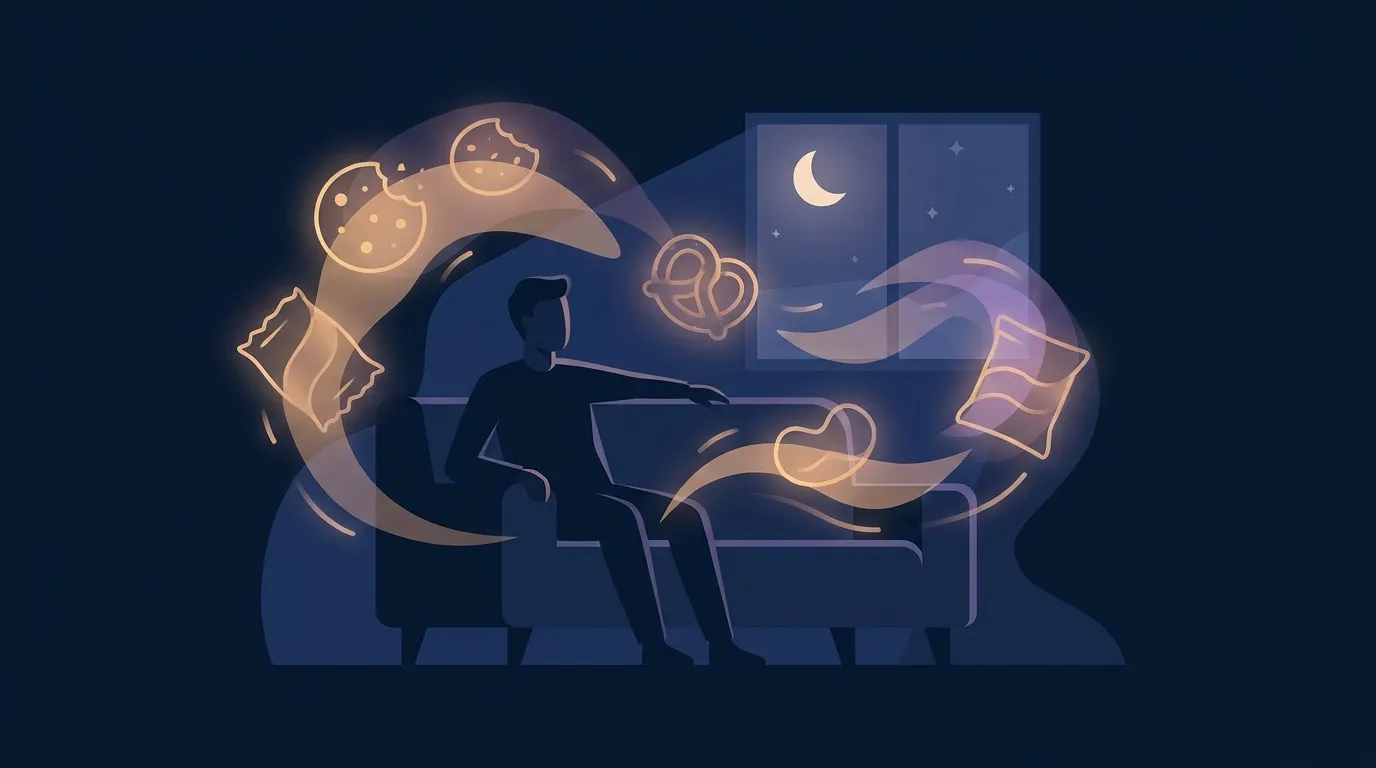
A few years ago someone posted a question to r/loseit that pulled in over 8,000 upvotes and 500 comments. The question was, paraphrased, "Why am I capable of eating balanced meals all day and then completely fall apart in the evening?" The thread was hundreds of people describing the same pattern. Disciplined breakfast. Disciplined lunch. Reasonable dinner. Then 9 p.m. arrives and a sleeve of cookies vanishes before the brain even registers eating.
If you've lived this, you already know the willpower lecture is useless. You don't lack willpower at 9 p.m. You had plenty at 7 a.m. What changed? The research has unusually clean answers, and most of them aren't about discipline. They're about timing biology, sleep, and how meals earlier in the day interact with the appetite system after sundown.
Here's what the science actually says.
Reason 1: Your Circadian Clock Wants You to Eat at Night
The cleanest study on this is Scheer, Morris, and Shea (2013) in Obesity. The team brought 12 healthy adults into a sleep lab for 13 days. Meals, sleep, and activity were precisely scheduled and balanced across the participants' biological clock cycles. The protocol was designed to strip out the noise of normal life and measure the pure circadian rhythm of hunger.
What they found: hunger followed a strong endogenous pattern. The lowest hunger was in the biological morning (around 8 a.m.), the highest in the biological evening (around 8 p.m.). The peak-to-trough swing was about 17%. Appetite for sweets, salty starches, and meats followed the same pattern, with swings of 14-25%.
The implication is clear and a little freeing. The "I'm starving at 8 p.m. for no reason" feeling is not a moral failing. It's a hardwired daily rhythm. The clock evolved this way probably because hunter-gatherer humans wanted to eat a substantial meal before the long fasting period of sleep. The system that worked great when food was scarce backfires when food is everywhere.
So fighting evening hunger with willpower is fighting biology. The high-leverage move is to give the surge somewhere productive to land. A real, satisfying dinner. Not a desk-side handful of crackers at 4 p.m. that leaves you genuinely hungry by 9.
Reason 2: Eating Late Is Worse Than Eating the Same Calories Earlier
This was the question everyone wanted answered for decades, and 2022 finally produced the cleanest test. Vujović and colleagues (2022) in Cell Metabolism ran a randomized crossover with 16 adults in the overweight or obese range. Each person did two protocols, separated by a washout. In one, meals were scheduled early. In the other, the exact same meals at the exact same calories were scheduled 4 hours later. Sleep, activity, and food were tightly controlled.
Same food. Same calories. Same person. Just shifted later.
The late-eating condition produced:
- Lower 24-hour leptin (about 16% less). Leptin is the hormone that signals fullness. Less of it means more hunger.
- Higher 24-hour ghrelin-to-leptin ratio (about 34% higher). Ghrelin drives hunger. The ratio shift moves the appetite system toward "want more food."
- Lower waketime energy expenditure (about 5% less). The body burned fewer calories overall.
- Lower 24-hour core body temperature. A small but real metabolic slowdown.
- Shifts in fat tissue gene expression away from breakdown and toward storage.
Read it twice. Same food. Same calories. Same person. The body responded to "later" as if the meal pattern itself was the problem. The hunger surge was bigger, the satiety signal was smaller, and the metabolic engine ran a bit cooler.
This doesn't mean every dinner needs to be at 5 p.m. It means that pattern of pushing eating much later (the late dinner, the post-dinner snack, the 11 p.m. ice cream) is working against the system in a measurable way. Most of the people who say "I eat fine until 9 p.m." are dealing with the metabolic version of jet lag, applied nightly.
Reason 3: Short Sleep Pushes Calories Into the Late Night
The third leg of the night-eating problem is sleep. Spaeth, Dinges, and Goel (2013) in Sleep ran a controlled lab study with 225 healthy adults. Participants were randomized to 5 nights of restricted sleep (4 hours in bed) or 5 nights of normal sleep (10 hours in bed). Food was available freely. Researchers tracked total intake, meal timing, and weight.
The sleep-restricted group:
- Gained more weight than the control group across just 5 nights
- Ate about 550 more calories per day on average
- Concentrated those extra calories in a late-night eating window between 10 p.m. and 4 a.m.
- Had a higher fat content in the extra calories (more processed snacks, less protein)
So sleep restriction doesn't just make you eat more. It pushes the eating into exactly the window that biology is already vulnerable in. The combination of short sleep + circadian peak hunger + late food availability is the perfect setup for the night-eating loop. Spaeth's follow-up work showed elevated ghrelin during sleep restriction predicted the magnitude of nighttime intake increase, which mechanistically ties the whole thing together.
If you're sleeping under 6 hours, the late-night eating problem is partly a sleep problem. Solving it at 10 p.m. is the wrong layer to solve at. We covered the broader story in our piece on how sleep affects muscle and metabolism, and the body composition tax of poor sleep during a deficit is large.

Reason 4: Underfeeding Earlier in the Day
The behavioral piece sits on top of the biology, and it's often the dominant factor. The classic pattern looks like this:
- Skip or shortchange breakfast (a yogurt, a coffee, "I'm not a breakfast person")
- Light lunch (a salad, a small bowl of soup)
- Reasonable dinner (a normal portion)
- 9 p.m. arrives. The sleeve of cookies. The cheese plate. The bowl of cereal you didn't plan to eat.
From the calorie ledger, the person above ate maybe 1,400-1,600 calories across breakfast, lunch, and dinner. They needed 2,200. The 600-calorie gap shows up as evening hunger that feels like willpower failure. It isn't. It's the body collecting the calories it didn't get earlier.
The fix here is unsexy and effective. Eat enough protein and calories during the day. A protein-forward breakfast, a real lunch, snacks if you need them. The evening hunger surge happens to everyone (Scheer 2013), but on a well-fed day, it's manageable. On an underfed day, the surge meets a real deficit and amplifies into a binge.
If you want that fix written out as an ordered plan rather than a diagnosis, we walk through the seven steps that stop late-night eating, starting at breakfast and finishing with what the cutoff-time trials actually found.
If your morning protein game is light, our piece on how much protein you actually need has the targets that most people miss. The most common pattern in our quiz data is "eats 30-40 grams of protein in the first 8 hours of the day, then crashes." That gap is fixable.
Knowing what to do is the easy part.
Take the free FitCraft assessment and get a personalized plan based on behavioral science, not willpower.
Take the Free Assessment Free • 2 minutes • No credit cardReason 5: The Environment
The last piece is what behavior research calls the food environment. Evening is when willpower is lowest (decision fatigue from the day), the kitchen is closest, and entertainment (TV, scrolling, gaming) reliably pairs with snacking. The home pantry at 9 p.m. is a much harder environment than the office break room at 11 a.m.
The single biggest behavioral lever is what's in the house. If you have a sleeve of cookies on the counter, you'll eat them. Not because you lack discipline but because the cost of the choice is two seconds of effort and the reward is immediate. If the same cookies require getting in a car and driving to a store, the calculation flips. The friction wins.
This is the same principle we wrote about in our piece on streak psychology and the design lessons of atomic habits applied to fitness: behavior is downstream of environment. Change the environment, change the behavior. Don't try to change the behavior in a hostile environment.
So How Do You Actually Stop?
The strategies that work are the ones that target the root cause for your specific case. Here's a triage:
If you're underfed during the day
Eat more, earlier, with more protein. A 30+ gram protein breakfast. A real lunch. The 4 p.m. snack if you need it. The evening surge will still come, but it'll be manageable instead of overwhelming. Most "no willpower at night" stories are calorie deficits collecting interest.
If you're sleeping under 6 hours
Fix the sleep first. Trying to white-knuckle 10 p.m. snacking when your ghrelin is elevated from chronic short sleep is fighting your endocrine system with discipline. You'll lose. Sleep is a precondition. Hit 7-8 hours for two weeks before you judge whether you have a "willpower problem."
If your environment is set up for night eating
Don't keep the food you don't want to eat in the house. The shopping cart is a much easier place to make decisions than the 9 p.m. couch. Plan a defined evening snack (a real, satisfying portion) and have it. Then stop. Fighting the urge from the couch fails. Pre-deciding the urge from the kitchen earlier in the day works.
If you have Night Eating Syndrome
Allison and colleagues (2010) in the International Journal of Eating Disorders set the diagnostic criteria. The core ones: at least 25% of daily calories consumed after the evening meal, or nocturnal awakenings to eat at least twice a week. Awareness of the eating, distress about it, persistence over 3 months. Prevalence in clinical obesity samples runs 6-14%.
If you meet those criteria, this isn't a willpower problem and it isn't a self-help problem. NES has effective treatments (cognitive behavioral therapy, sometimes light therapy or SSRIs) and the right next step is a clinician evaluation, not another article. If you've read this and any of the criteria sound exactly like you, talk to your doctor.
What Doesn't Work
A few interventions get recommended a lot in the night-eating discourse and have weak research behind them.
Drinking water when you're hungry. Sometimes thirst masks as hunger, but rarely at 9 p.m. The strong evening hunger of Scheer 2013 is mostly real metabolic signal, not dehydration confusion. If you're truly hungry, water won't fix it for more than a few minutes.
"Just brush your teeth at 8 p.m." The internet loves this trick. It works for some people as a behavioral cue, fails for most. If the underlying biology is hungry, mint flavor in your mouth doesn't change it.
Strict no-eating-after-X-hour rules. Time-restricted eating (TRE) has some evidence behind it for metabolic health, but rigid rules without addressing daytime intake or sleep usually fail. The pattern of "I'll just stop eating after 7 p.m." typically lasts about 4 days before the underlying drivers reassert themselves.
Willpower-based fixes in general. The reason these don't work isn't because the person lacks willpower. It's that willpower is a poor tool for fighting endocrine biology night after night. The interventions that work are upstream changes (sleep, daytime eating, environment) that reduce the urge in the first place.
The Bigger Picture
The night-eating problem is a great example of how fitness and weight management are about systems, not discipline. The same person who "lacks willpower at 9 p.m." has plenty of willpower for 14 other things in their day. What they don't have is a setup that makes the right choice the easy choice at 9 p.m. specifically. Once the setup changes (more protein at breakfast, better sleep, no cookies on the counter), the willpower question stops being relevant. The behavior changes because the biology and the environment changed.
This is the design philosophy behind every effective behavior change framework: don't ask for more willpower, ask for a better setup. We covered this from the habit-formation side in building an exercise habit without willpower, and the same logic applies to eating. The thing you keep failing at probably isn't a character flaw. It's a system flaw.
If you've read this far and the night-eating loop has been a recurring frustration, the take-home is unglamorous and effective: protein-forward breakfast, real meals through the day, 7-9 hours of sleep, no trigger foods on the counter, a planned evening meal followed by a defined cutoff. Start with whichever of those you're most under on. The willpower question takes care of itself.
Frequently Asked Questions
Why am I so hungry at night?
Your circadian clock raises hunger in the evening on purpose. Scheer, Morris, and Shea (2013) tracked appetite in 12 healthy adults across a 13-day controlled lab protocol and found endogenous hunger peaked around 8 p.m. and bottomed out around 8 a.m., with a 17% peak-to-trough swing. The pattern is biology, not lack of willpower. The fix isn't fighting it; it's structuring your day so the surge lands on real food, not snacks.
Is it really bad to eat at night?
It's worse than eating the same calories earlier. Vujović et al. (2022) ran a randomized crossover comparing identical meals eaten 4 hours later versus earlier. The late-eating condition increased hunger, lowered leptin (the satiety hormone) across 24 hours, decreased energy expenditure, and shifted fat tissue gene expression toward storage. Same calories, worse outcome. This doesn't mean a 7 p.m. dinner is harmful. It means the timing pattern matters when it pushes much later.
How can I stop overeating at night?
Most night-eating loops are upstream problems showing up downstream. Three high-leverage fixes: protect 7 to 9 hours of sleep (short sleep raises ghrelin and shifts intake to late at night per Spaeth 2013), eat enough protein and calories during the day (skipping breakfast is the strongest predictor of evening overeating), and structure a planned evening meal around a defined cutoff time. White-knuckling at 10 p.m. fails. Removing the trigger upstream works.
Do I have Night Eating Syndrome?
Probably not, but it's diagnosable. Allison et al. (2010) proposed the criteria: at least 25% of daily calories consumed after the evening meal, or at least two nocturnal awakenings per week to eat, with awareness of the eating, distress about it, and persistence over at least 3 months. Most people with garden-variety late-night snacking don't meet the criteria. If you do meet them, NES is treatable (CBT, light therapy, sometimes SSRIs) and a clinician evaluation is the right next step.
Does eating late actually cause weight gain?
It can, through three mechanisms even when calories are matched. Lower waketime energy expenditure (Vujović 2022 showed about a 5% drop), higher 24-hour ghrelin to leptin ratio, and pro-storage shifts in adipose tissue gene expression. Layered on top of that, late-night calories are often unplanned and unconscious, which usually means they're surplus calories on top of a normal day. So yes, both the timing biology and the eating-while-distracted behavior contribute.