The bird-dog crunch takes the standard bird-dog and adds a dynamic abdominal crunch between each extension. One addition. That's it. But it changes the exercise from a pure stability drill into a full core strength movement that hits your rectus abdominis, obliques, and deep stabilizers in the same rep. If you've been doing bird-dogs for a while and they don't feel challenging anymore, this is your next step.
Here's the key difference: the standard bird-dog asks you to resist movement. The bird-dog crunch asks you to create it and then control it. You extend opposite arm and leg, draw your elbow and knee together underneath your torso, then extend back out. Your hips stay level. Your spine stays neutral during the extension phase. Once isometric stability is established, adding controlled spinal flexion increases motor unit recruitment in the rectus abdominis and obliques.
Quick Facts: Bird-Dog Crunch
- Equipment needed: None
- Difficulty: Intermediate to Advanced
- Modality: Strength and stability
- Body region: Core (anterior, posterior, and deep stabilizers)
- FitCraft quest category: Strength
Muscles Worked
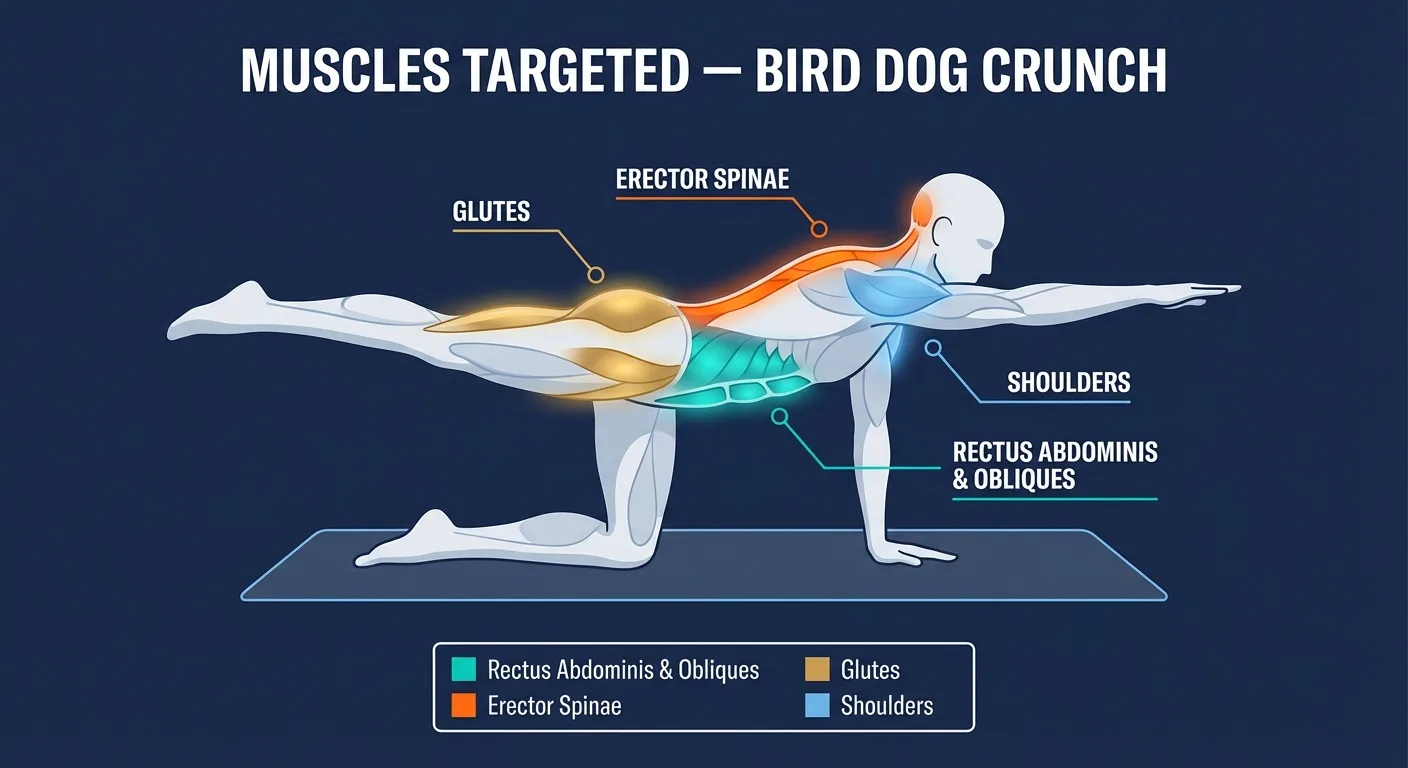
Primary movers: the rectus abdominis and the internal and external obliques. These produce the spinal flexion and contralateral coupling that brings the elbow and knee together underneath your torso. They shorten on the way into the crunch (concentric phase) and lengthen under tension as you re-extend (eccentric phase), which is what produces the strength stimulus.
Secondary movers: the erector spinae, gluteus maximus, and posterior deltoid. These drive the extension phase. The glutes lift and hold the back leg in line with the torso; the erectors keep the spine neutral against the anterior pull of the extended limbs; the rear delt supports the lifted arm position.
Stabilizers: the transverse abdominis, multifidus, diaphragm, and pelvic floor (the deep core canister), plus the shoulder girdle and hip stabilizers holding the all-fours position. The breath is a key stabilizer: exhaling during the crunch reinforces transverse abdominis activation and keeps intra-abdominal pressure from spiking.
Mechanism, why the crunch addition matters: the standard bird-dog is an anti-rotation isometric exercise. Adding a controlled spinal flexion at the bottom of every rep recruits the rectus abdominis and obliques dynamically while preserving the anti-rotation demand of keeping the hips square. The result is one exercise that trains both the bracing pattern and the active flexion pattern, which is why it works well as a single-movement core finisher once the standard bird-dog stops being challenging.
Step-by-Step: How to Perform a Bird-Dog Crunch
- Start on all fours. Position yourself on your hands and knees with hands directly under your shoulders and knees directly under your hips. Keep your spine neutral and your gaze on the floor about a foot in front of your hands.
Coach Ty's cue: "Stack your wrists under your shoulders and your knees under your hips. Even spacing makes the rest easier."
- Brace your core. Engage your abs like you're about to take a punch. Your back should stay flat. No sagging, no arching. Keep that brace constant through every phase of the movement.
Ty's cue: "Brace before you move. The brace doesn't release until the set ends."
- Extend opposite arm and leg. Reach your right arm forward and drive your left leg straight back until both are in line with your torso. Thumb points toward the ceiling, foot flexed with toes pointing down. Keep your hips square to the floor.
Ty's cue: "Push your heel toward the wall behind you, don't lift it toward the ceiling. That keeps your lower back out of it."
- Crunch elbow to knee. Exhale and draw your right elbow and left knee toward each other underneath your torso. Round your upper back slightly to maximize the crunch. Make contact, or come as close as your mobility allows.
Ty's key cue: "Exhale all the way through the crunch. That's what locks in your transverse abdominis."
- Extend back out. Inhale and re-extend the arm and leg to the full straight position. Pause briefly at the top to check your balance and alignment before the next rep.
- Complete all reps, then switch. Finish your target reps on one side before switching to left arm and right leg. This continuous-side approach builds more endurance than alternating every rep.
Get this exercise in a personalized workout
FitCraft, our mobile fitness app, uses its AI coach Ty to program core stability work like this into your plan at the right volume and intensity, based on your level, goals, and equipment. Ty was designed and trained by Domenic Angelino, MPH (Brown University) and NSCA-CSCS, with research published in the Journal of Strength and Conditioning Research and Medicine & Science in Sports & Exercise.
Take the Free Assessment Free · 2 minutes · No credit card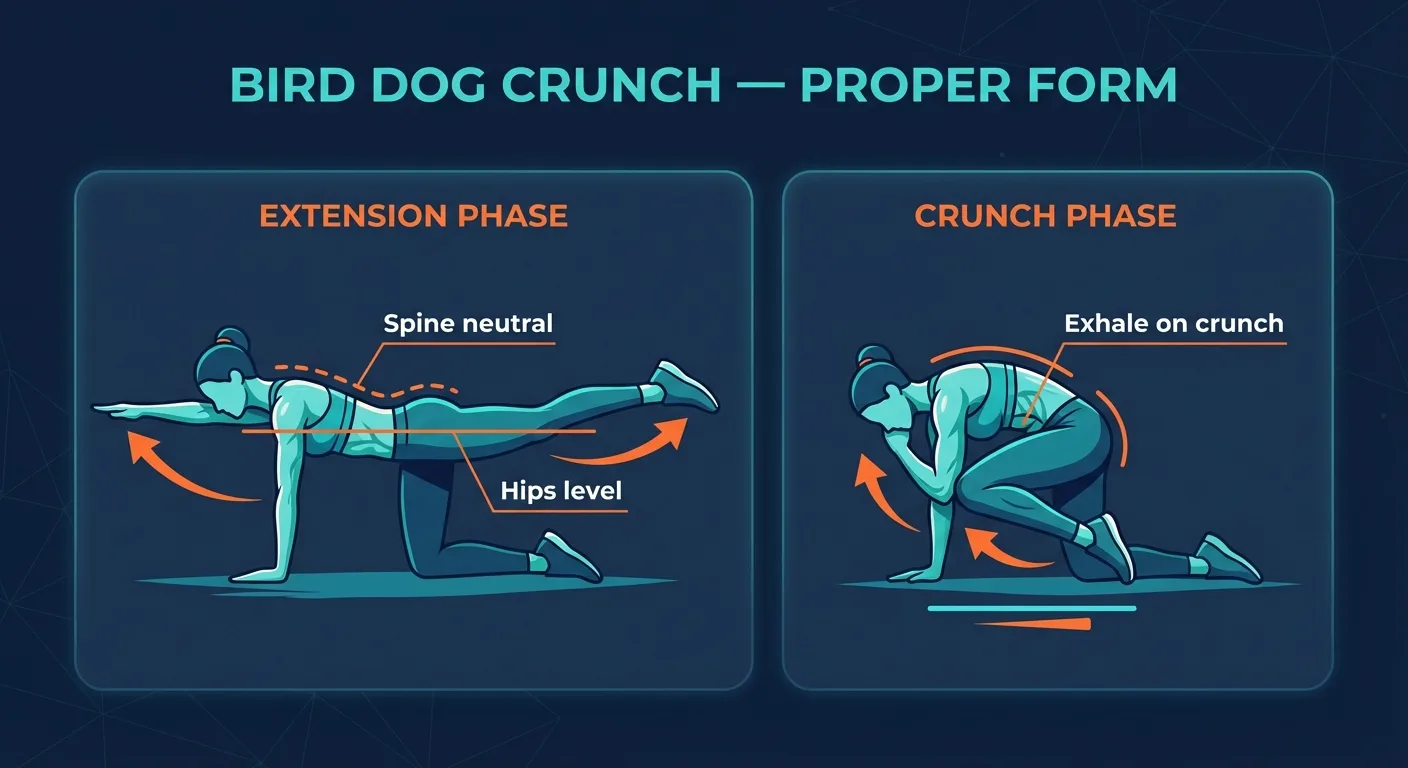
Common Mistakes (and How to Fix Them)
Rotating the hips during the crunch
What it looks like: your hip drops or twists to one side as you bring your elbow and knee together.
Why it matters: hip rotation shifts the work away from your core and into momentum. The anti-rotation demand is where most of the benefit lives.
The fix: slow down. Think about keeping your belt line parallel to the floor through the entire crunch. If you can't prevent rotation, reduce your range of motion until your stability catches up.
Rushing through reps
What it looks like: quick, jerky movements. No pause at extension, no pause at the crunch.
Why it matters: speed removes the stability component entirely. You're just swinging limbs instead of training your core to control them.
The fix: each rep should take 3 to 4 seconds. Count "one-one-thousand" at full extension and again at the crunch position.
Arching the lower back during extension
What it looks like: your lower back sags into hyperextension when your arm and leg are fully extended.
Why it matters: this puts compressive force on the lumbar spine and means your core isn't doing its job.
The fix: only extend your leg as high as your torso, not higher. Think about pushing your heel toward the wall behind you rather than lifting it toward the ceiling.
Pulling on the neck or tucking the chin hard
What it looks like: the head jams forward into the crunch, or the chin pulls down toward the chest.
Why it matters: it shifts the work from the abs to the cervical spine and limits how far the elbow can travel under the torso.
The fix: keep your gaze on the floor a foot in front of your hands through every rep. Let the upper back round, not the neck.
Bird-Dog Crunch Variations: Regressions and Progressions
Easier (Regression)
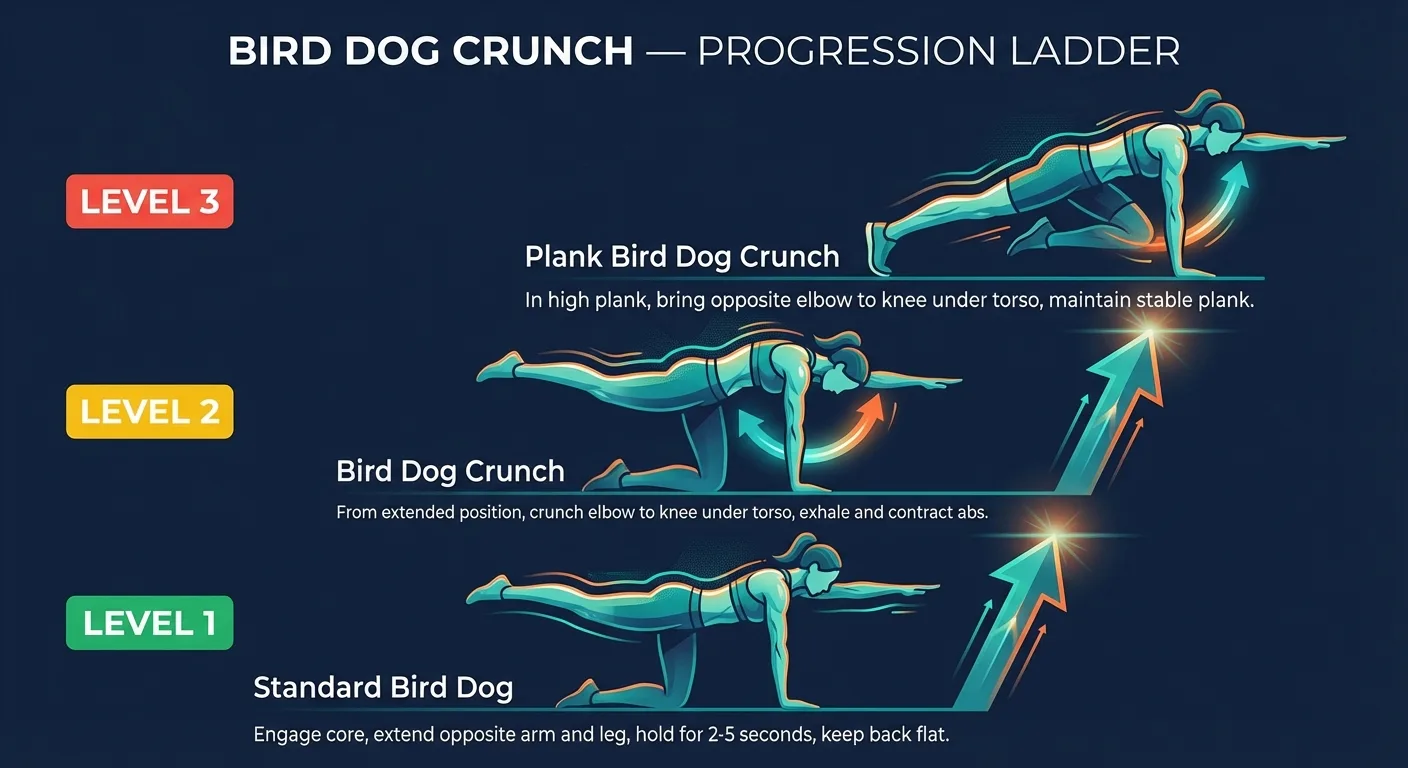
- Standard Bird-Dog: remove the crunch entirely. Extend opposite arm and leg, hold for 2 to 3 seconds, return to start. This builds the baseline stability needed before adding the crunch.
- Bird-Dog Crunch, Leg Only: keep both hands on the floor and only extend and crunch one leg at a time. This halves the balance demand while still training the crunch pattern.
Harder (Progression)
- Bird-Dog Crunch with Pause: hold the extended position for 5 seconds and the crunched position for 3 seconds on every rep. The isometric holds dramatically increase time under tension.
- Plank Bird-Dog Crunch: perform the movement from a push-up position instead of hands-and-knees. This removes two points of contact and forces your core to work much harder to prevent rotation.
When to Avoid or Modify Bird-Dog Crunches
The bird-dog crunch is safe for most healthy adults, but a few conditions call for modification or temporarily swapping to the standard bird-dog. None of these are permanent restrictions. They're starting points. Always consult your physician or physical therapist for personalized guidance.
- Acute lower-back pain or known disc pathology. The dynamic spinal flexion in the crunch can aggravate disc-related pain even though the underlying bird-dog pattern is back-friendly. Regress to the standard bird-dog and pair it with deadbugs to rebuild anti-extension capacity. Add the crunch back only when both feel easy and pain-free.
- First 6 to 8 weeks postpartum or active diastasis recti. Spinal flexion under load can widen abdominal separation. Restore deep-core function first with diaphragmatic breathing, transverse abdominis activation, the standard bird-dog, and deadbugs. Get clearance from a pelvic-floor physical therapist before progressing to the crunch variation.
- Pregnancy (second and third trimesters). Spinal flexion and a closing belly window are generally avoided during this period. Stick with the standard bird-dog, which trains the same stability pattern without the crunch component.
- Recent abdominal surgery (C-section, hernia repair, appendectomy). Get clearance from your surgeon. Most post-surgical protocols start with diaphragmatic breathing, then gentle bracing, then progressive loading. The bird-dog crunch belongs at the end of that progression.
- Wrist pain that flares in the all-fours position. Loading the wrists at 90 degrees of extension can aggravate carpal tunnel or arthritic wrists. Drop down to forearms, use push-up handles to keep the wrist neutral, or swap to deadbugs for a supine version of the same anti-extension training pattern.
- Shoulder impingement or rotator cuff irritation. The extended-arm position loads the supraspinatus tendon. Reduce the arm extension to a partial range and stay pain-free, or perform the leg-only variation until symptoms settle.
Related Exercises
If the bird-dog crunch is part of your routine, these movements complement or extend the same training pattern:
- Foundation regression: Bird-Dog is the prerequisite. Build 12 clean reps per side here before adding the crunch.
- Anti-extension counterpart: Deadbugs train the same contralateral coordination from a supine position, with less balance demand. Useful when wrists or shoulders need a break from the all-fours position.
- Isometric anti-extension: Forearm Planks hold the rigid trunk position the bird-dog crunch passes through during extension. Often paired in the same core finisher.
- Dynamic spinal flexion (different pattern): Crunches and Bicycle Crunches train the rectus abdominis and obliques with a more isolated flexion movement, useful as a secondary dynamic core exercise.
- Lateral-plane complement: Side Planks train anti-lateral-flexion, the third plane of core stability that the bird-dog crunch doesn't directly load.
- Dynamic plank progression: Mountain Climbers add a higher-intensity dynamic knee drive at an elevated heart rate, useful if you want the same contralateral coordination as a conditioning stimulus.
How to Program Bird-Dog Crunches
Bird-dog crunch programming follows the same evidence-based ranges as other dynamic core exercises. The American College of Sports Medicine (ACSM) Position Stand on resistance training recommends roughly 8 to 12 reps per set for strength and 12 to 20 for muscular endurance, with at least 48 hours between sessions training the same pattern (Ratamess et al., 2009).
| Level | Sets × Reps per side | Rest between sets | Frequency |
|---|---|---|---|
| Beginner (regress to standard bird-dog) | 2–3 × 8–12 | 45–60 seconds | 2–4 sessions/week |
| Intermediate (standard bird-dog crunch) | 3 × 10–15 | 45–60 seconds | 3–5 sessions/week |
| Advanced (paused or plank variation, slow tempo) | 3–4 × 12–20 | 60 seconds | 4–6 sessions/week |
Where in your workout: program bird-dog crunches after your warm-up and before heavy compound lifts. The exercise activates the deep stabilizers that protect your spine during squats, deadlifts, and rows. They also work well as a core finisher paired with forearm planks or deadbugs at the end of a session. Don't program them after heavy spinal loading when the erectors are already fatigued.
Form floor over rep targets: if your hips start rotating or your lower back sags on the last 2 reps of a set, stop the set there. Hitting a target rep count with broken form trains the wrong pattern. Quality reps build the stability you came here for.
How FitCraft Programs This Exercise
Knowing how to do a bird-dog crunch is step one. Knowing when to do it, how many reps, and when to progress is where most people get stuck.
FitCraft's AI coach Ty handles that. During your personalized diagnostic assessment, Ty maps your fitness level, goals, and any movement restrictions. Then Ty builds a personalized program that slots the right bird-dog variation into a balanced training plan: standard bird-dog if your stability needs building, bird-dog crunch once you can hold a clean extension, and progressions to paused or plank variations as your control improves.
Every program is designed by an Ivy League-trained exercise scientist and NSCA-certified strength coach using evidence-based periodization, then adapted to you by the AI.
Frequently Asked Questions
Can I do bird-dog crunches if I have lower back pain?
The bird-dog crunch adds spinal flexion to the standard bird-dog, which can aggravate some back conditions even though the underlying movement is back-friendly. If you have active lower back pain, start with the standard bird-dog (one of Dr. Stuart McGill's "Big 3" exercises for spinal health) and progress to the crunch variation only after you can perform 12 reps per side with perfect form. If pain persists or worsens during either version, stop and see a physical therapist for an assessment before resuming.
What muscles does the bird-dog crunch work?
The bird-dog crunch targets the rectus abdominis and obliques during the crunch phase, while the erector spinae, glutes, and deep core stabilizers (transverse abdominis, multifidus) work during the extension phase. The shoulders and upper back also engage to support body weight and maintain control throughout the movement.
What is the difference between a bird-dog and a bird-dog crunch?
The standard bird-dog extends opposite arm and leg, holds briefly, and returns to start. The bird-dog crunch adds an elbow-to-knee crunch underneath the torso between each extension, which increases rectus abdominis and oblique activation. The crunch makes it a more demanding exercise for core strength rather than only stability.
How many bird-dog crunches should I do?
A good starting point is 8 to 12 reps per side for 2 to 3 sets. Focus on controlled movement and a full range of motion rather than speed. If you cannot maintain a neutral spine during the extension phase, reduce the rep count or regress to the standard bird-dog until your stability improves.
Are bird-dog crunches safe during pregnancy?
The standard bird-dog is widely considered safe through pregnancy because it trains anti-rotation stability without supine positioning or high intra-abdominal pressure. The bird-dog crunch adds spinal flexion, which is generally avoided in the second and third trimesters and during the first 6 to 8 weeks postpartum, especially if you have active diastasis recti. Stick with the standard bird-dog during these periods and clear any progression with your OB or pelvic-floor physical therapist.