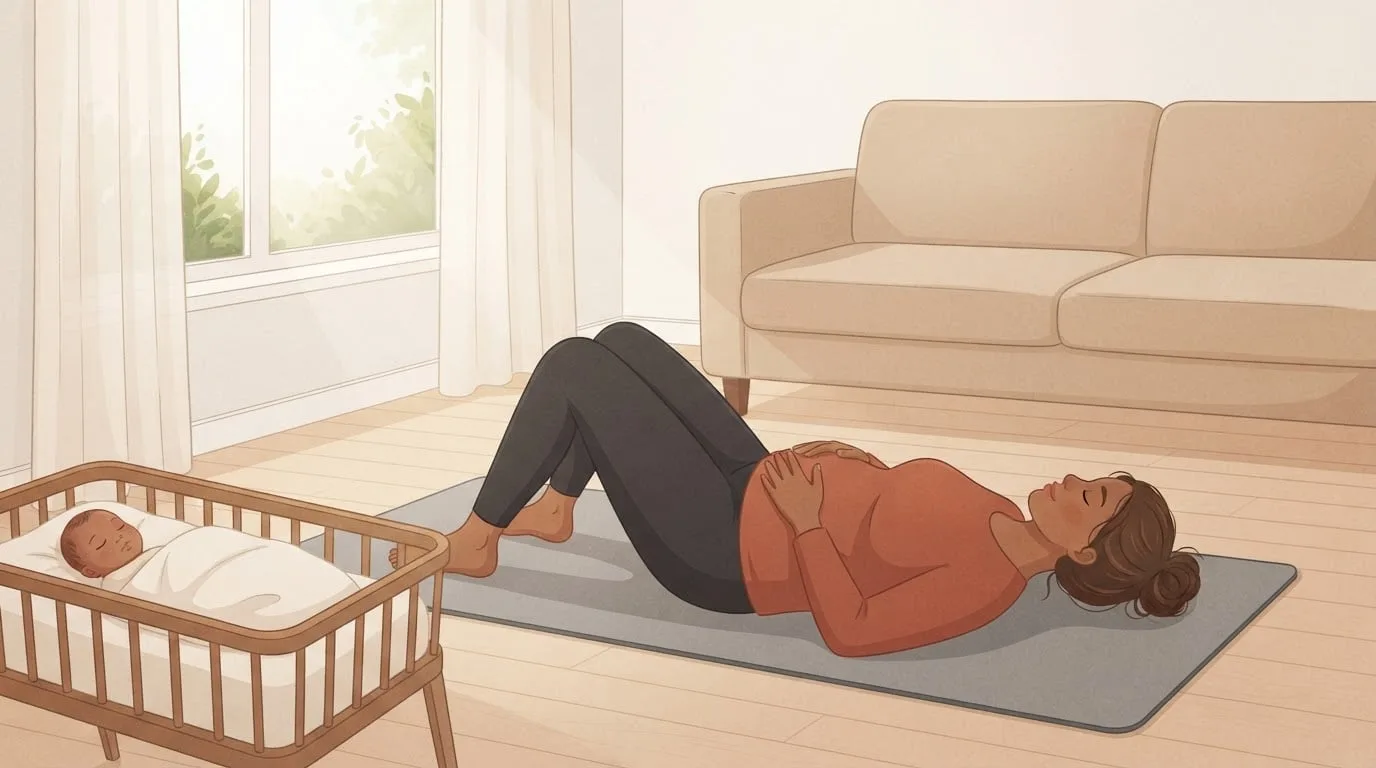
You've had major abdominal surgery and been handed a newborn on the same day. Nobody recovering from any other abdominal operation would be asked to get up every two hours through the night and carry a baby up the stairs, but that's the normal job after a C-section. So it makes sense if you're eager to feel like yourself again and nervous about anything that might pull on your incision. You're also far from alone: 32.4% of US births in 2024 were cesarean deliveries, according to the CDC.
The right post C-section exercises help your recovery rather than threaten it. Walking lowers the risk of blood clots. Gentle breathing and pelvic floor work start reconnecting muscles that pregnancy stretched. A gradual return to strength makes lifting a car seat easier. The key is order: what you do in week one looks nothing like what you do at week twelve, and core exercises after a C-section look nothing like sit-ups.
This guide gives you a week-by-week plan, each exercise with step-by-step instructions, how to check for abdominal separation, the exercises to hold off on and the warning signs that mean stop. It's a general plan. Your own obstetrician, midwife or pelvic health physiotherapist knows your surgery and your body, and their advice comes first.
How Soon Can I Exercise After a C-Section?
Gentle exercise can start within days, and harder exercise waits. The American College of Obstetricians and Gynecologists' committee opinion on exercise in pregnancy and after birth (ACOG Committee Opinion 804, 2020) encourages a gradual return to physical activity when there are no medical or surgical complications. It notes that some women can resume within days of delivery, and that pelvic floor exercises can begin in the immediate postpartum period. A cesarean is surgery, so the gentle part starts early and the demanding part takes longer.
Hospital recovery guidelines push in the same direction. The Enhanced Recovery After Surgery (ERAS) Society recommends early mobilization after a cesarean (Macones and colleagues, 2019), and the NHS advises a gentle daily walk to lower the risk of blood clots.
What about the six-week check? Many clinicians clear women for more strenuous exercise at a postpartum visit around 6 to 8 weeks after birth. That's a common clinical habit, not a rule written into ACOG's exercise guidance. ACOG's postpartum care guidance (Committee Opinion 736, 2018) recommends contact with your obstetric care provider within the first 3 weeks and a full postpartum visit no later than 12 weeks after birth. Ireland's health service, the HSE, says it can take around 12 weeks for a caesarean wound to heal properly, and suggests waiting 3 to 4 months before high-effort exercise such as running.
The long-term target is the same as for anyone. The World Health Organization's 2020 guidelines recommend at least 150 minutes of moderate aerobic activity a week for postpartum women, with a mix of aerobic and muscle-strengthening activities (Bull and colleagues, 2020). You build up to that over months, not weeks.
The Week-by-Week Plan at a Glance
Move to the next stage when the current one feels easy and your clinician agrees, not because the calendar says so. If a bad night or a sore day knocks you back, drop down a stage for a session or two.
| Stage | Exercises | Hold off on |
|---|---|---|
| Days 1 to 14 | Belly breathing, pelvic floor squeezes, ankle pumps, getting out of bed on your side, short walks | Lifting anything heavier than your baby, sit-ups of any kind, driving |
| Weeks 2 to 6 | Longer walks, pelvic tilts, heel slides, small glute bridges, clamshells, short wall sits | High-effort exercise, swimming, heavy lifting |
| Weeks 6 to 12, after your check | Dead bugs, bird dogs, side planks from the knees, incline planks, light dumbbell squats and rows | Running, jumping, full planks and curl-ups |
| From 12 weeks | Goblet squats, dumbbell hip hinges, carries, head lifts and curl-ups, a walk-run return to running | Jumping straight back to your pre-pregnancy loads or mileage |
Days 1 to 14: Breathing, Pelvic Floor and Walking
These first exercises after a C-section are about blood flow, breathing and getting moving again. None of them should hurt your incision. Do them little and often, several times a day.
1. Belly Breathing
Lie on your back with your knees bent, or sit propped up with pillows. Rest one hand on your lower ribs and the other on your belly above your dressing, never on it. Breathe in through your nose for about 4 seconds and let your ribs widen and your belly rise. Breathe out slowly through pursed lips for about 6 seconds and notice a gentle tightening low in your belly. Do 5 to 10 breaths, several times a day.
2. Pelvic Floor Squeezes
Start once your catheter is out. Sitting or lying down, squeeze and lift as if you were holding in wind and stopping the flow of urine at the same time. Hold for 3 to 5 seconds, then relax fully for the same time. Build toward 10-second holds, 10 times in a row, three times a day, and add a few quick squeezes at the end. Keep breathing, and don't clench your buttocks or thighs.
About one in three women leak urine after childbirth, according to a Cochrane review of 46 trials and 10,832 women (Woodley and colleagues, 2020). Pelvic floor training is low risk, and the review found no adverse effects in any trial apart from one where two pregnant women stopped because of pelvic floor pain. But the same review rated the evidence as uncertain that training after birth fixes leaking that has already lasted for months. If you still leak after the first few weeks, see a pelvic health physiotherapist rather than just squeezing harder.
3. Ankle Pumps and Circles
Lying or sitting, point your toes away from you, then pull them back toward your shins, 10 to 20 times. Then circle each ankle 10 times in each direction. Repeat every hour or so while you're awake in the first days. Moving your feet keeps blood flowing through your calves, which matters because blood clots are one of the risks after surgery and after birth.
4. Getting Out of Bed on Your Side
This one is a technique more than an exercise, and it protects your incision all day. Bend your knees, then roll onto your side in one piece, with shoulders and hips turning together. Let your legs slide over the edge of the bed as you push yourself up with your arms. Reverse the steps to lie down. When you cough, sneeze or laugh, hold a pillow or folded towel firmly against your incision for support.
5. Short Walks
Start with a few minutes around your room or home, several times a day, standing as tall as is comfortable rather than hunching over the incision. Add a few minutes every day or two if it feels fine. The HSE suggests starting walks without pushing the pram. Let comfort set the pace: if walking increases your pain or bleeding, do less the next day.
Weeks 2 to 6: Gentle Strength While You Heal
As the soreness settles, add these gentle lying and standing exercises on a mat or your bed. Do them once a day, 5 to 10 slow repetitions each, and stop well before anything pulls at your incision. Keep walking, gradually building the time. For at least the first 6 weeks, the HSE advises against lifting anything heavier than your baby and against high-effort activity, and the NHS lists both among the things you may not manage straight away.
6. Pelvic Tilts
Lie on your back with your knees bent and feet flat. Breathe in. As you breathe out, gently flatten your lower back toward the mat by tipping your pelvis, as if tucking your tailbone slightly under. Hold for a breath, then return to neutral. Keep the movement small and slow.
7. Heel Slides
Lie on your back with your knees bent. Breathe out and feel the gentle tightening low in your belly, then slowly slide one heel along the mat until that leg is nearly straight. Slide it back as you breathe in. Alternate legs. Your pelvis should stay still and your belly should stay flat, with no bulging along the middle.
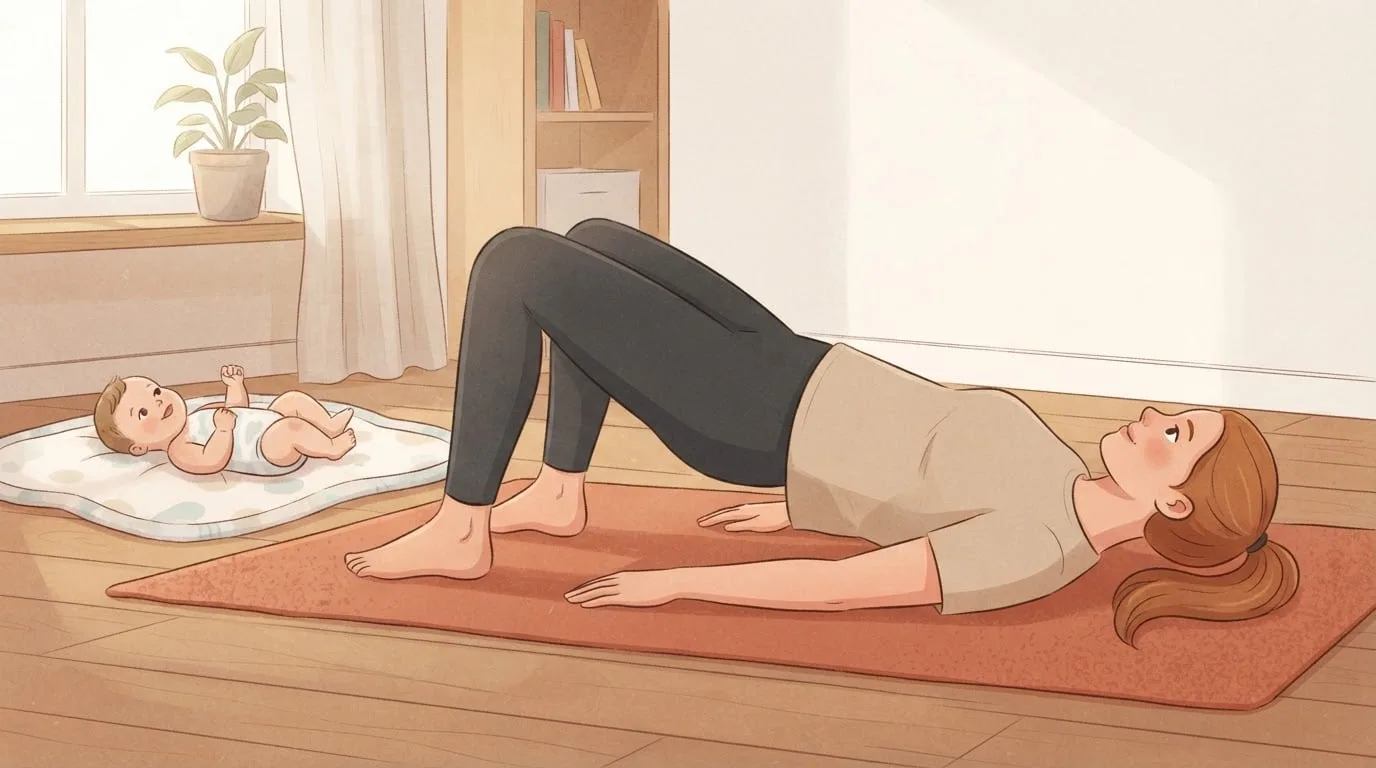
8. Small Glute Bridges
Lie on your back with your knees bent, feet flat and hip-width apart, arms by your sides. Breathe out, press through your heels and lift your hips just a few inches off the mat. Hold for a breath, then lower slowly. Over the weeks, lift a little higher, but never so high that your back arches or your incision feels stretched.
9. Clamshells
Lie on your side with your knees bent and stacked, your head resting on your lower arm. Keeping your feet together, slowly lift your top knee a few inches, then lower it. Don't let your top hip roll backward. If lying on your side is uncomfortable, put a pillow under your belly for support.
10. Short Wall Sits
Stand with your back against a wall and your feet about a foot in front of you. Slide down until your knees are slightly bent, no deeper than a quarter squat at first. Hold for 10 to 20 seconds while breathing normally, then slide back up. This strengthens your legs for getting up and down with your baby, with very little strain on your belly.
Find out what's really holding you back
FitCraft, our mobile fitness app, pairs you with an AI coach who builds you a personalized plan around your goals, schedule, and fitness level. Every FitCraft program is designed by Domenic Angelino, MPH (Brown University) and NSCA-CSCS, with research published in the Journal of Strength and Conditioning Research and Medicine & Science in Sports & Exercise.
Take the Free Assessment Free • 2 minutes • No credit cardWeeks 6 to 12: Core Exercises After a C-Section
Once your clinician has checked you and your incision has closed, the focus shifts to rebuilding your deep core and getting your strength back. Ab exercises after a C-section start here, and they're about control, not burn. Aim for two or three short sessions a week of 2 sets of 6 to 10 slow repetitions. On every rep, watch your belly: if the midline pushes up into a ridge, you hold your breath, or you leak, make the exercise easier.
11. Dead Bug, One Limb at a Time
Lie on your back with your knees bent and feet flat. Breathe out, feel your deep belly tighten, and slowly slide or lower one foot toward the floor, then bring it back. Alternate legs. When that's easy, lift both knees to 90 degrees and lower one heel at a time to tap the floor, still keeping your lower back steady.
12. Bird Dog
Start on your hands and knees, hands under shoulders and knees under hips. Breathe out and slide one leg straight back along the floor, then lift it to hip height if you can keep your back level. Return and switch sides. Later, reach the opposite arm forward at the same time. Move slowly enough that a cup of water on your back wouldn't spill.
13. Side Plank From the Knees
Lie on your side with your elbow under your shoulder and your knees bent behind you. Breathe out and lift your hips so your body makes a straight line from knees to head. Hold for 10 to 20 seconds while breathing, then lower. Do both sides.
14. Incline Plank
Place your forearms or hands on a kitchen counter and walk your feet back until your body is in a straight line. Breathe normally and hold for 15 to 30 seconds. Over the weeks, lower the surface: a sturdy chair, then your knees on the floor. Full planks on your toes come later, once you can hold the lower versions without doming.
15. Light Dumbbell Squats and Rows
For the squat, hold one light dumbbell at your chest, sit back toward a chair until you lightly touch it, then stand, breathing out as you rise. For the row, put one hand and knee on a bench or the sofa, let a light dumbbell hang from the other hand, then pull it toward your hip and lower it slowly. Start lighter than your baby and add weight gradually.
Low-impact cardio such as brisk walking or a stationary bike fits this stage too. Swimming waits until your bleeding has stopped, your wound has fully healed and your clinician agrees. The HSE counts swimming as high-effort exercise and suggests waiting 3 to 4 months after a caesarean.
How to Check for Diastasis Recti After a C-Section
Diastasis recti is a widening of the strip of connective tissue down the middle of your abdomen, and it's very common after pregnancy, however you gave birth. In a study that followed 300 first-time mothers (Sperstad and colleagues, 2016), 60% had a separation at 6 weeks after birth and about a third still did at 12 months.
- Lie on your back with your knees bent and feet flat.
- Place two or three fingertips across your midline just above your belly button, pointing toward your feet.
- Breathe out and lift your head and the tops of your shoulders slightly off the floor.
- Feel how many finger widths sink into the gap and how firm the tissue feels under your fingertips.
- Repeat at your belly button and a few centimeters below it, staying well above your scar.
Two or more finger widths is the threshold that research on new mothers has used to call it a diastasis. Depth and firmness matter more than width, and this home check is a rough screen, not a diagnosis. Our diastasis recti exercises guide has the full four-phase plan and the evidence on crunches. If you feel a firm bulge at or near your belly button or your scar, see your doctor, since that needs checking for a hernia.
From 12 Weeks: Strength, Then Impact
By around three months, most women are ready to train more like anyone else returning to exercise, as long as the earlier stages feel easy and nothing domes, leaks or hurts. Progress one thing at a time, such as weight, repetitions or impact, so you can tell what caused a flare-up if one happens.
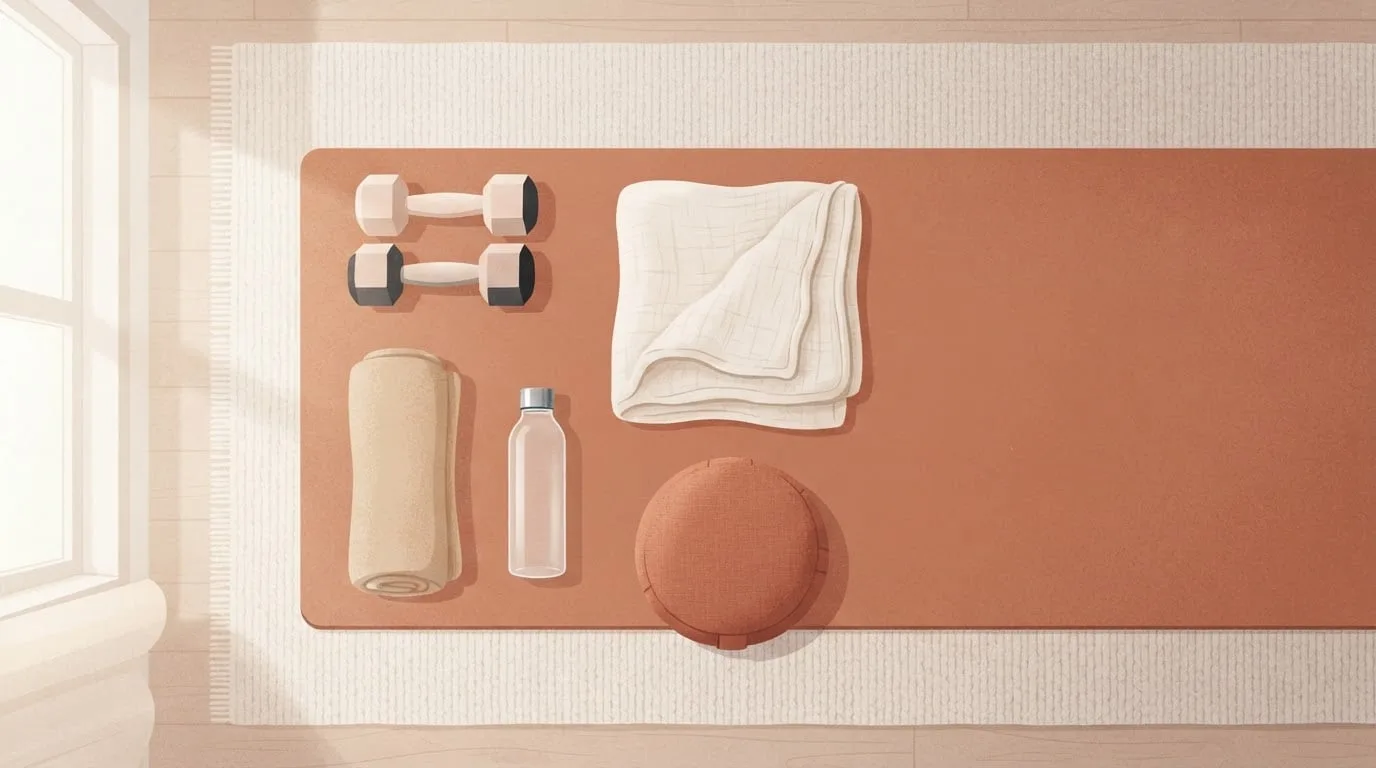
16. Goblet Squat
Hold one dumbbell vertically against your chest with both hands, feet a little wider than your hips. Breathe in, sit your hips down and back until your thighs are about level with the floor or as low as you can control, then breathe out as you stand. Keep your chest up and your knees in line with your toes.
17. Dumbbell Hip Hinge
Stand with a dumbbell in each hand in front of your thighs, knees soft. Push your hips back and let the weights slide down your thighs until you feel a stretch in your hamstrings, keeping your back flat. Breathe out and drive your hips forward to stand tall. This is the movement you use every time you pick your baby up from the floor.
18. Suitcase Carry
Hold one dumbbell at your side like a suitcase. Stand tall, without leaning toward or away from the weight, and walk 20 to 30 steps. Switch hands. Carries train exactly what daily life now asks of you: staying upright and braced while something heavy hangs off one side.
19. Head Lifts and Curl-Ups
Lie on your back with your knees bent. Breathe out, tuck your chin gently and lift just your head and the tops of your shoulders, then lower. When that stays smooth and flat along your midline, progress to a small curl-up. Range is the dial you turn. If your belly domes, make the movement smaller.
20. Walk-Run Return to Running
UK guidance on running after childbirth, summarized for clinicians in the British Journal of Sports Medicine (Donnelly and colleagues, 2020), advises waiting at least 12 weeks before planning a return to running, and treats that as a guide rather than a cutoff. Start with short intervals, such as one minute of easy jogging and two of walking, on flat ground. Add running time only if you finish without leaking, heaviness, pain or bulging. The HSE's 3 to 4 months for high-effort activity after a caesarean fits the same window.
What Exercises Not to Do After a C-Section
Most exercises aren't banned after a C-section, just postponed until your body can handle them. Hold off on these until the stage where they appear in the plan:
- Sit-ups, crunches and double leg raises in the first weeks. They put the most strain on the healing abdominal wall. Curl-ups come back later, in a smaller range.
- Full planks on your toes before you can hold an incline or knee plank without your belly doming.
- Lifting anything heavier than your baby for about the first 6 weeks.
- Running, jumping and high-intensity intervals before about 12 weeks.
- Swimming before your bleeding has stopped, your wound has fully healed and your clinician agrees.
- Anything that makes your belly cone into a ridge, makes you hold your breath, causes leaking or a heavy feeling in your pelvis, or hurts. That rule applies at every stage.
Warning Signs: When to Stop and Call Your Doctor
Some discomfort is normal while you heal. These signs aren't. The CDC lists the first group as urgent maternal warning signs, so get medical care immediately if you have any of them (CDC HEAR HER campaign):
- Bleeding that soaks through one or more pads in an hour, or clots bigger than an egg
- A fever of 100.4°F (38°C) or higher
- Chest pain, a racing heart or trouble breathing
- Severe swelling, redness or pain in one leg or arm
- A headache that won't go away or gets worse
Stop exercising and call your doctor or midwife soon if you notice any of these:
- Your incision becomes more red, painful or swollen, opens, or leaks pus or foul-smelling fluid
- Bleeding that gets heavier after exercise
- Pain that is worse during or after exercise, rather than easing as you warm up
- Leaking urine, or a heavy, dragging or bulging feeling in your vagina
- A bulge along your midline, at your belly button or near your scar
Postpartum Fitness Beyond the C-Section
Everything else about getting back to exercise after a baby applies whether you delivered vaginally or by cesarean: short nights, mom guilt and fitting workouts around feeds. Our postpartum fitness guide covers that bigger picture, including the research on what keeps new mothers moving.
Once you're cleared for general exercise, the question shifts from what's safe to what you'll keep doing. Our roundup of the best workout apps for moms separates the specialist postpartum apps from general fitness apps. FitCraft is a general fitness app rather than a postpartum recovery program, so it fits after your clinician has cleared you. Its 3D AI coaches demonstrate dumbbell, bodyweight, yoga and mobility exercises you can do at home, and streaks help the habit stick. As Stacy, a FitCraft user, put it: "After my second kid, I needed something stupidly simple."
The Bottom Line
Exercises after a C-section run in a fixed order. Breathing, pelvic floor squeezes, ankle pumps and short walks come in the first days. Gentle lying exercises follow over the next few weeks. Core rebuilding and light dumbbell work start after your clinician checks you, and heavier strength work and running come from about 12 weeks. Watch for doming, leaking, pain and bleeding at every stage, and treat them as signs to step back.
Your body did something enormous. Rebuilding it in the right order is how you get back to feeling strong, and there's no prize for rushing.
Frequently Asked Questions
How soon can I exercise after a C-section?
You can start gentle exercises after a C-section within the first days: belly breathing, pelvic floor squeezes, ankle pumps and short walks. Gentle lying exercises can follow over the next few weeks. Harder core work and strength training usually wait until your clinician has checked you, often around 6 to 8 weeks, and running or other high-effort exercise usually waits until at least 12 weeks.
What is the 5-5-5 rule for C-section recovery?
The 5-5-5 rule is a popular postpartum rest guideline shared online, not a clinical recommendation: five days in bed, five days on the bed and five days around the bed. After a C-section, treat it as permission to rest and accept help, not as an instruction to lie still. Recovery guidelines recommend getting up and walking early, because moving lowers the risk of blood clots.
How far can I walk 3 weeks after a C-section?
There's no research-based distance for week 3, so let comfort set it. Start from what felt easy the week before, add a few minutes every few days, walk on flat ground and stop if pain, bleeding or a pulling feeling at your incision increases. Ireland's HSE suggests starting your walks without pushing the pram.
How do I flatten my belly pooch after a C-section?
Some belly overhang after a C-section is normal for months while stretched skin and muscles recover, and scar tissue can pull the skin in just above the incision. Exercise can't target fat in one spot. Time, rebuilding your deep core, regular activity and steady, healthy eating are what help. See your doctor or a pelvic health physio if a bulge pushes out when you cough or strain.
When can I start bending after a C-section?
You can bend for everyday tasks such as picking up your baby or getting dressed from the first days, as long as you move slowly, bend your knees rather than folding at the waist and breathe out as you rise. Avoid lifting anything heavier than your baby and repeated loaded bending for about the first 6 weeks, or until your clinician clears you.
When can I do ab workouts after a C-section?
Gentle core work such as belly breathing, pelvic floor squeezes and pelvic tilts can start in the first weeks. Ab exercises with more load, such as dead bugs, bird dogs and side planks from the knees, usually begin after your postpartum check. Curl-ups and full planks come later, often from about 12 weeks, once you can do them without your belly doming, leaking or pain.