- Lift two to three times a week. Full-body resistance sessions covering legs, hips, chest, back, shoulders, and core. The 2024 Neeland review recommends at least twice weekly for anyone on a GLP-1.
- Eat 1.2 to 1.6 g of protein per kg of body weight per day. Anchor every meal around a protein source, because appetite suppression makes this the hard part.
- Walk daily. Aim for a step count you can sustain. It supports energy and recovery on top of the lifting.
- Ramp up over four weeks. One working set per movement in weeks 1 and 2, a second set in weeks 3 and 4, then start adding load or reps from week 5. Begin the same week you start the medication if your clinician agrees.
- Shorten, don't skip, on bad days. Nausea and low energy are common early on. A 10-minute version of the session keeps both the habit and the muscle signal alive.
- No gym needed. Bodyweight, bands, and dumbbells produce the muscle-preserving signal at the dose most people on a GLP-1 need.
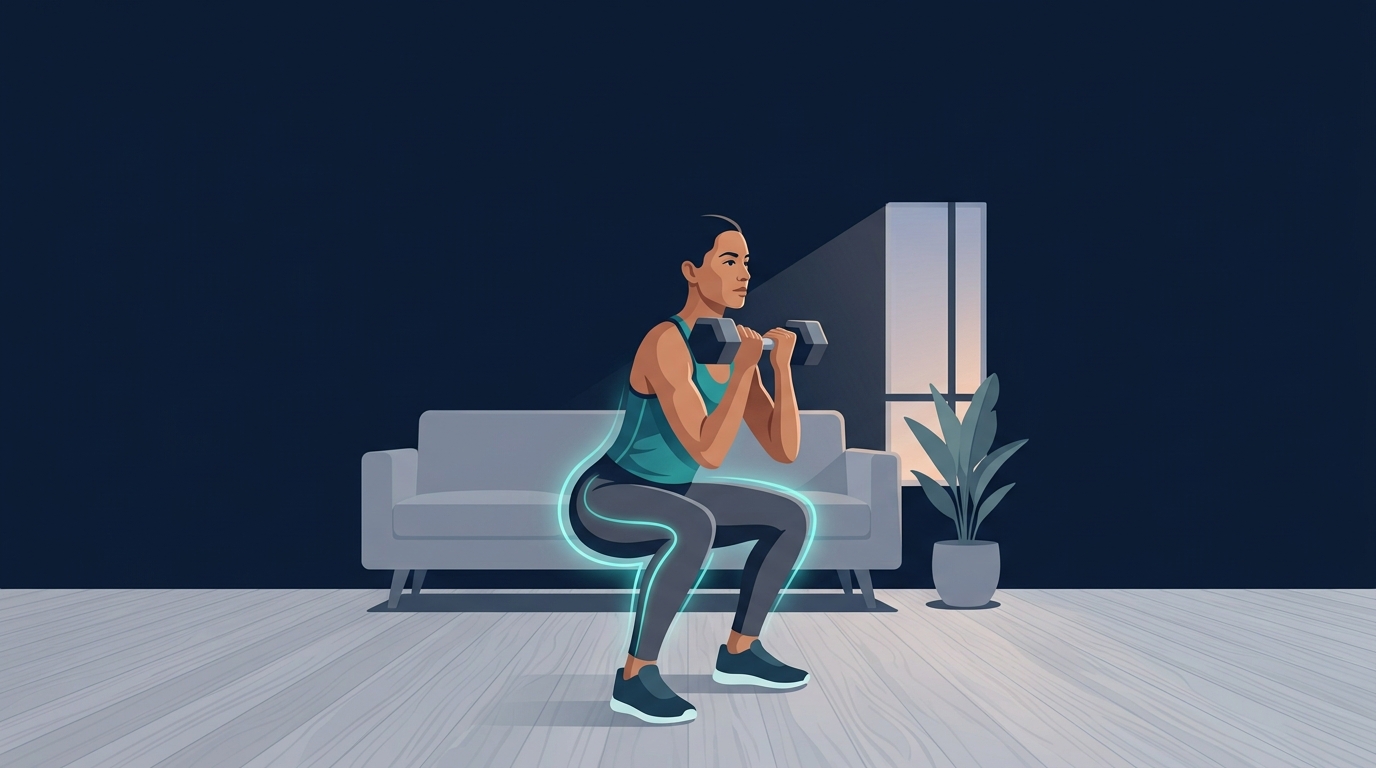
If you're losing weight on Ozempic, Wegovy, Mounjaro, or Zepbound, some of what comes off will be muscle. That's not a flaw in the drug. It's what happens during any large, fast weight loss. The good news is that muscle loss is one of the most controllable parts of the whole process, and the plan to control it is refreshingly simple. This guide lays out exactly what to do, how often, and how to tell if it's working.
One note before we start. This is general education, not a prescription. GLP-1 medications interact with a lot of systems in your body, and the right training and nutrition plan depends on your health history. Talk to the clinician who prescribed your medication before you start anything here. With that said, here's the plan the current clinical reviews actually point to.
Why muscle loss happens on a GLP-1 (and why it's fixable)
GLP-1 medications work by suppressing appetite and slowing how fast your stomach empties. You eat less, sometimes a lot less, and that creates a sustained calorie deficit. Your body then pulls energy from stored tissue. Some of that is fat. Some of it is muscle. The ratio isn't fixed, and that's the whole point of this guide.
The trial data puts real numbers on it. In the STEP 1 body composition substudy (Wilding et al., 2021) roughly 45 percent of the weight lost on semaglutide came from lean mass on a DXA scan. The tirzepatide substudy looked a little better, but the lesson is the same: a meaningful chunk of what you lose can be muscle unless you send your body a reason to keep it. We covered the full body-composition picture in our science deep dive on GLP-1 drugs and muscle loss.
Here's the part that matters. Two signals decide whether your body holds onto muscle during a deficit: mechanical loading (using the muscle) and protein (feeding the muscle). Turn both on and you keep most of your lean tissue. Leave both off and you lose more of it. That's the entire mechanism, and it's why this plan has exactly two ingredients that do the heavy lifting, plus walking to round it out.
Ingredient 1: Resistance training, two to three times a week
Resistance training is the non-negotiable centerpiece. When you load a muscle, you give your body a reason to maintain it, even when calories are scarce. A 2018 meta-analysis by Sardeli et al. in Nutrients pooled six trials of older adults in a calorie deficit and found that resistance training preserved nearly all lean mass while still allowing significant fat loss. The same physiology applies during GLP-1 weight loss.
How much do you actually need? Less than you'd think. The dose that preserves muscle is much lower than the dose that builds new muscle. The 2024 review by Neeland, Linge, and Birkenfeld in Diabetes, Obesity and Metabolism recommends progressive resistance training at least twice per week for anyone on GLP-1 therapy. Around 10 hard sets per major muscle group per week is plenty during a deficit, which fits comfortably into two or three short full-body sessions.
The weekly structure
Minimum effective plan: two full-body sessions a week, at least a day apart.
Better if you can: three full-body sessions a week.
Each session: one exercise for each major movement pattern, two or three working sets of 8 to 15 reps, stopping a rep or two short of failure. That last part matters: you're preserving muscle, not grinding yourself into the ground on a day when your appetite and energy are already lower than usual.
Every session should hit the same six patterns. You don't need dozens of exercises. You need the basics, done consistently, with a little more effort over time. This idea of adding a little each week is called progressive overload, and it's how a muscle keeps getting the signal to stick around.
| Movement pattern | No equipment | Bands or dumbbells |
|---|---|---|
| Squat (legs) | Bodyweight squat, chair sit-to-stand, wall sit | Goblet squat, dumbbell squat |
| Hinge (hips, hamstrings) | Glute bridge, single-leg hip hinge | Dumbbell Romanian deadlift, band good morning |
| Push (chest, shoulders) | Push-up (wall, knee, or incline) | Dumbbell chest press, overhead press |
| Pull (back) | Doorway row, towel row, inverted row | Band supported row, bent-over row |
| Lunge (single-leg) | Split squat, step-up | Dumbbell reverse lunge |
| Core | Plank, dead bug | Suitcase carry, side plank |
Start at a level that feels almost too easy. On a GLP-1, especially in the first weeks, your energy and appetite are shifting, and the goal is to build a habit you'll keep, not to prove anything in session one. Each week, add a rep, a set, or a small amount of resistance. That slow climb is what keeps the muscle-preserving signal switched on. If you want more on where the "two or three days" number comes from, our science page on training frequency for muscle walks through the evidence.
Ingredient 2: Protein, 1.2 to 1.6 g per kg per day
Protein is the other half of the muscle-preservation equation, and on a GLP-1 it's usually the harder half. When appetite drops, protein is the first thing most people fall short on, because high-protein foods are filling and you're already not hungry. That's exactly backward from what your muscle needs.
The target that shows up across the clinical literature is 1.2 to 1.6 grams of protein per kilogram of body weight per day during active weight loss, with the higher end for older adults and anyone starting with low muscle mass. The Cava, Yeat, and Mittendorfer (2017) review in Advances in Nutrition is the standard reference for eating to protect muscle during a deficit: higher protein plus resistance training preserves muscle and strength far better than dieting alone. And the Morton et al. (2018) meta-analysis in the British Journal of Sports Medicine pooled 49 studies and found that total daily protein was the strongest dietary driver of training results, with benefits leveling off around 1.62 g per kg per day. There's no need to overshoot.
For an 80 kg person (about 176 lb), that's roughly 96 to 128 grams of protein a day. Here's how to actually hit it when your appetite is working against you:
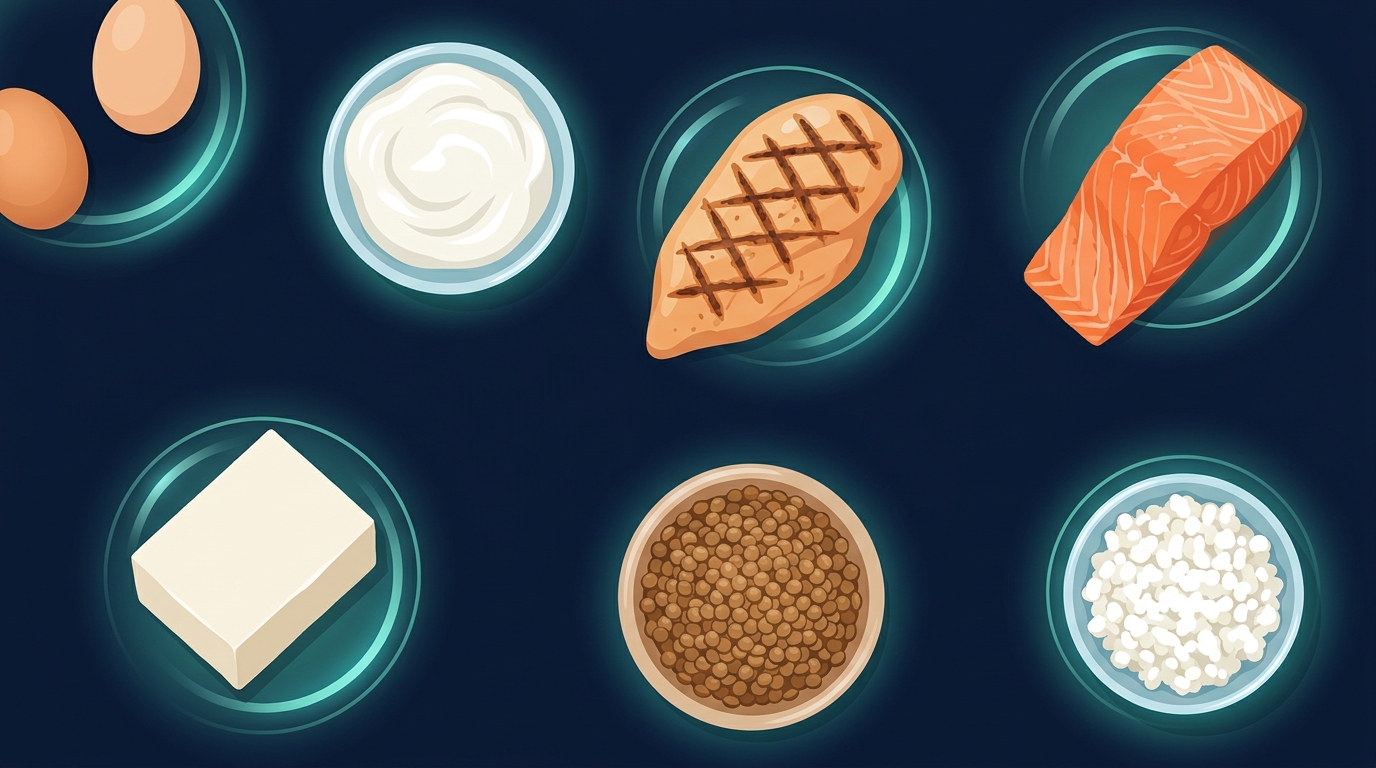
- Protein first, every meal. Put the protein on the plate before anything else, and eat it first. Eggs, Greek yogurt, cottage cheese, chicken, fish, tofu, tempeh, lentils, and protein powder are the workhorses.
- Use protein-dense, low-volume options. A scoop of protein powder in coffee or a Greek yogurt delivers a meal's worth of protein with very little stomach load. On a GLP-1, that's a feature, not a shortcut.
- Spread it across the day. Aim for a solid protein hit at each meal rather than one giant serving. Distributing protein across meals supports muscle protein synthesis more evenly.
- Track it for a week. Most people badly underestimate how little protein they're getting on a suppressed appetite. One week of logging usually reveals the gap.
Find out what's really holding you back
FitCraft, our mobile fitness app, pairs you with an AI coach who builds you a personalized plan around your goals, schedule, and fitness level. Every FitCraft program is designed by Domenic Angelino, MPH (Brown University) and NSCA-CSCS, with research published in the Journal of Strength and Conditioning Research and Medicine & Science in Sports & Exercise.
Take the Free Assessment Free • 2 minutes • No credit card
Ingredient 3: Daily walking on top
Walking doesn't preserve muscle the way lifting does, so it's a supporting player, not the star. But it earns its place. Daily movement supports cardiovascular fitness, helps with the energy availability that lets your higher protein intake actually feed muscle, and keeps you from sliding into the couch as your body weight drops.
That last risk is real, and it's newer than the muscle-loss story. A large 2026 analysis presented at the Endocrine Society's ENDO meeting found that people actually moved less after starting a GLP-1, not more. Daily steps dropped by about 560 a day on average. So the walking here is partly about counteracting a documented tendency to become more sedentary on these medications. Aim for a step target you can genuinely sustain, and treat it as the floor, not the ceiling. If you want to make walking do more, our guide to a weighted vest for walking covers a gentle way to add load.
The week-by-week plan
Timing matters more than people expect. The 2024 Neeland review specifically recommends starting resistance training during the dose-escalation phase, not waiting until your weight loss plateaus. The lean tissue that comes off in the first three months is the hardest to recover later, so the earlier you turn on the muscle-preserving signal, the less ground you have to make up. Two sessions a week is also the floor in the Physical Activity Guidelines for Americans, which call for muscle-strengthening activity on at least two days a week for every adult.
Starting early doesn't mean starting hard. In the first weeks your appetite, energy, and sometimes your stomach are all adjusting to the medication. So the plan below deliberately starts at a volume that will feel too easy. That's the point. You're building a habit that has to survive dose increases and rough days, and the fastest way to lose it is to go too hard in week one.
Pick one exercise for each of the six patterns from the table above and keep those same six for the first month. Familiar movements let you judge progress honestly, and they cut the mental load on days when you're running on very little food.
Weeks 1 and 2: learn the movements
Two sessions this week. One working set of each of the six patterns, 8 to 12 reps, stopping well short of failure. That's roughly 15 minutes of actual work. Your only job in these two weeks is to finish both sessions and learn what each movement feels like done well. If a push-up from the floor is too much, do it from a counter or a wall. If a bodyweight squat is shaky, sit down to a chair and stand back up. Starting easier is not a lesser version of the plan. It's the version that works.
Weeks 3 and 4: add the second set
Same six movements, same two or three days, now two working sets each. Sessions run about 25 minutes. Reps stay at 8 to 12 and you're still stopping two or three reps short of failure. By the end of week 4 most people notice the first real change: the movements feel coordinated instead of awkward, and the second set no longer feels like a negotiation.
This is also where the third weekly session becomes worth adding if your energy allows it. Two days protects muscle. Three days gives you a buffer for the weeks when the medication wins and you only manage one.
Weeks 5 to 8: start progressing
Now you add load. Each week, pick one thing to nudge on each movement: one more rep, a slightly heavier dumbbell, a harder variation, or a slower lowering phase. Not all four at once, and not on every exercise every week. This slow climb is progressive overload, and it's the mechanism that keeps telling your body the muscle is still worth feeding.
A concrete example of moving up a variation: incline push-ups on a counter become incline push-ups on a chair, then kneeling push-ups, then full push-ups. Same pattern, four levels of difficulty, no equipment. Do the same for squats by moving from a chair sit-to-stand to a full bodyweight squat to a goblet squat with a dumbbell.
Expect progression to be uneven. Weight loss on a GLP-1 means you're carrying less body weight each month, so bodyweight movements may get easier while loaded ones stall. Both are normal. Holding your working weights steady during a deficit is already a win.
Week 9 and beyond: maintain and monitor
By week 9 you have a habit rather than a project. Keep two or three sessions a week, keep two or three sets per movement, and keep nudging load when a set feels genuinely easy. You can now add a third set on your two hardest movements, usually the squat and the hinge, if you want a bit more margin.
Add a variation swap roughly every 8 to 12 weeks to keep things interesting: reverse lunges in place of split squats, Romanian deadlifts in place of glute bridges. Keep the pattern, change the exercise. And keep checking the function markers in the next section, because those are what tell you the plan is still doing its job. If you'd rather have an app handle the programming and the week-to-week progression for you, we compared the best fitness apps for GLP-1 users with muscle preservation in mind.
| Phase | Sessions per week | Sets per movement | Focus |
|---|---|---|---|
| Weeks 1-2 | 2 | 1 set of 8-12 | Learn the movements, finish every session |
| Weeks 3-4 | 2-3 | 2 sets of 8-12 | Build the habit, add the third day if energy allows |
| Weeks 5-8 | 2-3 | 2-3 sets of 8-12 | Add reps, load, or a harder variation each week |
| Week 9+ | 2-3 | 2-3 sets of 8-15 | Maintain, swap variations every 8-12 weeks, monitor function |
What a week looks like
The weekly shape stays the same through every phase above. Only the sets and the load change. Adjust the days to your own schedule. The one rule is to keep at least one day between lifting sessions. If you want this shape drafted around your own equipment and schedule, our free AI workout generator does it for free.
| Day | Focus | Detail |
|---|---|---|
| Monday | Full-body strength | Squat, push, pull, core · 2-3 sets each · ~25 min |
| Tuesday | Walk | Easy walk at a sustainable pace |
| Wednesday | Full-body strength | Hinge, lunge, push, pull · 2-3 sets each · ~25 min |
| Thursday | Walk | Easy walk |
| Friday | Full-body strength (optional third) | Mix of all six patterns · ~25 min |
| Saturday | Walk or activity you enjoy | Hike, bike, sport, or a longer walk |
| Sunday | Rest | Light movement only |
Protein target of 1.2 to 1.6 g per kg applies every single day, training or not. On a suppressed appetite, the rest days are often where people fall furthest behind on protein, so don't let your guard down when there's no workout to remind you.
Training around GLP-1 side effects
Most plans written for GLP-1 users quietly assume you'll feel fine. Plenty of days you won't, and a plan that ignores that is a plan you'll abandon in month two. The same test applies to apps: our ranking of the best workout apps for weight loss scores each one on whether it survives a bad week. Gastrointestinal side effects are the most common reason people stop training early. In the STEP 1 trial (Wilding et al., 2021, New England Journal of Medicine), 44.2 percent of participants taking semaglutide reported nausea compared with 17.4 percent on placebo, and gastrointestinal events of some kind affected 74.2 percent of the semaglutide group. The reassuring part: those effects were usually mild to moderate, and they tended to fade as people stayed on a given dose.
So the goal isn't to train through everything. It's to have a smaller version of the session ready, so a rough day costs you 15 minutes instead of a month of momentum.
Nausea days
Nausea usually spikes in the days after a dose increase and settles as your body adjusts. A few practical adjustments make training tolerable:
- Notice your pattern and schedule around it. Most people find some days of the week reliably worse than others. Put your lifting sessions on your better days and your walk on the rough ones. You're arranging your week around the medication, not adjusting the medication.
- Stay upright. Movements that put your head below your heart or compress your stomach tend to feel worst. Swap floor work for standing versions: a wall sit instead of a floor-based leg exercise, a standing overhead press instead of a lying press.
- Leave a gap after eating. GLP-1 medications slow how fast your stomach empties, so food sits longer than you're used to. Training two or three hours after a meal is a lot more comfortable than training 30 minutes after one.
- Cut to one set. One set of each of the six patterns still sends the muscle-preserving signal. It takes about 12 minutes.
- Sip water throughout. Small amounts, often, rather than a large volume at once.
Low-energy days
Low energy on a GLP-1 is usually an availability problem, not a motivation one. You're eating meaningfully less, and your body notices. The fix is a smaller session, not a rest day, because rest days multiply. One skipped session becomes a skipped week faster than most people expect.
Have a defined minimum version and treat it as the real workout, not a consolation prize. Ours is one set each of a squat, a push, and a pull, done at whatever difficulty feels manageable. Ten minutes. On the days you can't face the full session, that's the plan, and finishing it counts as a completed session.
If your energy is flat every single day for more than a week or two, that's information rather than weakness. It usually means protein and total calories have drifted too low, which is easy to do on a suppressed appetite. Track your intake for a few days and bring the numbers to your prescribing clinician.
When to actually rest
Shortening beats skipping, but some days you should genuinely not train. Rest, and contact your healthcare provider when it's warranted, if you have any of the following:
- Vomiting or diarrhea. Both cause fluid and electrolyte losses that make exercise genuinely unsafe. Rehydrate and wait until you've kept food and fluids down for a full day.
- Dizziness or lightheadedness when you stand up. A common sign of dehydration or low blood sugar. Training with it risks a fall.
- Severe or persistent abdominal pain. This is a documented warning sign with GLP-1 medications and needs prompt medical attention, not a lighter workout.
- Fever or active illness. The usual rules apply here, and they apply on a GLP-1 too.
- Sharp joint or muscle pain. Distinct from the ordinary soreness of a new program. Stop the movement that causes it.
Missing a session for any of these costs you almost nothing. A single week off doesn't undo the muscle you've protected. Pick the plan back up at the phase you left, or one phase earlier if you've been out for more than two weeks, and carry on. For more on the day-to-day realities of training on these medications, our post on Ozempic and exercise covers the practical side in more depth.
How to tell if it's working
You don't need a monthly DXA scan to know whether you're preserving muscle. Function is a better everyday signal than any single number, and you can check it at home. Pick two or three of these and revisit them every few weeks:
- Grip strength. How firmly you can squeeze, or how long you can hang from a bar, tracks whole-body muscle and strength surprisingly well.
- Sit-to-stand. Standing up from a chair without using your hands, and how many times you can do it in 30 seconds, is a classic functional check.
- Walking speed. Whether your usual walking pace holds steady as you lose weight.
- Your working weights. If the resistance you use in your sessions is holding or slowly climbing, your muscle is being maintained.
If these hold steady while the scale drops, the weight you're losing is mostly fat and the plan is working. If they start slipping, that's your cue to add a third lifting day, push your protein toward the top of the range, and check in with your healthcare provider. This is the same functional monitoring that matters for anyone at risk of sarcopenia, the age-related loss of muscle that resistance training is uniquely good at fighting.
Frequently Asked Questions
What is the best workout plan for GLP-1 users?
Full-body resistance training two to three times a week, built around six movement patterns (squat, hinge, push, pull, lunge, and core), paired with 1.2 to 1.6 grams of protein per kilogram of body weight per day and daily walking. Start with one working set per pattern in weeks 1 and 2, add a second set in weeks 3 and 4, then begin adding load or reps from week 5 onward. It works at home with bodyweight, bands, or dumbbells. The structure targets the two signals that decide whether your body keeps muscle during weight loss: mechanical loading and protein. Confirm the plan with your prescribing clinician before you start.
Can you exercise on Ozempic?
Yes, and it's one of the most useful things you can do while taking it. Resistance training is what tells your body to hold onto muscle while semaglutide drives the calorie deficit that produces the weight loss. The adjustments are practical rather than medical: expect lower energy and a smaller appetite, start at a lower volume than you otherwise would, and plan around gastrointestinal side effects, which are common. In the STEP 1 trial, 44.2 percent of participants on semaglutide reported nausea compared with 17.4 percent on placebo, and those effects were usually mild to moderate and faded with time. On a rough day, shorten the session instead of skipping it. Always clear a new exercise program with the clinician who prescribed your medication.
How often should I lift weights while on a GLP-1 medication?
Resistance training two to three times a week is the target most clinical reviews recommend. The 2024 Neeland review in Diabetes, Obesity and Metabolism advises progressive resistance training at least twice per week plus adequate protein for anyone on GLP-1 therapy. Two full-body sessions covering the major muscle groups is enough to signal your body to keep muscle during weight loss, and a third session adds a margin of safety. Consistency matters more than intensity, so pick a schedule you can actually keep.
Do I need a gym to preserve muscle on Ozempic or Wegovy?
No. The muscle-preserving signal comes from mechanical loading at a meaningful dose, not from any specific equipment. Bodyweight squats, push-up progressions, single-leg work, resistance-band rows, and dumbbell variations all produce the same signal as barbell training at the dose most people on a GLP-1 need. A 25-minute home session two or three times a week is enough to shift your body from shedding muscle to maintaining it.
How much protein should I eat on a GLP-1 to keep muscle?
Most clinical guidance lands at 1.2 to 1.6 grams of protein per kilogram of body weight per day during active weight loss, with the higher end for older adults and anyone with low muscle mass. The Morton et al. 2018 meta-analysis in the British Journal of Sports Medicine found total protein intake was the strongest dietary driver of resistance-training gains, with benefits plateauing near 1.62 g per kg per day. Appetite suppression makes hitting the target hard, so anchor every meal around a protein source first.
When should I start resistance training after beginning a GLP-1?
As early as you can, ideally the same week you start the medication, if your clinician agrees. The 2024 Neeland review recommends beginning resistance training during the dose-escalation phase rather than waiting for weight loss to plateau, because the lean tissue lost in the first few months is the hardest to recover later. Start light, keep the sessions short, and progress gradually.
How do I know if I am losing too much muscle on a GLP-1?
Track simple function rather than chasing a scan. Grip strength, walking speed, and the ability to stand up from a chair without using your hands are practical checks you can repeat at home. If those hold steady over the months of weight loss, the muscle that came off was metabolically acceptable. If they decline, that is a signal to increase resistance training and protein and to talk with your healthcare provider.
References
- Neeland IJ, Linge J, Birkenfeld AL. "Changes in lean body mass with glucagon-like peptide-1-based therapies and mitigation strategies." Diabetes, Obesity and Metabolism. 2024;26(Suppl 4):16-27. DOI: 10.1111/dom.15728
- Morton RW, Murphy KT, McKellar SR, et al. "A systematic review, meta-analysis and meta-regression of the effect of protein supplementation on resistance training-induced gains in muscle mass and strength in healthy adults." British Journal of Sports Medicine. 2018;52(6):376-384. PMID: 28698222
- Sardeli AV, Komatsu TR, Mori MA, Gaspari AF, Chacon-Mikahil MPT. "Resistance Training Prevents Muscle Loss Induced by Caloric Restriction in Obese Elderly Individuals: A Systematic Review and Meta-Analysis." Nutrients. 2018;10(4):423. PMID: 29596307
- Cava E, Yeat NC, Mittendorfer B. "Preserving Healthy Muscle during Weight Loss." Advances in Nutrition. 2017;8(3):511-519. PMC5421125
- Wilding JPH, Batterham RL, Davies M, et al. "Impact of Semaglutide on Body Composition in Adults With Overweight or Obesity: Exploratory Analysis of the STEP 1 Study." Diabetes, Obesity and Metabolism. 2021. PMC8089287
- Wilding JPH, Batterham RL, Calanna S, et al. "Once-Weekly Semaglutide in Adults with Overweight or Obesity." New England Journal of Medicine. 2021;384(11):989-1002. DOI: 10.1056/NEJMoa2032183
- U.S. Department of Health and Human Services. Physical Activity Guidelines for Americans, 2nd edition. Washington, DC: HHS; 2018. health.gov