You want to start working out at home, where nobody's watching and there's no commute. Then you look for a plan, and every one assumes a rack of dumbbells, a pull-up bar and a spare room. You have a living room, a staircase and about half an hour.
That's enough to start. This is a no equipment workout plan built from things already in your home: a sturdy chair, a wall, your stairs, a backpack and the floor. You get a 4-week calendar that tells you what to do each day, the two workouts it uses, a ladder for making each move harder without weights, a guide to fitting it in a small space, and what to do once the four weeks are up.
The 4-Week Home Workout Plan at a Glance
You train three days a week and alternate two short workouts, so each one comes up six times in four weeks. On two other days you walk, and from week 3 the stairs add a little cardio. If three training days won't fit, our workout schedule for beginners has a 2-day week.
| Day | Week 1 | Week 2 | Week 3 | Week 4 |
|---|---|---|---|---|
| Mon | Workout 1, 2 rounds | Workout 2, 2 rounds | Workout 1, 3 rounds | Workout 2, 3 rounds |
| Tue | 15-minute walk | 20-minute walk | 20-minute walk and 2 stair climbs | 25-minute walk and 3 stair climbs |
| Wed | Workout 2, 2 rounds | Workout 1, 2 rounds | Workout 2, 3 rounds | Workout 1, 3 rounds |
| Thu | Rest | 10 minutes of stretching | Rest | 10 minutes of stretching |
| Fri | Workout 1, 2 rounds | Workout 2, 2 rounds | Workout 1, 3 rounds | Workout 2, 3 rounds, then retest |
| Sat | 20-minute walk | 25-minute walk | 30-minute walk | 30-minute walk and 3 stair climbs |
| Sun | Rest | Rest | Rest | Rest |
Here's what changes from one week to the next:
- Week 1: two rounds of each workout on the easiest rung of every move. Stop each set with about 3 reps left, and write down your reps.
- Week 2: the same rungs, with 1 or 2 more reps per move wherever you can manage them.
- Week 3: a third round. Move an exercise up one rung once you reach the top of its rep range in every round.
- Week 4: keep climbing. At the end of Friday's session, count your best set of push-ups and time your longest plank, then compare both with week 1.
Any three days with a gap between them work, so shift the calendar to suit your week. A missed session isn't a reason to restart. Do the next one on the list and carry on.
The Two Home Workouts
Each workout is a circuit. Do one set of each move in order, rest about 45 seconds between moves, then rest 1 to 2 minutes before the next round. Warm up first with 2 minutes of marching in place and a few slow arm circles.
Workout 1: chair, counter and wall
| Move | What you use | Reps per round |
|---|---|---|
| Chair squat | A sturdy chair | 10-12 |
| Counter push-up | The kitchen counter | 6-10 |
| Corner row | An inside wall corner | 10-12 |
| Glute bridge | The floor | 12-15 |
| Split squat | The back of the chair, for balance | 6-8 per leg |
| Bird dog | The floor | 6 per side |
Workout 2: stairs and backpack
| Move | What you use | Reps per round |
|---|---|---|
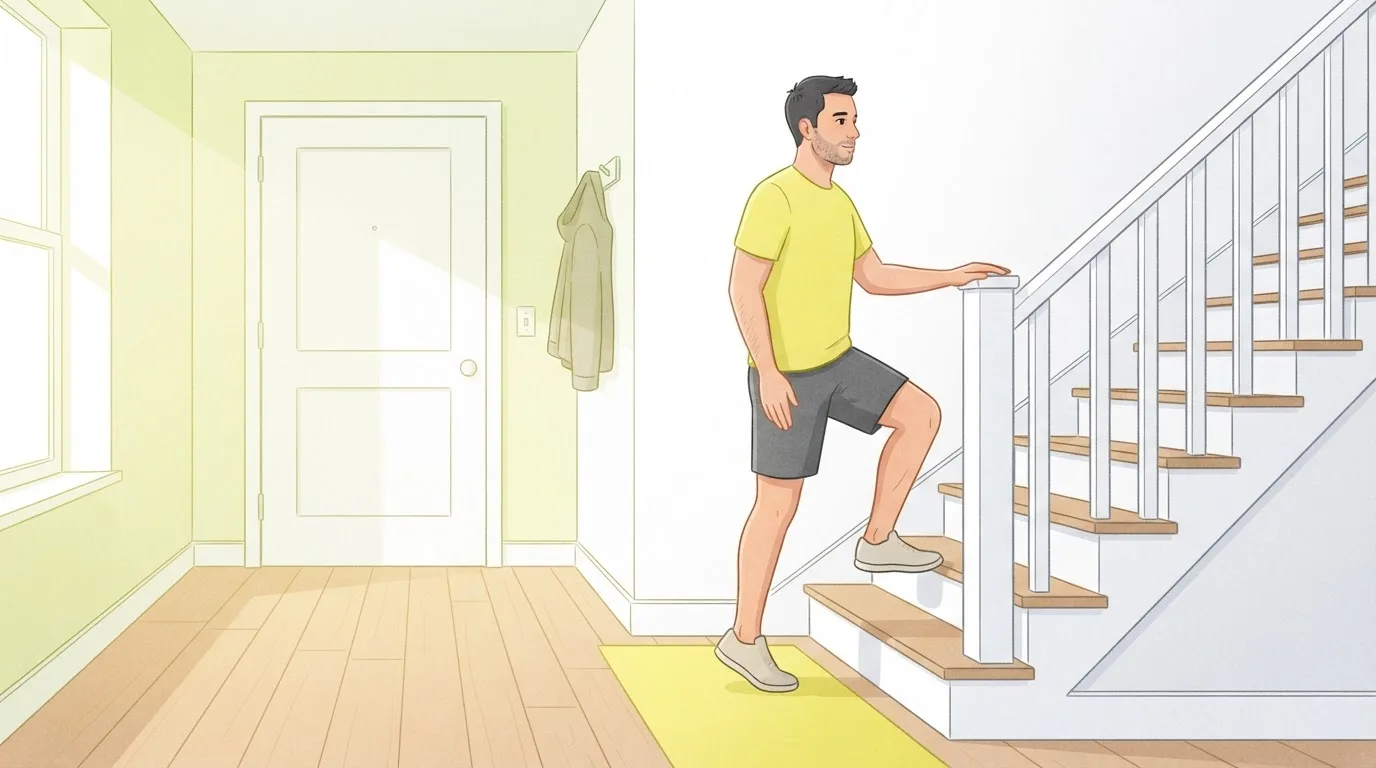
| Step-up | The bottom stair and the rail | 8-10 per leg |
| Stair push-up | Hands on the second or third step | 6-10 |
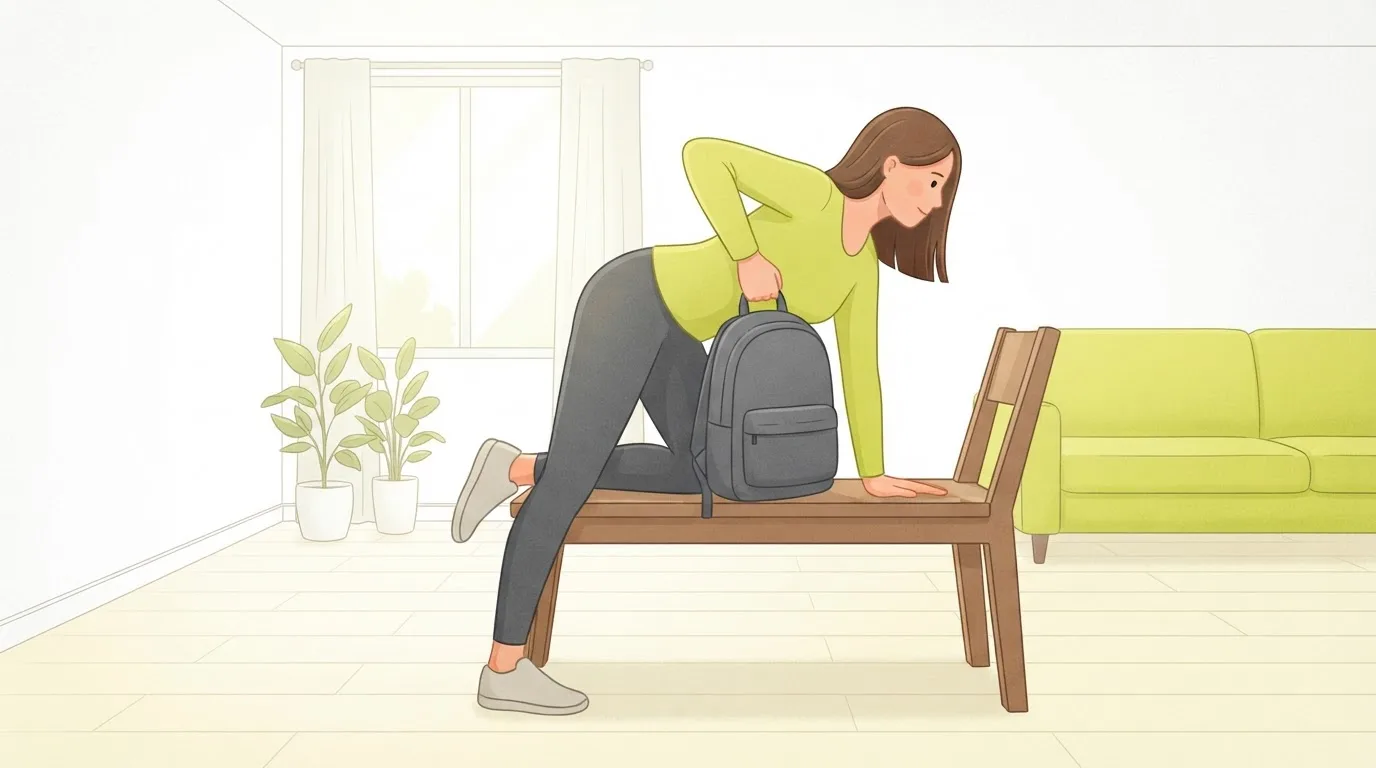
| Backpack row | A backpack with a few books in it, one hand on the chair | 10-12 per arm |
| Backpack Romanian deadlift | The same backpack, held by its top handle | 10-12 |
| Wall sit | A clear stretch of wall | 20-30 sec |
| Plank | The floor, knees down if you need it | 20-30 sec |
The chair squat, counter push-up, corner row, glute bridge, split squat and plank are taught step by step in the beginner routine linked in the next section. Here's how to do the other six moves.
- Step-up. Face the stairs with one hand on the rail. Put your whole right foot on the bottom step, press through that heel to stand tall on it, then step down with control. Finish your reps on one leg, then switch.
- Stair push-up. Place your hands on the edge of the second or third step, walk your feet back until your body is straight, and lower your chest toward the step. It's a little harder than the counter version because the step sits lower.
- Backpack row. Rest one hand and the same-side knee on the chair seat. Hold the backpack by its top handle and pull it toward your hip, keeping your elbow close to your side.
- Backpack Romanian deadlift. Hold the backpack's top handle in both hands in front of your thighs. Push your hips back with soft knees until you feel a stretch behind your thighs, then stand tall.
- Wall sit. Slide your back down a wall until your knees bend to about 90 degrees, or stay higher if that's too much, and hold. Our wall sit page shows the position.
- Bird dog. On your hands and knees, reach one arm forward and the opposite leg back, hold for a breath, and switch. The bird dog trains your trunk without loading your lower back.
What Every Beginner Plan Has in Common
The rules under this calendar are the same ones behind any good beginner plan, at home or in a gym. Train your whole body two or three times a week, do 2 or 3 rounds or sets of each move, end each set with a couple of reps still in you, and change one small thing a week, more reps first and a harder version second. Our beginner workout routine explains the sets, reps, rest and effort in detail. It also teaches the moves this plan borrows from it and gives a dumbbell version of each one for when you buy weights.
How to Make Each Move Harder Without Weights
Without weights, you make a move harder by changing the angle, the range, the pause or the number of legs doing the work. Each row below is a ladder of household setups, from easiest on the left to hardest on the right. Climbing it is how you apply progressive overload at home. Move up one rung once you reach the top of the rep range in every round.
| Move | Rung 1 | Rung 2 | Rung 3 | Rung 4 | Rung 5 |
|---|---|---|---|---|---|
| Push-up | Hands on a wall | Kitchen counter | Third stair | Bottom stair | Floor, knees down, then a full push-up |
| Squat | Sit fully on the chair, then stand | Touch the seat without sitting | No chair | 3-second pause at the bottom | Backpack hugged to your chest |
| Row | Corner row, feet close | Corner row, feet farther out | Backpack row, light | Backpack row, more books | Backpack row, 3 seconds down |
| Hinge | Glute bridge | Bridge with a 3-second squeeze | Bridge with heels on the bottom stair | Single-leg bridge | Backpack Romanian deadlift |
| Single leg | Split squat holding the chair | Split squat, hands free | Step-up onto the bottom stair | Step-up onto the second stair | Either one wearing the backpack |
| Trunk | Bird dog | Plank on your knees | Forearm plank | Plank, 40 seconds | Plank, lifting one foot at a time |
Harder versions build real strength. In a 4-week trial of 23 young men who already did some training, Kotarsky and colleagues (2018) had one group train push-ups three days a week and switch to a harder version each time the current one got easy. That group raised its bench press strength significantly without ever touching a bench.
Muscle doesn't need heavy weights to grow either. A meta-analysis of 21 studies by Schoenfeld and colleagues (2017) found that light and heavy loads built similar muscle when sets were taken to failure, though heavy loads still built more maximal strength. The 2026 ACSM position stand also found that the type of equipment didn't consistently change results. So the backpack and the stairs count as much as a rack of dumbbells while you're starting out.
Find out what's really holding you back
FitCraft, our mobile fitness app, pairs you with an AI coach who builds you a personalized plan around your goals, schedule, and fitness level. Every FitCraft program is designed by Domenic Angelino, MPH (Brown University) and NSCA-CSCS, with research published in the Journal of Strength and Conditioning Research and Medicine & Science in Sports & Exercise.
Take the Free Assessment Free • 2 minutes • No credit cardHousehold Swaps for Gym Equipment
Most of what a beginner uses at a gym is a bench, a step and something to lift. Your home already has all three.
| Household item | Stands in for | Use it for | Check first |
|---|---|---|---|
| Sturdy chair | A bench | Chair squats, balance for split squats, a hand rest for backpack rows | No wheels, and pushed against a wall so it can't slide |
| Bottom stair | A step or box | Step-ups and stair push-ups | Clear the stairs and keep one hand on the rail |
| A flight of stairs | A stair machine | Brisk climbs for cardio | Walk up at a steady pace and walk down slowly |
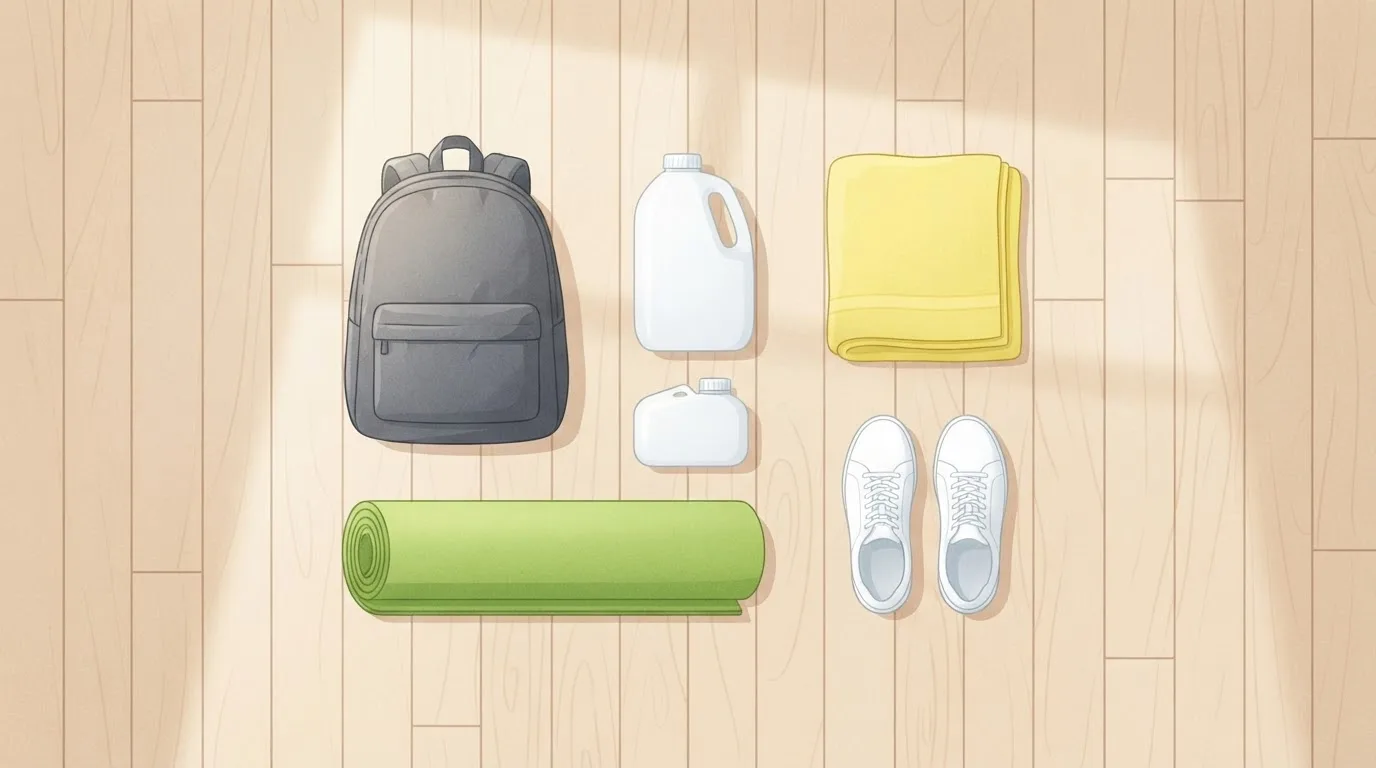
| Backpack | A dumbbell | Rows, Romanian deadlifts and squats | Pack books or full bottles tightly so the load doesn't shift |
| Water jugs | Light dumbbells | Rows and squats with one in each hand | Solid handles and tight caps |
| Folded towel | A knee pad | Kneeling push-ups, bird dogs, split squats | Fold it twice on a hard floor |
| A bare wall | A support | Wall sits, wall push-ups, corner rows | Nothing hanging where your arms or head will go |
A liter of water weighs about 1 kg (2.2 pounds), so four full 1-liter bottles in a backpack make about 4 kg (9 pounds), a sensible start for rows and Romanian deadlifts. A full US gallon jug weighs about 8.3 pounds (3.8 kg), and a pair of them covers most beginner rows and squats.
The stairs earn their place twice. They give you a step for step-ups, and a few brisk climbs count as cardio. In a study by Jenkins and colleagues (2019), inactive young adults climbed a three-flight stairwell of 60 steps vigorously three times a day, three days a week, and their aerobic fitness rose modestly after six weeks. In this plan, a stair climb means walking up one or two flights at a brisk pace you can still talk through, walking down slowly, and resting a minute before the next one. That's gentler than the study, which suits the first month.
How Much Space a Home Workout Needs
You need a patch of floor about the size of a yoga mat, roughly 6 by 2 feet (180 by 60 cm), plus an arm's length on every side. To test a spot, lie on your back with your arms stretched overhead and sweep them out to your sides. Then stand and swing your arms in a slow circle. If you touch nothing, the space works.
- Floor. Use a rug or mat for the floor moves and a folded towel under your knees. Train barefoot or in sneakers rather than socks, so your feet don't slip.
- Noise. Nothing in this plan jumps, so it works in an apartment with neighbors below. If a move gets loud, slow it down.
- Setup. Keep the chair, mat and backpack in one corner. When getting ready takes a minute, skipping a session gets harder to justify.
- Time. Pick a slot you can protect, such as before the house wakes up or after the kids are in bed, and keep it the same each training day.
Short sessions in a small space are worth doing. A 2022 review by Fyfe and colleagues found that small doses of resistance training, including brief, frequent bouts with little or no equipment, can improve strength and everyday physical function. The authors also noted that cutting the time and equipment a session needs may lower the barriers that stop people from training at all.
What to Do After Week 4
Four weeks teaches you the moves and builds the habit. When you've finished at least 10 of the 12 sessions, pick one of these next steps.
- Repeat the calendar one rung higher. Start week 1 again with every move one step up the ladder. With five rungs per move, most moves leave room for two or three more blocks.
- Add weight. A heavier backpack takes you a long way. When it stops being enough, a pair of adjustable dumbbells lets you switch to the dumbbell versions in the beginner routine linked above.
- Change the format. Our 30-day workout challenge gives you a short guided session every day at four levels. Our AI workout generator builds a new plan with sets, reps and rest from five questions, and you can save it as a PDF to print.
- Train four days. Our guide to home workouts that actually work has a four-day sample week for when three days feel easy.
If you'd like the next block built for you, a home workout app with no equipment can do it. FitCraft's 3D AI coaches demonstrate every exercise on an interactive model and say your name during workouts. Your workouts adjust as you progress, and streaks and calendar rewards give you a reason to show up on a cold Tuesday in February. Our review of the best no equipment workout apps compares eight bodyweight apps side by side.
The Bottom Line
A home workout plan for beginners works when it gives you a calendar you can follow and a way to make each move harder. Three short sessions a week, two walks, a chair, your stairs and a backpack are enough to carry you through the first month.
As Katie put it: "I've tried everything. This is the first time I've stuck with something past two weeks." Put Monday's workout on your calendar, and set the chair and the backpack out tonight.
Frequently Asked Questions
Can you get in shape with a home workout plan for beginners?
Yes. A home workout plan for beginners with three bodyweight sessions a week builds strength and fitness, as long as the moves get harder as you improve. In one 4-week trial, push-ups made harder step by step raised bench press strength (Kotarsky 2018), and in another study, short stair climbs improved fitness in six weeks (Jenkins 2019).
How long should a beginner home workout be?
A beginner home workout should take about 20 to 30 minutes. Two rounds of six moves with short rests take about 20 minutes, and three rounds take closer to 30, plus a 2- to 3-minute warm-up. Three sessions of that length a week are enough to start.
What can I use instead of dumbbells at home?
A backpack packed with books or full water bottles, or a pair of water jugs, can replace dumbbells for a beginner. A liter of water weighs about 1 kg (2.2 pounds), and a full US gallon jug weighs about 8.3 pounds (3.8 kg). Pack the bag tightly so the load doesn't shift when you row or hinge.
What if I don't have stairs?
Use a sturdy, low step stool or a solid box for step-ups and stair push-ups, or swap the step-ups for split squats holding a chair. For the stair climbs, walk briskly outside or march in place with high knees for the same amount of time.
Is this home workout plan good for women?
Yes. The plan works the same way for women and men, and nothing in it needs to change. Start each move on the rung that fits your strength today, pick a backpack load you can lift with good form, and move up at your own pace.