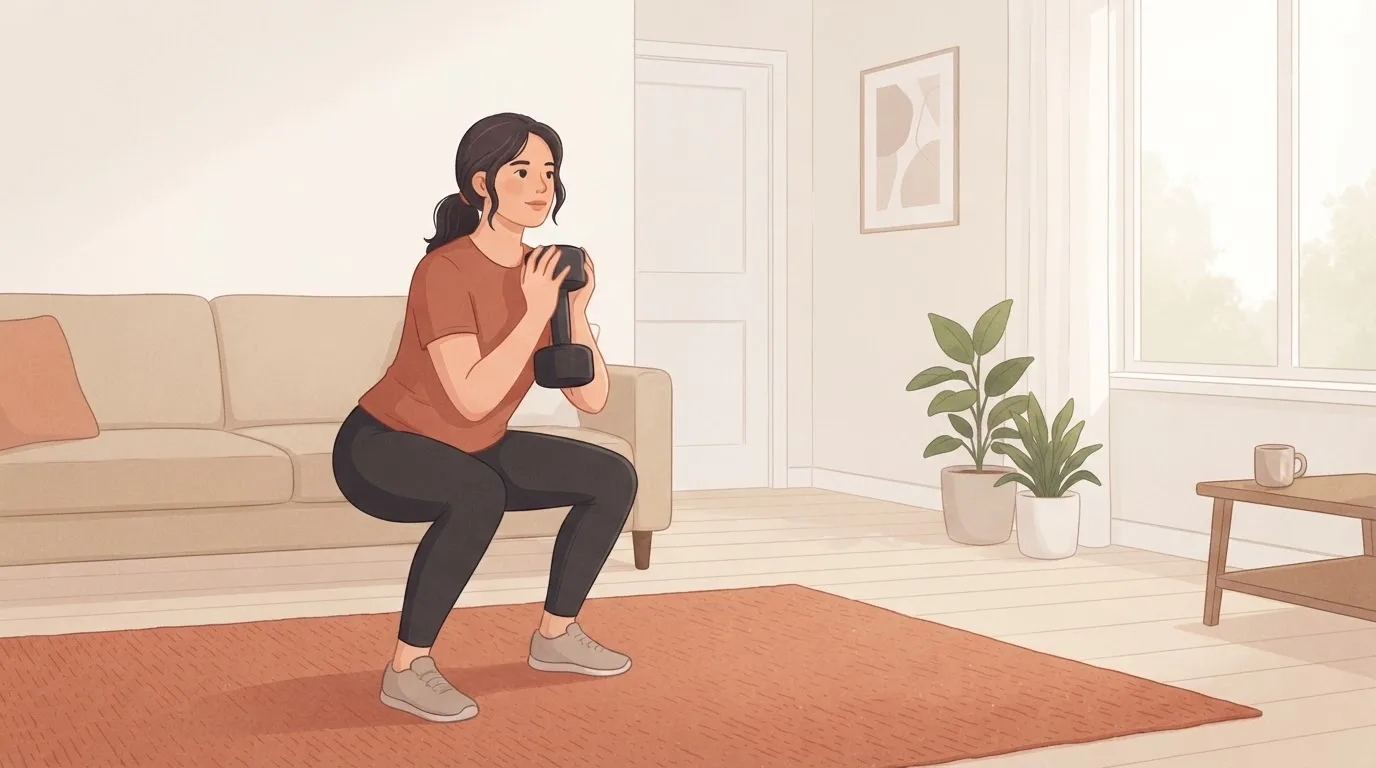
You've decided this is the year you start working out. You search for a beginner workout routine and find a gym plan built on machines you've never touched, a five-day split and a circuit with burpees on day one. So you pick the hardest one, push through a week of sore legs, and let it slide by week three.
Most workout routines for beginners list the exercises and skip how to do each move, how hard a set should feel and what to change the next week. When a plan leaves those out, people guess, overdo it and stop. This routine fills them in. Each of the six moves has a no-equipment version, a dumbbell version and a one-line gym swap, and the 8-week beginner workout plan further down shows you how to progress them.
The Beginner Workout Routine at a Glance
Do the six moves in the order below, three days a week, with a rest day between sessions. Each row gives a version for your living room floor and a version with dumbbells, and you can mix the two in one session.
| # | Move | No equipment | With dumbbells | Sets x reps | Rest |
|---|---|---|---|---|---|
| 1 | Squat | Chair squat | Goblet squat | 2-3 x 8-12 | 90 sec |
| 2 | Push | Incline push-up on a counter | Dumbbell floor press | 2-3 x 6-12 | 60-90 sec |
| 3 | Pull | Corner row | One-arm dumbbell row | 2-3 x 8-12 per side | 60 sec |
| 4 | Hip hinge | Glute bridge | Dumbbell Romanian deadlift | 2-3 x 8-12 | 90 sec |
| 5 | Single leg | Split squat, holding a chair | Dumbbell split squat | 2-3 x 8-10 per leg | 60 sec |
| 6 | Trunk | Plank on your knees | Forearm plank | 2-3 x 20-40 sec | 45 sec |
Together the six moves train your legs, hips, chest, back, shoulders, arms and trunk. Three days a week with a day off between, such as Monday, Wednesday and Friday, suits most people. Our workout schedule for beginners lays out 2-, 3- and 4-day weeks if yours needs a different shape. If you own no equipment at all, our home workout plan for beginners turns the no-equipment column into a 4-week calendar.
Training at a gym works too, using the swap listed under each move. A 2023 meta-analysis of 13 studies by Haugen and colleagues found no difference in strength or muscle growth when free weights and machines were compared head to head, so pick the version you'll keep doing.
How to Do Each Exercise
Each move has an easier version to start on and a harder one for later. Start on the version where you can manage 8 clean reps but not 15, and move up once the top of the rep range feels easy on every set.
1. Squat
Stand in front of a sturdy chair with your feet a little wider than your hips. Push your hips back and bend your knees until you lightly touch the seat, then stand by pressing through your whole foot. Keep your chest up and your knees pointing the same way as your toes.
- Easier: sit all the way down on the chair between reps, then stand.
- Harder: hold one dumbbell upright against your chest for a goblet squat, and drop the chair once you can reach the same depth without it.
- At the gym: the leg press, or a goblet squat with a heavier dumbbell.
2. Push-up
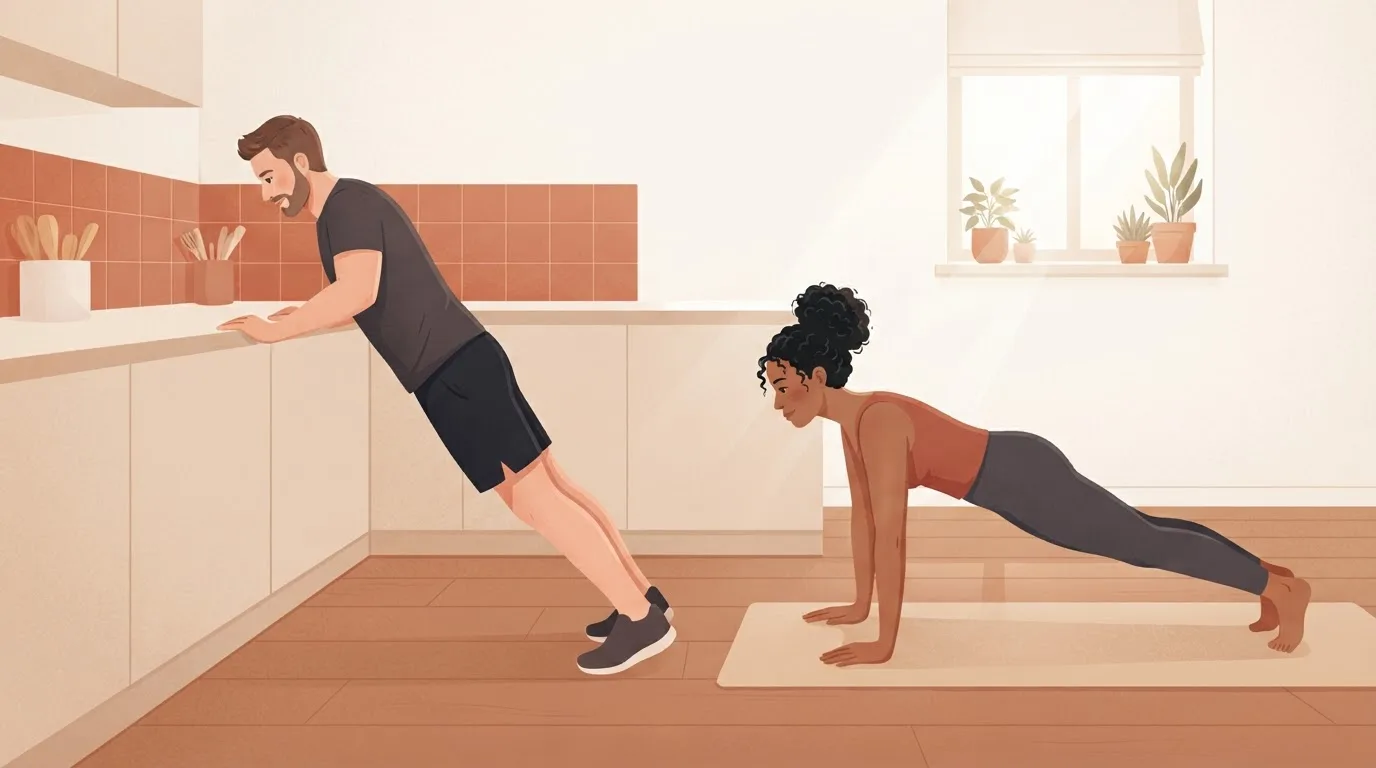
Put your hands on the edge of a kitchen counter, a little wider than your shoulders, and walk your feet back until your body forms one line from head to heels. Lower your chest toward the edge with your elbows angled back at about 45 degrees, then press away. A lower surface makes the incline push-up harder.
- Easier: push against a wall.
- Harder: a full push-up on the floor, or a dumbbell floor press lying on your back with a dumbbell in each hand.
- At the gym: the chest press machine or a dumbbell bench press.
3. Row
Put one hand and the same-side knee on a sturdy chair or bench and hold a dumbbell in the other hand. Pull your elbow back toward your hip until the dumbbell reaches your ribs, then lower it slowly with your back flat. That's the one-arm dumbbell row. With no dumbbells, the corner row trains many of the same upper-back muscles. Stand with your back to an inside corner, rest the backs of your upper arms on the two walls, and press your elbows back to push your body away.
- Easier: corner rows with your feet close to the corner.
- Harder: move your feet farther from the corner, or row a heavier dumbbell and take 3 seconds to lower it.
- At the gym: the seated cable row.
4. Hip hinge
The glute bridge is the easier hinge. Lie on your back with your knees bent and your feet flat, squeeze your glutes and lift your hips until your body makes a line from shoulders to knees. The dumbbell Romanian deadlift is the standing version. Hold the dumbbells in front of your thighs, push your hips back with soft knees until you feel a stretch in the backs of your legs, then drive your hips forward to stand tall.
- Easier: the glute bridge, with a 2-second squeeze at the top.
- Harder: the Romanian deadlift with heavier dumbbells, keeping your back flat the whole way down.
- At the gym: the back extension bench.
5. Split squat
Take a long step forward with your feet about hip-width apart side to side and your back heel up. Lower straight down until your back knee hovers just above the floor, then push through your front foot to rise. Do all your reps on one leg, then switch. A split squat puts most of the work on one leg at a time, which shows you whether one side is weaker.
- Easier: hold the back of a chair and lower only halfway.
- Harder: let go of the chair and hold a dumbbell in each hand.
- At the gym: step-ups onto a low box or bench.
6. Plank
Set your forearms on the floor with your elbows under your shoulders, step your feet back, and hold your body straight from head to heels. Squeeze your glutes, brace your stomach as if someone is about to poke it, and breathe slowly. End the set when your hips sag or your lower back starts to ache. The forearm plank page shows the position step by step.
- Easier: keep your knees on the floor.
- Harder: build up to 40 seconds, then lift one foot for a few seconds at a time.
How Many Sets and Reps Should a Beginner Do?
Do 2 sets of each move in your first two weeks and 3 sets after that. Aim for 8 to 12 reps a set, or 6 to 12 for push-ups, which are harder to scale, and 20 to 40 seconds for the plank. Across three sessions, that's 6 to 9 sets of each move a week.
Two large reviews support that dose for people starting out. Rhea and colleagues (2003) pooled 140 studies. Untrained people gained the most strength when they trained each muscle three days a week at about 60 percent of their one-rep max, a moderate weight, with four sets per muscle group. The 2026 ACSM position stand by Currier and colleagues drew on 137 systematic reviews. It found that 2 to 3 sets per exercise and at least two sessions a week improved strength, and that 10 or more sets per muscle a week favored muscle growth.
For health, you don't need much more than this. In a meta-analysis of 16 cohort studies, Momma and colleagues (2022) linked strength training to a 10 to 17 percent lower risk of early death, heart disease, cancer and diabetes, with the largest drop at about 30 to 60 minutes a week. One session of this routine a week already lands in that range, and the second and third sessions are there for strength and muscle.
How hard each set should feel
End each set when you could still do 2 or 3 more good reps. That margin is called reps in reserve, and it sets the effort in this routine instead of a fixed weight. Most people misjudge it. Halperin and colleagues (2022) pooled 12 studies of 414 people and found that people underestimated how many reps they had left by about one rep on average. Their guesses got better closer to failure and in sets of 12 reps or fewer.
So once a week, take the last set of push-ups or glute bridges until your form starts to slip. That single hard set shows you what 2 or 3 reps left really feels like, without the risk of grinding out a loaded squat.
How long to rest
Rest 60 to 90 seconds between sets, and up to 2 minutes after the squat and the Romanian deadlift, which use the most muscle. Short on time? Pair two moves that don't compete, such as a set of push-ups followed by a set of rows, and rest after the pair.
Picking your starting point
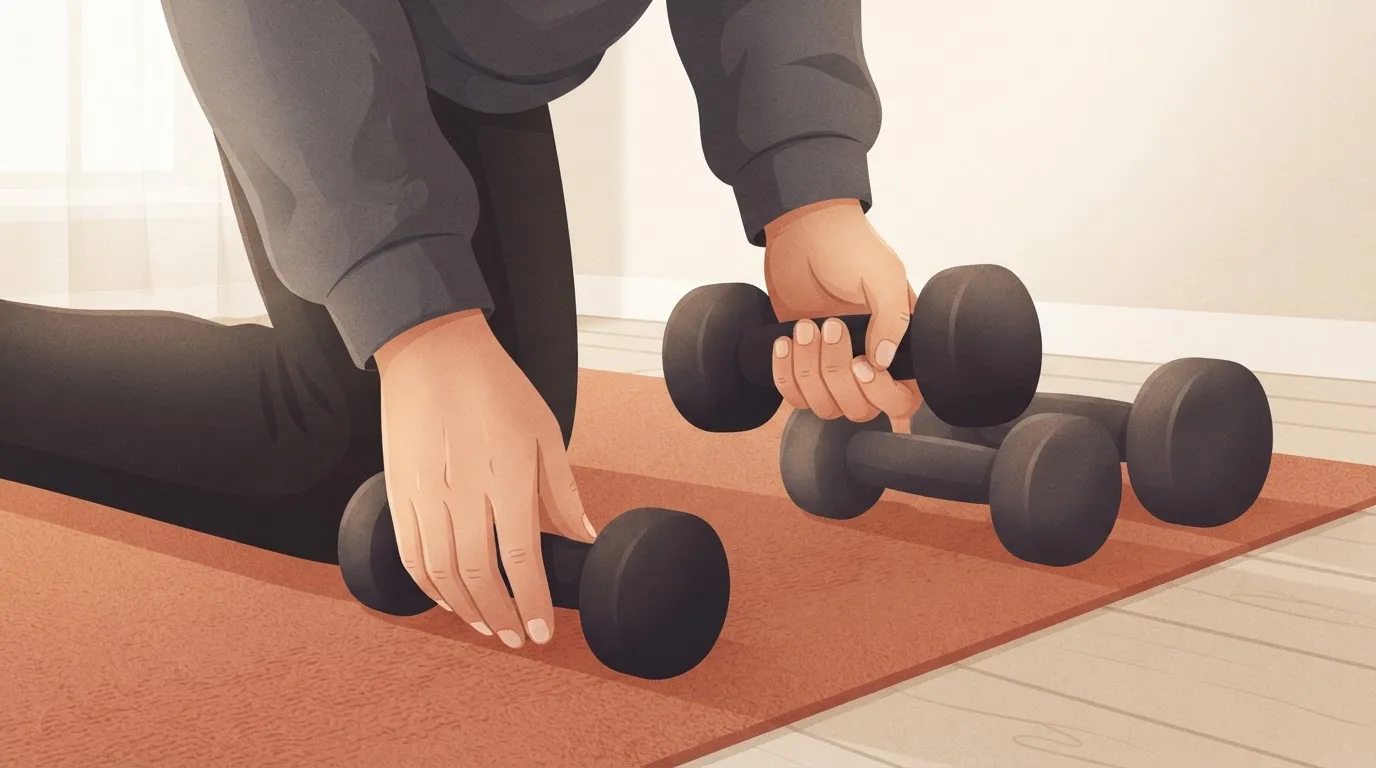
For each bodyweight move, that means the version where you can do at least 8 clean reps but no more than about 15. For each dumbbell move, pick a weight you could lift about 12 times with 2 or 3 reps to spare. If you're unsure, start lighter. A week on a dumbbell that's too light does no harm, and by the second session you'll know whether to move up. Our guide on how to start lifting weights walks through testing each starting weight.
What Workout Should I Do First for Beginners?
Start with this full-body routine, done exactly as written for two weeks, before you try a split, a class or a challenge. Inside each session, do the squat and the hip hinge early. Simão and colleagues (2012) reviewed the research on exercise order. An exercise done early in a session got more total reps, and untrained people gained more strength on whichever exercise came first. If one move matters most to you, put it at the top.
| Part | What you do | Time |
|---|---|---|
| Warm-up | March in place or walk around the house for 2 minutes, then do one easy set each of chair squats and counter push-ups | 5 min |
| Main block | The six moves in order, 2 or 3 sets each | 20 to 30 min |
| Cool-down | Walk slowly, then hold two or three gentle stretches for your hips and chest | 3 to 5 min |
With 3 sets of each move, the whole session runs 35 to 40 minutes. With 2 sets in weeks 1 and 2, it's closer to 30. If three days a week still feels like a big jump, the short daily sessions in our 30-day workout challenge are a gentler way in, and our guide to starting to work out with zero fitness covers your very first week.
Find out what's really holding you back
FitCraft, our mobile fitness app, pairs you with an AI coach who builds you a personalized plan around your goals, schedule, and fitness level. Every FitCraft program is designed by Domenic Angelino, MPH (Brown University) and NSCA-CSCS, with research published in the Journal of Strength and Conditioning Research and Medicine & Science in Sports & Exercise.
Take the Free Assessment Free • 2 minutes • No credit cardYour 8-Week Beginner Workout Plan
This beginner workout plan keeps the same six moves for eight weeks and changes one thing at a time. Sets go up first, then reps, then the version or the weight. Repeating the same moves is deliberate, because you get better at a movement by practicing it often.
| Week | Sets per move | Stop each set with | What changes |
|---|---|---|---|
| 1-2 | 2 | About 3 reps left | Learn the moves on the easier versions and write down your reps. |
| 3-4 | 3 | 2 or 3 reps left | Add a rep to each set whenever you can. |
| 5-6 | 3 | 2 reps left | When a move reaches the top of its range on every set, move it up one version or one dumbbell size and drop back to 8 reps. |
| 7 | 3 | 1 or 2 reps left | Keep adding reps on the new versions and weights. |
| 8 | 2 | About 3 reps left | Take a lighter week, then retest your push-ups and plank and compare them with week 1. |
The rule in weeks 5 to 7 is called double progression. You add reps within the range first, and you only move up in weight or difficulty once you own the top of it. It's a forgiving rule, and the research suggests the order isn't critical. In a trial of 43 people with at least a year of lifting experience, Plotkin and colleagues (2022) compared adding weight with adding reps over 8 weeks and found similar gains in muscle size and strength.
A worked example: the goblet squat over 8 weeks
Here's how one move might progress for someone who starts with a 15-pound (about 7 kg) dumbbell. Treat it as an example, not a target. Your numbers will differ, and some weeks won't go up at all.
| Week | Dumbbell | Reps in each set | Note |
|---|---|---|---|
| 1 | 15 lb | 10, 10 | Felt easy, about 4 reps left |
| 2 | 15 lb | 12, 12 | Ready for a third set |
| 3 | 15 lb | 12, 11, 10 | Third set added |
| 4 | 15 lb | 12, 12, 12 | Top of the range on every set |
| 5 | 20 lb (about 9 kg) | 8, 8, 8 | New size, back to 8 reps |
| 6 | 20 lb | 10, 9, 9 | Climbing again |
| 7 | 20 lb | 11, 11, 10 | Close to the top |
| 8 | 20 lb | 10, 10 | Lighter week before the next block |
What to expect by week 8
Strength climbs fastest in the first month, much of it because your nervous system is learning to use the muscle you already have. Muscle itself can start changing sooner than many people think. In a small study by Seynnes and colleagues (2007), seven young adults did hard leg extensions on a flywheel machine three times a week. The electrical activity in their thigh muscles rose by about a third, their thigh muscles were measurably larger after 20 days, and their maximum strength rose by about 39 percent in 35 days. Changes you can see in the mirror usually take longer than changes you can feel.
The 3-3-3 Rule, the 3-2-1 Rule and Other Shortcuts
You'll see a few number rules for beginners online. Here's what each one means and how it compares with this routine.
What is the 3-3-3 rule for gym?
The 3-3-3 rule is a simple gym framework of three workouts a week, three exercises per workout and three sets of each. It's easy to remember, but three exercises can't cover a squat, a hinge, a push and a pull in one session, so something always gets left out. This routine keeps the three days and the three sets and doubles the exercise list to six.
What is the 3-2-1 rule for working out?
The 3-2-1 rule is a weekly split of three strength sessions, two Pilates or other low-impact sessions and one cardio session, with a day left for rest. That's six training days, which is a lot when you're starting out. Begin with the three strength days of this routine and easy walks in between, then add the Pilates or cardio days once the routine feels automatic.
What is the 5-5-5-30 rule?
The 5-5-5-30 rule means doing 5 push-ups, 5 squats and 5 lunges, then holding a plank for 30 seconds, most often right after you get up. It's a good daily habit starter and fits well on your rest days, but it's too little work to replace a full session.
When to Move On From This Routine
Run the routine for at least 8 weeks, and keep it for 12 if it's still moving. You've outgrown it when you're on the hardest version of most moves, the top of the rep range comes easily, and sessions feel short. At that point you have three good next steps.
- Add exercises and variety. Our full body workout routine has three longer routines for bodyweight, dumbbells, and dumbbells plus bands.
- Build your own plan. Our guide on how to create a workout plan starts from your goal and the days you have.
- Get a fresh plan in a minute. Our AI workout generator asks five questions and gives you a plan with sets, reps and rest.
If you'd like someone to run each session for you, FitCraft does that with bodyweight and dumbbell workouts like these. A 3D AI coach demonstrates each exercise on an interactive model and says your name during the workout. Your workouts adjust as you progress, and streaks, XP and leaderboards make it easier to keep showing up. See how it works on our best workout app for beginners page.
The Bottom Line
A beginner workout routine works when it's simple enough to repeat and specific enough to progress. Do six moves three days a week, with 2 or 3 sets of 8 to 12 reps and a couple of reps left in every set. Change one small thing at a time, and the routine will carry you through your first two months.
Working out consistently is hard, but it doesn't have to be. As Stacy, 41, put it: "After my second kid, I needed something stupidly simple." Pick your three days, start on the easier versions, and do your first session this week.
Frequently Asked Questions
What is a good beginner workout plan?
A good beginner workout plan repeats one full-body routine three days a week for 8 to 12 weeks and makes it a little harder each week. Use six moves that cover a squat, a push, a pull, a hip hinge, a single-leg move and a plank. Do 2 or 3 sets of 8 to 12 reps, and add reps before you add weight.
What are 7 exercises I can do every day as a beginner?
Seven gentle exercises you can do every day as a beginner are walking, marching in place, chair squats, wall push-ups, glute bridges, bird dogs and calf raises. Keep the daily version light, one or two easy sets of each. Save harder strength sessions for three days a week, so your muscles get a day to recover between them.
What exercise burns the most belly fat?
No exercise burns belly fat on its own, because your body doesn't take fat from the muscle you're working. In a trial by Vispute and colleagues (2011), six weeks of ab exercises five days a week didn't reduce belly fat. Full-body strength training does help: a meta-analysis by Wewege and colleagues (2022) found it lowered body fat percentage by about 1.5 points and reduced visceral fat, the deep fat around your organs. Pair a routine like this one with walking and a modest calorie deficit.
What are the only 5 exercises you'll ever need?
The five exercises most beginners need are a squat, a push-up, a row, a hip hinge such as the Romanian deadlift, and a plank. Together they train your legs, hips, chest, back, shoulders, arms and trunk. Add a single-leg move like the split squat and you have the six-move routine on this page.
How long should a beginner workout routine take?
A beginner workout routine should take about 30 to 40 minutes, including a 5-minute warm-up. With 2 sets of each move in the first two weeks it runs close to 30 minutes, and with 3 sets it runs 35 to 40. Two or three sessions of that length a week are enough to get stronger.
Is exercising 5 times a week too much?
Exercising 5 times a week isn't too much for most beginners, as long as only two or three of those days are strength sessions. A good mix is three days of this routine and two days of walking, with a day off between strength days and at least one full rest day each week.