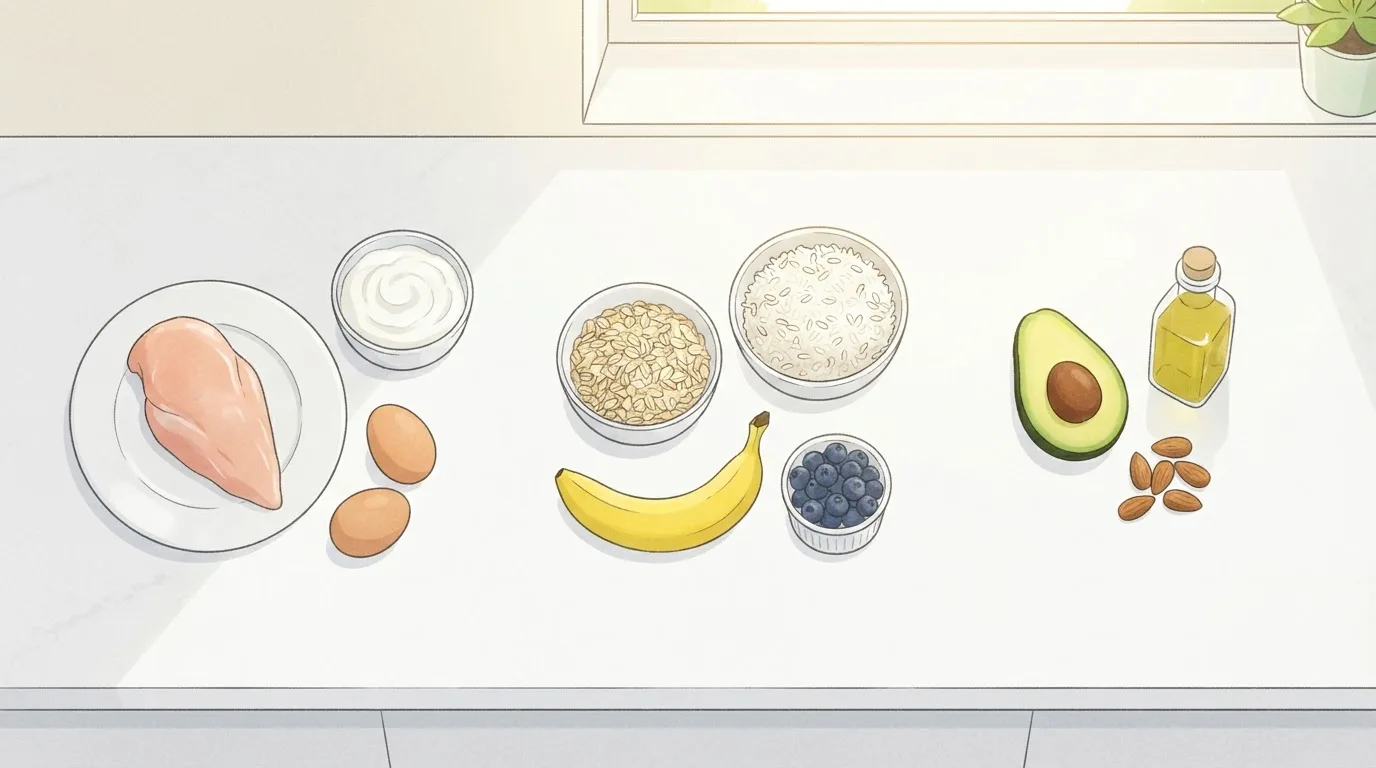
You've decided to try counting macros. Maybe a friend lost weight doing it, or your calorie app keeps showing a pie chart you don't know how to read. Then you open a calculator, get four numbers, and the questions start. Do you weigh the chicken raw or cooked? What about the oil in the pan? And why does your log say you hit your target while the scale hasn't moved in two weeks?
That gap between the log and the scale makes most people feel like they're doing it wrong, and many quit in the first month. The method isn't hard. It just has a handful of rules nobody explains, and a few small logging errors can wipe out a whole deficit. This guide covers how to calculate macros for weight loss, how to log food so the numbers mean something, and how to adjust when the scale disagrees.
What Does Counting Macros Mean?
Counting macros means tracking the grams of protein, carbohydrate and fat you eat each day against a target for each one. Those three are the macronutrients, the nutrients that supply your calories. Counting calories alone tells you how much you ate. Counting macros also tells you what it was made of, which matters for keeping muscle while you lose fat.
Each macro carries a set amount of energy. The Food and Agriculture Organization's report on food energy (2003) gives the general factors most labels and apps use: about 4 calories per gram of protein, 4 per gram of carbohydrate, 9 per gram of fat and 7 per gram of alcohol. So grams convert straight into calories.
| Macro | Calories per gram | Main job | Foods that are mostly this macro |
|---|---|---|---|
| Protein | 4 | Builds and repairs muscle, keeps you full | Chicken, fish, eggs, Greek yogurt, tofu, lentils |
| Carbohydrate | 4 | Fuels training and the brain | Rice, oats, potatoes, bread, fruit |
| Fat | 9 | Hormones, absorbing some vitamins | Oils, nuts, avocado, butter, cheese |
| Alcohol (not a macro target) | 7 | None you need | Beer, wine, spirits |
A "macros diet" isn't a list of allowed foods. It's a set of numbers, and any food that fits them counts. That idea is often called flexible dieting or IIFYM (if it fits your macros), and our review of the flexible dieting research covers how it compares with strict meal plans.
How to Count Macros in 6 Steps
Here's the whole method in one list. Steps 1 and 2 take five minutes once. Steps 3 to 6 are the daily skill.
- Find your calorie target. Estimate your maintenance calories, then subtract about 10 to 20 percent to lose weight.
- Set protein, then fat, then carbs. Protein from body weight, fat near 0.8 g per kg, carbs from the calories left.
- Get a food scale and one place to log. Grams beat cups and spoons.
- Weigh food raw and log it as raw. Or weigh it cooked and use a cooked entry, but never mix the two.
- Read labels and estimate meals out. Log oils, sauces and drinks, and round restaurant meals up.
- Review your average weight every two weeks and adjust. Change calories by 100 to 200 at a time, and keep protein where it is.
Step 1: Find your calorie target
Your maintenance calories, also called TDEE, are what you burn in a day. Most calculators estimate it from the Mifflin-St Jeor equation (Mifflin et al., 1990), which predicts resting burn from your weight, height, age and sex, then multiply by an activity factor between 1.2 and 1.9. To lose weight, eat about 10 to 20 percent below that number; our review of what the research says about calorie deficits covers how big a deficit should be. Our macro calculator does Step 1 and Step 2 together in under a minute, so you can skip the arithmetic and come back to the steps that the calculator can't do for you.
Treat the number as a first guess. The equation is usually within about 10 percent for healthy adults, but your real maintenance only shows up after two weeks of honest logging and weighing (Step 6).
Step 2: Set protein first, then fat, then carbs
Set the macros in this order, because each has a different job.
- Protein: 1.6 to 2.2 g per kg of body weight (0.7 to 1 g per pound). A 2018 meta-analysis by Morton et al. of 49 trials found that gains in muscle from strength training levelled off around 1.6 g per kg, with an upper confidence limit near 2.2. In a calorie deficit, aim for the upper half: a review by Helms et al. (2014) argued that lean, trained people dieting hard need more protein to hold muscle. Our protein calculator gives you a single number for your goal.
- Fat: about 0.8 g per kg, and keep it above about 20 percent of your calories. Fat is the easiest macro to overeat because each gram carries 9 calories.
- Carbs: whatever is left. Subtract the protein and fat calories from your target and divide by 4.
Does the exact split matter for weight loss? Less than the internet suggests. In the POUNDS Lost trial (Sacks et al., 2009), 811 adults ate one of four diets with different fat, protein and carb percentages, and all four lost about 6 kg at six months with similar results at two years. In the DIETFITS trial (Gardner et al., 2018), 609 adults on a healthy low-fat or healthy low-carb diet lost similar weight over a year. Protein is the exception: a meta-analysis of 24 trials by Wycherley et al. (2012) found that higher-protein diets at the same calories lost about 0.87 kg more fat and kept about 0.43 kg more lean mass. So get protein right, and split the rest however you enjoy eating.
For context, the Institute of Medicine's dietary reference intakes (2005) set healthy adult ranges at 45 to 65 percent of calories from carbs, 10 to 35 percent from protein and 20 to 35 percent from fat. Most macro plans for weight loss sit at the high end of the protein range.
Step 3: Get a food scale and one place to log
A digital kitchen scale that reads in grams is the one piece of kit that makes counting macros work. Cups and tablespoons are rough: a "cup" of cereal or a "tablespoon" of peanut butter changes a lot depending on how you scoop it. Pick one place to log, either any food-tracking app with a large database or a notebook, and use it every day. The tool matters far less than logging the same way every time.
Logging is worth the effort. A systematic review by Burke et al. (2011) of 22 studies found a consistent link between self-monitoring and weight loss. And it gets faster: in a 24-week online program, Harvey et al. (2019) found people spent about 23 minutes a day logging in the first month and about 15 by the sixth, and the people who lost at least 10 percent of their weight logged in about 2.7 times a day against 1.7 for everyone else.
Step 4: Weigh food raw and log it as raw

Cooking changes a food's weight but not its macros. Meat loses water and gets lighter, so each gram gets denser in protein. Rice and pasta soak up water and get heavier. If you weigh food in one state and log it with a database entry for the other, your log goes badly wrong. These numbers come from USDA FoodData Central:
| What you ate | Weighed | Logged as | Your log says | You actually ate |
|---|---|---|---|---|
| Chicken breast | 145 g cooked | Raw chicken breast | 174 kcal, 33 g protein | About 240 kcal, 45 g protein |
| White rice | 211 g cooked | Raw white rice | 770 kcal, 169 g carbs | About 275 kcal, 60 g carbs |
Those two portions came from 200 g of raw chicken and 75 g of dry rice. The chicken error hides about 66 calories and 12 g of protein, and the rice error adds nearly 500 calories that you never ate. The fix is simple. Weigh raw whenever you can, and pick the database entry that matches the state you weighed. If you cook a batch for the family, add up the macros of the raw ingredients, weigh the whole pot after cooking, and log your share as its fraction of the cooked weight.
Step 5: Read labels and estimate meals out
Labels are close, but not exact. US rules allow the measured calories in a packaged food to run up to 20 percent above the label before the food counts as misbranded (21 CFR 101.9). In practice the gap is usually small: Jumpertz et al. (2013) tested 24 popular snack foods and found a median of 4.3 percent more calories than the labels said. Restaurant food is looser. Urban et al. (2010) measured 29 reduced-calorie restaurant dishes and found an average of 18 percent more calories than stated, and the free sides pushed some meals much higher.
- Read "per serving" against the weight. A bag of nuts may list macros for 28 g when you ate 45 g.
- Log cooking fat. One tablespoon of olive oil, about 13.5 g, adds about 120 calories and 13.5 g of fat.
- Log drinks and sauces. Juice, lattes, alcohol, dressings and ketchup all count.
- Round restaurant meals up. Pick the closest chain entry or build the dish from its parts, then add 10 to 20 percent.
Step 6: Review your average weight every two weeks and adjust
Weigh yourself first thing in the morning on most days and compare two-week averages, not single days, because water and food in your gut swing the scale by a kilogram or more. Then use this rule:
- Losing steadily, at up to about 1 percent of body weight a week: keep going, even if it is slower than you hoped.
- No change for two weeks while you logged every day: lower calories by 100 to 200, taken from carbs or fat. Keep protein where it is.
- Losing faster than 1 percent a week, or training feels flat: add 100 to 200 calories back.
Before you cut, check your logging. In a classic study, Lichtman et al. (1992) found that people who believed they couldn't lose weight on under 1,200 calories underreported what they ate by an average of 47 percent and overreported their exercise by 51 percent. Their metabolisms were normal. The gap was food they ate but didn't report. Oils, bites and drinks are the easiest things to miss, and nobody is immune to it.
Find out what's really holding you back
FitCraft, our mobile fitness app, pairs you with an AI coach who builds you a personalized plan around your goals, schedule, and fitness level. Every FitCraft program is designed by Domenic Angelino, MPH (Brown University) and NSCA-CSCS, with research published in the Journal of Strength and Conditioning Research and Medicine & Science in Sports & Exercise.
Take the Free Assessment Free • 2 minutes • No credit cardHow to Calculate Macros for Weight Loss: A Worked Example
Here's the whole method with real numbers. Meet a 38-year-old woman who is 5 ft 5 in (165 cm) tall, weighs 165 lb (74.8 kg), works at a desk, walks most days and is new to strength training. She wants to lose fat without losing muscle.
Her calorie target
- Resting burn (Mifflin-St Jeor): 10 × 74.84 + 6.25 × 165.1 − 5 × 38 − 161 = about 1,429 calories.
- Maintenance (light activity, × 1.375): about 1,965 calories.
- Target (15 percent deficit, × 0.85): about 1,670 calories a day.
Her macros
| Macro | How it's set | Grams | Calories |
|---|---|---|---|
| Protein | 1.8 g × 74.8 kg | 135 g | 540 |
| Fat | 0.8 g × 74.8 kg | 60 g | 540 |
| Carbs | (1,670 − 540 − 540) ÷ 4 | 148 g | 592 |
| Total | 1,672 |
That works out to about 32 percent protein, 35 percent carbs and 32 percent fat. Our macro calculator gives the same numbers on its moderate cut setting for a beginner.
One day of her log
Every food below is weighed raw or dry, except the rice, which she weighs cooked and logs with a cooked entry. Values are from USDA FoodData Central and rounded to whole numbers.
| Meal | Food | Weight | kcal | Protein (g) | Carbs (g) | Fat (g) |
|---|---|---|---|---|---|---|
| Breakfast | 2 large eggs | 100 g | 143 | 13 | 1 | 10 |
| Breakfast | Rolled oats, dry | 40 g | 152 | 5 | 27 | 3 |
| Breakfast | Blueberries | 100 g | 57 | 1 | 15 | 0 |
| Lunch | Chicken breast, raw weight | 200 g | 240 | 45 | 0 | 5 |
| Lunch | White rice, cooked | 150 g | 195 | 4 | 43 | 0 |
| Lunch | Broccoli | 150 g | 51 | 4 | 10 | 1 |
| Lunch | Olive oil | 10 g | 88 | 0 | 0 | 10 |
| Snack | Plain nonfat Greek yogurt | 200 g | 118 | 20 | 7 | 1 |
| Snack | Banana, 1 medium | 118 g | 105 | 1 | 27 | 0 |
| Dinner | Salmon, raw weight | 150 g | 312 | 31 | 0 | 20 |
| Dinner | White rice, cooked | 80 g | 104 | 2 | 23 | 0 |
| Dinner | Broccoli | 100 g | 34 | 3 | 7 | 0 |
| Dinner | Almonds | 15 g | 87 | 3 | 3 | 7 |
| Total | 1,686 | 132 | 163 | 57 | ||
| Target | 1,670 | 135 | 148 | 60 |
She finished 16 calories over, 3 g short on protein, 15 g over on carbs and 3 g under on fat. That's a good day. Aim to land within about 5 to 10 g of each macro and 100 calories of your target. Chasing exact zeros makes counting miserable and adds nothing your weekly average will notice.
You may notice that 132 × 4 + 163 × 4 + 57 × 9 comes to 1,693, not 1,686. Databases use food-specific energy factors and count fiber differently, so the 4-4-9 math and the calorie column rarely match exactly. Log the calories the database or label gives you.
What Should My Macros Be for 1,500 Calories a Day?
At 1,500 calories, a common split works out like this:
| Split (carbs / protein / fat) | Carbs | Protein | Fat |
|---|---|---|---|
| 40 / 30 / 30 | 150 g | 113 g | 50 g |
| 50 / 25 / 25 | 188 g | 94 g | 42 g |
| 40 / 35 / 25 (higher protein) | 150 g | 131 g | 42 g |
Percentages are a shortcut, so check protein against your weight. For a 140 lb (63.5 kg) person, 1.8 g per kg is 114 g of protein, 0.8 g per kg is 51 g of fat, and the remaining calories give 146 g of carbs, which lands close to the 40/30/30 row. For a 200 lb person, 1,500 calories is usually too low to sustain and may sit below their resting burn. Never set a target under your estimated resting calories without a doctor or dietitian involved.
What is a 40/30/30 macro split?
A 40/30/30 split gets 40 percent of calories from carbs, 30 percent from protein and 30 percent from fat. At 2,000 calories that's 200 g of carbs, 150 g of protein and 67 g of fat. It's a reasonable middle-of-the-road split with plenty of protein, but there's nothing special about the exact ratio, as the POUNDS Lost and DIETFITS trials above show.
Common Macro Counting Mistakes
- Mixing raw and cooked entries. The single biggest source of error, as the rice example shows.
- Skipping the small stuff. Cooking oil, butter on toast, creamer, a handful of your kid's fries. Each one is small, but they add up to hundreds of calories a day.
- Trusting a random database entry. User-added entries are often wrong. Pick entries that match the label or a verified source, and save the ones you use.
- Logging later from memory. Log before or right after you eat. Memory always rounds down.
- Treating the weekend as off the books. Two untracked days can erase a five-day deficit.
- Changing targets after a few days. Give any change two full weeks before you judge it.
- Letting protein slide on busy days. If you only hit one number, make it protein, and keep calories roughly on target.
How to Make Counting Macros Easier

Counting is fiddly in week one and quick by week four. These habits get you there faster.
- Repeat meals. Most people eat the same few breakfasts and lunches. Save them as meals in your log and add them in one tap.
- Batch-cook protein. Weigh a batch of chicken, beef or tofu raw, cook it, then divide it into equal portions so every portion has known macros.
- Plan the day before. Log tomorrow's meals tonight, then eat to the plan. Adjusting a plan is easier than fixing a day that's already gone over.
- Build each meal around protein. Roughly 25 to 40 g of protein per meal across three or four meals gets most people to their target without a late-night scramble.
- Leave room for food you love. Fit a treat into your numbers rather than banning it. A plan you can keep beats a perfect plan you quit.
- Start with protein only if four numbers feel like too much. Track calories and protein for two weeks, then add carbs and fat once that feels automatic.
Is Counting Macros Right for You?
Counting macros suits people who like numbers, want to protect muscle while they lose fat, or have stalled on looser approaches. It isn't for everyone. In a study of 493 college students, Simpson and Mazzeo (2017) found that people who used calorie trackers reported more eating concern and dietary restraint. The study can't say which came first, but if you have a history of disordered eating, or logging starts to make you anxious, stop and use a gentler method such as hand-sized portions with a coach or dietitian.
Counting also covers only half of body change. Your eating decides how much weight you lose, and strength training decides how much of it is fat rather than muscle. If you want the training half laid out for you, our roundup of the best workout apps for weight loss compares the options honestly. FitCraft doesn't count your food. It covers the training side: an AI coach demonstrates each exercise on an interactive 3D model, your workouts adjust as you progress, and streaks help you keep showing up while you learn to count.
The Bottom Line
Counting macros comes down to four numbers and one habit. Set calories about 15 percent below maintenance, protein at 1.6 to 2.2 g per kg, fat near 0.8 g per kg and carbs from the rest. Then weigh, log and review every two weeks. Most of the frustration comes from a few fixable errors, mainly raw and cooked mix-ups and forgotten oils, so fix those before you cut calories. Barry, 42, a FitCraft user, lost 28 pounds in four months by fitting his workouts around breakfast while his kids ate, and a routine that fits your life works the same way. Start with today's breakfast: weigh it, log it, and you've done Step 4.
Frequently Asked Questions
What is 40/30/30 macro?
A 40/30/30 macro split gets 40 percent of your calories from carbohydrate, 30 percent from protein and 30 percent from fat. At 2,000 calories that's 200 g of carbs, 150 g of protein and 67 g of fat, and at 1,500 calories it's 150 g, 113 g and 50 g. It's a reasonable split, but setting protein by body weight and letting carbs fill the rest usually fits your body better.
What are the big 3 macros?
The big 3 macros are protein, carbohydrate and fat. Protein and carbohydrate supply about 4 calories per gram and fat about 9, the general factors the FAO lists for food energy. Alcohol supplies about 7 calories per gram, so it counts toward your calories even though it isn't one of the three macros you set targets for.
Can you eat too much protein?
For healthy adults, high protein intakes look safe for the kidneys: a 2018 meta-analysis of 28 trials and 1,358 people found that changes in kidney function did not differ between higher-protein diets (at least 1.5 g per kg, 20 percent of calories or 100 g a day) and normal or lower-protein diets (Devries 2018). Above about 2.2 g per kg there's little extra muscle benefit, so the extra protein mostly displaces carbs and fat you could enjoy. If you have kidney disease, ask your doctor before raising protein.
What's the worst carb for belly fat?
No single carb adds fat to your belly on its own, and none removes it; your total calories decide how much fat you lose. Sugary drinks are the most consistent suspect: in a 6-year study of 1,003 adults, daily drinkers gained more deep belly fat than non-drinkers even after accounting for weight change (Ma 2016), though that study shows an association, not cause. They're also easy calories to forget to log.
Do you count macros raw or cooked?
Weigh food raw when you can and log it with a raw database entry, because raw weights don't change with cooking time. If you weigh food cooked, log it with a cooked entry. Mixing them is the biggest single error: 211 g of cooked rice logged as raw rice reads as about 770 calories instead of about 275.
Is counting macros better than counting calories for weight loss?
Calories decide how much weight you lose, and macros, mainly protein, shape what that weight is made of. In a meta-analysis of 24 trials, higher-protein diets at the same calories lost about 0.87 kg more fat and kept about 0.43 kg more lean mass than standard-protein diets (Wycherley 2012). Counting calories plus a protein target gets you most of the benefit of full macro counting.
How long should you count macros?
Most people need four to eight weeks of weighing and logging to learn what their portions look like. After that, many switch to logging only protein and calories, or to logging a few days a week, and go back to full counting if progress stalls. Tracking gets quicker with practice: in one 24-week program, time spent logging fell from about 23 minutes a day in the first month to about 15 by the sixth (Harvey 2019).