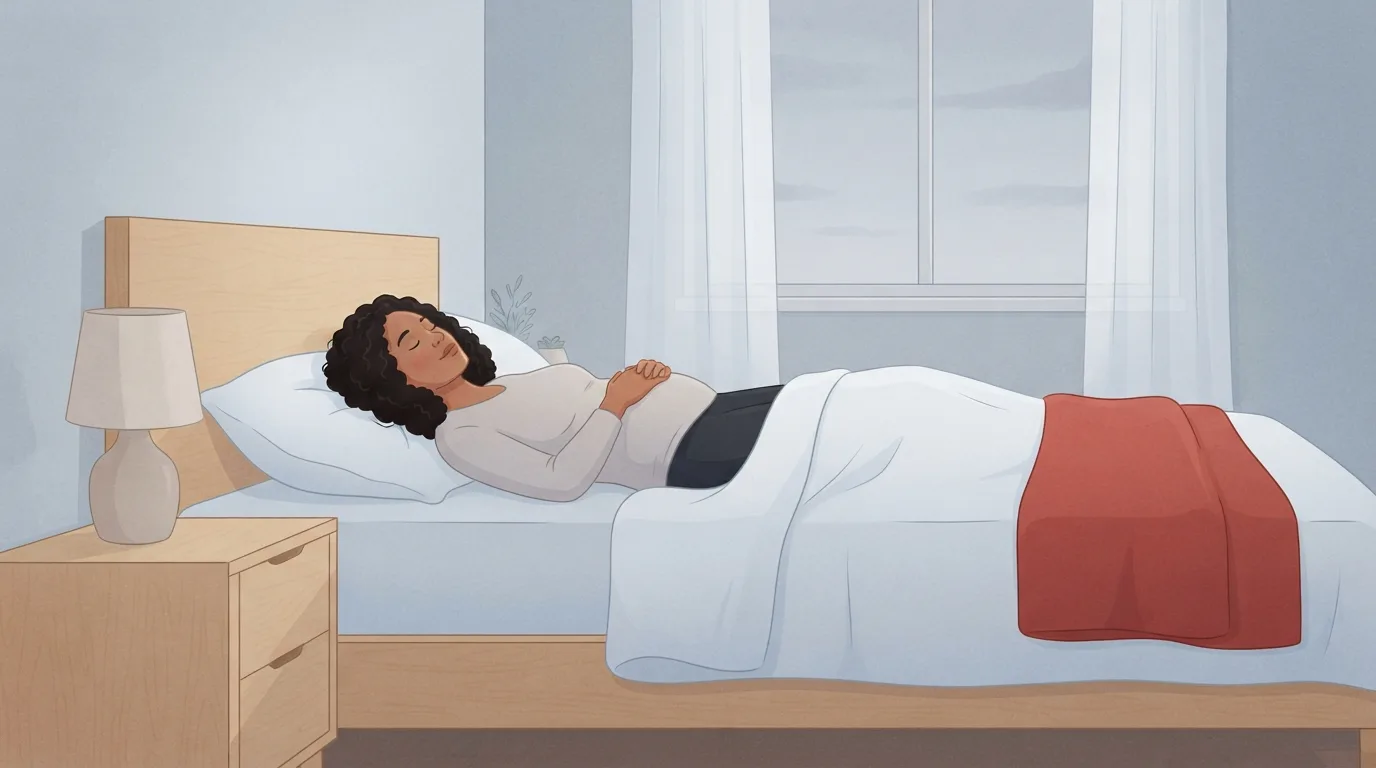
You've been in bed for 40 minutes. Every time you check the time, the sum gets worse: fall asleep now and you'll get six hours, then five and a half, then five. Your body is tired and your brain is running a meeting.
So you try harder. You lie very still, close your eyes tighter and tell yourself to sleep. Sleep is one of the few things that gets harder the more effort you put in, because trying keeps your brain on alert. After enough nights like that, the bed itself starts to mean "lie here and worry," and the problem feeds itself.
None of that means your body is broken. Most of the time it's a learned pattern, and learned patterns change with a better routine. Below you'll find what a normal time to fall asleep is, 10 methods with real studies behind them, an honest look at the military method, what doesn't work, and when trouble falling asleep needs a doctor rather than a new trick.
How Long Should It Take to Fall Asleep?
Up to about half an hour is normal. A National Sleep Foundation expert panel that reviewed 277 studies (Ohayon and colleagues, 2017) rated falling asleep within 30 minutes as a sign of good sleep quality at every age. Taking about 45 minutes or longer counted as a sign of poor sleep quality for adults under 65, and about an hour or longer after 65.
That changes what "faster" should mean for you. If you currently lie awake for an hour, getting to 20 minutes is a big win. If you already fall asleep in 15, there isn't much left to gain. The searches for how to fall asleep in 10 seconds or in 2 minutes are chasing something you probably don't want, because dropping off the instant your head touches the pillow, night after night, is more often a sign that you're short on sleep than a skill.
How to Fall Asleep Faster: The 10 Methods at a Glance
The first five methods are for tonight, once you're in bed. The other five take effect over days and weeks, because they work on your body temperature, your light exposure and your daily rhythm.
| Method | When to use it | Best evidence |
|---|---|---|
| 1. Get up after about 20 minutes awake | In bed | AASM clinical guideline (stimulus control) |
| 2. Slow your breathing | In bed or the last 20 minutes before | Small sleep-lab study |
| 3. Relax your muscles from the face down | In bed | AASM clinical guideline (relaxation therapy) |
| 4. Picture one detailed scene | In bed | Randomized study in people with insomnia |
| 5. Write tomorrow's to-do list | Five minutes before lights out | Randomized sleep-lab study |
| 6. Warm bath or shower | 1 to 2 hours before bed | Meta-analysis of 13 studies |
| 7. Cool, dark, quiet bedroom | All night | Review of lab studies |
| 8. Dim lights, no screens | The last 2 hours | Controlled lab studies |
| 9. Caffeine cutoff | About 9 hours before bed | Meta-analysis of 24 studies |
| 10. Regular exercise, hard sessions early | Daytime, ending 4 hours before sleep | Meta-analysis plus 4 million nights of wearable data |
How to Fall Asleep When You Can't: Five Methods for Tonight
These are the methods to use when you're lying awake right now. They share one idea: lower the alarm level in your body and give your mind something calm to do, instead of fighting for sleep.
1. Get Out of Bed After About 20 Minutes Awake
This is the core of stimulus control, one of the main parts of cognitive behavioral therapy for insomnia (CBT-I). The American Academy of Sleep Medicine's 2021 guideline (Edinger and colleagues) suggests stimulus control as a treatment on its own for chronic insomnia, and it strongly recommends the full multicomponent CBT-I program it belongs to.
The rules are simple and they feel backwards for the first few nights:
- Go to bed only when you're sleepy, not just tired or because the clock says so.
- If you're awake for what feels like about 20 minutes, get up. Guess. Watching the clock defeats the point.
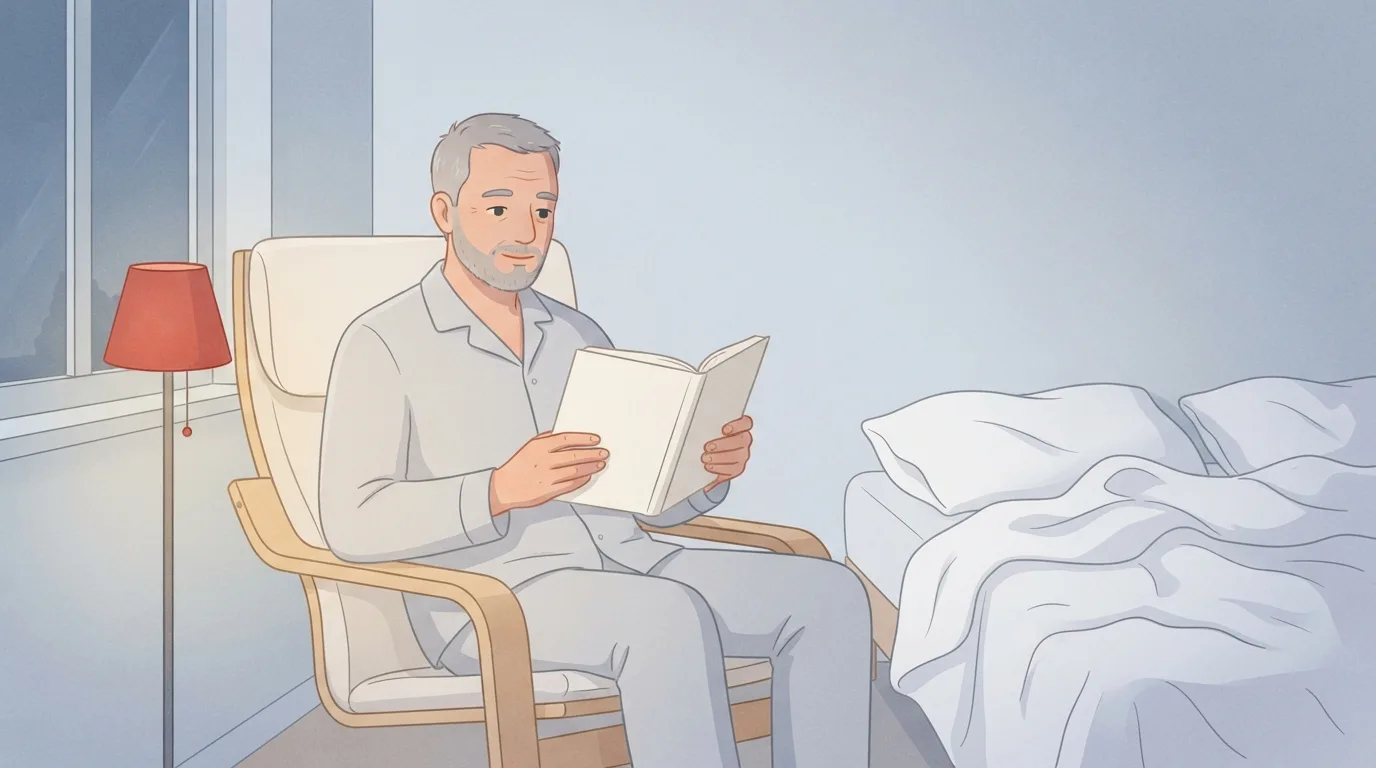
- Go to another room and do something quiet in dim light, such as reading a paper book or folding laundry, and go back to bed when you feel sleepy again. Repeat as often as you need to.
- Use the bed for sleep and sex only. No scrolling, work or arguments in it.
- Get up at the same time every morning, however the night went.
You'll probably lose a little sleep in the first week. That's expected. The goal is to retrain the link between bed and sleep, and it's the reason this method helps more over a fortnight than on any single night.
2. Slow Your Breathing to About Six Breaths a Minute
Slow breathing shifts your nervous system toward its resting side. Tsai and colleagues (2015) compared 14 people with self-reported insomnia against 14 good sleepers and measured their sleep in the lab with polysomnography. When the insomnia group practiced slow, paced breathing at six breaths a minute for 20 minutes before going to sleep, they fell asleep faster, woke less often and spent more of the night asleep. It's a small study, so treat it as promising rather than settled.
Six breaths a minute is a 10-second breath. Breathe in through your nose for about 4 seconds and out slowly for about 6, letting your belly rise rather than your shoulders. Keep it gentle. If counting makes you more alert, drop the count and simply make each out-breath longer than the in-breath.
The 4-7-8 method is the version most people search for. Breathe in quietly through your nose for a count of 4, hold for 7, breathe out through your mouth with a soft whoosh for 8, and repeat for four rounds. Vierra and colleagues (2022) had 43 healthy young adults do three sets of it and found their heart rate and systolic blood pressure fell straight afterwards. In the participants who weren't sleep-deprived, heart rate variability also shifted toward the calming side of the nervous system. That study measured the body's response, not sleep. No trial has yet tested whether 4-7-8 shortens the time it takes to fall asleep. If the long hold makes you lightheaded, shorten it or skip it.
3. Relax Your Body From the Face Down
Muscle tension and a racing mind feed each other, so relaxing one quiets the other. The AASM guideline suggests relaxation therapy as a stand-alone treatment for chronic insomnia, the same strength of recommendation it gives stimulus control. The most common version is progressive muscle relaxation:
- Start with your face. Scrunch your forehead and eyes for about 5 seconds, then let go completely for 10 to 20 seconds and notice the difference.
- Clench your jaw, then release it and let your tongue rest off the roof of your mouth.
- Lift your shoulders toward your ears, then drop them as low as they'll go.
- Work down through your hands, arms, belly, thighs, calves and feet the same way.
- Finish by breathing out slowly and letting your whole body feel heavy on the mattress.
Go gently on any area that cramps easily, such as the calves or feet. Light tension is enough to feel the release.
4. Give Your Mind One Detailed Scene
Telling yourself to stop thinking rarely works. Giving your mind a better thing to think about does. Harvey and Payne (2002) gave 41 people with insomnia one of three instructions for a night: distract yourself with a detailed, engaging mental image, distract yourself in general, or no instructions. The imagery group fell asleep sooner and had fewer unwanted thoughts than the group with no instructions. General distraction didn't help.
Pick a scene you know well and that holds your interest without exciting you: walking a favorite trail, cooking a meal step by step, or setting up a campsite. Fill it with detail, from the sound underfoot to the smell of the food. Word games such as the "cognitive shuffle," where you picture random objects for each letter of a word, rest on the same idea, though they haven't been tested as directly.
5. Write Tomorrow's To-Do List for Five Minutes
Unfinished tasks are one of the most common things that keep people awake. Scullin and colleagues (2018) had 57 healthy adults aged 18 to 30 spend five minutes writing before lights-out in a sleep lab. Half wrote a to-do list for the next few days and half wrote about tasks they had already finished. The to-do group fell asleep in about 16 minutes on average, against about 25 minutes for the other group, and the more specific their lists were, the faster they fell asleep.
Use paper, not your phone, and be specific: "email the landlord about the boiler" beats "house stuff." Writing the list down tells your brain it doesn't have to keep rehearsing it.
How Do Soldiers Sleep Fast? The Military Method, Checked
The "military method" comes from Relax and Win, a 1981 book by the track coach Bud Winter, who described teaching relaxation to US Navy pre-flight cadets during the Second World War. The version that circulates today goes like this:
- Lie down and relax your whole face, including your forehead, the muscles around your eyes, your tongue and your jaw.
- Drop your shoulders as low as they'll go, then let your arms go loose, one side at a time.
- Breathe out and let your chest relax.
- Relax your legs from the thighs down to the calves and feet.
- Clear your mind for about 10 seconds by picturing a calm scene, such as lying in a canoe on a still lake, or by silently repeating "don't think."
The evidence is thinner than the claims. The method has never been tested as a package in a published trial, and the success figures attached to it online come from the book's own account rather than from a study. Its two ingredients have been tested, though: muscle relaxation (method 3) and focused imagery (method 4) both have evidence that they help people fall asleep sooner. So it's a sensible combination of good parts that the book says takes weeks of practice. Treat it as a routine to rehearse, not a two-minute switch.
Find out what's really holding you back
FitCraft, our mobile fitness app, pairs you with an AI coach who builds you a personalized plan around your goals, schedule, and fitness level. Every FitCraft program is designed by Domenic Angelino, MPH (Brown University) and NSCA-CSCS, with research published in the Journal of Strength and Conditioning Research and Medicine & Science in Sports & Exercise.
Take the Free Assessment Free • 2 minutes • No credit cardIn the Evening: Three Methods for the Last Two Hours
Your body falls asleep more easily when its core temperature is dropping and its melatonin is rising. These three methods help both happen on time.
6. Take a Warm Bath or Shower 1 to 2 Hours Before Bed
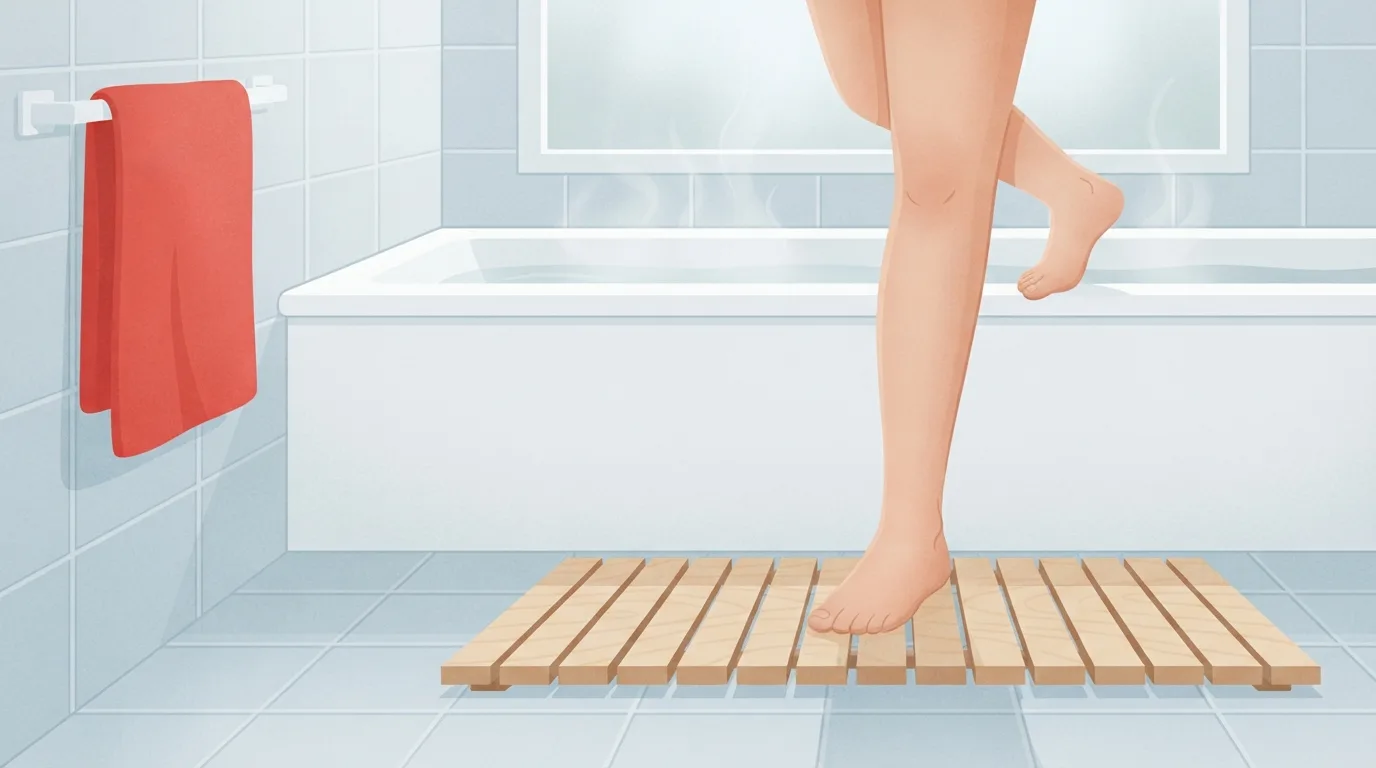
It sounds odd that warming up helps you cool down, but that's how it works. Warm water draws blood to your hands and feet, and the skin there then sheds heat quickly, so your core temperature falls faster afterwards. Haghayegh and colleagues (2019) screened 5,322 articles for a meta-analysis and pooled 13 studies. A bath or shower at 40 to 42.5°C (104 to 108.5°F), taken 1 to 2 hours before bedtime for as little as 10 minutes, significantly shortened the time it took to fall asleep and improved self-rated sleep quality.
The hands and feet matter here. In a classic lab study, Kräuchi and colleagues (1999) reported in Nature that warm hands and feet, meaning blood vessels in the skin opening up to shed heat, went with falling asleep faster. If your feet are always cold in bed, a pair of socks is a reasonable cheap experiment.
7. Keep the Bedroom Cool, Dark and Quiet
A hot bedroom costs you sleep. Reviewing the lab evidence, Okamoto-Mizuno and Mizuno (2012) concluded that heat exposure with normal bedding increases time awake and reduces deep sleep and REM sleep, and that humid heat is worse still. Aim for a room that's cool enough that you want a blanket, with breathable bedding.
Darkness and quiet do the rest. Blackout curtains or an eye mask block streetlight and early dawn, and steady background sound such as a fan can cover traffic or a snoring partner. Cover small standby lights with tape if they bother you.
8. Dim the Lights and Put the Screen Down
Ordinary indoor light in the evening delays your melatonin. Gooley and colleagues (2011) compared 116 healthy adults living in room light (under 200 lux) with dim light (under 3 lux) in the 8 hours before bed. Room light delayed the start of melatonin release in 99% of them and shortened the night's melatonin by about 90 minutes.
Screens held close to your face add to it. In a lab study by Chang and colleagues (2015), people who read on a light-emitting eReader before bed took longer to fall asleep, released less melatonin, had their body clocks pushed later and felt less alert the next morning than when they read a printed book. For the last two hours, switch from overhead lights to a lamp, read on paper, and charge your phone outside the bedroom if you can.
During the Day: Two Methods That Start Hours Earlier
The last two methods happen long before bedtime, which is why people forget to connect them to the night.
9. Stop Caffeine About 9 Hours Before Bed
Caffeine lasts longer than it feels. Drake and colleagues (2013) gave adults 400 milligrams of caffeine, roughly four cups of brewed coffee, at bedtime, 3 hours before or 6 hours before, and compared each with a placebo. All three disrupted sleep, and even the dose taken 6 hours before bed cut total sleep by more than an hour on a home sleep monitor.
A larger review put numbers on the cutoff. Gardiner and colleagues (2023) pooled 24 studies and found caffeine cut total sleep by 45 minutes and added about 9 minutes to the time it took to fall asleep. To protect total sleep, they estimated a regular coffee (107 milligrams per 250 milliliters) should come at least 8.8 hours before bed, and a typical pre-workout supplement (217.5 milligrams) at least 13.2 hours before. For an 11 p.m. bedtime, that means your last coffee by about 2 p.m. and no pre-workout powder after mid-morning.
Your own cutoff may differ. Caffeine is cleared mostly by one liver enzyme, CYP1A2, which handles about 95% of it, and genetic differences in that enzyme make people clear caffeine at very different speeds (Nehlig, 2018). Tea, cola, energy drinks and dark chocolate all count toward the total.
10. Exercise Most Days, and Finish Hard Workouts 4 Hours Before Bed
Regular exercise is one of the best-supported ways to fall asleep faster without a pill. Kredlow and colleagues (2015) pooled 66 studies and found that regular exercise had small-to-medium benefits on how long it takes to fall asleep and moderate benefits on overall sleep quality. Our review of exercise and sleep research covers the newer network meta-analyses of 86 trials and the dose that seems to work best.
Timing matters mostly for hard sessions. Stutz and colleagues (2019) reviewed 23 studies of a single evening workout and found evening exercise didn't harm sleep overall, with one exception: vigorous exercise ending within an hour of bedtime might delay sleep and shorten it. Leota and colleagues (2025) then analyzed a year of wearable data from 14,689 active people. High-strain sessions late in the evening were linked with later sleep onset, shorter and poorer sleep, and a higher heart rate overnight. Sessions that ended at least 4 hours before sleep onset showed no link with sleep at all, however hard they were.
In practice, put your hardest workouts in the morning, at lunch or straight after work. If the evening is your only slot, keep the last couple of hours before bed for lighter work such as yoga, mobility or an easy walk. Better sleep then pays you back in the gym, because sleep is when training turns into muscle and strength, as our look at sleep and muscle growth explains.
The hard part is the word "regular." Most people know exercise helps them sleep and still stop by week three. Our roundup of the best fitness apps for staying consistent compares the options built to keep you training through the weeks when motivation fades. FitCraft is one of them: a 3D AI coach demonstrates each exercise, says your name during the workout and keeps a streak going, and its yoga, mobility, dumbbell and bodyweight workouts let you keep the gentle sessions for the evening and the strength work for earlier in the day. As one user, Katie, put it: "I've tried everything. This is the first time I've stuck with something past two weeks."
What Doesn't Help You Fall Asleep Faster
A few popular habits make falling asleep easier tonight and harder overall.
- A nightcap. Alcohol does make you fall asleep sooner. A review of every known study in healthy volunteers by Ebrahim and colleagues (2013) found that alcohol at all doses shortened the time to fall asleep, then disrupted the second half of the night and delayed the first REM period. You trade an easier start for a worse night.
- Lying in bed willing it to happen. That's the effort trap from the start of this guide, and method 1 exists to break it.
- Watching the clock. Every check turns into a calculation of lost sleep. Turn the clock to face the wall.
- Sleep hygiene tips on their own for long-term insomnia. The AASM guideline suggests that clinicians not use sleep hygiene as the only treatment for chronic insomnia. The tips still help as part of a plan, but a list of habits isn't a treatment by itself.
- Sleeping in after a bad night. A late morning pushes the next night's sleepiness later. Keeping a steady wake time helps more, and our guide to the best time to go to bed shows how to pick that time and the bedtime that goes with it.
This guide doesn't cover sleeping pills or sleep supplements. If you're thinking about either, talk to a doctor or pharmacist first, because they can interact with other medicines and health conditions.
When to See a Doctor About Trouble Falling Asleep
Occasional bad nights are normal, especially around stress, travel or illness. Chronic insomnia is different: the National Heart, Lung, and Blood Institute defines it as trouble sleeping on 3 or more nights a week for more than 3 months that another health problem doesn't fully explain.
If that's you, ask about cognitive behavioral therapy for insomnia. It's the first-line treatment, and it combines several of the methods above with sleep scheduling and work on the thoughts that keep you awake, over several weeks. A meta-analysis by Trauer and colleagues (2015) pooled 20 trials with 1,162 adults with chronic insomnia. After treatment, people fell asleep about 19 minutes sooner and spent about 26 fewer minutes awake during the night, and the gains seemed to last.
See a doctor sooner if any of these apply to you:
- Loud snoring, gasping or pauses in your breathing that a partner notices, or waking unrefreshed however long you sleep. These can be signs of sleep apnea.
- An uncomfortable urge to move your legs in the evening that eases when you move. That can be restless legs syndrome.
- Worry, low mood or panic that keeps you awake most nights.
- Falling asleep easily only at 2 or 3 a.m. and struggling to wake for work, which can be a body clock disorder.
- Feeling drowsy while driving or at work. Get help now rather than later.
The Bottom Line
To fall asleep faster tonight, stop forcing it: get up if you're awake after about 20 minutes, slow your breathing, relax your body from the face down, and give your mind one detailed scene or a written to-do list. To fall asleep faster every night, take a warm bath 1 to 2 hours before bed, keep the room cool and dim, stop caffeine about 9 hours before bedtime, and exercise most days with hard sessions finished at least 4 hours before sleep.
Expect the evening and daytime changes to work over a week or two rather than overnight. And if trouble falling asleep has lasted for months, that's insomnia, which has a proven treatment and is worth a doctor's time.
Frequently Asked Questions
How can I fall asleep in 5 minutes?
You can't reliably make yourself fall asleep in 5 minutes on demand, and taking up to about 30 minutes is normal. The quickest methods with study support are slow breathing, relaxing your muscles from the face down and picturing one detailed scene, and they work best once you already feel sleepy. If you fall asleep within a few minutes every night, you may simply be short on sleep.
What breathing exercise can help me fall asleep in 60 seconds?
No breathing exercise reliably puts you to sleep in 60 seconds. Four rounds of 4-7-8 breathing take a little over a minute, which is likely where the claim comes from, but its one study measured heart rate and blood pressure, not sleep. Slow breathing at about six breaths a minute for 20 minutes before bed is the version a sleep-lab study linked to falling asleep sooner.
How do you fall asleep when your mind won't stop racing?
Give your mind a specific job. Write a detailed to-do list for tomorrow for five minutes before lights out, then picture one familiar scene in full sensory detail once you're in bed. In a sleep-lab study, people who wrote a specific to-do list fell asleep about 9 minutes sooner than people who wrote about tasks they'd finished.
Does exercise help you fall asleep faster?
Yes, when it's regular. A meta-analysis of 66 studies found regular exercise had small-to-medium benefits on how long it takes to fall asleep and moderate benefits on sleep quality. Timing matters for hard sessions: in wearable data from 14,689 people, workouts that ended at least 4 hours before sleep onset showed no effect on sleep, while hard ones late in the evening pushed sleep later.
How late can I drink coffee and still fall asleep?
A 2023 meta-analysis of 24 studies suggests finishing a regular cup of coffee at least 8.8 hours before bed, so about 2 p.m. for an 11 p.m. bedtime. A typical pre-workout supplement, with roughly twice the caffeine, needs about 13 hours. People clear caffeine at very different speeds, so if you sleep badly on coffee days, move your cutoff earlier.
What are the benefits of good sleep?
Regular sleep of at least 7 hours a night protects health, performance and safety in adults. The joint consensus statement of the American Academy of Sleep Medicine and the Sleep Research Society links regularly sleeping less than 7 hours to weight gain, diabetes, high blood pressure, heart disease, depression, weaker immune function, more errors and a greater risk of accidents. Good sleep also helps your body recover from training.