
You've probably heard that 10 p.m. is the magic hour, that every hour before midnight counts double, or that you should copy the routine of some early-rising CEO. Then you look at your own week: an alarm at 6:15 on weekdays, a late dinner on Thursday, and a Saturday where you're wide awake at midnight and asleep until 10.
That pattern can leave you feeling jet-lagged every Monday without ever getting on a plane. It's also easy to read as a willpower problem, as if better people simply go to bed on time. Most of the time it's a scheduling problem, and schedules are fixable.
The good news is that the research on bedtime is more practical than the myths. It points to a window, not a magic minute, and it says the most useful thing you can do is make that window the same every night. Below you'll find how to calculate your bedtime, how much sleep you need at each age, how your chronotype changes the answer, what the big UK Biobank studies found, and how to move your bedtime earlier if it has drifted.
What Is the Best Time to Go to Sleep?
The best time to go to sleep, and the real answer to "when should I go to bed?", is the time that leaves you enough hours before you have to get up, at a point in the evening when your body clock is ready for it. For most adults with a 6 to 7 a.m. alarm, that works out to roughly 10 to 11 p.m. If you start work at 10 a.m. and naturally run late, midnight can be a perfectly good bedtime.
The amount comes first. The American Academy of Sleep Medicine and the Sleep Research Society (Watson and colleagues, 2015) agree that adults should sleep 7 or more hours a night on a regular basis. A bedtime that can't deliver 7 hours before your alarm is too late, however good the clock time sounds.
The timing comes second. Your body clock decides when sleep comes easily and when it doesn't, and it varies from person to person. The rest of this guide is about matching those two things to the life you actually have.
How Do I Calculate My Bedtime?
Work backwards from your wake-up time. Subtract the sleep you need, then subtract about 15 minutes to fall asleep. If it usually takes you longer than that, our guide on how to fall asleep faster covers the methods that shorten it, from slow breathing to getting up after about 20 minutes awake.
| Wake-up time | Lights out for 7 hours | Lights out for 8 hours | Lights out for 9 hours |
|---|---|---|---|
| 5:00 a.m. | 9:45 p.m. | 8:45 p.m. | 7:45 p.m. |
| 5:30 a.m. | 10:15 p.m. | 9:15 p.m. | 8:15 p.m. |
| 6:00 a.m. | 10:45 p.m. | 9:45 p.m. | 8:45 p.m. |
| 6:30 a.m. | 11:15 p.m. | 10:15 p.m. | 9:15 p.m. |
| 7:00 a.m. | 11:45 p.m. | 10:45 p.m. | 9:45 p.m. |
| 7:30 a.m. | 12:15 a.m. | 11:15 p.m. | 10:15 p.m. |
| 8:00 a.m. | 12:45 a.m. | 11:45 p.m. | 10:45 p.m. |
| 8:30 a.m. | 1:15 a.m. | 12:15 a.m. | 11:15 p.m. |
| 9:00 a.m. | 1:45 a.m. | 12:45 a.m. | 11:45 p.m. |
Treat the 7-hour column as the latest you should go to bed, not the target. Seven hours is the floor in the consensus statement, plenty of adults need more, and the only way to find your number is to try a schedule for two weeks and notice whether you wake before the alarm and stay alert through the afternoon.
Online sleep calculators often count in 90-minute cycles and tell you to wake at the end of one. That's a rough guide at best. The National Heart, Lung, and Blood Institute puts a cycle at about 80 to 100 minutes, with four to six cycles a night, so a schedule that lands on an exact cycle boundary is mostly luck. A window of sleep you can keep every night matters far more than the precise minute.
How Much Sleep You Need by Age
Two expert panels have set sleep ranges by age: the American Academy of Sleep Medicine for children and teenagers (Paruthi and colleagues, 2016), with the adult figure from the AASM and Sleep Research Society statement above, and the National Sleep Foundation (Hirshkowitz and colleagues, 2015). Their numbers line up closely.
| Age | AASM recommendation | National Sleep Foundation range |
|---|---|---|
| Newborns, 0 to 3 months | Not set | 14 to 17 hours |
| Infants, 4 to 12 months | 12 to 16 hours, including naps | 12 to 15 hours |
| Toddlers, 1 to 2 years | 11 to 14 hours, including naps | 11 to 14 hours |
| Preschool, 3 to 5 years | 10 to 13 hours, including naps | 10 to 13 hours |
| School age, 6 to 12 years | 9 to 12 hours | 9 to 11 hours |
| Teenagers, 13 to 18 years | 8 to 10 hours | 8 to 10 hours |
| Adults, 18 to 64 years | 7 or more hours | 7 to 9 hours |
| Older adults, 65 and up | 7 or more hours | 7 to 8 hours |
Put those ranges against a real morning and the bedtimes follow. A 9-year-old who wakes at 6:45 for school needs to be asleep somewhere between about 6:45 and 9:45 p.m., and a 15-year-old with the same alarm needs to be asleep by about 10:45 at the latest. That teenage bedtime is hard to hit for a reason covered in the next section: teenage body clocks run late.
Night Owl or Early Bird: How Your Chronotype Changes Your Bedtime
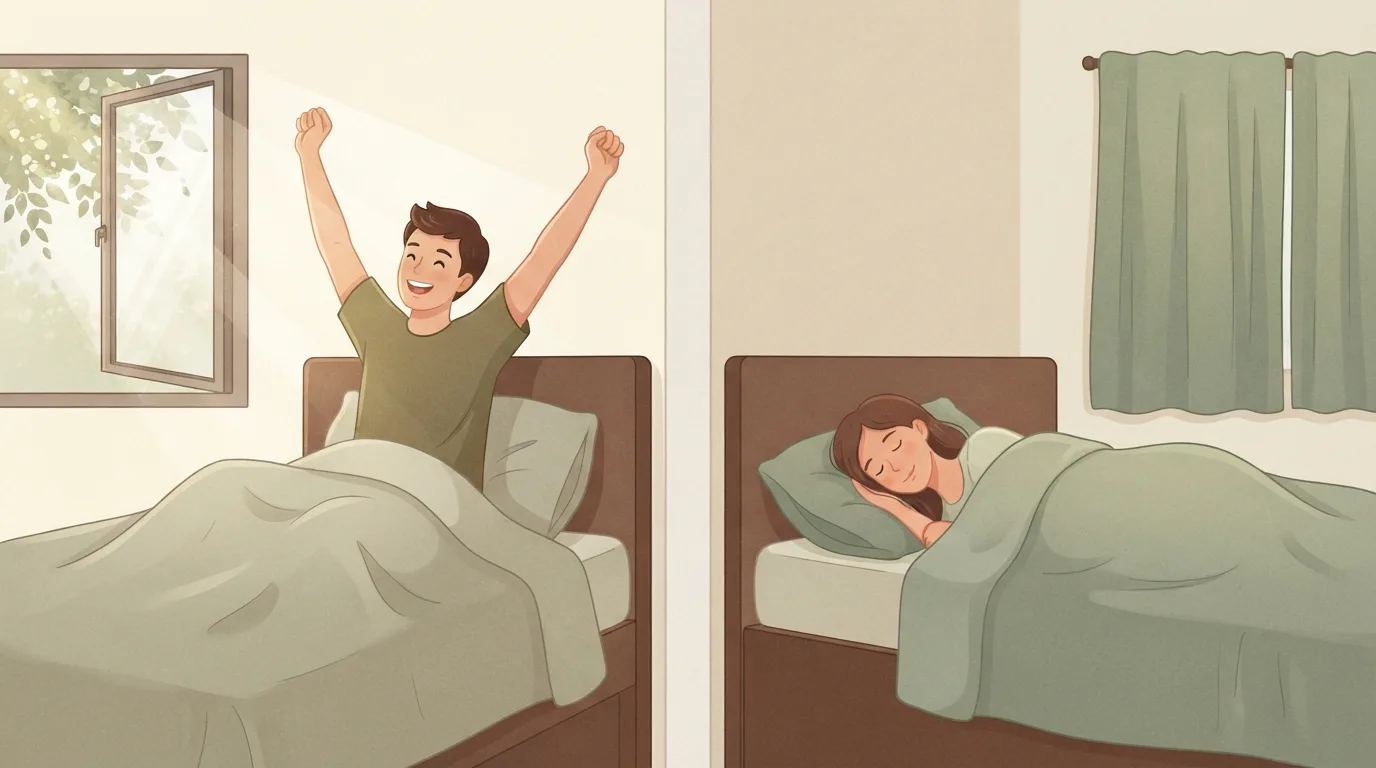
Your chronotype is the timing your body clock prefers. Some people are sleepy at 9:30 p.m. and up with the sun; others don't feel tired until after midnight. Both are normal variations, shaped by genes, age and light.
Age moves it a lot. Roenneberg and colleagues (2004) surveyed about 25,000 people and found sleep timing drifts steadily later through the teens, then turns around sharply at about age 20 and moves earlier through adulthood. That's why a teenager's natural bedtime runs later than a parent's, and why "just go to bed earlier" rarely works on a 16-year-old.
Being a night owl isn't harmful in itself, but living against your clock may be. In the UK Biobank, Knutson and von Schantz (2018) followed 433,268 adults for an average of 6.5 years. People who called themselves definite evening types had a 10% higher risk of death from any cause than definite morning types, after adjusting for sleep duration, smoking, body weight and other factors. The authors suggest a likely reason: evening types are often forced onto early work and social schedules that clash with their internal timing.
The encouraging part is that much of the lateness comes from light. Wright and colleagues (2013) sent adults camping for a summer week with natural light only. Their internal clocks moved about 2 hours earlier, and the later chronotypes moved the most. You don't need a tent to use that finding: daylight in the morning and less bright light late at night pull a night owl's clock earlier.
Find out what's really holding you back
FitCraft, our mobile fitness app, pairs you with an AI coach who builds you a personalized plan around your goals, schedule, and fitness level. Every FitCraft program is designed by Domenic Angelino, MPH (Brown University) and NSCA-CSCS, with research published in the Journal of Strength and Conditioning Research and Medicine & Science in Sports & Exercise.
Take the Free Assessment Free • 2 minutes • No credit cardIs 10 p.m. the Best Time to Sleep? What the UK Biobank Found
The "10 to 11 p.m." answer you see everywhere comes from one study. Nikbakhtian and colleagues (2021) used wrist-worn accelerometers to measure when 88,026 UK Biobank participants actually fell asleep over a week, then tracked new cases of cardiovascular disease for an average of 5.7 years. Falling asleep between 10:00 and 10:59 p.m. was linked with the lowest rate. Compared with that hour, the risk was:
- 24% higher for people who fell asleep before 10 p.m.
- 12% higher for those who fell asleep between 11 and 11:59 p.m.
- 25% higher for those who fell asleep at midnight or later.
Three details matter before you set an alarm for 9:45. The link held after the researchers adjusted for sleep duration, sleep irregularity and standard heart risk factors. It was stronger in women, and in men only the before-10 group stood out. And the authors say plainly that their findings don't show causality. So the study supports a sensible window for most adults, and it also shows that earlier isn't automatically better.
Why a Regular Bedtime Beats a Perfect One
If one finding deserves more attention than the 10 p.m. headline, it's this one. Windred and colleagues (2024) calculated a sleep regularity score from more than 10 million hours of accelerometer data in 60,977 UK Biobank participants. Compared with the least regular fifth, the more regular groups had a 20 to 48% lower risk of death from any cause over about six years, and regularity predicted that risk better than sleep duration did.
Irregular timing also drags the body clock later. Phillips and colleagues (2017) tracked 61 college students for 30 days. In the least regular sleepers, melatonin started rising at about eight minutes past midnight, against about 9:30 p.m. in the most regular group, a gap of roughly two and a half hours. The irregular students also got less daytime light.
Researchers call the weekday-weekend version of this social jetlag: the gap between when you sleep on work days and on free days. Wittmann and colleagues (2006) described it in 501 volunteers and found late chronotypes had the biggest gaps, along with poorer wellbeing and more smoking. In data from about 65,000 people, Roenneberg and colleagues (2012) linked more social jetlag to a higher body mass index, beyond the effect of sleep length.
The practical rule is simple. Choose a wake-up time you can keep seven days a week, give or take about an hour, and let your bedtime follow from it. Consistency is the part of sleep most people can actually control, and it's the same lesson that applies to training: the routine you repeat beats the perfect plan you keep restarting.
Is Sleep Before Midnight Better?
The old line that "an hour before midnight is worth two after" isn't true as stated, but it points at something real. Your sleep is run by two systems. One is sleep pressure, which builds the longer you're awake. The other is your circadian clock, which sets the hours when sleep comes easily.
In a classic lab study, Dijk and Czeisler (1995) had eight men live on a 28-hour day for more than a month, so their sleep fell at every point of their internal clock. Deep slow-wave activity was highest at the start of every sleep episode and fell across it, whatever the clock time, while REM sleep followed the circadian clock and peaked late in the biological night. NHLBI's summary of sleep stages says the same in plain terms: more deep sleep early in the night, more REM later.
So midnight itself isn't special. A night owl who sleeps from 1 to 9 a.m. every day gets the deep sleep early and the REM late, just like an early bird. The problem is a late bedtime paired with an early alarm, because it cuts off the REM-rich final cycles. That's what "too late to go to bed" really means: a bedtime that leaves fewer than 7 hours before your alarm, or one that's far from your usual time.

How Workout Timing Moves Your Body Clock
Light isn't the only signal your clock listens to. Youngstedt and colleagues (2019) had 99 fit adults, 51 of them aged 59 to 75, exercise on a treadmill for an hour at moderate effort on three days in a row, at one of eight times of day. Exercise at 7 a.m. or between 1 and 4 p.m. shifted the melatonin rhythm earlier. Exercise between 7 and 10 p.m. shifted it later. Age and sex made no difference, and the shifts were similar in size to what bright light of the same length would be expected to do.
That gives you a lever. If your bedtime has drifted past midnight and you want it earlier, a morning or early-afternoon workout pulls your clock in the right direction. If you work nights, the same curve can help you hold a late schedule, and our night shift workout guide shows how to anchor training to your sleep. For everyone else, the research on the best time to workout says the hour you can repeat matters more for results than the hour itself, and the two goals usually point the same way.
Regular exercise also improves sleep quality in general, as our review of exercise and sleep research lays out. The catch is the word "regular." If you keep falling off a routine, our comparison of the best workout apps for busy professionals scores the options on the things that keep a fixed slot alive, such as how fast you get to the first rep and what happens when you miss a day. FitCraft is one of them: a 3D AI coach demonstrates every exercise and says your name mid-workout, programs run over several weeks, and a streak gives the morning session a reason to happen tomorrow too.
How to Move Your Bedtime Earlier
If your current bedtime is later than the chart says it should be, shift it gradually. Jumping two hours earlier in one night usually means two hours of lying awake.
- Fix your wake-up time first. Pick the time you need on workdays and keep it on weekends, within about an hour. The bedtime follows the wake-up time, not the other way round.
- Get outside light soon after you wake. Take a short walk, eat breakfast by a bright window or commute on foot. Morning light is the main signal that pulls a late body clock earlier.
- Move bedtime 15 to 30 minutes earlier every few days, and only go to bed when you feel sleepy.
- Schedule workouts in the morning or early afternoon while you're shifting, and keep 7 to 10 p.m. sessions for later.
- Make the last hours of the evening easy to sleep after. Our guide on how to fall asleep faster covers the light, caffeine and wind-down details.
Expect it to take one to two weeks to feel settled. After a late weekend or a trip, go back to the same wake-up time the next morning rather than sleeping in, even if you're tired. That one habit protects the schedule more than any bedtime rule.
When a Late Bedtime Needs a Doctor
Most bedtime problems are schedule problems, but some aren't. Talk to a doctor if:
- You can't fall asleep before 2 or 3 a.m. even after weeks of a fixed wake-up time and morning light, and you struggle badly to wake for school or work. That can be a body clock disorder called delayed sleep-wake phase disorder, and it's especially common in teenagers.
- Night or rotating shifts leave you unable to sleep in the daytime or drowsy at work most days.
- You get 7 to 9 hours but still feel sleepy through the day, snore loudly or wake gasping.
- Your child's or teenager's sleep problems are affecting school, mood or behavior.
The Bottom Line
Start with your wake-up time, count back 7 to 9 hours plus about 15 minutes, and that's your bedtime. For most adults with a 6 or 7 a.m. alarm it lands between about 10 and 11 p.m., which also matches the window the UK Biobank study linked with the lowest heart disease risk.
Then protect the schedule more than the exact hour. The same wake-up time every day, morning light and well-timed exercise do more for your sleep than chasing a perfect bedtime you can only hit twice a week.
Frequently Asked Questions
Which time is perfect for sleeping?
There's no single perfect hour for everyone. For most adults the best window is the one that allows at least 7 hours asleep before a fixed wake-up time, which often means lights out between about 10 and 11 p.m. A UK Biobank study linked falling asleep between 10 and 10:59 p.m. with the lowest heart disease rate, but it was observational and doesn't prove that the hour itself matters.
How do I calculate my bedtime?
Start from the time you have to get up, subtract the sleep you need (at least 7 hours for adults, 8 to 10 for teenagers), then subtract about 15 minutes to fall asleep. For a 6:30 a.m. alarm and 8 hours of sleep, that's lights out at about 10:15 p.m. Keep that wake-up time on weekends too, so the bedtime stays easy to hit.
Does it matter what time you sleep if you get 8 hours?
Less than people think, as long as the timing is the same most nights and suits your body clock. Large UK Biobank studies found that very late or very irregular sleep was linked with worse heart health and higher mortality, and that regularity predicted risk better than total hours. Eight hours from 1 to 9 a.m. every day is a different thing from 8 hours that start at a different time each night.
What does the 10-3-2-1-0 sleep rule mean?
It's a popular countdown: no caffeine 10 hours before bed, no food or alcohol 3 hours before, no work 2 hours before, no screens 1 hour before, and zero presses of the snooze button. Several parts line up with sleep research, especially the caffeine and screen steps, but the rule itself hasn't been tested as a package. The caffeine step has the strongest evidence behind it.
Which age sleeps the most?
Newborns do. The National Sleep Foundation's panel recommends 14 to 17 hours a day for babies up to 3 months old, falling to 11 to 14 hours for toddlers, 9 to 11 for school-age children, 8 to 10 for teenagers and 7 to 9 for adults. Adults 65 and older are advised to get 7 to 8 hours.
Is 45 minutes of sleep enough?
Not as a night's sleep. Forty-five minutes is less than one full sleep cycle, which lasts about 80 to 100 minutes, and adults need at least 7 hours a night. As a daytime nap it can take the edge off sleepiness, though waking from deep sleep partway through a cycle can leave you groggy for a while.
Is midnight 12 a.m. or 12 p.m.?
In everyday US use, midnight is 12 a.m., the first moment of the new day, and noon is 12 p.m. Because the two labels are easy to mix up, many schedules write midnight in words or use the 24-hour time 00:00 instead.