
You log a snack bar and your app says 190 kcal. The wrapper says 190 Calories. A snack bar you bought on a trip to Europe says 806 kJ and 192 kcal. Then someone online insists a "calorie" is a thousand times smaller than a "Calorie," and you start wondering whether every number you've tracked was off by a factor of a thousand.
It wasn't. Whether you searched kcal vs cal or cal vs kcal, the confusion comes from three units with overlapping names, not from your math. Below is how the units relate, what food labels in different countries are required to print, why fitness trackers use kcal, how to convert kilojoules with a worked example, and the label errors that matter far more than the unit when you count calories.
kcal vs cal at a Glance
Four units show up on food, fitness devices and science homework. Calories and kilocalories, as food labels use them, are the same thing. The small calorie is 1,000 times smaller, and the kilojoule is the metric unit some labels print first.
| Unit | Symbol | Size | Where you see it |
|---|---|---|---|
| Small calorie (gram calorie) | cal | 4.184 joules; warms 1 gram of water by 1 degree C | Chemistry and physics classes |
| Kilocalorie | kcal | 1,000 cal, or 4,184 joules (4.184 kJ) | EU and UK labels, research papers, fitness trackers and apps |
| Food Calorie (large calorie) | Cal, or the word "Calories" | Exactly 1 kcal | US Nutrition Facts labels, menus, most diet apps |
| Kilojoule | kJ | 1,000 joules, or about 0.239 kcal | EU and UK labels (listed first), Australia and New Zealand |
One more detail for the precise reader. Two definitions of the calorie are in common use: the thermochemical calorie, exactly 4.184 joules, and the International Table calorie, 4.1868 joules, according to the NIST Guide to the SI. They differ by less than 0.1 percent. Food energy uses 4.184, the factor in the 2003 FAO report on food energy.
Is kcal the Same as Calories?
Yes. On food labels, in diet apps and on fitness trackers, kcal and Calories are the same unit, and 1 kcal is 1 Calorie. You can treat the two numbers as interchangeable without converting anything.
The US National Institute of Standards and Technology says it plainly in the footnotes to its SI guide. The "large calorie" is an old name for the kilocalorie, "which is the calorie used to express the energy content of foods," and "in practice, the prefix 'kilo' is usually omitted." That dropped prefix is the whole source of the confusion. When a label, a menu or a friend says calories, they mean kilocalories.
The capital C has a history. According to a history of the calorie by Hargrove (2006) in the Journal of Nutrition, the French scientist Nicolas Clément introduced the Calorie in lectures in Paris between 1819 and 1824, and the word entered English in 1863 as the heat needed to warm 1 kilogram of water by 1 degree. The capitalized Calorie on US food labels traces back to the American chemist Wilbur Atwater's food-energy writing of 1887 and 1894. Textbooks used the capital letter to tell the big unit from the small one, but in everyday writing the capital rarely survives. On a US label "Calories" starts a line, so it's capitalized either way.
The only place the small calorie matters is a chemistry or physics problem, where "cal" means 4.184 joules and "kcal" means 1,000 of them. If you ever see "cal" on food, it's shorthand for kcal. Food labels don't count in small calories.

What Is a Kilocalorie?
A kilocalorie is the amount of heat that raises the temperature of 1 kilogram of water, about one liter, by 1 degree Celsius. Today it's defined exactly as 4,184 joules. A small calorie is the same idea for 1 gram of water, so a kilocalorie is 1,000 small calories.
Food energy works the same way. Bomb calorimeters burn a food sample and measure the heat released, and the energy your body can actually use from protein, carbohydrate, fat and alcohol is then estimated with conversion factors. Those factors are where the familiar 4, 4 and 9 come from: about 4 kcal per gram of protein and carbohydrate and 9 per gram of fat.
The joule is the official SI unit, and international nutrition bodies would rather everyone used it. The 2003 FAO report calls the calorie "not a coherent unit of thermochemical energy," notes that the joule alone has been recommended for more than 30 years, and admits that both kJ and kcal still sit side by side in most food regulations. Its stated conversions are 1 kcal = 4.184 kJ and 1 kJ = 0.239 kcal.
kcal vs Calories on Food Labels, Country by Country
Which unit you see depends on where the food was packaged. Here's what the rules require, from the regulations themselves.
| Where | Energy on the label | The rule | Reference intake |
|---|---|---|---|
| United States | "Calories" per serving; kJ optional in parentheses | 21 CFR 101.9(c)(1) | 2,000 calories |
| European Union | kJ and kcal, per 100 g or 100 ml | Regulation (EU) 1169/2011, Article 32 and Annex XV | 8,400 kJ / 2,000 kcal |
| United Kingdom | kJ and kcal, per 100 g or 100 ml | The same regulation, kept in UK law | 8,400 kJ / 2,000 kcal |
| Australia and New Zealand | kJ, or kJ and kcal | Food Standards Code, Standard 1.2.8 | 8,700 kJ, if % daily intake is shown |
United States: Calories
The US rule is 21 CFR 101.9, the FDA's nutrition labeling regulation. It requires energy to be listed as "Calories," "Calories, total" or "Total calories" per serving, rounded to the nearest 5 calories up to 50 and to the nearest 10 above that. Anything under 5 calories may be listed as zero. The same paragraph lets a maker add the energy in kilojoules, in parentheses right after the calories, so a US label can legally say "Calories 250 (1046 kJ)." Calories may be calculated with the general factors of 4, 4 and 9 per gram of protein, carbohydrate and fat, and the percent Daily Values are based on a reference intake of 2,000 calories.
European Union: kJ and kcal
EU labels follow Regulation (EU) No 1169/2011. Article 30 makes the energy value part of the mandatory nutrition declaration, Article 32 requires it per 100 g or per 100 ml, and Annex XV sets the unit as "kJ/kcal," so both appear. Article 32 also fixes the reference intake statement, "Reference intake of an average adult (8 400 kJ/2 000 kcal)." Energy is calculated with the factors in Annex XIV: 17 kJ or 4 kcal per gram of carbohydrate and protein, 37 kJ or 9 kcal per gram of fat, 29 kJ or 7 kcal for alcohol, and 8 kJ or 2 kcal for fiber.
United Kingdom: the same rule after Brexit
The UK kept Regulation 1169/2011 in its own law, and the current UK text of Annex XV still sets energy as kJ/kcal. A sandwich in a UK supermarket shows the same pair of numbers as one in Germany.
Australia and New Zealand: kilojoules first
The shared food code for both countries, Standard 1.2.8, requires the nutrition information panel to give average energy "in kilojoules or both in kilojoules and in kilocalories." So an Australian or New Zealand label may show kilojoules only, and you divide by 4.184 to get kcal.
Find out what's really holding you back
FitCraft, our mobile fitness app, pairs you with an AI coach who builds you a personalized plan around your goals, schedule, and fitness level. Every FitCraft program is designed by Domenic Angelino, MPH (Brown University) and NSCA-CSCS, with research published in the Journal of Strength and Conditioning Research and Medicine & Science in Sports & Exercise.
Take the Free Assessment Free • 2 minutes • No credit cardWhy Fitness Trackers and Apps Say kcal
Your watch, treadmill or workout app may show "kcal" where a US food label says "Calories." It's the same unit. The symbol kcal is unambiguous. It's the unit on EU and UK labels and in research papers, and it can't be misread as the small calorie the way "cal" can, which makes it a natural choice for devices and apps sold in many countries. Some devices let you switch the energy unit. Apple's guide to Workout settings on Apple Watch, for example, lists energy among the units you can change.
Burning kcal vs Cal: same number, rough estimate
A workout that "burned 300 kcal" burned 300 food Calories, directly comparable to what's on your plate. The unit is fine. The estimate is the weak link. Shcherbina and colleagues (2017) tested seven wrist-worn devices on 60 adults against lab measurements while they sat, walked, ran and cycled. No device estimated energy expenditure with an error below 20 percent. A meta-analysis of 60 validation studies by O'Driscoll and colleagues (2020) found accuracy varied with the type of activity, and that devices combining heart rate with motion sensing did better than motion alone. Our breakdown of how accurate Apple Watch calories are goes deeper on one device.
So use the burn figure to compare your own workouts with each other, not to decide how much extra food you've earned. If you eat back every exercise calorie a tracker reports, a 20 percent error in the burn can erase part of your deficit.
How to Convert kJ to kcal (With a Worked Example)
To convert kilojoules to kilocalories, divide by 4.184. To go the other way, multiply kcal by 4.184. For a quick mental estimate, divide the kJ figure by 4 and take off about 5 percent.
Worked example: one snack bar, two numbers
Take a European snack bar with 25 g of carbohydrate, 8 g of fat and 5 g of protein. The maker calculates each unit separately with the Annex XIV factors:
- Kilojoules: 25 × 17 + 8 × 37 + 5 × 17 = 425 + 296 + 85 = 806 kJ
- Kilocalories: 25 × 4 + 8 × 9 + 5 × 4 = 100 + 72 + 20 = 192 kcal
- Check by converting: 806 ÷ 4.184 = 192.6, so about 193 kcal
The two printed numbers disagree by about one kcal. That isn't a mistake. The kJ factors and the kcal factors in the regulation are each rounded on their own: 17 kJ is really 4.06 kcal, and 37 kJ is 8.84 kcal, not 9. The same rounding explains the reference intake. 2,000 kcal is exactly 8,368 kJ, but the regulation pairs it with a round 8,400 kJ, which works out to about 2,008 kcal. For counting calories, a gap of 0.5 percent doesn't matter.
Going from kcal to kJ works the same way. A US snack listed at 250 Calories is 250 × 4.184 = 1,046 kJ.
Quick conversion table
| Kilojoules (kJ) | Kilocalories (kcal) = food Calories |
|---|---|
| 100 kJ | 24 kcal |
| 418 kJ | 100 kcal |
| 500 kJ | 120 kcal |
| 1,000 kJ | 239 kcal |
| 2,000 kJ | 478 kcal |
| 4,184 kJ | 1,000 kcal |
| 8,400 kJ | 2,008 kcal (labeled as 2,000) |
What kcal vs cal Means for Counting Calories
Nothing changes. If you've been logging the numbers your labels and app show, you've been logging kilocalories all along. The unit isn't where calorie counting goes wrong. These four things are.
Rounding and legal tolerance
US labels round to the nearest 5 or 10 calories, and anything under 5 can read zero, so a "zero calorie" spray used five times a day can add up. The same regulation treats a food as misbranded only if its calories run more than 20 percent above the label. In practice, a label is a close estimate, not a measurement of your exact portion.
Stated versus measured calories
When researchers burn the food, packaged labels hold up reasonably well. Jumpertz and colleagues (2013) tested 24 popular US snack foods and found usable calories ran a median 4.3 percent above the label, well within FDA limits. Restaurant food is looser. Urban and colleagues (2010) found reduced-calorie restaurant dishes averaged 18 percent more energy than stated and supermarket frozen meals 8 percent more, though the results varied too much to reach statistical significance. In a larger test of 269 items from 42 restaurants, the same group (2011) found stated values were accurate on average, but 19 percent of items carried at least 100 kcal more than listed.
Whole foods the factors misjudge
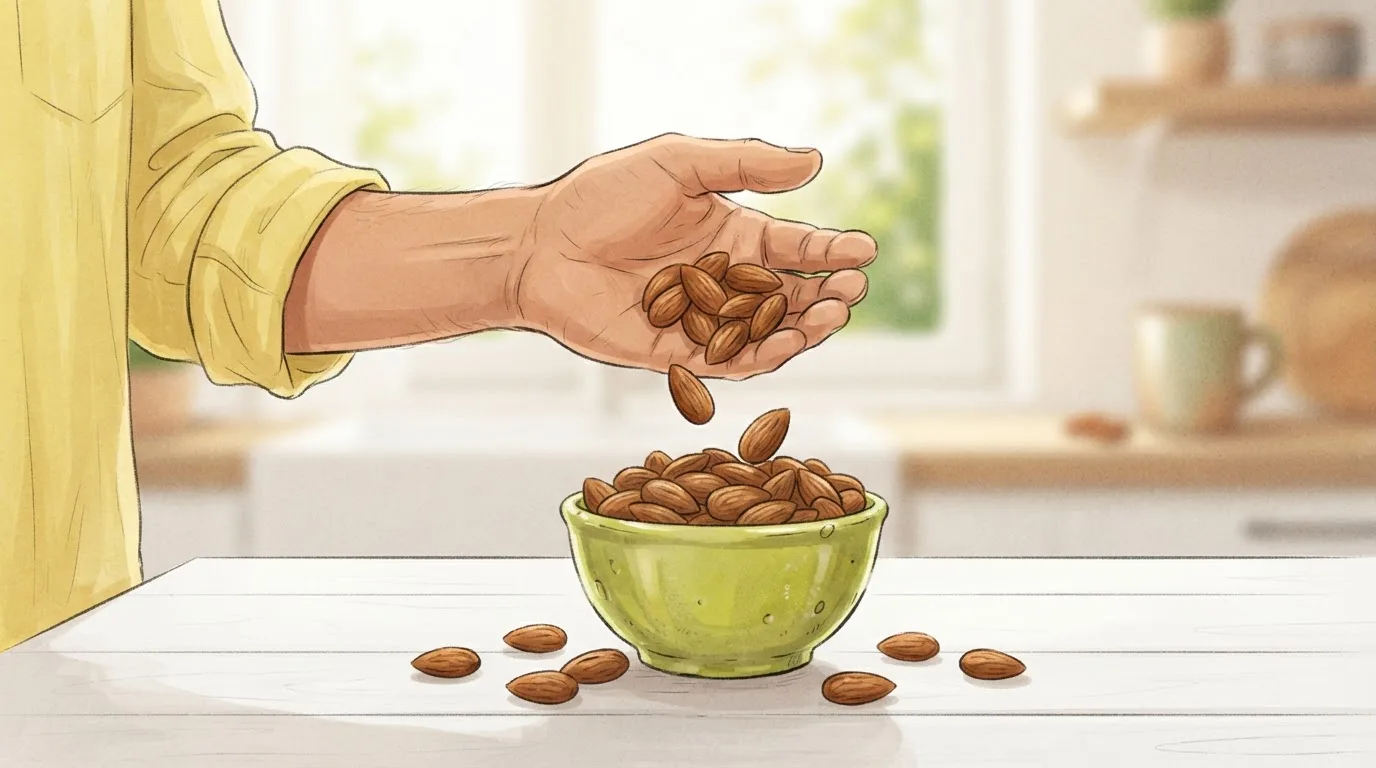
The 4-4-9 factors assume you absorb a fixed share of each nutrient, and some foods don't play along. Novotny, Gebauer and Baer (2012) fed 18 adults controlled diets with and without almonds and collected everything they excreted. A 28-gram serving of almonds delivered about 129 kcal, not the 168 to 170 the standard factors predict, an overestimate of 32 percent. A follow-up study by Gebauer and colleagues (2016) found that whole and chopped almonds gave fewer calories than the factors predict, while almond butter matched the prediction, so the form you eat them in matters. The authors suggest that whole raw almonds may break into fewer, larger pieces, which could hold back the release of their fat.
Portions and consistency
The biggest error is usually the portion you measure, not the label. Weighing food beats eyeballing it, and logging the same way every day beats chasing perfect numbers. Our guide on how to count macros walks through weighing food raw and reading labels. To set a starting target, the TDEE calculator estimates your daily energy needs in kcal, and our review of what a calorie deficit is explains how big a gap below that number the research supports. Then judge the plan by your weight trend over several weeks, which absorbs every error above.
The Bottom Line
kcal and Calories are the same unit, and 1 kcal is 1 food Calorie, 1,000 small calories or 4.184 kJ. The small calorie lives in chemistry class. US labels print Calories, EU and UK labels print kJ and kcal side by side, and Australia and New Zealand lead with kJ, which you divide by 4.184 to get kcal. If you've been counting, your numbers were never off by a thousand.
Knowing the unit is the easy part. Building a routine you'll keep long enough for those numbers to show up on the scale is harder, and that's where most people stall, not on the math. If weight loss is your goal, the eating side is only half the plan. Our comparison of the best workout apps for weight loss covers the training side: what exercise does for weight loss, why strength training belongs in the plan, and how to choose an app you'll keep using. As Stacy, 41, a FitCraft user, put it after losing 22 pounds in four months, "After my second kid, I needed something stupidly simple."
Frequently Asked Questions
Is kcal the same as calorie count?
Yes. The calorie count on a food label or in a tracking app is a count of kilocalories, so 250 kcal and 250 Calories are the same amount of energy. You never need to multiply or divide by 1,000 when logging food or exercise.
Are calories and kilocalories the same?
In nutrition, yes. The calories on food labels, menus and fitness apps are kilocalories with the kilo prefix dropped, so kilocalories vs calories is a difference in name, not in size. Only in chemistry and physics is a calorie the small unit, 1/1,000 of a kilocalorie.
What is 100 kcal in calories?
100 kcal is 100 Calories on a food label, the same number. In the small calories used in chemistry it would be 100,000 cal, and in kilojoules it's about 418 kJ. The same rule works for any number, so 259 kcal is 259 Calories and 1,000 kcal is 1,000 Calories.
Is burning kcal the same as burning Calories?
Yes. When a fitness tracker, treadmill or app says you burned 300 kcal, that's 300 food Calories, directly comparable to the numbers on your food labels. The bigger issue is accuracy: in a study of seven wrist-worn devices, none estimated energy expenditure with an error below 20 percent.
How many calories are in a gram of carbs?
A gram of carbohydrate counts as 4 kcal under US labeling rules and 4 kcal, or 17 kJ, under EU rules. Protein is also 4 kcal per gram and fat 9 kcal (17 kJ and 37 kJ in the EU). EU rules count alcohol at 7 kcal (29 kJ) and fiber at 2 kcal (8 kJ) per gram.
Why do some food labels show kJ instead of calories?
The joule is the official SI unit of energy, and many countries label food in kilojoules. EU and UK labels must show energy in both kJ and kcal, and Australia and New Zealand require kJ with kcal optional. US labels use Calories and may add kJ in parentheses. Divide kJ by 4.184 to get kcal.
Is it realistic to eat 1200 calories a day?
For some women it can be, under guidance. The 2013 US obesity guideline lists 1,200 to 1,500 kcal a day for women and 1,500 to 1,800 for men as common weight-loss targets, adjusted for body weight and activity. For many active adults, 1,200 is a steep cut that makes it hard to eat enough protein and train well, so estimate your own needs first and start with a modest deficit.