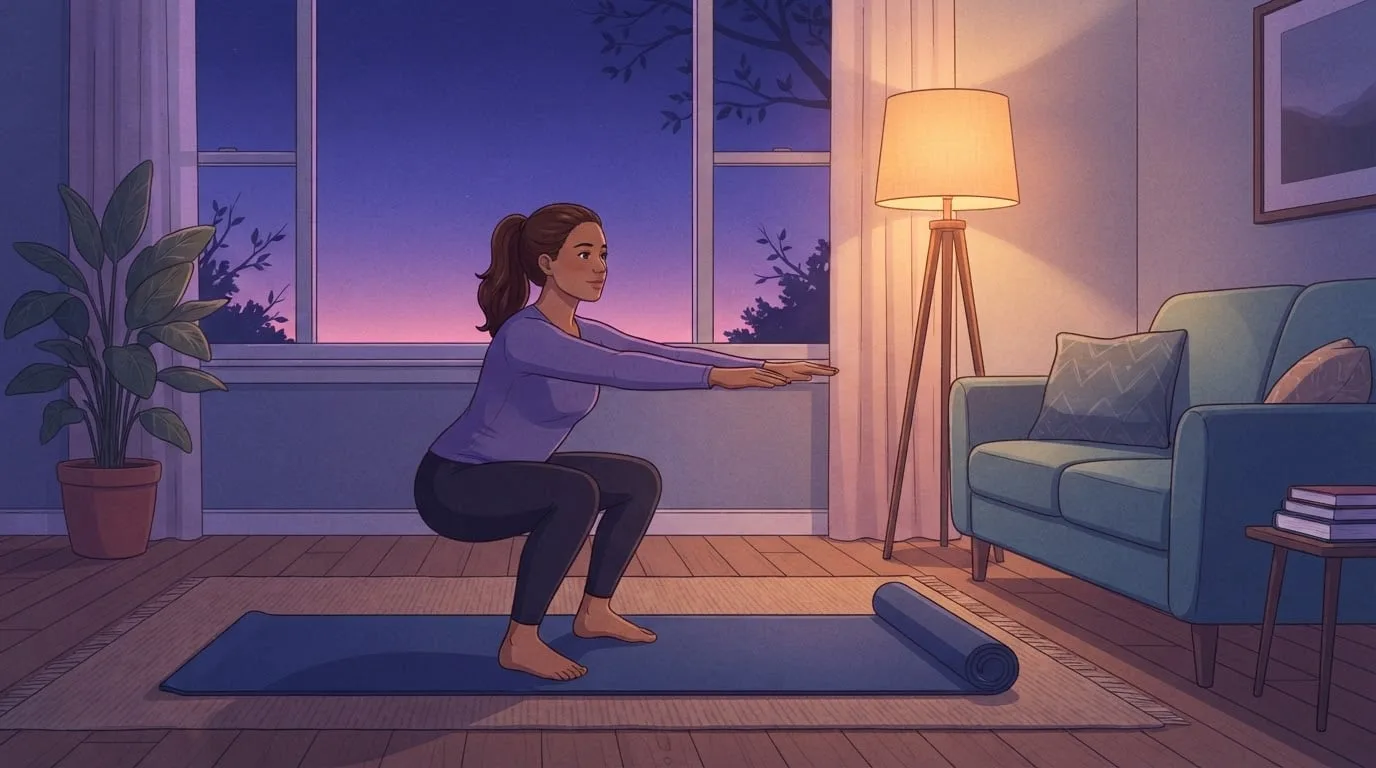
Early morning workouts have one big advantage over every other time slot: nothing has happened yet. No meeting has run late, nobody needs a lift, and the day hasn't had a chance to talk you out of it. That's why so many people schedule a workout before work. Morning exercise is also when your body feels its worst. You're stiff and a little slow, and a workout that felt easy at 6 p.m. can feel heavy at 6 a.m.
So a lot of people try a 45-minute video on day one, feel awful, and stop by Thursday. That isn't a willpower problem. The plan just didn't account for what a body is like 15 minutes after waking up.
This guide gives you a morning workout routine built for that body. You get a 20-minute plan with reps and rounds for every move, a 10-minute version for rushed days and a dumbbell version. Then it covers how to warm up when you're stiff, whether to train fasted or eat a small snack, what the research says about morning versus evening training, and how to progress over 6 weeks.
The 20-Minute Morning Workout Routine
Do this full-body routine 3 or 4 mornings a week. You need a mat or a rug, a sturdy chair or the edge of a couch, and enough floor to lie down with your arms overhead. Nothing in it jumps, so it won't wake the house.
Part 1: Warm-up (5 minutes)
- March in place with big arm swings, 60 seconds. Start slowly and let your knees rise higher as you go.
- Arm circles, 30 seconds forward and 30 seconds back. Begin small and make the circles bigger.
- Hip hinges, 10 reps. Hands on your hips, push your hips back with a long, flat back until you feel the backs of your thighs, then stand tall.
- Squats to a chair, 10 reps. Touch the seat lightly and stand back up. Go only as deep as feels easy at first.
- Wall push-ups, 10 reps. Hands on the wall at shoulder height, body straight.
- Reverse lunge with an overhead reach, 5 per side. Step back, lower gently, and reach both arms up as your back knee drops.
Part 2: The circuit (3 rounds, about 13 minutes)
Move from one exercise to the next with only the time it takes to get into position. Rest 60 seconds after each round. In round 1, stop each set with about 3 good reps left. By round 3, finish with 1 or 2 left.
| Move | Reps or time | Easier | Harder |
|---|---|---|---|
| 1. Squat | 12 reps | Squat to a chair | Pause 2 seconds at the bottom |
| 2. Push-up | 8 to 12 reps | Hands on a counter or couch arm | Lower for 3 seconds |
| 3. Reverse lunge | 8 per leg | Hold the back of a chair | Drive the back knee up as you stand |
| 4. Superman hold | 20 seconds | Lift arms only | Hold 30 seconds |
| 5. Glute bridge | 15 reps, 2-second squeeze at the top | Smaller range | Single-leg bridge, 8 per side |
| 6. Forearm plank | 20 to 30 seconds | Knees down | Hold 45 seconds |
| 7. Step jacks | 30 seconds | Slower pace | Faster pace, bigger arm swing |
The order alternates legs, upper body and core so one area rests while the next one works. Step jacks are a quiet version of jumping jacks: tap one foot out to the side as your arms rise, bring it back, then switch sides.
Part 3: Cool-down (2 minutes)
Walk slowly around the room for a minute. Then stand still and take five slow breaths, making each breath out longer than the breath in. That's the whole routine: about 20 minutes from the first march to the last breath.
Three form points that matter most early in the day
- Squat and lunge: keep your whole foot on the floor and let your knees travel in line with your toes.
- Push-up: keep your body in one straight line from head to heels, and lower your chest, not your head.
- Superman and plank: squeeze your glutes and keep your neck long. If your lower back complains, shorten the hold.
A 10-Minute Morning Workout for Rushed Days
On mornings when 20 minutes isn't going to happen, do this instead. Each move is 40 seconds of work and 20 seconds of rest, and you go through the list twice.
- Quick warm-up, 1 minute: 30 seconds of marching with arm swings, then 30 seconds of arm circles.
- Squat, 40 seconds. Rest 20 seconds.
- Push-up, 40 seconds. Use a counter or your knees if you need to. Rest 20 seconds.
- Alternating reverse lunge, 40 seconds. Rest 20 seconds.
- Forearm plank, 40 seconds. Drop to your knees partway through if your form slips. Rest 20 seconds.
- Repeat moves 2 to 5 once more, then walk around for a minute to cool down.
Treat the first round as part of the warm-up and do it at about 70% effort. Ten minutes won't replace the full routine every day, but it keeps the habit alive on the mornings that would otherwise become a zero.
A Dumbbell Morning Workout (20 to 25 Minutes)
If you own a pair of dumbbells, swap the bodyweight circuit for this one on 1 or 2 mornings a week. Use the same 5-minute warm-up, then do 3 rounds and rest 60 to 90 seconds after each round. Pick a weight you could lift about 13 to 15 times when the target is 10, and go lighter in round 1.
- Goblet squat, 10 reps. Hold one dumbbell upright at your chest.
- One-arm dumbbell row, 10 per side. One hand on a chair seat, flat back, pull the dumbbell toward your hip.
- Dumbbell floor press, 10 reps. Lie on your back with your knees bent and press both dumbbells up from your chest.
- Dumbbell Romanian deadlift, 10 reps. Soft knees, push your hips back and slide the dumbbells down your thighs with a flat back.
- Dumbbell reverse lunge, 8 per leg. Dumbbells at your sides.
- Dumbbell overhead press, 8 to 10 reps. Standing or seated, ribs down, press straight up.
The Romanian deadlift sits fourth for a reason. By then your hips and back have warmed up through the squats and rows, and bending forward under load feels much better than it would in the first minutes after you get up.
How to Warm Up When You're Stiff in the Morning
Part of morning stiffness is temperature. Your body temperature is near its daily low when you wake up, and muscle force and power rise with it through the day. A review of time-of-day studies by Mirizio and colleagues (2020) found that in most studies, short all-out efforts such as sprints, jumps and hard muscle contractions peak between 4 p.m. and 8 p.m. The review listed an active warm-up among the factors that can shrink that morning gap.
The effect is easy to see in the lab. In Racinais and colleagues (2005), eight men did all-out cycling sprints between 7 and 9 a.m. and again between 5 and 7 p.m., with and without a 12-minute warm-up of easy pedaling plus three 5-second bursts. Power was higher in the afternoon, and the warm-up raised muscle temperature and power compared with no warm-up. Across 32 high-quality studies, warming up improved performance in 79% of the measures tested, with little sign that it ever made things worse (Fradkin and colleagues, 2010).
Here's how to use that on a stiff morning:
- Add 2 or 3 minutes to the warm-up on cold or creaky days. Stop when you feel warm and slightly out of breath, not when a set time runs out.
- Go from small ranges to big ones. Your first squats can be quarter squats. By the tenth rep, sit to your normal depth.
- Use round 1 as part of the warm-up. Keep it at about 70% effort and save the harder push for rounds 2 and 3.
- Leave loaded forward bending until later in the session. Deep toe touches and Romanian deadlifts come after squats and rows, not first thing.
If you wake up with a stiff back or tight hips most days, a few minutes of mobility first can help. Our morning mobility routine is a separate 10-minute sequence that starts lying down and finishes standing, and it explains why the spine feels stiffer after a night in bed. Do its 5-minute version before this workout on the stiffest mornings, or do the full sequence on its own on rest days.
Is It OK to Work Out on an Empty Stomach, or Should You Eat First?
For a 20-minute morning workout, either works, so choose the one that feels better. Aird and colleagues (2018) reviewed 46 studies that compared fasted and fed exercise. Eating beforehand improved performance in prolonged aerobic exercise, but it made no clear difference in shorter aerobic sessions. Training fasted raised the amount of fat released into the blood after the session.

That fat finding is why fasted cardio gets so much attention, but more fat burned during a workout doesn't add up to more fat lost over weeks. Our look at whether fasted workouts are good for weight loss walks through the trials, and the short version is that your total energy balance decides fat loss, not the timing of breakfast.
A small snack makes sense in these situations:
- You feel shaky, light-headed or sick when you train on nothing. That's a reason to eat, not a test to push through.
- The session is longer or harder than this routine, such as a long run or a hard interval workout.
- You take insulin or another medicine that lowers blood sugar. Talk to your doctor before you train fasted.
Keep the snack small and easy to digest: a banana, a slice of toast with honey or a small yogurt, eaten 15 to 30 minutes before you start. Drink a glass of water either way, because you've gone several hours without one.
Find out what's really holding you back
FitCraft, our mobile fitness app, pairs you with an AI coach who builds you a personalized plan around your goals, schedule, and fitness level. Every FitCraft program is designed by Domenic Angelino, MPH (Brown University) and NSCA-CSCS, with research published in the Journal of Strength and Conditioning Research and Medicine & Science in Sports & Exercise.
Take the Free Assessment Free • 2 minutes • No credit cardDo Morning Workouts Work as Well as Evening Ones?
Yes, over weeks of training. You'll usually feel a little weaker in the morning, but that gap closes when you train at that hour regularly. Grgic and colleagues (2019) pooled 11 studies of morning versus evening resistance training with everything else kept equal. Before training, people were stronger in the evening. After weeks of morning training, their morning strength rose to about the level of their evening strength. Strength gains were similar in both groups, and so was muscle growth.
Two newer studies add detail, and both need care in how you read them:
- Women and men may respond differently. Arciero and colleagues (2022) randomized 56 already-active adults in their 40s to 12 weeks of training between 6 and 8 a.m. or between 6:30 and 8:30 p.m. In women, morning training cut more abdominal fat and blood pressure, while evening training built more upper-body strength and power. In men, evening training lowered systolic blood pressure more. It was a small trial funded by a supplement company, so treat it as a lead, not a verdict.
- Early exercisers lost more weight in one long trial. In a 10-month supervised program, Willis and colleagues (2020) found that people who did most of their sessions between 7 a.m. and noon lost 7.2% of their body weight, against 2.1% for people who trained mostly between 3 and 7 p.m. People chose their own times, so this shows a link, not proof that the clock caused it.
The metabolic studies behind the "evening is better" headlines, including the mouse research that started them, are covered in our review of morning vs evening exercise. The practical answer is to train at the time you can repeat. If that's the morning, you give up nothing in long-term strength or muscle.
How to Progress Your Morning Workout Over 6 Weeks
A routine that never changes stops working within a month or two. The fix is progressive overload: make the work a little harder each week or two. You don't need heavier weights to do it. In Plotkin and colleagues (2022), 43 trained adults spent 8 weeks either adding weight or adding reps with the same weight, and both groups built similar muscle and strength. Kotarsky and colleagues (2018) split 23 moderately trained men into a push-up group and a bench press group, training three days a week for 4 weeks. The push-up group switched to tougher variations as they got stronger, and their bench press strength rose much like it did in the group that trained on the bench press.
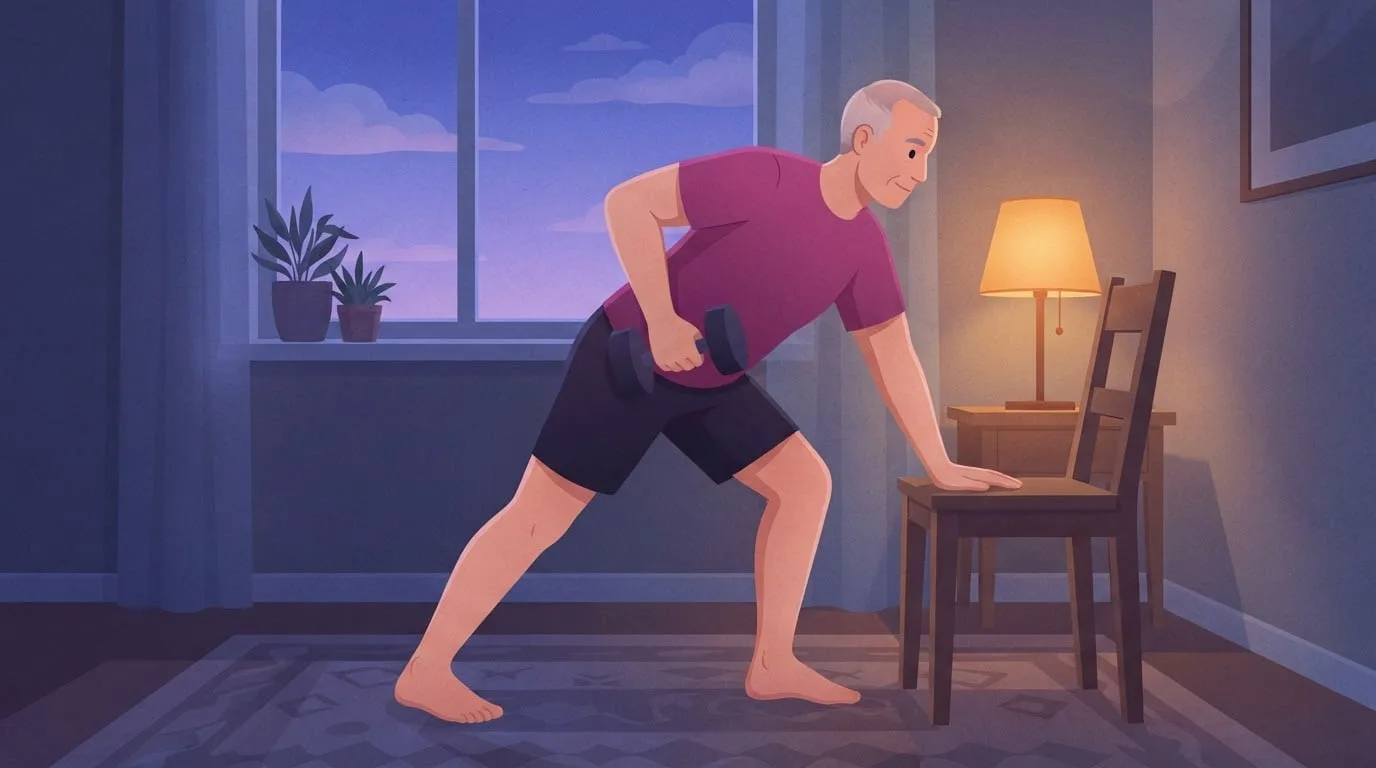
Use this rule: when all three rounds feel like a 6 or 7 out of 10 with 2 or 3 reps left on every move, it's time for the next step.
| Week | Mornings | What changes |
|---|---|---|
| 1 to 2 | 3 | Do 2 rounds, using the easier option on any move that feels shaky. Learn the moves and finish feeling you could do more. |
| 3 | 3 | Go to the full 3 rounds. |
| 4 | 3 | Add 2 reps to each move, or 10 seconds to each hold. |
| 5 | 4 | Add a fourth morning. Switch two moves to the harder option, such as counter push-ups to floor push-ups. |
| 6 | 4 | Use the harder option on every move, or make 1 or 2 of your mornings the dumbbell version. |
Two rules keep this from going wrong. Change one thing at a time, so you know what made it harder. And if you miss a morning, don't double up the next day. Just do the next planned session.
How Many Mornings a Week Should You Work Out?
Three or four mornings of this routine is the sweet spot for most people. The World Health Organization's 2020 guidelines (Bull and colleagues) recommend 150 to 300 minutes of moderate activity a week, or 75 to 150 minutes of vigorous activity, plus muscle-strengthening work on at least 2 days. Four 20-minute sessions cover the strength part and some of the activity minutes. Brisk walks on the other days make up the rest.
You can move every day, but don't do this full strength circuit every day. Your muscles adapt in the recovery between hard sessions. Put a walk, yoga or the mobility sequence on the days in between.
Getting out of bed for it is a separate skill from doing it. Our guide to building a morning workout habit covers the night-before prep, where to put the alarm and how to attach the workout to something you already do every morning, so this page doesn't repeat it.
If you'd rather have someone lead the session than count reps yourself, a home workout app that needs no equipment can run it for you. In FitCraft, a 3D AI coach demonstrates each exercise, says your name while you work and keeps your streak going, and its workouts include bodyweight and dumbbell strength, cardio, yoga and mobility, so the in-between days have a plan too.
The Bottom Line
A morning workout routine works best when it's short, quiet and full-body: a 5-minute warm-up, three rounds of squats, push-ups, lunges, superman holds, glute bridges, planks and step jacks, and a 2-minute cool-down. Warm up longer on stiff mornings, eat a small snack if training on empty leaves you shaky, and add reps, rounds or harder versions every week or two. Morning training builds the same strength and muscle as evening training once your body gets used to the hour.
The hard part is the third and fourth week, when the novelty is gone. As one FitCraft user, Jim, put it: "I kept telling myself I'd start Monday. FitCraft made me start on a Wednesday and I haven't stopped."
Frequently Asked Questions
Is it okay to work out as soon as you wake up?
Yes, for most healthy adults it's fine to work out soon after waking, as long as you warm up for longer than you would later in the day. Muscle temperature and power are at their lowest in the early morning, and an active warm-up of 5 to 10 minutes narrows that gap. Drink a glass of water, start with easy movement and save your hardest effort for the second half of the session.
What is the 3-3-3 rule for exercising?
The 3-3-3 rule is a social media workout template, not a rule that comes from research. The most common version is three exercises for three sets each, three days a week, and another version splits the week between strength days, cardio days and rest days. Either is a reasonable starting structure for a beginner, and the 20-minute routine on this page fits the first version if you do it three mornings a week.
Do I burn more fat working out on an empty stomach?
You burn more fat during a fasted workout, but not more fat over weeks of training. Fasted exercise raises fat use during and after the session, while trials that lasted several weeks found the same fat loss whether people trained fasted or fed, because the body balances its fuel use over the rest of the day. Train fasted if it feels better, not because you expect to lose more fat.
What are good exercises to do in the early morning to help with weight loss?
Full-body moves that use big muscle groups, such as squats, lunges, push-ups and glute bridges, done as a circuit with little rest, plus brisk walks on other days. Weight loss still depends mostly on your total energy balance over the week, so the best morning exercise for weight loss is the one you repeat 3 to 5 times a week. In one 10-month trial, people who did most of their sessions before noon lost more weight than late-day exercisers, but that comparison wasn't randomized.
Is it better to work out every day?
You don't need to work out hard every day, but moving every day helps. The World Health Organization recommends 150 to 300 minutes of moderate activity a week plus muscle-strengthening work on at least 2 days. Do a full-body strength routine 3 or 4 mornings a week and fill the other days with walks, yoga or mobility so your muscles recover between hard sessions.
How long should a morning workout be?
A morning workout can be 10 to 30 minutes and still work. Twenty minutes is enough for a full-body bodyweight circuit with a proper warm-up, and 10 minutes is a useful minimum on rushed days. A 20-minute routine you do four mornings a week will do more for you than a 60-minute one you manage once.