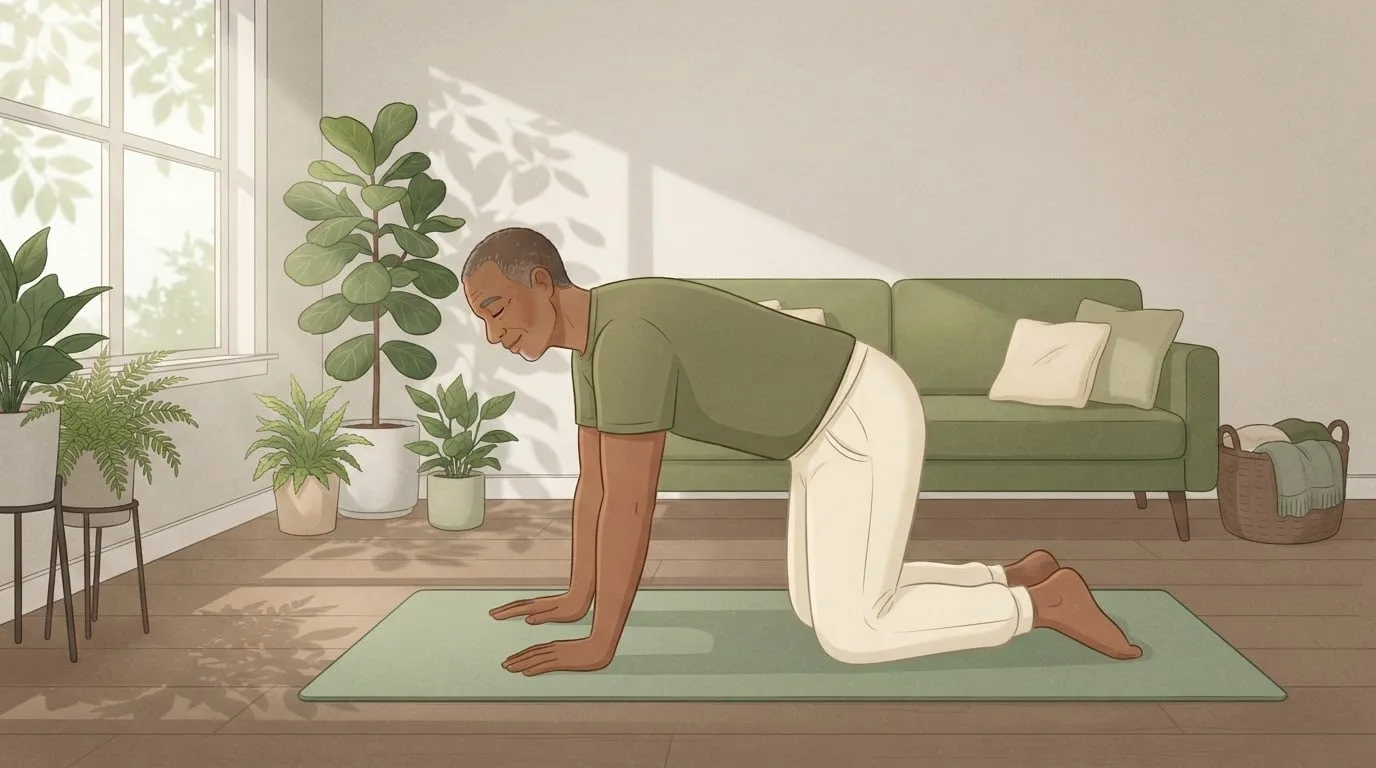
You get out of bed and your body feels about twenty years older than it did last night. Putting on socks takes two tries. Your lower back feels like a plank of wood until you've been up for an hour.
It's easy to take that as a sign you're getting old or falling apart. Mostly it isn't. You've just spent seven or eight hours lying still, and a good part of morning stiffness is normal physiology that eases once you move.
Below is a morning movement routine you can repeat every day: a timed 10-minute sequence first, then a 5 minute mobility routine for rushed mornings and a standing version for the desk or the kitchen counter. After that comes the science of why mornings feel stiff, what morning mobility stretches can and can't do, and how to make the routine harder over the weeks.
The 10-Minute Morning Mobility Routine
Do the moves in this order. The sequence starts on your back, where your spine is supported, rolls onto all fours, kneels and finishes standing, and each move gets a little bigger than the one before it. You need a mat or a rug, plus a wall or a chair for balance. The clock column shows where you should be if you're keeping time, including the switch between sides.
| Order | Move | Dose | Clock |
|---|---|---|---|
| 1 | Knee drops | 8 per side | 0:00 to 1:00 |
| 2 | Glute bridges | 10 slow reps | 1:00 to 2:00 |
| 3 | Side-lying open book | 5 per side | 2:00 to 3:30 |
| 4 | Cat-cow, small range | 8 slow breaths | 3:30 to 4:30 |
| 5 | Bird dog | 5 per side, 3-second hold | 4:30 to 5:30 |
| 6 | Half-kneeling hip flexor stretch with reach | 30 seconds per side | 5:30 to 6:45 |
| 7 | Standing hip circles | 5 each direction, each leg | 6:45 to 8:00 |
| 8 | Calf raises and ankle circles | 10 raises, then 5 circles each way per ankle | 8:00 to 8:45 |
| 9 | Overhead arm sweeps | 8 slow sweeps | 8:45 to 9:15 |
| 10 | Half squat to overhead reach | 8 reps | 9:15 to 10:00 |
How to Do Each Move
- Knee drops. Lie on your back with your knees bent and your feet planted a little wider than your hips. Let both knees fall slowly to one side and then the other while your shoulders stay down. You can do this one in bed.
- Glute bridges. With your feet flat and hip-width apart, squeeze your glutes and lift your hips until your knees, hips and shoulders line up. Pause for 2 seconds at the top and lower slowly. Bridges move your hips into extension, the opposite of the position you slept and will sit in.
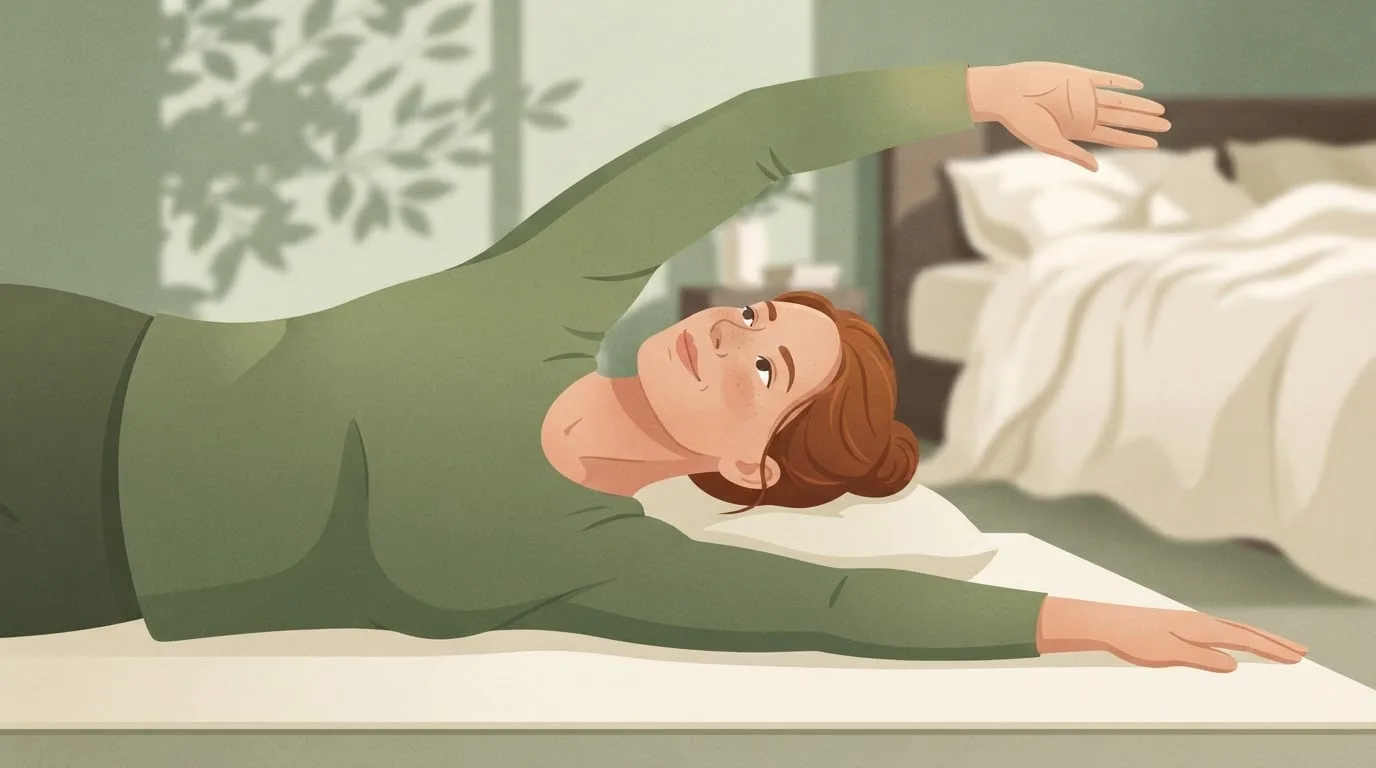
- Side-lying open book. Lie on your side with your knees bent to 90 degrees and stacked, arms straight out in front of you at shoulder height. Sweep the top arm up and over to the other side so your chest turns toward the ceiling, and follow your hand with your eyes. Your knees stay together, so the twist comes from your upper back.
- Cat-cow, small range. On all fours, gently round your upper back as you breathe out, then let your chest sink and lift your gaze as you breathe in. Keep the rounding modest for the first few breaths and let it grow as your back warms up.
- Bird dog. From all fours, reach one arm forward and the opposite leg back until both are level with your body, hold for 3 seconds and return. Your back stays flat enough to balance a glass of water on it. The bird dog exercise page shows the full form.
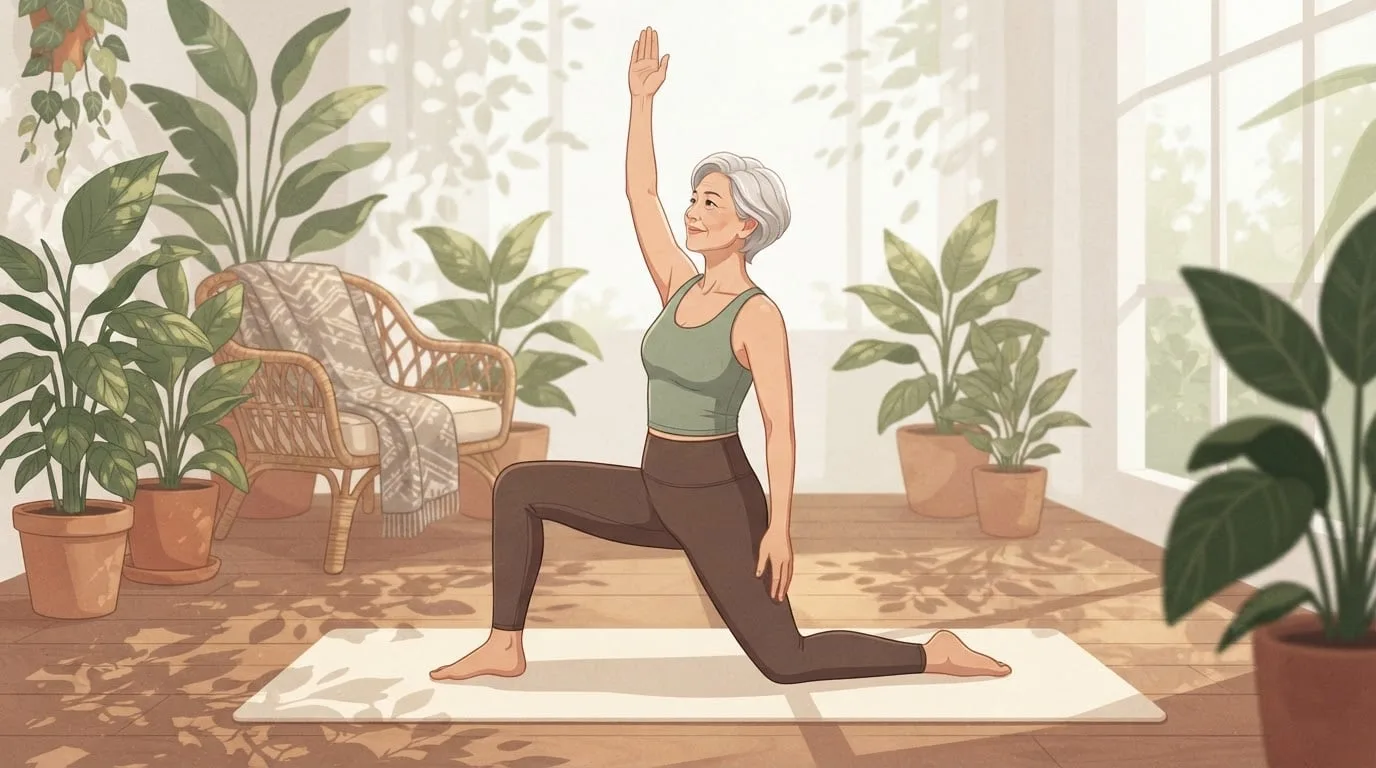
- Half-kneeling hip flexor stretch with reach. Kneel on your right knee with your left foot flat in front. Tuck your tailbone under, shift your weight forward until the front of your right hip stretches, then reach your right arm overhead. Switch sides after 30 seconds.
- Standing hip circles. Hold a wall or a chair, lift one knee to hip height and draw the widest slow circle you can with it, out to the side and back down. Do 5 in each direction, then change legs.
- Calf raises and ankle circles. Rise onto the balls of your feet 10 times, then lift one foot and circle that ankle 5 times each way before switching.
- Overhead arm sweeps. Stand tall and sweep both arms forward and up overhead, then out wide and back down to your sides. Keep your ribs down so the reach comes from your shoulders rather than an arching back.
- Half squat to overhead reach. Sit back to a comfortable half squat, then stand and reach both arms overhead, rising onto your toes if your balance allows. This is the first move that bends your hips, knees and ankles together, and by now they're warm.
Go at the pace of your breathing. Each move should feel like a stretch or a working muscle near the end of its range. If a move causes pain that is sharp, pinching or shooting, make it smaller or leave it out.
A 5-Minute Mobility Routine for Busy Mornings
On rushed days, six of the moves fit into five minutes. Keep the order, because the short version still runs from the floor up to standing.
- Knee drops: 6 per side (0:00 to 0:45).
- Cat-cow: 6 slow breaths (0:45 to 1:30).
- Bird dog: 4 per side (1:30 to 2:15).
- Half-kneeling hip flexor stretch with reach: 30 seconds per side (2:15 to 3:30).
- Standing hip circles: 4 each direction, each leg (3:30 to 4:15).
- Half squat to overhead reach: 6 reps (4:15 to 5:00).
Five minutes a day adds up to 35 minutes a week, which is plenty for steady progress, as the evidence section below shows. A 5 minute morning routine you actually do will get you further than a 20-minute one you keep skipping.
A Standing Morning Mobility Routine for Desk Days
This version needs no floor. Do it beside your desk, at the kitchen counter or holding the back of a sturdy chair. That also makes it a good morning mobility routine for seniors and for anyone whose knees don't enjoy kneeling.
- Chin tucks: 6 reps with 3-second holds (0:00 to 0:30). Draw your head straight back over your shoulders with your eyes level.
- Shoulder rolls and arm sweeps: 8 of each (0:30 to 1:15).
- Seated cat-cow: 6 slow breaths on the edge of a chair (1:15 to 2:00). The seated cat cow page shows the movement.
- Standing trunk rotations: 5 per side with your arms crossed on your chest and your hips facing forward (2:00 to 2:45).
- Standing hip circles: 4 each direction, each leg, one hand on the desk or chair (2:45 to 3:45).
- Standing hip flexor stretch: 20 seconds per side in a split stance, back knee soft and tailbone tucked (3:45 to 4:30).
- Calf raises: 12 slow reps holding on for balance (4:30 to 5:00).
If balance is a worry, keep one hand on the chair for every standing move. You can repeat this version mid-morning too, which breaks up a long stretch of sitting.
Why Does Your Body Feel Stiff in the Morning?
Your spine changes shape every night. The discs between your vertebrae hold a lot of water, and lying down takes the load off them, so they draw fluid back in while you sleep. Once you're upright, gravity slowly squeezes it out again.
You can measure it with a tape. Reilly and colleagues (1984) measured eight men nine times across 24 hours and found they were 19.3 millimeters taller on waking than at midnight, about 1.1 percent of their height. More than half of each day's height loss happened in the first hour after getting up, and 80 percent within three hours. MRI scans tell the same story. Botsford and colleagues (1994) found the three lowest discs in the lower back lost about 16 percent of their volume on average after four hours of standing and three of sitting, compared with after six hours lying down.
Fuller discs are stiffer to bend. Adams, Dolan and Hutton (1987) measured 21 volunteers and found their range of lower back bending grew by 5 degrees from early morning to the afternoon. Combining that with lab tests on spinal segments, they estimated that bending forward stresses the discs about 300 percent more in the early morning than later in the day, and concluded that discs and ligaments are at greater risk of injury then. A trial by Snook and colleagues (1998) tested what that means in practice: in 85 people with persistent low back pain, learning to limit lower back bending in the early morning reduced pain compared with sham exercises. That's why this routine keeps the cat-cow small, uses a half squat and leaves toe touches for later.
The rest of the stiffness is simply stillness. Muscles and joints that haven't moved for hours feel tight until they've been warmed up and taken through their range a few times, which is why the routine starts small and builds.
Find out what's really holding you back
FitCraft, our mobile fitness app, pairs you with an AI coach who builds you a personalized plan around your goals, schedule, and fitness level. Every FitCraft program is designed by Domenic Angelino, MPH (Brown University) and NSCA-CSCS, with research published in the Journal of Strength and Conditioning Research and Medicine & Science in Sports & Exercise.
Take the Free Assessment Free • 2 minutes • No credit cardDo Morning Mobility Stretches Work? What the Evidence Says
In the short term, yes, and the effect is brief. A systematic review by Behm and colleagues (2016) found that static, dynamic and contract-relax stretching all improved range of motion straight away, with the gain typically lasting less than 30 minutes. So the looser feeling after your routine is real but temporary. It makes the next half hour easier, which is mostly what you want from a morning routine.
Lasting range comes from repetition. Thomas and colleagues (2018) reviewed 23 studies and found range of motion improved once stretching added up to at least 5 minutes a week per muscle group, and more weekly sessions went with bigger gains, with 5 or more days a week working well. A larger meta-analysis by Konrad and colleagues (2024) pooled 77 studies and found stretch training increased range of motion with a moderate effect. Static holds produced more long-term range than bouncing or dynamic stretches, and in their analysis the amount, intensity and frequency of stretching made no significant difference. Read together, the two reviews say regular stretching works and the exact dose matters less than doing it. A daily morning slot is just the easiest way to make sure it happens.
Most of this routine is active movement rather than long holds, because it doubles as a warm-up for the day. If more range over months is your main goal, add a few longer static holds in the evening. Our comparison of static vs dynamic stretching explains which kind to use before exercise.
This page is a timed sequence for the first ten minutes of your day. If you'd rather pick exercises for a particular joint, our guide to the best mobility exercises lists ten full-body moves with a dose for each, and our hip mobility exercises guide goes deeper on the hips, including why strength work through a full range builds mobility too.
How to Progress Your Morning Mobility Routine
A routine that never changes stops asking anything of your body. Move up one step every two to four weeks, in this order:
- Weeks 1 and 2: the 5-minute version every day. The goal is the habit, not the stretch.
- Weeks 3 and 4: the full 10 minutes. Same moves, more of them.
- Then pause at the end of each range. Hold for 3 to 5 seconds at the top of each hip circle, at the end of the open book and in the hip flexor stretch, and press gently further with your own muscles rather than gravity. Controlling the end of a range is what turns flexibility into mobility.
- Then make the moves bigger. Let the half squat get deeper once you've been up for an hour or more, and add the deeper moves from the mobility guides later in the day rather than straight out of bed.
- Then add strength. Two or three short strength sessions a week with squats, lunges and hinges, taken through a full range, build the strength to use the mobility you've gained.
Missing a morning won't undo anything. In a study by Lally and colleagues (2010), volunteers who repeated a new daily behavior in the same setting took anywhere from 18 to 254 days for it to become automatic, and missing a single day didn't materially affect the process. What helps is a fixed cue. Do the routine straight after something you already do every morning, like switching on the kettle or before you pick up your phone.
If you'd rather have someone else plan the sessions, FitCraft's mobility and yoga workouts cover this kind of work. An AI coach demonstrates each exercise on an interactive 3D model and says your name as you go, and streaks and a workout calendar keep track of the mornings you show up. If you want the whole plan on your phone, start with this home workout app with no equipment needed.
When Morning Stiffness Is Worth a Doctor's Visit
Ordinary morning stiffness fades within minutes of moving. The UK's National Institute for Health and Care Excellence uses half an hour as a marker. Its osteoarthritis guideline (NG226) describes the typical picture in adults aged 45 and over as joint pain linked to activity with morning stiffness that's absent or lasts no longer than 30 minutes, and it treats longer morning stiffness as a reason to consider other causes.
See a doctor if any of these apply to you:
- Stiffness lasts longer than about 30 minutes on most mornings.
- A joint is hot, red or swollen.
- Back pain comes with numbness, tingling or weakness in your legs, or with fever or weight loss you can't explain.
- The stiffness started after a fall or an injury.
- It keeps getting worse over weeks rather than easing with movement.
The Bottom Line
A morning mobility routine works best when it's short, gentle and done most days: ten minutes from the floor to standing, five when you're rushed, or the standing version at your desk. Mornings feel stiff because your discs are full and your body has been still, so start small, keep deep forward bends for later, and let each move grow as you warm up.
The hard part is the same as with any habit: doing it on the fortieth morning, not just the first. As one FitCraft user, Katie, put it: "I've tried everything. This is the first time I've stuck with something past two weeks." You don't need a perfect routine. You need one you'll repeat.
Frequently Asked Questions
What is a good morning mobility routine for beginners?
A good morning mobility routine for beginners is the 5-minute version on this page: knee drops, cat-cow, bird dog, a half-kneeling hip flexor stretch, standing hip circles and a half squat to an overhead reach. Do it every day for two weeks before moving up to the full 10 minutes. Every move should feel like a stretch or a working muscle, never sharp pain.
Is a morning mobility routine good for seniors?
Yes, as long as it suits your balance and joints. The standing version on this page needs no floor work and can be done holding the back of a sturdy chair or a kitchen counter, which makes it a safe starting point for many older adults. Check with your doctor first if you have osteoporosis, a recent fall, joint replacements or a balance problem.
Is it bad to stretch right after waking up?
Gentle movement right after waking up is fine. The one thing to hold back on for the first hour is deep forward bending of the lower back, such as toe touches. Your spinal discs are fuller of fluid in the morning, and a classic study estimated that bending forward puts far more stress on them early in the day than in the afternoon.
How long should a morning mobility routine be?
Five to ten minutes is enough for most people. A review of 23 studies found range of motion improved once stretching reached at least 5 minutes a week per muscle group, spread over 5 or more days. If you want a 15-minute version, do the 10-minute routine and then repeat the open book, bird dog and hip flexor stretch.
Should I do mobility before a morning workout?
Yes. The 10-minute routine works as a warm-up because most of it is active movement rather than long holds. Keep any static stretch before a hard workout under about 60 seconds per muscle, because a review found longer holds caused a slightly bigger short-term drop in performance.
Does a morning mobility routine help back pain?
It can help with everyday morning stiffness, but it isn't a treatment for back pain on its own. In a trial of 85 people with persistent low back pain, learning to limit lower back bending in the early morning reduced pain compared with sham exercises. See a doctor for back pain with numbness, leg weakness, fever or stiffness that lasts most of the morning.