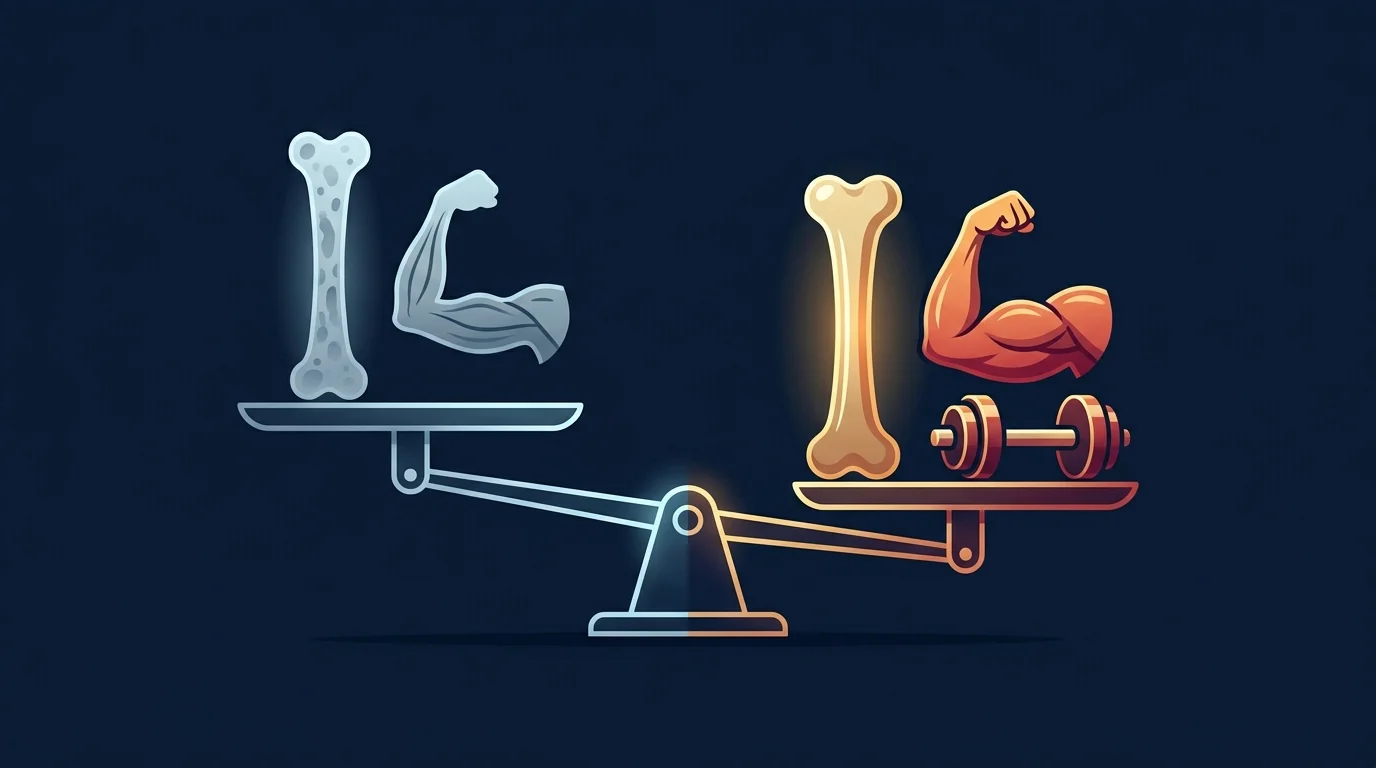
Numbers cut through the noise. The conversation about menopause and exercise is full of anecdote and marketing, so this page does one thing: collects the best-sourced statistics, stamps each with its study and year, and separates what the losses look like from what training gives back. Every figure here links to a verifiable source.
Two categories. First, the statistics on what changes during the menopause transition: symptom prevalence, bone loss, muscle loss. Second, the statistics on what resistance training does about it, drawn from randomized trials and meta-analyses. The gap between those two sets of numbers is the reason strength training keeps showing up as the top recommendation for women in this window.
For the mechanism behind these numbers, our explainer on the musculoskeletal syndrome of menopause covers why falling estrogen drives bone, muscle, and joint changes at once. This page is about the figures.
How Common the Symptoms Are (2024)
The single best current source for prevalence is the 2024 Climacteric review that proposed the term "musculoskeletal syndrome of menopause." Wright, Schwartzman, Itinoche, and Wittstein (2024) aggregated the clinical literature and reported:
- More than 70 percent of women experience musculoskeletal symptoms across the perimenopause-to-postmenopause transition.
- About 25 percent are functionally disabled by those symptoms at some point during the transition.
- Over 50 percent of perimenopausal women report arthralgia (joint pain), often bilateral and without a clear mechanical cause.
- Roughly 47 million women worldwide enter the menopause transition each year.
The disability figure is the one that gets under-reported. One in four is not a rounding error. It means women who cannot climb stairs comfortably, cannot lift a grocery bag without pain, or cannot sleep on one side because a shoulder locks. These are not minor aches. They are meaningful drops in baseline function.
How Fast Bone Slips Away (2008)
The landmark data on the pace of bone loss comes from SWAN, the Study of Women's Health Across the Nation. Finkelstein et al. (2008) in the Journal of Clinical Endocrinology and Metabolism tracked bone mineral density across 1,902 women through the menopause transition and found loss accelerates sharply around the final menstrual period:
- Late perimenopause: lumbar spine density fell about 0.018 g/cm² per year, total hip about 0.010 g/cm² per year.
- Postmenopause: the rates rose to about 0.022 g/cm² per year at the spine and 0.013 g/cm² per year at the hip.
- Bone loss was roughly 35 to 55 percent slower in women in the top third of body weight versus the bottom third, across all ethnic groups studied.
In relative terms, that spine figure works out to roughly 2 percent of bone density per year for many women during the transmenopausal window. Compounded over the several years around the final period, that is a substantial hit to skeletal reserve, which is why fracture risk climbs in the postmenopausal decades.
How Fast Muscle Slips Away
Muscle loss is the quieter statistic. Baseline age-related loss runs about 1 to 2 percent per year after age 50, and the menopause transition layers extra loss on top through the estrogen-related blunting of muscle protein synthesis. The practical consequence is captured well by the sarcopenia literature. Globally, sarcopenia (clinically low muscle strength and mass) affects roughly 10 to 27 percent of adults over 65, per the pooled analysis by Petermann-Rocha et al. (2022) in the Journal of Cachexia, Sarcopenia and Muscle, climbing steeply after 80.
And the stakes are not cosmetic. A 2017 meta-analysis of community-dwelling older adults by Liu et al. in Maturitas found sarcopenia raised all-cause mortality risk by about 60 percent (pooled hazard ratio 1.60), with an even higher near-term risk. Muscle is not vanity. It is the upstream reserve that keeps you independent. Our deeper dive on sarcopenia and resistance training covers the diagnostic criteria and the reversal evidence in full.
What Strength Training Gives Back: Bone (2018)
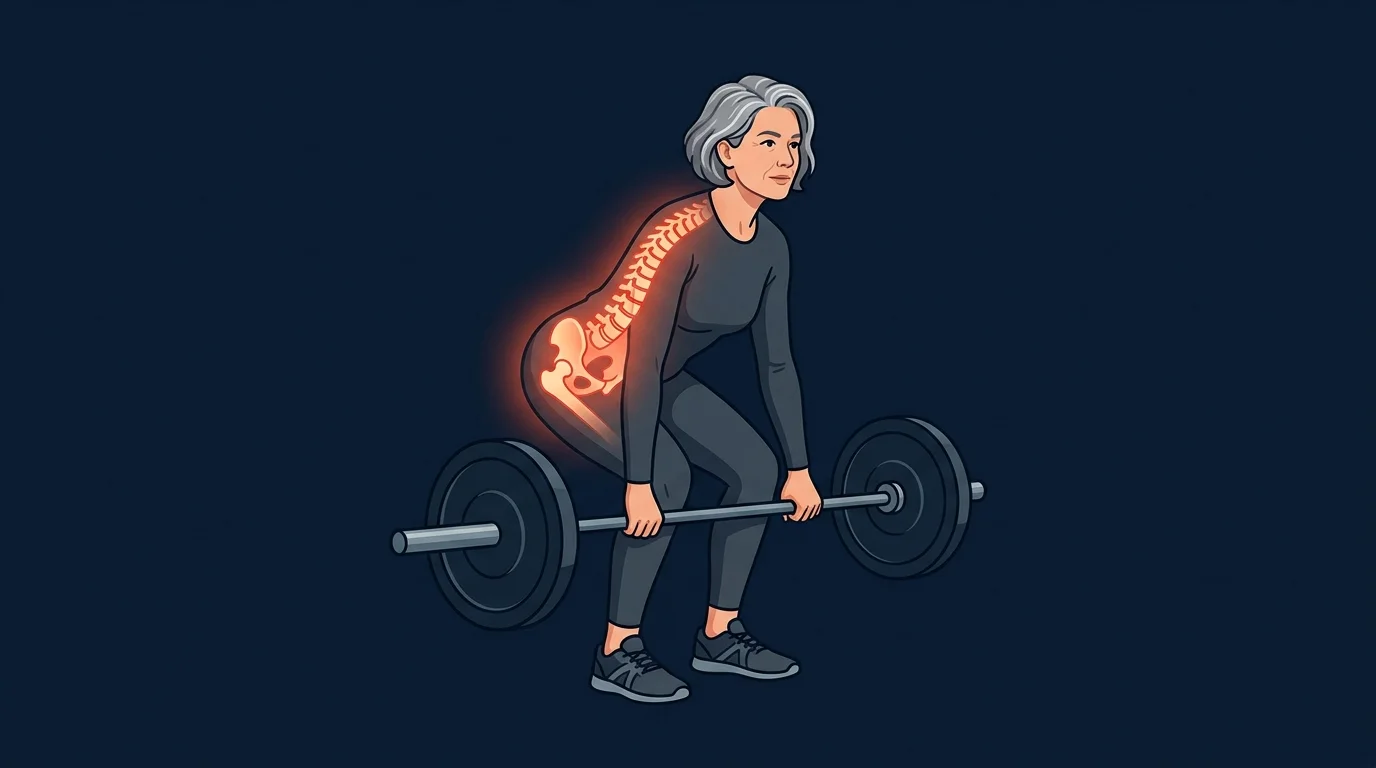
The cleanest randomized data on reversing postmenopausal bone loss is the LIFTMOR trial. Watson et al. (2018) in the Journal of Bone and Mineral Research randomized 101 postmenopausal women with low bone mass to 8 months of twice-weekly, 30-minute supervised high-intensity resistance and impact training or a home-based low-intensity control. The results:
- Lumbar spine bone density: +2.9 percent in the training group versus -1.2 percent in control (between-group difference 4.1 percent, p<0.001).
- Femoral neck bone density: +0.3 percent versus -1.9 percent (between-group difference 2.2 percent, p<0.05).
- Function: significant improvements in the timed up-and-go, functional reach, back extensor strength, and 5-times sit-to-stand.
- Adherence and safety: above 90 percent adherence, no serious adverse events.
The training was heavy (deadlifts, overhead press, and back squats above 85 percent of one-rep max, plus impact work). That intensity is not where everyone starts, and lighter progressive loading still produces meaningful, if smaller, bone stimulus. But the headline holds: postmenopausal bone loss is not a one-way street. The practical, home-adapted version of this protocol is laid out in our week-by-week strength training after menopause plan.
Get an evidence-based plan built for you
FitCraft, our mobile fitness app, pairs you with an AI coach who builds you a personalized plan around your goals, schedule, and fitness level. Every FitCraft program is designed by Domenic Angelino, MPH (Brown University) and NSCA-CSCS, with research published in the Journal of Strength and Conditioning Research and Medicine & Science in Sports & Exercise.
Take the Free Assessment Free • 2 minutes • No credit cardWhat Strength Training Gives Back: Muscle and Function
For muscle and physical function, two syntheses do the heavy lifting.
Chen et al. (2021), restricted to sarcopenic older adults. Chen, He, Feng, Ainsworth, and Liu in the European Review of Aging and Physical Activity pooled 14 randomized trials with 561 sarcopenic older adults. The between-group standardized mean differences after resistance training:
- Handgrip strength: SMD 0.81 (a large effect)
- Knee extension strength: SMD 1.26 (a very large effect)
- Gait speed: SMD 1.28 (a very large effect)
- Timed up-and-go: SMD -0.93 (a large mobility improvement)
- Skeletal muscle mass: SMD 0.27, NOT statistically significant
Note that last one. In already-sarcopenic adults, training reliably improves strength and function, but visible mass gains are smaller and less consistent. What you get is stronger muscle, faster walking, and easier chair rises, which is what actually predicts independence.
Radaelli et al. (2025), the big-picture network meta-analysis. Radaelli and colleagues in Sports Medicine pooled 151 randomized trials with 6,306 adults over 60 and confirmed resistance training reliably improves lean body mass, muscle size, strength, and walking speed. Lower-volume programs were enough for lean mass and hypertrophy, while higher volumes drove the biggest strength and walking-speed gains. In plain terms: even a modest amount of lifting moves the needle after 60.
Peterson et al. (2010), the dose-response anchor. Peterson, Rhea, Sen, and Gordon in Ageing Research Reviews pooled 47 studies of progressive resistance training in older adults and found average strength gains of roughly 29 percent on leg press and 33 percent on knee extension, with about 5.3 percent greater relative strength improvement for each increment in training intensity. Load matters more than sheer volume in this population.
What Strength Training Gives Back: Symptoms and Hormonal Interaction
Beyond bone and muscle, a 2023 systematic review by Capel-Alcaraz et al. in the Journal of Clinical Medicine screened 5,964 articles and analyzed 12 studies, finding strength training was associated with improvements in leg strength, physical activity, bone density, and several metabolic and hormonal markers, with mixed but generally favorable effects on hot flashes. The symptom effects tend to build over weeks of consistent training rather than appearing immediately.
One striking interaction stat: in a 2021 double-blind randomized trial, Dam et al. in Frontiers in Physiology gave early postmenopausal women 12 weeks of resistance training with either transdermal estrogen or placebo. The estrogen group gained 7.4 percent quadriceps cross-sectional area versus 3.9 percent on placebo, and 5.5 percent whole-body fat-free mass versus 2.9 percent. Estrogen amplified the training response. That is a medical decision to discuss with a clinician, but it underlines that the training itself works either way. Our perimenopause fitness guide covers the lifestyle side in more depth.
The Historical Benchmark: Lifting Works Even in the 90s (1994)
No roundup of this evidence is complete without the study that broke the "it's too late" assumption. In 1994, Fiatarone and colleagues in the New England Journal of Medicine put 100 frail nursing-home residents (mean age 87) through 10 weeks of high-intensity resistance training and measured a 113 percent increase in muscle strength, alongside improved gait speed and stair-climbing power. If muscle plasticity survives into the late 80s and 90s, the idea that a postmenopausal woman in her 50s or 60s is "too old to start" does not hold. We cover this trial in detail on the sarcopenia research page.
Reading the Numbers Together
Line the two ledgers up. Bone falling around 2 percent a year at the spine, on one side. LIFTMOR putting 2.9 percent back over 8 months, on the other. Muscle and strength eroding through the transition, against Chen's large strength and gait-speed effects and Radaelli's confirmation across 6,306 people. The losses are real and the gains are real, and the gains come from one intervention more than any other.
Two honest caveats keep this balanced. First, the mass gains in already-sarcopenic women are modest; the reliable wins are strength and function, not a dramatically bigger muscle on a scan. Second, the biggest bone results (LIFTMOR) came from heavy, supervised training, so home-based lighter progressions deliver a smaller effect. Smaller is not zero. Progressive resistance training at any starting point beats not training, and it compounds over months.

What the Research Suggests Going Forward
The statistics converge on a simple prescription. Progressive resistance training, twice a week minimum, sustained over months, is the intervention with the strongest evidence for the bone, muscle, and function losses of the menopause transition. Higher relative intensity produces bigger bone and strength gains, but even modest, home-based programs move lean mass and walking speed. The medical conversation about hormone therapy and bone-directed drugs sits alongside training, not instead of it. Our guide to strength training for women over 40 turns that prescription into an actual week: three full-body sessions, six movement patterns, dumbbells and a chair.
The research gaps are worth naming. Most bone trials are short (8 to 12 months); we have less randomized data on decade-long adherence. Menopause-specific hypertrophy data is thinner than the general older-adult literature. And individual response varies widely. None of that changes the direction of the evidence. It just means the honest framing is "this reliably helps," not "this guarantees a specific number for you."
References
- Wright VJ, Schwartzman JD, Itinoche R, Wittstein J. "The musculoskeletal syndrome of menopause." Climacteric. 2024;27(5):466-472. doi:10.1080/13697137.2024.2380363 (PMID 39077777).
- Finkelstein JS, Brockwell SE, Mehta V, et al. "Bone mineral density changes during the menopause transition in a multiethnic cohort of women." Journal of Clinical Endocrinology and Metabolism. 2008;93(3):861-868. doi:10.1210/jc.2007-1876 (PMID 18160467).
- Watson SL, Weeks BK, Weis LJ, Harding AT, Horan SA, Beck BR. "High-Intensity Resistance and Impact Training Improves Bone Mineral Density and Physical Function in Postmenopausal Women With Osteopenia and Osteoporosis: The LIFTMOR Randomized Controlled Trial." Journal of Bone and Mineral Research. 2018;33(2):211-220. doi:10.1002/jbmr.3284 (PMID 28975661).
- Chen N, He X, Feng Y, Ainsworth BE, Liu Y. "Effects of resistance training in healthy older people with sarcopenia: a systematic review and meta-analysis of randomized controlled trials." European Review of Aging and Physical Activity. 2021;18:23. doi:10.1186/s11556-021-00277-7.
- Radaelli R, Rech A, Molinari T, et al. "Effects of Resistance Training Volume on Physical Function, Lean Body Mass and Lower-Body Muscle Hypertrophy and Strength in Older Adults: A Systematic Review and Network Meta-analysis of 151 Randomised Trials." Sports Medicine. 2025;55(1):167-192. doi:10.1007/s40279-024-02123-z (PMID 39405023).
- Peterson MD, Rhea MR, Sen A, Gordon PM. "Resistance exercise for muscular strength in older adults: a meta-analysis." Ageing Research Reviews. 2010;9(3):226-237. doi:10.1016/j.arr.2010.03.004.
- Dam TV, Dalgaard LB, Ringgaard S, et al. "Transdermal Estrogen Therapy Improves Gains in Skeletal Muscle Mass After 12 Weeks of Resistance Training in Early Postmenopausal Women." Frontiers in Physiology. 2021;11:596130. doi:10.3389/fphys.2020.596130.
- Capel-Alcaraz AM, García-López H, Castro-Sánchez AM, et al. "The Efficacy of Strength Exercises for Reducing the Symptoms of Menopause: A Systematic Review." Journal of Clinical Medicine. 2023;12(2):548. doi:10.3390/jcm12020548 (PMC9864448).
- Petermann-Rocha F, Balntzi V, Gray SR, et al. "Global prevalence of sarcopenia and severe sarcopenia: a systematic review and meta-analysis." Journal of Cachexia, Sarcopenia and Muscle. 2022;13(1):86-99. doi:10.1002/jcsm.12783.
- Liu P, Hao Q, Hai S, Wang H, Cao L, Dong B. "Sarcopenia as a predictor of all-cause mortality among community-dwelling older people: A systematic review and meta-analysis." Maturitas. 2017;103:16-22. doi:10.1016/j.maturitas.2017.04.007.
Frequently Asked Questions
What percentage of women get musculoskeletal symptoms during menopause?
More than 70 percent of women experience musculoskeletal symptoms across the perimenopause-to-postmenopause transition, and about 25 percent are functionally disabled by them at some point, according to the 2024 Climacteric review by Wright et al. that named the musculoskeletal syndrome of menopause. Arthralgia (joint pain) alone affects over half of women in the perimenopausal window. Roughly 47 million women worldwide enter the menopause transition each year.
How fast do women lose bone density during menopause?
The SWAN study (Finkelstein et al., 2008) measured accelerated bone loss around the final menstrual period. In late perimenopause, lumbar spine density fell about 0.018 g/cm² per year and total hip about 0.010 g/cm² per year; in postmenopause the rates rose to about 0.022 and 0.013 g/cm² per year respectively. Loss was roughly 35 to 55 percent slower in heavier women. That translates to bone density dropping on the order of 2 percent per year at the spine during the transition for many women.
How much bone density can strength training add after menopause?
In the LIFTMOR randomized trial (Watson et al., 2018), postmenopausal women with low bone mass who did 8 months of twice-weekly high-intensity resistance and impact training gained 2.9 percent bone density at the lumbar spine, a 4.1 percent difference versus a low-intensity control group that lost ground. Femoral neck density improved 0.3 percent versus a 1.9 percent loss in control. Adherence was above 90 percent with no serious adverse events.
Does resistance training work for older women who already have low muscle?
Yes. A 2021 meta-analysis by Chen et al. of 14 randomized trials in sarcopenic older adults found large effects on handgrip strength (SMD 0.81), knee extension strength (SMD 1.26), and gait speed (SMD 1.28) from resistance training. A 2025 Sports Medicine network meta-analysis by Radaelli et al. pooling 151 trials and 6,306 adults over 60 confirmed reliable gains in lean mass, muscle size, strength, and walking speed.
How much muscle do women lose across the menopause transition?
Muscle loss accelerates through the transition on top of normal age-related loss, which runs about 1 to 2 percent per year after age 50. The blunted anabolic response to training and protein that comes with falling estrogen is a major reason the same workout produces less result than it did earlier in life. Resistance training is the intervention with the strongest evidence for slowing and partly reversing that loss.