- In the AGUEDA randomized trial (Sanchez-Martinez et al., Age and Ageing, 2026), 90 older adults did 24 weeks of supervised resistance training. The Alzheimer's-disease cortical-thickness signature shifted by −0.23 SMD overall versus controls.
- The effect was much larger in amyloid-positive participants (−0.64 SMD), the group already on the Alzheimer's trajectory. No effect was seen in amyloid-negative participants.
- The brain-imaging changes tracked with improved executive function. Authors interpret the signature reduction as adaptive (likely reflecting reduced inflammation-related swelling), not atrophy.
- Across older-adult research, resistance training raises BDNF and IGF-1, reduces systemic inflammation, and ranks #1 of seven exercise modalities for global cognition in a 2025 network meta-analysis of 4,349 adults.
- Two to three weekly sessions using bodyweight or resistance bands is enough. The trial used elastic bands and bodyweight at RPE 4 to 8, three times a week.
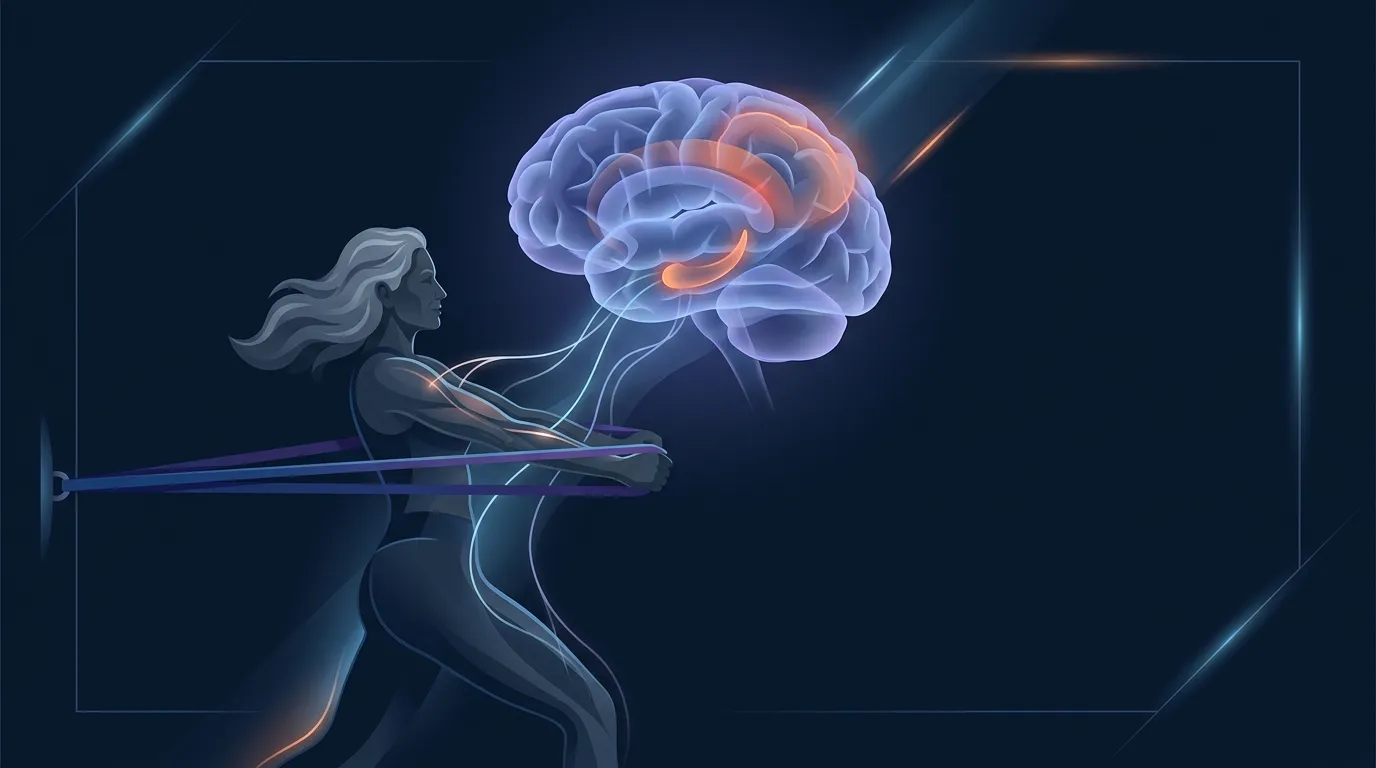
For a long time, the default story about exercise and brain health went like this. Cardio protects the brain. Lifting builds muscle. If you cared about dementia risk, you ran or walked. If you cared about strength, you lifted. Two separate buckets.
That story is starting to break. The newest direct evidence on resistance training and the Alzheimer's brain is a 2026 secondary analysis from the AGUEDA randomized controlled trial. It's the first study to ask, in cognitively healthy older adults, whether 24 weeks of structured lifting can actually reshape the brain regions that Alzheimer's targets. The answer was yes, and the effect was strongest in the people already most at risk.
This isn't a small finding. It also isn't a license to claim that lifting prevents dementia. Here's what the evidence actually shows, where it stops, and what to do with it.
The Research: What 24 Weeks of Lifting Did to the Brain
The Active Gains in Brain Using Exercise During Aging (AGUEDA) trial randomized 90 cognitively healthy older adults (mean age 71.7, 58% female) into two groups. Forty-six did supervised resistance training three times a week for 24 weeks. Forty-four sat on a waiting list. Brain MRIs and cognitive batteries ran at baseline and at 24 weeks. The primary analysis on cognitive outcomes was published in Alzheimer's & Dementia in 2026. The brain-imaging secondary analysis, by Sanchez-Martinez et al. in Age and Ageing, is what we'll focus on here.
The Alzheimer's Brain Signature, in Plain Language
An "AD signature" is a composite of cortical-thickness and volume measurements in brain regions that Alzheimer's disease preferentially affects. Think medial temporal lobe, posterior cingulate, parts of the parietal cortex. Researchers built these signatures by reverse-engineering which regions atrophy first in patients with diagnosed AD, then using those regions as a vulnerability marker in healthy older adults.
What complicates the picture: in amyloid-positive adults (people who carry the AD risk protein in the brain but have not yet developed cognitive symptoms), the AD signature regions sometimes appear thicker, not thinner. Phan et al. (2024) documented this counter-intuitive pattern in Annals of Neurology. The leading explanation is inflammation-driven swelling, an early sign that the disease process has started before atrophy takes over. So a reduction in that pre-atrophic thickness can read as adaptive normalization, not damage.
What the Numbers Showed
The headline result: the resistance training group showed a significant reduction in the macrostructural AD signature versus controls. Effect size of −0.23 standardized mean difference (95% CI, −0.43 to −0.02; p = 0.032). Modest by itself, but the more interesting finding hides inside the subgroup analysis.
- Amyloid-positive participants: effect size of −0.64 SMD (95% CI, −1.09 to −0.18; p = 0.010). This is the group already on the AD trajectory.
- Amyloid-negative participants: no significant effect.
- Cognition link: reductions in the thickness/volume signature were associated with improved executive function. The brain change wasn't just imaging-deep.
The authors interpret this carefully. They don't claim 24 weeks of lifting "reversed" Alzheimer's pathology. What they say is that the structural change in the signature, paired with the executive-function improvement, is consistent with an adaptive brain response: likely reduced inflammatory swelling, possibly some early neuroprotective remodeling. In the people whose brains were furthest down the AD path, the effect was four times larger than in the trial as a whole.
The Intervention Was Boring
Here's the part that tends to surprise people. The intervention was not heavy lifting. Participants did three supervised sessions per week, 60 minutes each. Eight minutes of warm-up, 45 minutes of resistance work, seven minutes of cool-down. Exercises used elastic bands and bodyweight, hitting upper and lower body. Intensity was scaled by rate of perceived exertion, RPE 4 to 8 out of 10, and progressively bumped up across the 24 weeks.
Adherence was strong: 85.2% mean attendance, 87% of participants hit at least 80% of sessions. No barbells, no power cages, no max-effort sets. Just consistent, progressive band and bodyweight work over six months, supervised so participants actually showed up.
Anyone who can do a sit-to-stand, a wall push-up, and a band row could replicate this protocol at home. Which matters, because the practical bar is low.
Why Lifting Would Affect the Brain in the First Place
The structural-imaging result didn't come out of nowhere. Resistance training has a growing mechanistic story for how it reaches the brain, summarized in a 2024 International Journal of Molecular Sciences review (Sepulveda-Lara et al.). The pathways are imperfectly understood, but several converge on neuroprotection.
BDNF, the brain's growth factor. Muscle contractions activate the IGF-1/PI3K/Akt signaling pathway, which upregulates brain-derived neurotrophic factor (BDNF) production. BDNF crosses the blood-brain barrier, binds TrkB receptors on neurons, supports synaptic plasticity, and appears to counteract tau hyperphosphorylation and amyloid toxicity in preclinical models. One study cited in the review reported a 65% increase in plasma BDNF after 10 weeks of lower-limb resistance training in older adults.
IGF-1 and mTOR signaling. Resistance training raises insulin-like growth factor 1, which drives neuroplasticity downstream. The mTORC1 pathway, which exercise activates, is reduced in Alzheimer's brains. Restoring it in animal models improves hippocampal-dependent memory.
Inflammation reduction. Chronic low-grade inflammation is one of the better-supported upstream drivers of Alzheimer's pathology. Resistance training reduces TNF-alpha, IL-6, and other proinflammatory markers, particularly in adults with metabolic risk factors. This matches the AGUEDA team's interpretation that thickness reductions in amyloid-positive adults likely reflect less inflammation-driven swelling.
Myokines. Muscle is now understood as an endocrine organ. It secretes signaling molecules called myokines (irisin, FGF21, others) that travel through the blood and act on distant tissues including the brain. Several myokines appear to support redox homeostasis and resist oxidative stress in the central nervous system.
Amyloid clearance. In rodent models, resistance training reduces both the volume and number of beta-amyloid plaques. The human evidence here is thinner, but the AGUEDA structural finding is consistent with the preclinical signal.
None of these is a smoking gun on its own. Together, they form a plausible biological story for why a 24-week lifting program could shift brain imaging measurements that previously seemed exercise-resistant.

What Other Studies Say About Lifting and the Aging Brain
The AGUEDA brain-imaging paper sits inside a larger and rapidly growing literature. A few studies are worth knowing.
Resistance Training and Executive Function (Liu-Ambrose, 2010)
Liu-Ambrose and colleagues ran one of the cleanest longer-term trials. They randomized 155 women aged 65 to 75 to one of three groups: once-weekly resistance training, twice-weekly resistance training, or a twice-weekly balance-and-tone control. Twelve months. Published in Archives of Internal Medicine in 2010.
The resistance training groups improved on the Stroop test (a standard measure of selective attention and conflict resolution) by 10.9 to 12.6%. The control group declined by 0.5%. Improvement showed up between months 6 and 12, not earlier. This is one of the studies that put executive function on the resistance-training map.
Hippocampal and Precuneus Protection in MCI (Ribeiro, 2025)
A 2025 trial in GeroScience (Ribeiro et al.) randomized 44 older adults with mild cognitive impairment to 24 weeks of resistance training or a control condition. MRIs at baseline and follow-up. The training group preserved right hippocampal and precuneus volume. The control group lost volume in both. White matter integrity also improved in the trained group and worsened in controls. Verbal episodic memory improved in the training arm.
This matters because it extends the AGUEDA finding into adults with documented cognitive impairment. The brain regions involved (hippocampus, precuneus) are exactly the Alzheimer's-vulnerable areas.
The 2025 Network Meta-Analysis: Resistance Training Wins for Global Cognition
If you want the highest-level summary, Han et al. (2025) in Frontiers in Aging Neuroscience pooled 58 randomized controlled trials and 4,349 healthy older adults across seven exercise modalities. Resistance training ranked first for improving global cognition (SMD = 0.55, SUCRA 83.3%) and showed a meaningful effect on inhibitory control (SMD = −0.32). The reported "optimal dose" landed at twice weekly, 45 minutes, for at least 12 weeks.
That's the practical baseline. Two sessions a week, 45 minutes per session, sustained for at least three months. Below that, the effect sizes thin out.
Get an evidence-based plan built for you
FitCraft, our mobile fitness app, pairs you with an AI coach who builds you a personalized plan around your goals, schedule, and fitness level. Every FitCraft program is designed by Domenic Angelino, MPH (Brown University) and NSCA-CSCS, with research published in the Journal of Strength and Conditioning Research and Medicine & Science in Sports & Exercise.
Take the Free Assessment Free • 2 minutes • No credit cardWhat This Means If You're Reading This in Your 50s, 60s, or 70s
Two ways to read this evidence. The first is the cautious version: a single 90-person trial, even a well-designed one, doesn't change the world. The second is the practical version: the cost-benefit of two to three weekly strength sessions is already absurdly favorable, the AD-signature finding adds another data point to a pile that's been growing for fifteen years, and there's no other intervention with a comparable ratio of upside to downside.
Either way, the implication is the same. You should be lifting.
The translation to practice isn't complicated. The Cochrane review on strength training after 60 covered the same dose: two to three sessions a week, 8 to 12 reps, major muscle groups, progressive challenge. Same prescription for strength, fall prevention, mortality, and, now, brain. You don't need separate programs for separate outcomes.
What about cardio? Don't drop it. The aerobic exercise literature on brain volume remains stronger for hippocampal growth, and the network meta-analysis above shows aerobic and resistance training each rank high for different cognitive domains. The pragmatic answer is both: 2 to 3 strength sessions plus weekly aerobic work (walking counts) covers the most ground.
Common Misconceptions
Misconception: "Cardio is for the brain. Lifting is just for muscle."
This was conventional wisdom from roughly 2005 to 2015, when most of the high-profile brain-exercise studies focused on aerobic training. The picture has shifted. Resistance training has the most consistent benefit for executive function across multiple meta-analyses, ranks first in the 2025 network meta-analysis for global cognition, and now has the first randomized brain-imaging evidence directly linking it to Alzheimer's-pattern regions. The new model is that aerobic and resistance training affect partially overlapping but distinct brain systems. Both belong in your week.
Misconception: "You need heavy weights to get the brain effects."
You don't. The AGUEDA intervention used elastic bands and bodyweight, scaled by RPE. The Ribeiro MCI trial used standard resistance training programming. The Liu-Ambrose executive function trial used machines (Keiser pneumatic resistance). The common thread isn't load. It's progressive effort sustained over months. A wall push-up that becomes a knee push-up that becomes a regular push-up is progressive resistance training. A sit-to-stand that gets faster, then adds a pause, then adds a hand-held weight is progressive resistance training. The brain doesn't care about barbells.
Misconception: "If I already exercise, I'm covered."
Maybe. The AGUEDA exclusion criteria filtered out adults already meeting structured strength-training recommendations (specifically, those doing two or more weekly resistance sessions at baseline). The cleanest signal is in people who are adding structured lifting on top of whatever else they're doing. A daily walker who doesn't lift is exactly the profile in the trial. If you walk regularly but have never trained your major muscle groups against resistance, you're the person these findings are most relevant to.
What the Research Can't Tell Us Yet
Honest accounting of the limits matters here. A few important ones.
- It's a secondary analysis of one trial. AGUEDA was originally designed to test cognition, not AD signatures. The brain-imaging analysis was pre-specified but is still secondary. We need replication.
- Sample size on the amyloid-positive subgroup was small. The −0.64 SMD effect is large, but it comes from a subset of 90 participants. The confidence interval is wide.
- Twenty-four weeks is short for a disease that develops over decades. What we don't know is whether the structural change translates to lower dementia incidence years later. That's the trial that hasn't been run yet.
- Adherence was supervised. 85% session attendance reflects a structured study with coaches showing up to make sure people trained. Real-world adherence is typically much lower.
- Population specificity. Participants were 71.7 years old on average and cognitively healthy at baseline. We don't know if the same protocol would work the same way in adults already symptomatic, much younger, or with different risk profiles.
None of this argues against lifting. It argues against overclaiming. The honest read is: 24 weeks of progressive resistance training reshaped Alzheimer's-pattern brain imaging in a randomized trial, the effect was concentrated in the highest-risk subgroup, and the mechanisms are biologically plausible. That's a meaningful research-grade finding. It's not yet a clinical dementia-prevention prescription.
How to Apply This Without Overcomplicating It
If you want to translate the trial protocol into your week, here's the simplest version that maps to the evidence.
- Two to three sessions per week. Twenty to forty-five minutes each. This matches both AGUEDA (3x60min) and the network meta-analysis optimum (2x45min).
- Six basic patterns. Sit-to-stand or squat. Push (wall, knee, or floor push-up). Pull (band row or doorway row). Hinge (good morning or hip bridge). Carry or plank. Calf or single-leg balance work. Two sets each is a real session.
- Bands and bodyweight are enough. A basic set of three resistance bands is inexpensive. No gym required.
- Progress weekly or biweekly. Add a rep, add a set, slow down the tempo, or step up to a heavier band. The "progressive" part is the part that drives adaptation.
- Sustain for at least 12 weeks. Below this, the cognitive effect sizes thin out. The brain-imaging changes in AGUEDA showed up at 24 weeks.
- Pair with walking. 7,500 to 10,000 steps a day, or any aerobic activity you'll actually do, complements the strength work.
The hardest part isn't picking exercises. It's doing them consistently for six months. Most adults who start a fitness program stop within 12 weeks. That's the design problem. Programs designed around adherence (adaptive difficulty, visible progress, accountability) hold people in for longer than programs that rely on willpower alone. Streak-based systems work in this population the same way they work in everyone else.

References
- Sanchez-Martinez J, Fernandez-Gamez B, Erickson KI, Ortega FB, et al. "Effects of a 24-week resistance exercise program on Alzheimer's disease brain signatures in cognitively unimpaired older adults: a secondary analysis of the AGUEDA randomized controlled trial." Age and Ageing. 2026;55(4):afag086. doi:10.1093/ageing/afag086
- Sepulveda-Lara A, Sepulveda P, Marzuca-Nassr GN. "Resistance Exercise Training as a New Trend in Alzheimer's Disease Research: From Molecular Mechanisms to Prevention." International Journal of Molecular Sciences. 2024;25(13):7084. doi:10.3390/ijms25137084
- Liu-Ambrose T, Nagamatsu LS, Graf P, Beattie BL, Ashe MC, Handy TC. "Resistance training and executive functions: a 12-month randomized controlled trial." Archives of Internal Medicine. 2010;170(2):170-178. doi:10.1001/archinternmed.2009.494
- Han H, Zhang J, Zhang F, Li F, Wu Z. "Optimal exercise interventions for enhancing cognitive function in older adults: a network meta-analysis." Frontiers in Aging Neuroscience. 2025;17:1510773. doi:10.3389/fnagi.2025.1510773
- Ribeiro IC, Teixeira CVL, de Resende TJR, et al. "Resistance training protects the hippocampus and precuneus against atrophy and benefits white matter integrity in older adults with mild cognitive impairment." GeroScience. 2025. doi:10.1007/s11357-024-01483-8
- Phan TG, et al. "Increased Cortical Thickness in Alzheimer's Disease." Annals of Neurology. 2024. doi:10.1002/ana.26894
Frequently Asked Questions
Does strength training reduce Alzheimer's risk?
The strongest direct evidence comes from the 2026 AGUEDA secondary analysis by Sanchez-Martinez and colleagues, published in Age and Ageing. Over 24 weeks, supervised resistance training reshaped the macrostructural Alzheimer's-disease brain signature in cognitively unimpaired older adults (−0.23 SMD overall), with a much larger effect in amyloid-positive participants (−0.64 SMD), and those brain changes tracked with improved executive function. The study can't prove resistance training prevents Alzheimer's, but it shows the brain regions involved in the disease respond to lifting. Population-level evidence on resistance training and dementia incidence is still developing.
How much resistance training do you need to affect brain health?
The AGUEDA trial used three supervised 60-minute sessions per week for 24 weeks. A 2025 network meta-analysis of 58 randomized controlled trials in older adults (Han et al., Frontiers in Aging Neuroscience) found the optimal protocol for global cognition was twice-weekly resistance training of about 45 minutes for at least 12 weeks. Two to three sessions per week of progressive resistance training is a reasonable target for brain-health benefits.
Do you need heavy weights to get brain benefits?
No. The AGUEDA intervention used elastic bands and bodyweight exercises, with intensity scaled by rate of perceived exertion (RPE 4-8 out of 10). The brain-imaging changes appeared with this equipment. What matters is progressive overload (gradually adding reps, sets, or band resistance over time) and consistent attendance, not loaded barbells. The trial reported 85% mean attendance over six months.
Is lifting better than cardio for the brain?
They probably do different things. Cardio has stronger evidence for hippocampal volume and aerobic-fitness pathways. Resistance training shows the most consistent benefit for executive function (planning, attention, inhibitory control), and now for Alzheimer's-pattern cortical changes in amyloid-positive adults. The most likely best answer is both: combine 2-3 weekly strength sessions with regular cardio.
What if I'm over 60 and have never lifted?
Start with two sessions a week using bodyweight or light resistance bands. Pick six basic movements that cover the major patterns (sit-to-stand, wall or chair push-ups, rows with a band, hinge, plank, calf raises) and do two sets of each. Most participants in the brain-imaging trials were in their late 60s and 70s and had no prior lifting experience. Always consult your doctor before starting a new program, especially if you have cardiovascular disease, joint replacements, or other chronic conditions.